Overview
This set of blue-and-white libation cup (jue) and stand with dragons and a 'Mountains of Good Fortune and Sea of Longevity' design, Yongle mark and period, has a total height of approximately 16 cm. It is a treasure among archaistic ritual vessels fired by the Yongle imperial kilns, perfectly combining the ancient bronze jue form with Yongle blue-and-white technology. It integrates three-dimensional sculpture, painted decoration, and incised design. The cup body is painted with dragons among clouds, while the stand is adorned with the "Mountains and Sea" motif and both painted and incised dragons, demonstrating ingenious conception and majestic grandeur. Its characteristics, such as the unglazed sandy base, absence of a reign mark, and ruyi-shaped supports, are all consistent with early Yongle imperial kiln features. This object was not ordinary drinking ware but a supreme ritual vessel used in court sacrifices, banquets, or grand ceremonies to manifest imperial authority and invoke the eternal stability of the realm. It represents the pinnacle of Yongle imperial kiln achievement in design, forming, and decorative art.
I. Overview of Core Characteristics
Feature DimensionSpecific DescriptionObject DesignationBlue-and-White Libation Cup and Stand with Dragons, 'Mountains of Fortune and Sea of Longevity' Design, Yongle mark and periodHistorical PeriodMing Dynasty, Yongle reign (1403-1424 AD)DimensionsTotal Height: approx. 16 cm (combined height of cup and stand)Basic ComponentsLibation Cup (Jue): Imitates Shang-Zhou bronze jue form: a spout at the front, a tail at the back, a handle (pan, here cylindrical) in the center, resting on three pointed legs. Stand: A shallow dish with folded rim, featuring a central raised platform to receive the cup's three legs.Decorative LayoutCup: The exterior is fully painted in underglaze blue with dragons among clouds, depicted as fierce and powerful. Stand: The center of the stand has three raised "Mountains of Good Fortune"; the cup's three legs stand precisely within these mountains. Surrounding the mountains, the "Sea of Longevity" is depicted in underglaze blue as turbulent waves. Inside Wall of Stand: On the left and right sides, one dragon each is painted in underglaze blue. Two additional dragons are rendered using incised technique (anke), creating a unique effect of "visible and hidden dragons" alongside the blue ones.Cobalt-blue HueUses imported 'Sumali' blue pigment. The color is intense, vibrant翠 (emerald-greenish blue), with a purplish tinge. Areas of heavy application show distinct 'iron-rust speckles' and natural diffusion.Glaze, Body, and BaseThe glaze is thick, lustrous, moist, white with a bluish cast. The base is a "sandy base" (shadi), meaning the body is exposed and unglazed. The body material is fine, showing natural 'fiery red' (huoshi hong) and firing support marks. The underside of the stand has four "ruyi-shaped" supports, ingeniously designed.MarkThe entire set bears no reign mark, consistent with a common feature of early Yongle imperial carved vessels (zhuoqi).
II. In-Depth Analysis of Artistry and Craftsmanship
1. Archaistic Ritual Form and Innovation
Jue Cup Origins: The jue was a core wine vessel of the Three Dynasties' ritual-music civilization, symbolizing rank and power. The Yongle imperial kilns' translation into porcelain was not simple antiquarianism but a reinterpretation of ancient ritual vessels in ceramic medium, endowing them with new-era splendor and function. This reflects the political-cultural intent of the early Ming to restore Han rituals and establish orthodoxy.
Cup-and-Stand Set: The matched set of cup and stand originated from the "cup-on-stand" (taizhan) system of the Song dynasty, becoming a fixed ritual combination by Ming-Qing times. This design cleverly integrates the cup's legs with the stand's "Mountains of Fortune," with the three legs standing among the three peaks, symbolizing "the eternal stability of the realm and the divine mandate of imperial power."
2. Significance of the "Mountains and Sea" and "Visible/Hidden Dragons"
Thematic Decoration: "Mountains of Fortune and Sea of Longevity" is a classic auspicious pattern of the Yongle-Xuande period. The "Mountains of Fortune," often represented by three or five peaks, symbolize the mythical Isles of the Blest (Penglai, Fangzhang, Yingzhou), representing the稳固 (stability) of imperial power and enduring good fortune. The "Sea of Longevity," the surging waves, signifies an everlasting realm and longevity rivaling heaven. This stand combines this motif in three-dimensional (applied mountains) and two-dimensional (blue sea) forms, a masterful conception.
Decorative Mastery: The treatment of the four dragons on the stand is extraordinary. Two are painted in vibrant underglaze blue,鲜明夺目 (striking and eye-catching). The other two employ incised technique: the dragon designs were carved into the leather-hard body before glazing and firing, becoming visible only when viewed at an angle under light. They create a contrast of solid and void, visible and hidden, with the blue dragons. This combined use of "painted dragons" and "incised dragons" represents the height of technical ingenuity, enhancing the scene's depth and an aura of mysterious authority.
3. Typical Yongle Blue-and-White and Manufacturing Techniques
Blue-and-White Characteristics: The typical traits of Sumali blue are fully displayed. The blue sinks into the body, iron-rust speckles are naturally distributed, and the diffusion effect makes the dragons among clouds appear shrouded in mist—majestic yet with朦胧之美 (a hazy beauty).
Forming and Base: The shaping of the cup's three legs and the stand's "mountains" required extremely high forming skill. The ruyi-shaped supports not only served a practical function (preventing a fully glazed foot ring from sticking to the kiln shelf) but also, with their elegant curves, became important decorative elements, reflecting the imperial kilns' pursuit of perfection in detail. The "sandy base" is finely smoothed, with natural fiery red, serving as important dating evidence.
4. Period Characteristic of "No Mark"
Many important early Yongle imperial carved vessels, especially ritual objects or those with special forms, often bore no reign mark. The absence of a mark on this cup-and-stand set aligns with this period phenomenon. Its身份与等级 (status and rank) were demonstrated through incomparable form, decoration, and top-tier blue-and-white craftsmanship, reflecting the confidence of the Yongle imperial kilns.
III. Historical Context and Usage
Supreme Court Ritual Vessel: Such objects were most likely used in the most important sacrificial rituals within the Forbidden City (e.g., offerings to Heaven and ancestors), grand court ceremonies, or imperial birthday banquets. It was not practical drinking ware but a ritual prop承载 (carrying) the political ideals of "revering heaven and emulating the ancestors" and the "divine right of kings"—the material embodiment of imperial power and the Mandate of Heaven.
Artistic Declaration of the Yongle Heyday: This object fuses archaism (the jue form), auspicious symbolism (Mountains and Sea), imperial symbols (dragons), and the period's most advanced blue-and-white and incised techniques. It is the集中投射 (concentrated projection) of the Yongle Emperor's ambition to showcase his cultural governance and military achievements and to create a太平盛世 (peaceful and prosperous age) in art. Its grand conception and exquisite craftsmanship are the very embodiment of the "Yongle气象 (spirit/mete)."
Pinnacle of East-West Synthesis: The Sumali blue came from the Islamic world, the jue form traces to ancient Central Plains, the dragon totem is core to Chinese imperial authority, and the Mountains and Sea contain Daoist ideas of an immortal realm. This set can be considered a crystallization of early 15th-century Eurasian civilizational achievements, forged in the kiln fires of Jingdezhen.
IV. Authentication Key Points
Such important objects are rare and unique; later imitations struggle to capture their spirit. Authentication requires comprehensive scrutiny from overall vitality down to microscopic traces.
Overall Vitality: Originals possess an overwhelming imperial grandeur and a浑然天成的古拙感 (natural, archaic simplicity). The form is solemn and striking, the decorative layout full of tension, beyond the reach of later imitations.
Complexity of Techniques: Focus on the "visible/hidden dragons" technique. The incised dragons should have流畅犀利 (fluid and sharp) lines, hidden under the glaze, appearing and disappearing. Imitation incising often appears stiff, blurry, or is over-aged to掩饰 (conceal). The integration of blue-and-white and incising must be natural and harmonious.
Cobalt Blue and Iron-Rust Speckles: The characteristics of original Sumali blue must be present: natural diffusion, speckles sunken into the body. Imitation pigment is often浮艳 (flashy and floating), with artificially applied, stiffly distributed speckles.
Body and Base Details: The "sandy base" texture should be fine and温润 (warm/smooth), with fiery red emanating from within and showing natural wear. The form, proportion, and wear pattern of the four ruyi-shaped supports are crucial authentication points; imitations often have malformed or overly "fresh" supports.
Period Traces: The entire set should have a协调一致的 (harmonious and consistent) patina and usage wear (e.g., natural wear where the cup meets the stand). Artificial aging on imitations is often突兀 (abrupt) in spots and inconsistent overall.
Conclusion
This Yongle blue-and-white libation cup and stand with the 'Mountains of Fortune and Sea of Longevity' and dragons is a "ritual sculpture" that transcends the category of ordinary porcelain. It was not created for daily use but to彰显天命 (manifest the Mandate of Heaven),祭祀山河 (sacrifice to the mountains and rivers), and定义王朝正统 (define dynastic legitimacy). Within its compact space, it solidified the ritual-music spirit of antiquity, the imperial ambition of Yongle, the material exchange between East and West, and the工匠的登峰技艺 (pinnacle skill of artisans). Its silent majesty and complex symbolism still speak to viewers today of the most magnificent and solemn vision of power, order, and eternity held by a world-spanning empire at its zenith six hundred years ago. Its artistic and historical value stands as a典范 (paradigm), unmatched in the world, among Yongle imperial ware and indeed among Chinese ritual porcelain.
明永乐青花福山寿海龙纹爵杯连托
概述
此套 明永乐青花福山寿海龙纹爵杯连托,通高约16厘米,为永乐时期御窑烧造的仿古礼器之珍品。它将上古青铜爵形制与永乐青花工艺完美结合,集立体雕塑、平面绘画与暗刻工艺于一身。爵身绘云龙,托盘饰以“福山寿海”及明暗双龙,构思精妙,气势恢宏。其沙底无款、如意形支足等特征,均符合永乐官窑早期风貌。此器并非普通饮器,而是宫廷祭祀、宴飨或重大典礼中彰显皇权天威、祈求江山永固的至高礼器,代表了永乐御窑设计、成型与装饰艺术的巅峰水准。
一、 核心特征总览
特征维度具体描述器物定名明永乐 青花福山寿海龙纹爵杯连托历史年代明永乐时期 (1403-1424年)器物尺寸通高约16厘米(爵杯与托盘组合高度)基本组成爵杯:仿商周青铜爵造型,前有流,后有尾,中有鋬(圆柱形耳),下承三锥形足。托盘:折沿浅盘式,中心起台,承托爵杯三足。纹饰布局爵杯:外壁以青花满绘云龙纹,龙行于云间,姿态威猛。托盘:盘心凸起“三座福山”,爵杯三足恰好立于山间;福山周围以青花绘“寿海”波涛纹。盘内壁:左右两侧以青花各绘一条行龙;另两条龙纹则以暗刻工艺表现,与青花龙形成“明暗双龙”的独特效果。青花发色使用进口“苏麻离青”料,发色浓艳青翠,蓝中泛紫,积料处可见明显的“铁锈斑”与自然晕散。釉面胎足釉面肥厚莹润,白中闪青。底部为“沙底”,即露胎无釉,胎质细腻,可见自然火石红及垫烧痕迹。托盘底部设有四个“如意形”支足,设计精巧。款识全器无款识,符合永乐早期官窑琢器常见特征。
二、 艺术与工艺深度解析
1. 仿古礼制的造型创新
2. “福山寿海”与“明暗双龙”的深意
主题纹饰:“福山寿海”是永乐、宣德时期典型的吉祥图案。“福山”通常以三峰或五峰代表海上仙山(蓬莱、方丈、瀛洲),象征皇权稳固、福祚绵长;“寿海”即澎湃的海水,寓意江山万代、寿与天齐。此托盘将其立体化(堆塑福山)与平面化(青花寿海)结合,构思卓绝。
装饰绝技:托盘上的四条龙纹处理堪称鬼斧神工。两条以浓艳青花绘就,鲜明夺目;另外两条采用暗刻工艺,先于胎体上刻划出龙纹,再罩釉烧成,需侧光细看方能显现,与青花龙形成虚实相生、一明一暗的对比。这种“画龙”与“刻龙”并用的装饰手法,极尽工艺之巧思,增强了画面的层次感与神秘威严的气氛。
3. 典型的永乐青花与制作工艺
4. 无款的时代特征
三、 历史内涵与使用场景
宫廷最高等级礼器:此类器物极可能用于紫禁城内最重要的祭祀仪式(如祭天、祭祖)、朝廷大典或皇帝寿诞筵席。它并非实用饮酒器,而是承载着“敬天法祖”、“君权神授”政治理念的礼仪道具,是皇权与天命的物质化身。
永乐盛世的艺术宣言:此器将仿古(爵形)、祥瑞(福山寿海)、皇权象征(龙纹)与当时最顶尖的青花、暗刻工艺融为一体,是永乐皇帝展现其文治武功、缔造太平盛世的雄心壮志在艺术上的集中投射。其宏伟的构思与精绝的工艺,正是“永乐气象”的具象体现。
中西合璧的巅峰之作:苏麻离青料来自伊斯兰世界,爵的造型溯于中原上古,龙的图腾是中华皇权核心,福山寿海蕴含道家仙境思想。这套器物堪称十五世纪初欧亚大陆文明成果在景德镇窑火中熔铸而成的结晶。
四、 鉴藏要点
此类重器孤品罕有,后世难仿其神,鉴藏需从宏观气韵至微观痕迹全面审视:
整体气韵:真品具有压倒性的皇家气势与浑然天成的古拙感。造型庄重奇崛,纹饰布局充满张力,非后世仿品所能企及。
工艺复合度:重点审视“明暗双龙”工艺。暗刻龙纹应线条流畅犀利,藏于釉下,若隐若现。仿品暗刻常显生硬模糊,或为掩饰而过度做旧。青花与暗刻的结合须自然和谐。
青花与铁锈斑:真品苏麻离青特征必须到位,晕散自然,铁锈斑沉入胎骨。仿品青料多浮艳,铁锈斑为人工点染,分布呆板。
胎足细节:“沙底”质感应细腻温润,火石红由内而发,有自然磨损。四个如意形支足的造型、比例及磨损状态是重要鉴定点,仿品常形制走样或过于生嫩。
时代痕迹:整套器物应有协调一致的岁月包浆与使用痕迹(如托盘承托处的自然磨损)。仿品做旧痕迹往往局部突兀,整体不协调。
结语
此明永乐青花福山寿海龙纹爵杯连托,是一件超越了普通瓷器范畴的“礼制雕塑”。它并非为日用而生,而是为彰显天命、祭祀山河、定义王朝正统而造。在其方寸之间,凝固了上古的礼乐精神、永乐的帝国雄心、中西的物产交流与工匠的登峰技艺。它那无声的威严与繁复的符号,至今仍向世人诉说着六百年前,一个世界性帝国在鼎盛时期,对于权力、秩序与永恒最为华美而庄严的想象。其艺术价值与历史价值,在永乐官窑乃至中国礼器瓷中,均堪称典范,举世无双。
Overview
This set of blue-and-white libation cup (jue) and stand with dragons and a 'Mountains of Good Fortune and Sea of Longevity' design, Yongle mark and period, has a total height of approximately 16 cm. It is a treasure among archaistic ritual vessels fired by the Yongle imperial kilns, perfectly combining the ancient bronze jue form with Yongle blue-and-white technology. It integrates three-dimensional sculpture, painted decoration, and incised design. The cup body is painted with dragons among clouds, while the stand is adorned with the "Mountains and Sea" motif and both painted and incised dragons, demonstrating ingenious conception and majestic grandeur. Its characteristics, such as the unglazed sandy base, absence of a reign mark, and ruyi-shaped supports, are all consistent with early Yongle imperial kiln features. This object was not ordinary drinking ware but a supreme ritual vessel used in court sacrifices, banquets, or grand ceremonies to manifest imperial authority and invoke the eternal stability of the realm. It represents the pinnacle of Yongle imperial kiln achievement in design, forming, and decorative art.
I. Overview of Core Characteristics
Feature DimensionSpecific DescriptionObject DesignationBlue-and-White Libation Cup and Stand with Dragons, 'Mountains of Fortune and Sea of Longevity' Design, Yongle mark and periodHistorical PeriodMing Dynasty, Yongle reign (1403-1424 AD)DimensionsTotal Height: approx. 16 cm (combined height of cup and stand)Basic ComponentsLibation Cup (Jue): Imitates Shang-Zhou bronze jue form: a spout at the front, a tail at the back, a handle (pan, here cylindrical) in the center, resting on three pointed legs. Stand: A shallow dish with folded rim, featuring a central raised platform to receive the cup's three legs.Decorative LayoutCup: The exterior is fully painted in underglaze blue with dragons among clouds, depicted as fierce and powerful. Stand: The center of the stand has three raised "Mountains of Good Fortune"; the cup's three legs stand precisely within these mountains. Surrounding the mountains, the "Sea of Longevity" is depicted in underglaze blue as turbulent waves. Inside Wall of Stand: On the left and right sides, one dragon each is painted in underglaze blue. Two additional dragons are rendered using incised technique (anke), creating a unique effect of "visible and hidden dragons" alongside the blue ones.Cobalt-blue HueUses imported 'Sumali' blue pigment. The color is intense, vibrant翠 (emerald-greenish blue), with a purplish tinge. Areas of heavy application show distinct 'iron-rust speckles' and natural diffusion.Glaze, Body, and BaseThe glaze is thick, lustrous, moist, white with a bluish cast. The base is a "sandy base" (shadi), meaning the body is exposed and unglazed. The body material is fine, showing natural 'fiery red' (huoshi hong) and firing support marks. The underside of the stand has four "ruyi-shaped" supports, ingeniously designed.MarkThe entire set bears no reign mark, consistent with a common feature of early Yongle imperial carved vessels (zhuoqi).
II. In-Depth Analysis of Artistry and Craftsmanship
1. Archaistic Ritual Form and Innovation
Jue Cup Origins: The jue was a core wine vessel of the Three Dynasties' ritual-music civilization, symbolizing rank and power. The Yongle imperial kilns' translation into porcelain was not simple antiquarianism but a reinterpretation of ancient ritual vessels in ceramic medium, endowing them with new-era splendor and function. This reflects the political-cultural intent of the early Ming to restore Han rituals and establish orthodoxy.
Cup-and-Stand Set: The matched set of cup and stand originated from the "cup-on-stand" (taizhan) system of the Song dynasty, becoming a fixed ritual combination by Ming-Qing times. This design cleverly integrates the cup's legs with the stand's "Mountains of Fortune," with the three legs standing among the three peaks, symbolizing "the eternal stability of the realm and the divine mandate of imperial power."
2. Significance of the "Mountains and Sea" and "Visible/Hidden Dragons"
Thematic Decoration: "Mountains of Fortune and Sea of Longevity" is a classic auspicious pattern of the Yongle-Xuande period. The "Mountains of Fortune," often represented by three or five peaks, symbolize the mythical Isles of the Blest (Penglai, Fangzhang, Yingzhou), representing the稳固 (stability) of imperial power and enduring good fortune. The "Sea of Longevity," the surging waves, signifies an everlasting realm and longevity rivaling heaven. This stand combines this motif in three-dimensional (applied mountains) and two-dimensional (blue sea) forms, a masterful conception.
Decorative Mastery: The treatment of the four dragons on the stand is extraordinary. Two are painted in vibrant underglaze blue,鲜明夺目 (striking and eye-catching). The other two employ incised technique: the dragon designs were carved into the leather-hard body before glazing and firing, becoming visible only when viewed at an angle under light. They create a contrast of solid and void, visible and hidden, with the blue dragons. This combined use of "painted dragons" and "incised dragons" represents the height of technical ingenuity, enhancing the scene's depth and an aura of mysterious authority.
3. Typical Yongle Blue-and-White and Manufacturing Techniques
Blue-and-White Characteristics: The typical traits of Sumali blue are fully displayed. The blue sinks into the body, iron-rust speckles are naturally distributed, and the diffusion effect makes the dragons among clouds appear shrouded in mist—majestic yet with朦胧之美 (a hazy beauty).
Forming and Base: The shaping of the cup's three legs and the stand's "mountains" required extremely high forming skill. The ruyi-shaped supports not only served a practical function (preventing a fully glazed foot ring from sticking to the kiln shelf) but also, with their elegant curves, became important decorative elements, reflecting the imperial kilns' pursuit of perfection in detail. The "sandy base" is finely smoothed, with natural fiery red, serving as important dating evidence.
4. Period Characteristic of "No Mark"
Many important early Yongle imperial carved vessels, especially ritual objects or those with special forms, often bore no reign mark. The absence of a mark on this cup-and-stand set aligns with this period phenomenon. Its身份与等级 (status and rank) were demonstrated through incomparable form, decoration, and top-tier blue-and-white craftsmanship, reflecting the confidence of the Yongle imperial kilns.
III. Historical Context and Usage
Supreme Court Ritual Vessel: Such objects were most likely used in the most important sacrificial rituals within the Forbidden City (e.g., offerings to Heaven and ancestors), grand court ceremonies, or imperial birthday banquets. It was not practical drinking ware but a ritual prop承载 (carrying) the political ideals of "revering heaven and emulating the ancestors" and the "divine right of kings"—the material embodiment of imperial power and the Mandate of Heaven.
Artistic Declaration of the Yongle Heyday: This object fuses archaism (the jue form), auspicious symbolism (Mountains and Sea), imperial symbols (dragons), and the period's most advanced blue-and-white and incised techniques. It is the集中投射 (concentrated projection) of the Yongle Emperor's ambition to showcase his cultural governance and military achievements and to create a太平盛世 (peaceful and prosperous age) in art. Its grand conception and exquisite craftsmanship are the very embodiment of the "Yongle气象 (spirit/mete)."
Pinnacle of East-West Synthesis: The Sumali blue came from the Islamic world, the jue form traces to ancient Central Plains, the dragon totem is core to Chinese imperial authority, and the Mountains and Sea contain Daoist ideas of an immortal realm. This set can be considered a crystallization of early 15th-century Eurasian civilizational achievements, forged in the kiln fires of Jingdezhen.
IV. Authentication Key Points
Such important objects are rare and unique; later imitations struggle to capture their spirit. Authentication requires comprehensive scrutiny from overall vitality down to microscopic traces.
Overall Vitality: Originals possess an overwhelming imperial grandeur and a浑然天成的古拙感 (natural, archaic simplicity). The form is solemn and striking, the decorative layout full of tension, beyond the reach of later imitations.
Complexity of Techniques: Focus on the "visible/hidden dragons" technique. The incised dragons should have流畅犀利 (fluid and sharp) lines, hidden under the glaze, appearing and disappearing. Imitation incising often appears stiff, blurry, or is over-aged to掩饰 (conceal). The integration of blue-and-white and incising must be natural and harmonious.
Cobalt Blue and Iron-Rust Speckles: The characteristics of original Sumali blue must be present: natural diffusion, speckles sunken into the body. Imitation pigment is often浮艳 (flashy and floating), with artificially applied, stiffly distributed speckles.
Body and Base Details: The "sandy base" texture should be fine and温润 (warm/smooth), with fiery red emanating from within and showing natural wear. The form, proportion, and wear pattern of the four ruyi-shaped supports are crucial authentication points; imitations often have malformed or overly "fresh" supports.
Period Traces: The entire set should have a协调一致的 (harmonious and consistent) patina and usage wear (e.g., natural wear where the cup meets the stand). Artificial aging on imitations is often突兀 (abrupt) in spots and inconsistent overall.
Conclusion
This Yongle blue-and-white libation cup and stand with the 'Mountains of Fortune and Sea of Longevity' and dragons is a "ritual sculpture" that transcends the category of ordinary porcelain. It was not created for daily use but to彰显天命 (manifest the Mandate of Heaven),祭祀山河 (sacrifice to the mountains and rivers), and定义王朝正统 (define dynastic legitimacy). Within its compact space, it solidified the ritual-music spirit of antiquity, the imperial ambition of Yongle, the material exchange between East and West, and the工匠的登峰技艺 (pinnacle skill of artisans). Its silent majesty and complex symbolism still speak to viewers today of the most magnificent and solemn vision of power, order, and eternity held by a world-spanning empire at its zenith six hundred years ago. Its artistic and historical value stands as a典范 (paradigm), unmatched in the world, among Yongle imperial ware and indeed among Chinese ritual porcelain.
明永乐青花福山寿海龙纹爵杯连托
概述
此套 明永乐青花福山寿海龙纹爵杯连托,通高约16厘米,为永乐时期御窑烧造的仿古礼器之珍品。它将上古青铜爵形制与永乐青花工艺完美结合,集立体雕塑、平面绘画与暗刻工艺于一身。爵身绘云龙,托盘饰以“福山寿海”及明暗双龙,构思精妙,气势恢宏。其沙底无款、如意形支足等特征,均符合永乐官窑早期风貌。此器并非普通饮器,而是宫廷祭祀、宴飨或重大典礼中彰显皇权天威、祈求江山永固的至高礼器,代表了永乐御窑设计、成型与装饰艺术的巅峰水准。
一、 核心特征总览
特征维度具体描述器物定名明永乐 青花福山寿海龙纹爵杯连托历史年代明永乐时期 (1403-1424年)器物尺寸通高约16厘米(爵杯与托盘组合高度)基本组成爵杯:仿商周青铜爵造型,前有流,后有尾,中有鋬(圆柱形耳),下承三锥形足。托盘:折沿浅盘式,中心起台,承托爵杯三足。纹饰布局爵杯:外壁以青花满绘云龙纹,龙行于云间,姿态威猛。托盘:盘心凸起“三座福山”,爵杯三足恰好立于山间;福山周围以青花绘“寿海”波涛纹。盘内壁:左右两侧以青花各绘一条行龙;另两条龙纹则以暗刻工艺表现,与青花龙形成“明暗双龙”的独特效果。青花发色使用进口“苏麻离青”料,发色浓艳青翠,蓝中泛紫,积料处可见明显的“铁锈斑”与自然晕散。釉面胎足釉面肥厚莹润,白中闪青。底部为“沙底”,即露胎无釉,胎质细腻,可见自然火石红及垫烧痕迹。托盘底部设有四个“如意形”支足,设计精巧。款识全器无款识,符合永乐早期官窑琢器常见特征。
二、 艺术与工艺深度解析
1. 仿古礼制的造型创新
2. “福山寿海”与“明暗双龙”的深意
主题纹饰:“福山寿海”是永乐、宣德时期典型的吉祥图案。“福山”通常以三峰或五峰代表海上仙山(蓬莱、方丈、瀛洲),象征皇权稳固、福祚绵长;“寿海”即澎湃的海水,寓意江山万代、寿与天齐。此托盘将其立体化(堆塑福山)与平面化(青花寿海)结合,构思卓绝。
装饰绝技:托盘上的四条龙纹处理堪称鬼斧神工。两条以浓艳青花绘就,鲜明夺目;另外两条采用暗刻工艺,先于胎体上刻划出龙纹,再罩釉烧成,需侧光细看方能显现,与青花龙形成虚实相生、一明一暗的对比。这种“画龙”与“刻龙”并用的装饰手法,极尽工艺之巧思,增强了画面的层次感与神秘威严的气氛。
3. 典型的永乐青花与制作工艺
4. 无款的时代特征
三、 历史内涵与使用场景
宫廷最高等级礼器:此类器物极可能用于紫禁城内最重要的祭祀仪式(如祭天、祭祖)、朝廷大典或皇帝寿诞筵席。它并非实用饮酒器,而是承载着“敬天法祖”、“君权神授”政治理念的礼仪道具,是皇权与天命的物质化身。
永乐盛世的艺术宣言:此器将仿古(爵形)、祥瑞(福山寿海)、皇权象征(龙纹)与当时最顶尖的青花、暗刻工艺融为一体,是永乐皇帝展现其文治武功、缔造太平盛世的雄心壮志在艺术上的集中投射。其宏伟的构思与精绝的工艺,正是“永乐气象”的具象体现。
中西合璧的巅峰之作:苏麻离青料来自伊斯兰世界,爵的造型溯于中原上古,龙的图腾是中华皇权核心,福山寿海蕴含道家仙境思想。这套器物堪称十五世纪初欧亚大陆文明成果在景德镇窑火中熔铸而成的结晶。
四、 鉴藏要点
此类重器孤品罕有,后世难仿其神,鉴藏需从宏观气韵至微观痕迹全面审视:
整体气韵:真品具有压倒性的皇家气势与浑然天成的古拙感。造型庄重奇崛,纹饰布局充满张力,非后世仿品所能企及。
工艺复合度:重点审视“明暗双龙”工艺。暗刻龙纹应线条流畅犀利,藏于釉下,若隐若现。仿品暗刻常显生硬模糊,或为掩饰而过度做旧。青花与暗刻的结合须自然和谐。
青花与铁锈斑:真品苏麻离青特征必须到位,晕散自然,铁锈斑沉入胎骨。仿品青料多浮艳,铁锈斑为人工点染,分布呆板。
胎足细节:“沙底”质感应细腻温润,火石红由内而发,有自然磨损。四个如意形支足的造型、比例及磨损状态是重要鉴定点,仿品常形制走样或过于生嫩。
时代痕迹:整套器物应有协调一致的岁月包浆与使用痕迹(如托盘承托处的自然磨损)。仿品做旧痕迹往往局部突兀,整体不协调。
结语
此明永乐青花福山寿海龙纹爵杯连托,是一件超越了普通瓷器范畴的“礼制雕塑”。它并非为日用而生,而是为彰显天命、祭祀山河、定义王朝正统而造。在其方寸之间,凝固了上古的礼乐精神、永乐的帝国雄心、中西的物产交流与工匠的登峰技艺。它那无声的威严与繁复的符号,至今仍向世人诉说着六百年前,一个世界性帝国在鼎盛时期,对于权力、秩序与永恒最为华美而庄严的想象。其艺术价值与历史价值,在永乐官窑乃至中国礼器瓷中,均堪称典范,举世无双。
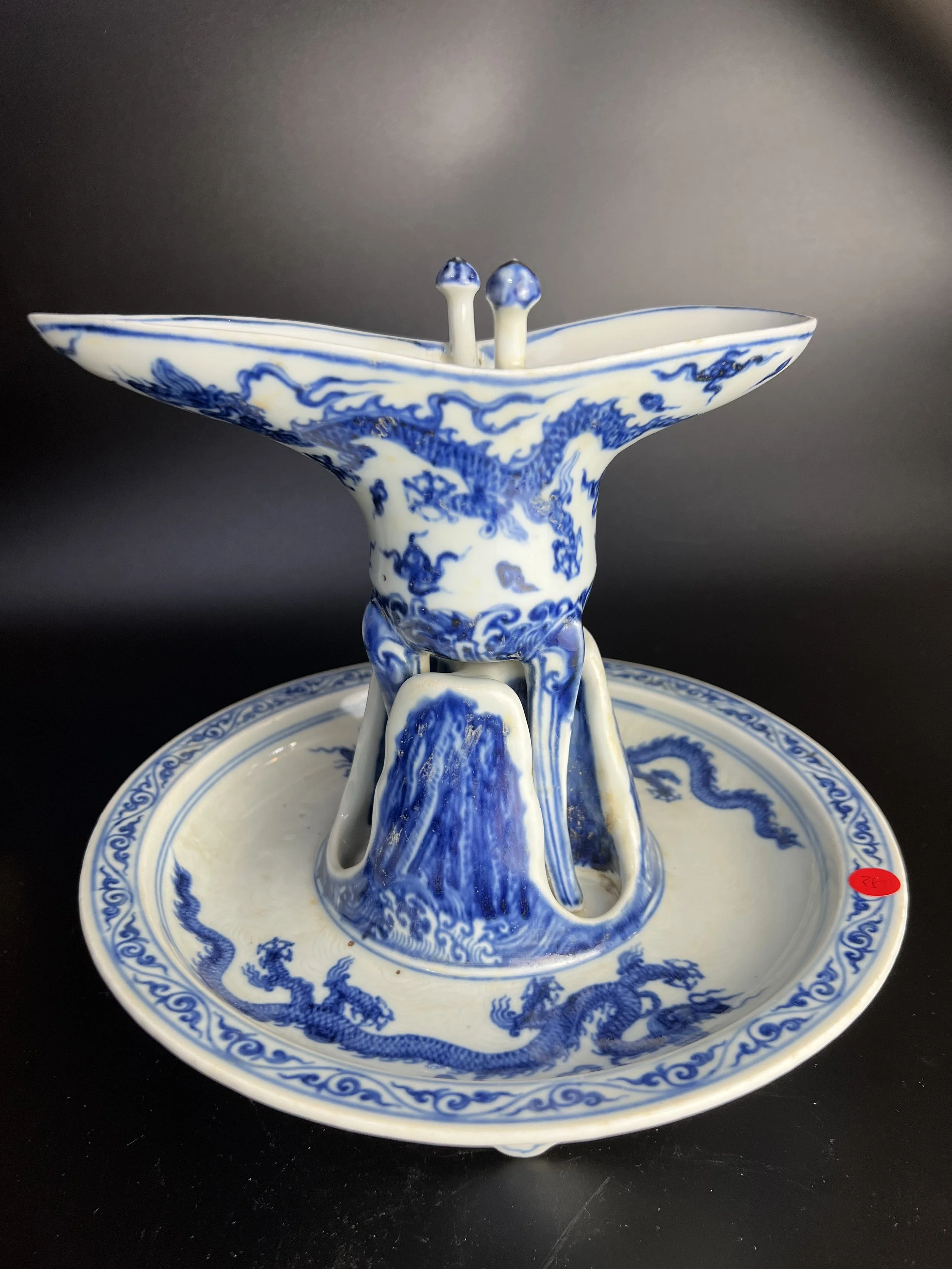 Image 1 of 19
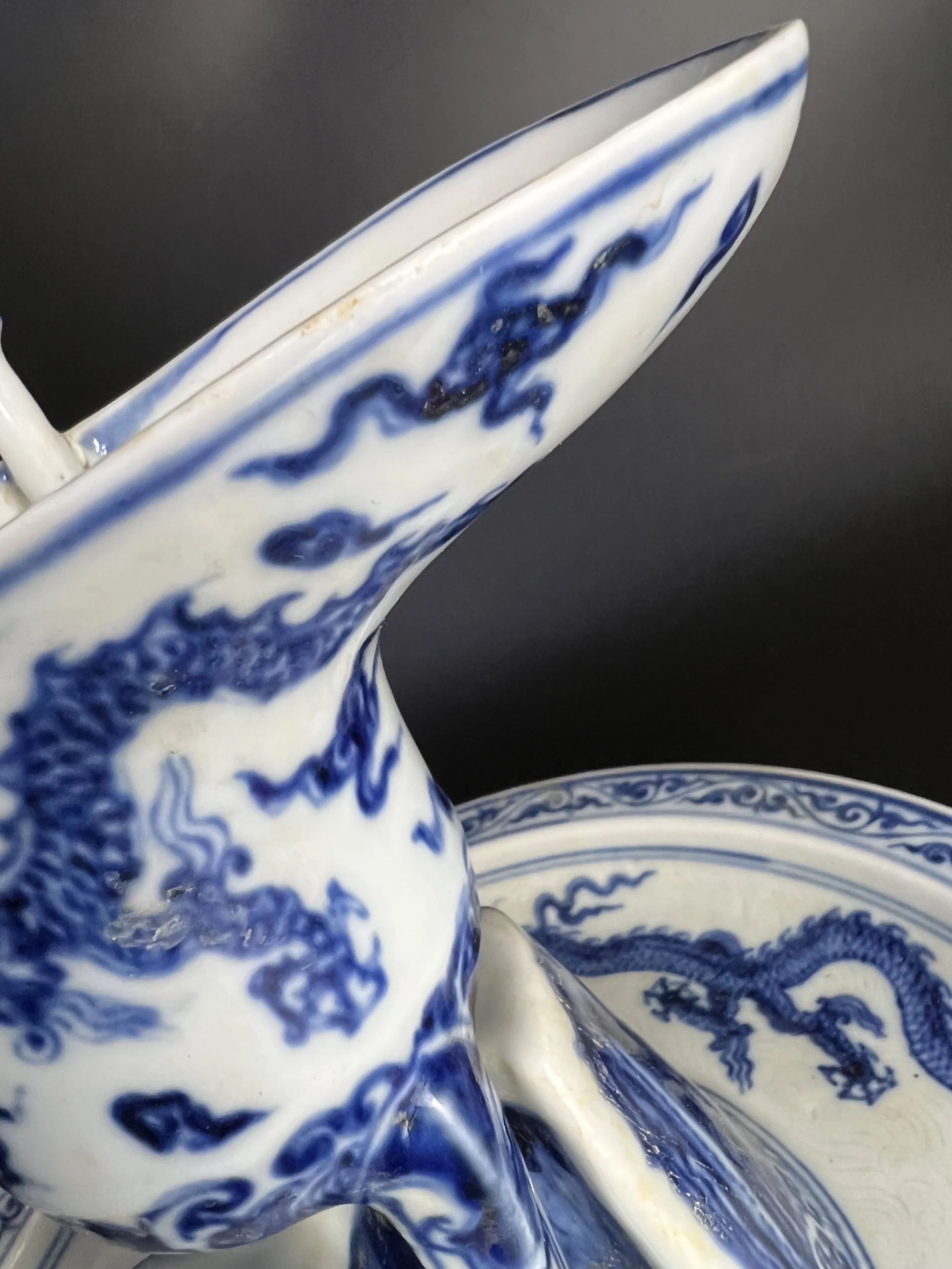 Image 2 of 19
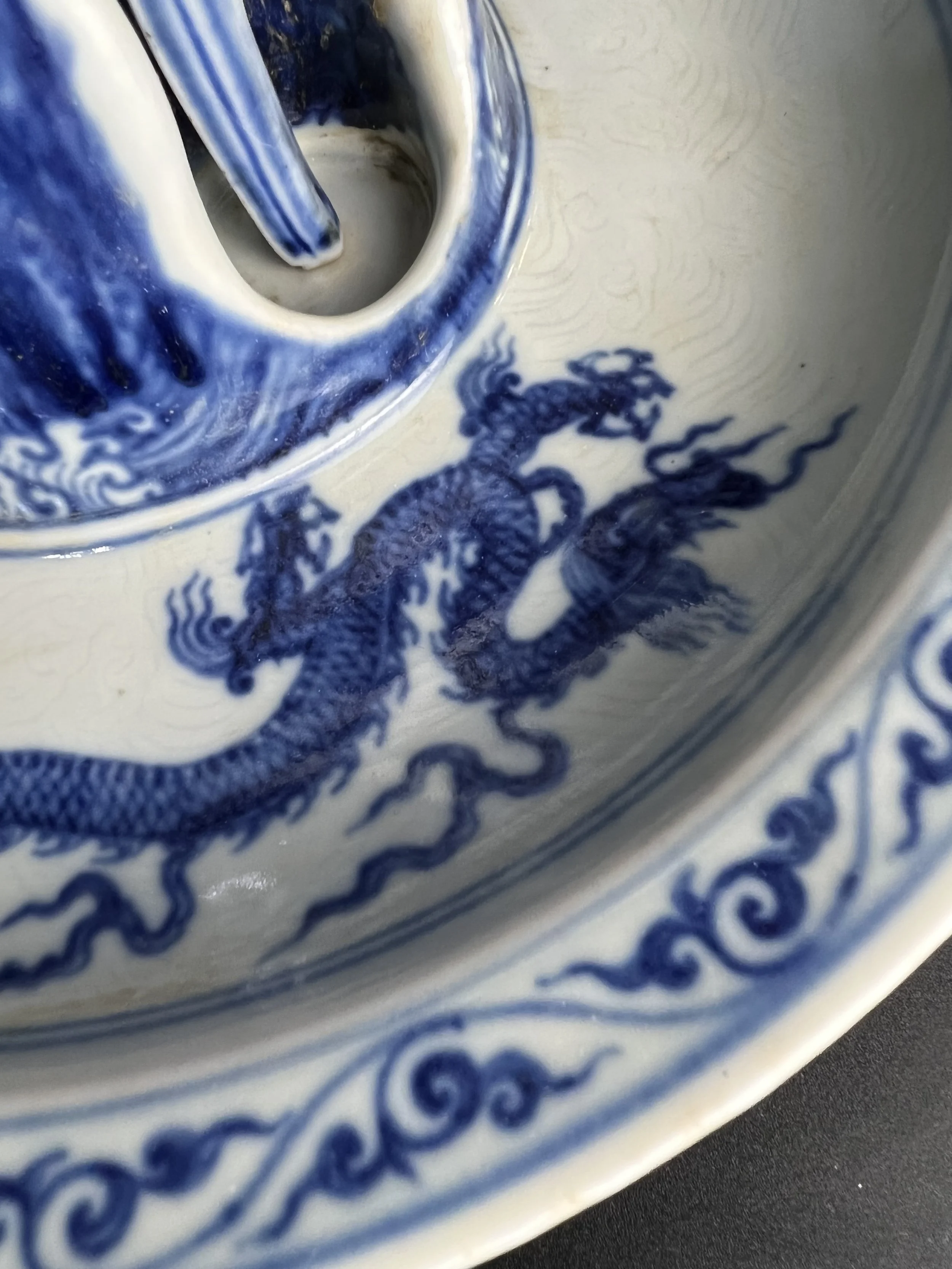 Image 3 of 19
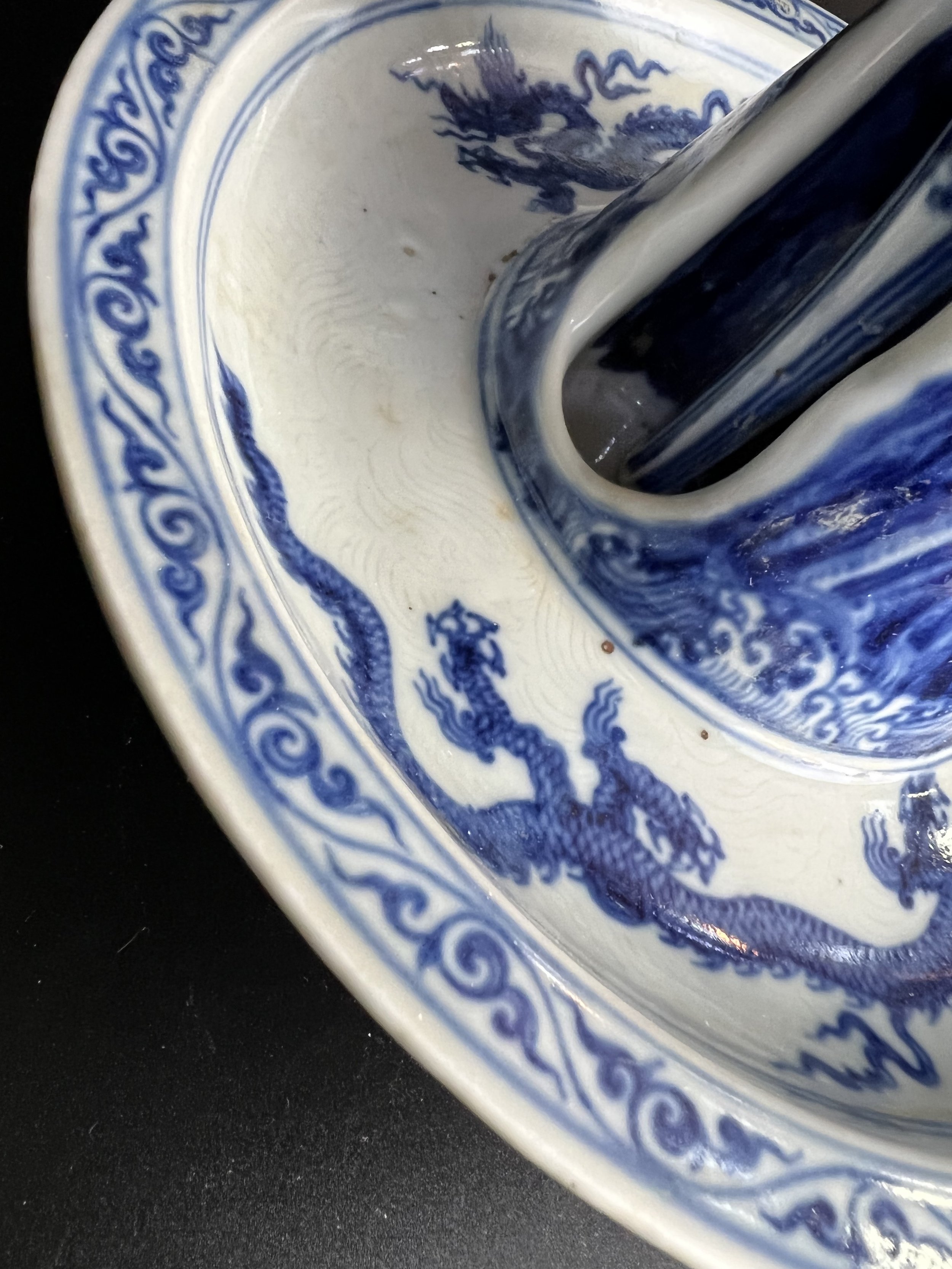 Image 4 of 19
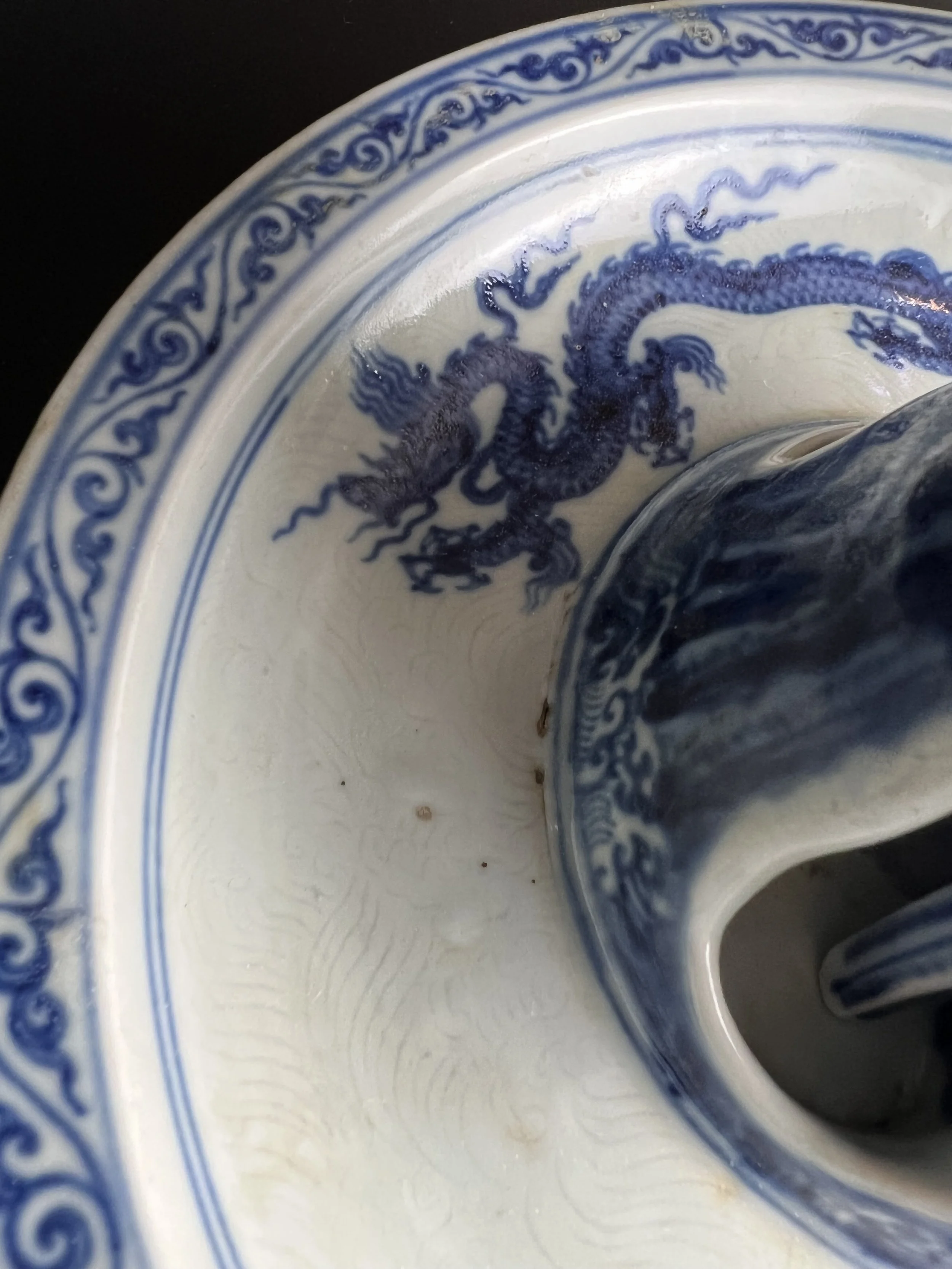 Image 5 of 19
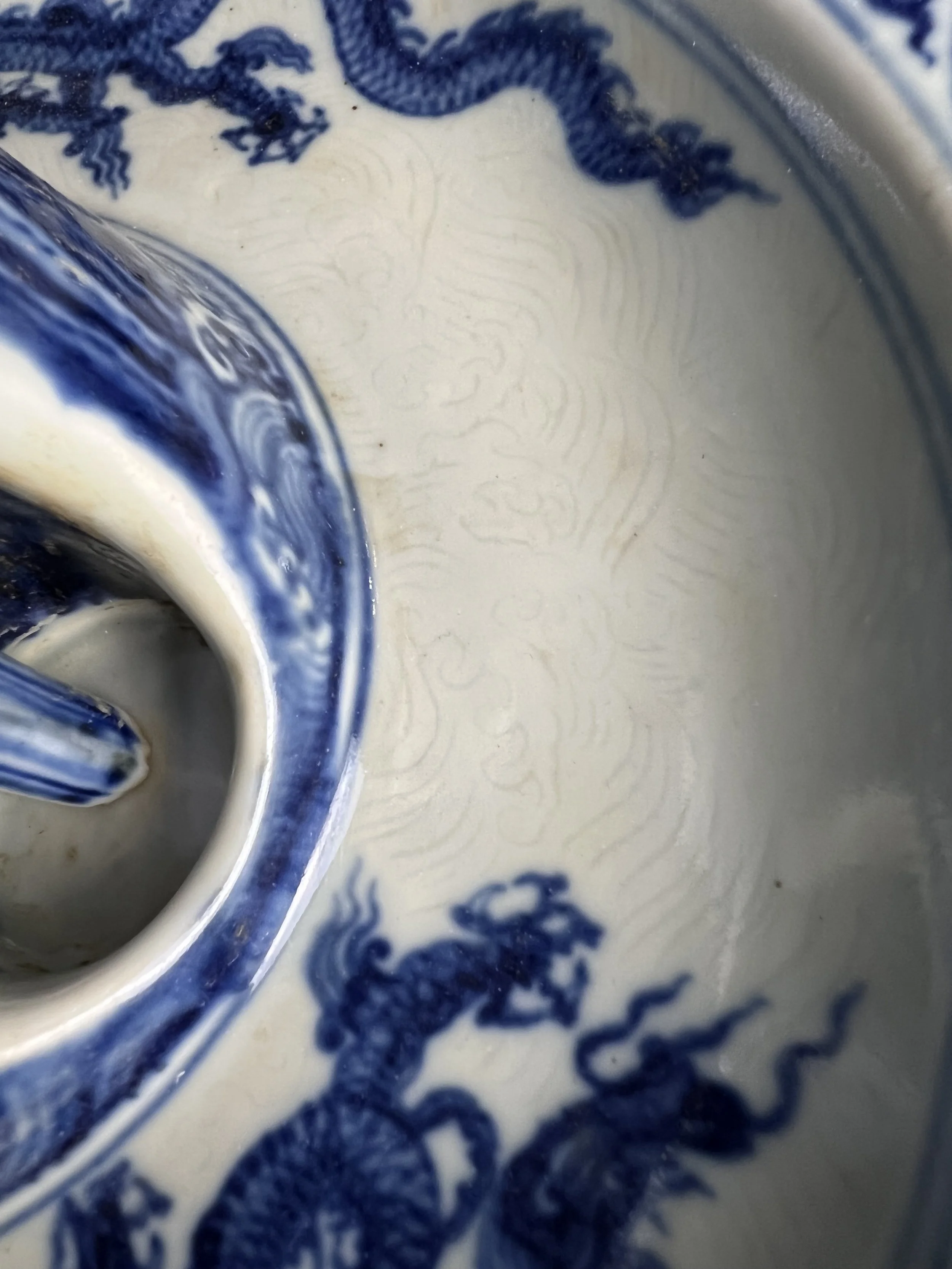 Image 6 of 19
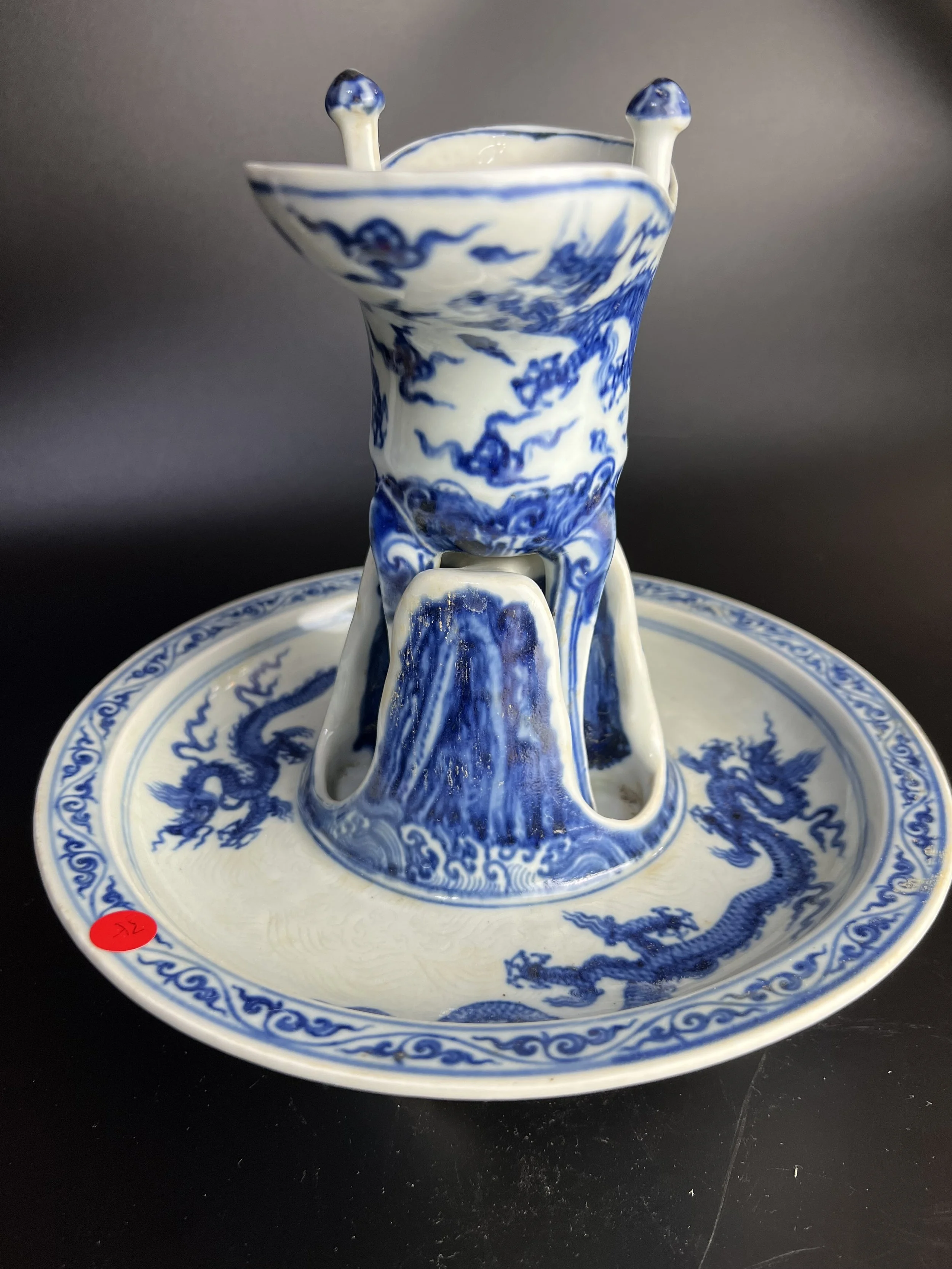 Image 7 of 19
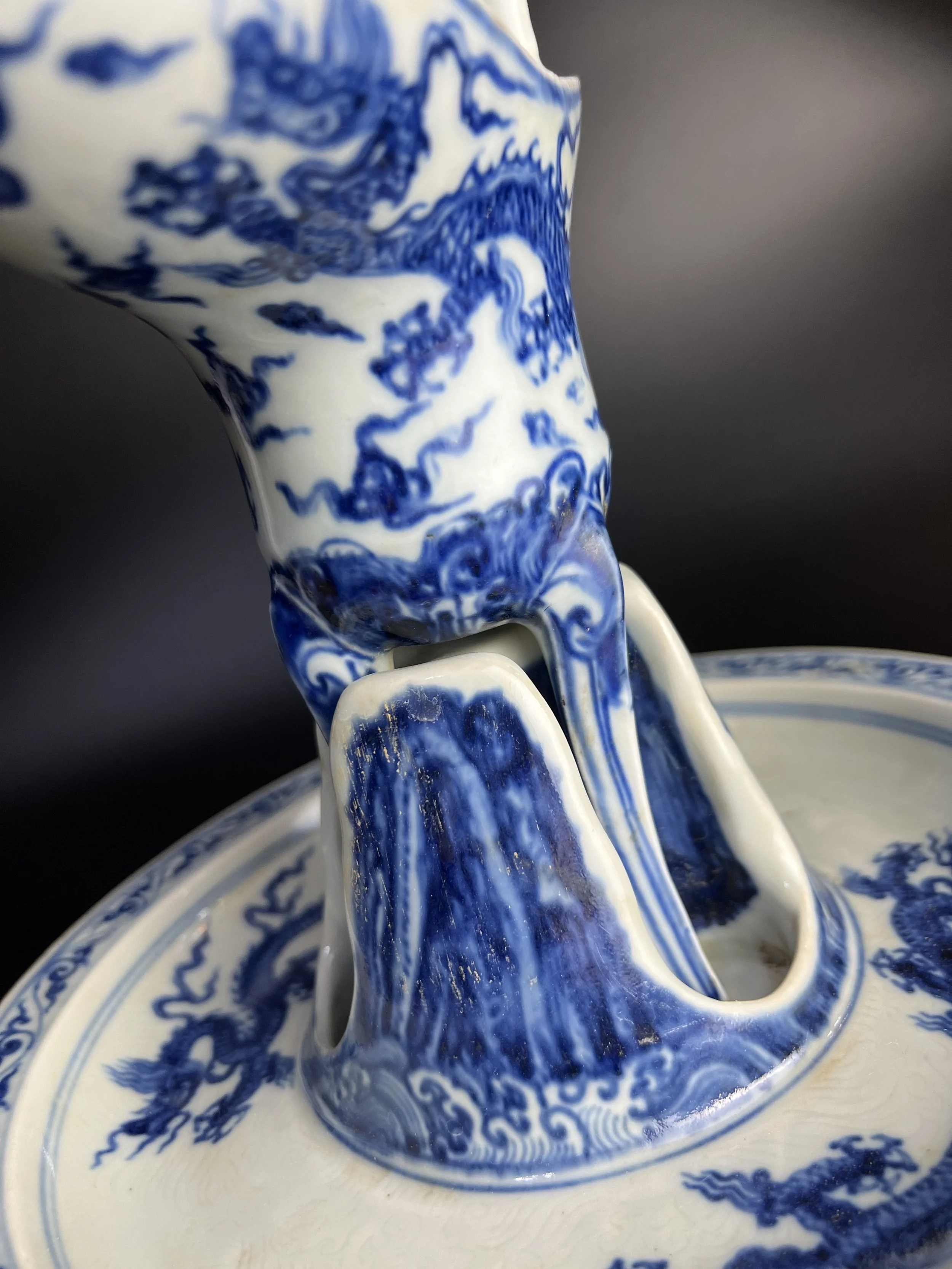 Image 8 of 19
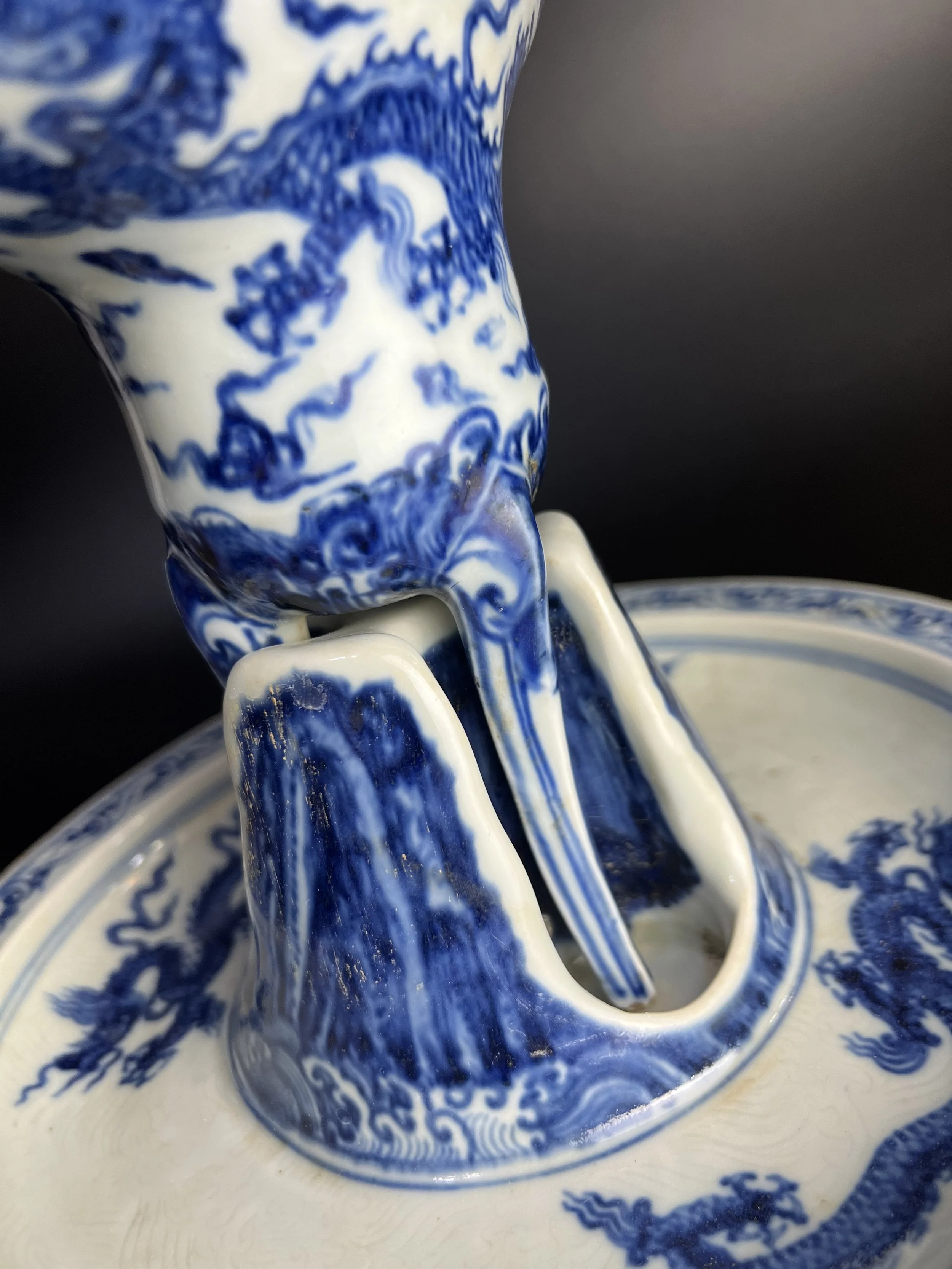 Image 9 of 19
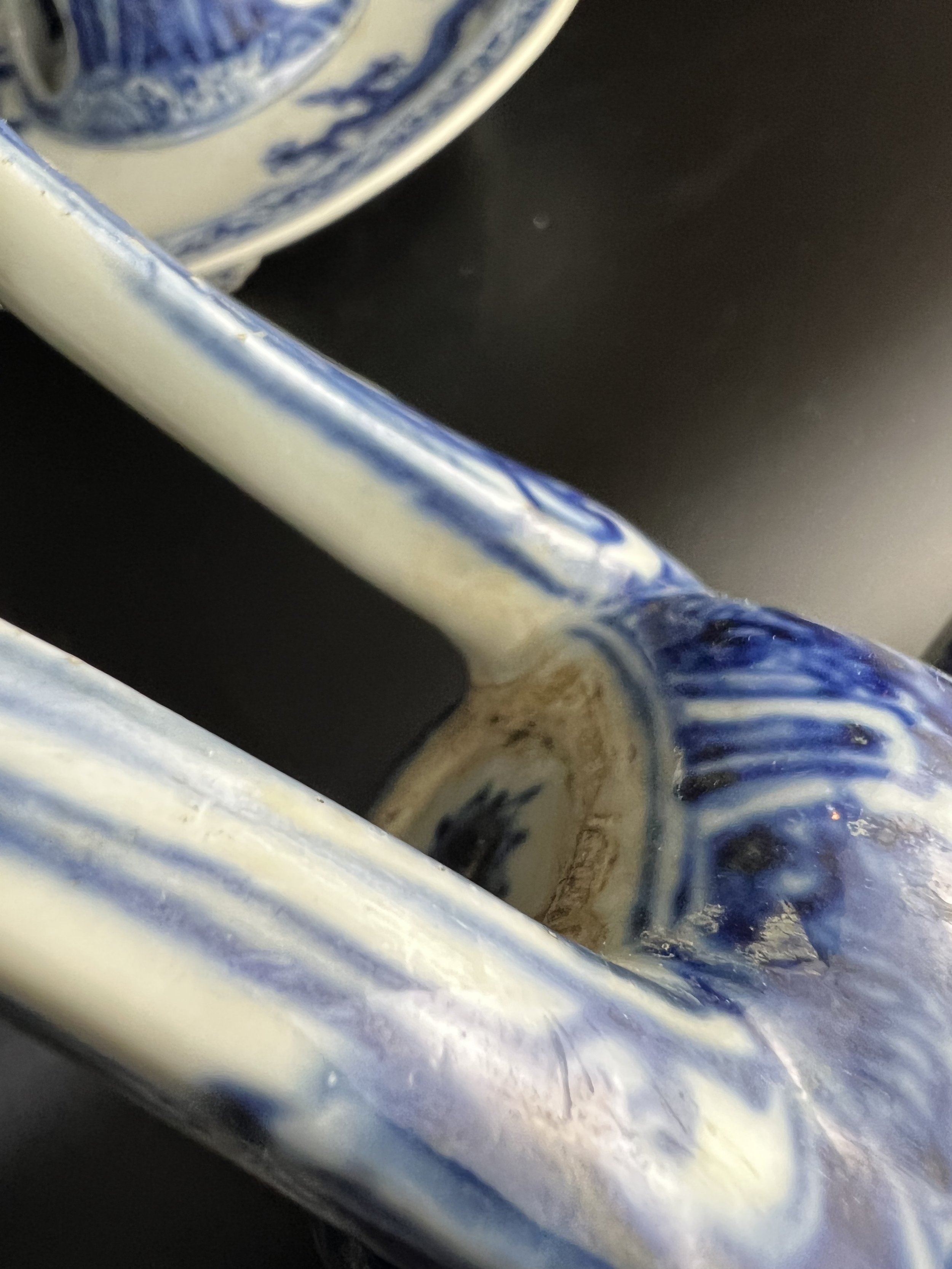 Image 10 of 19
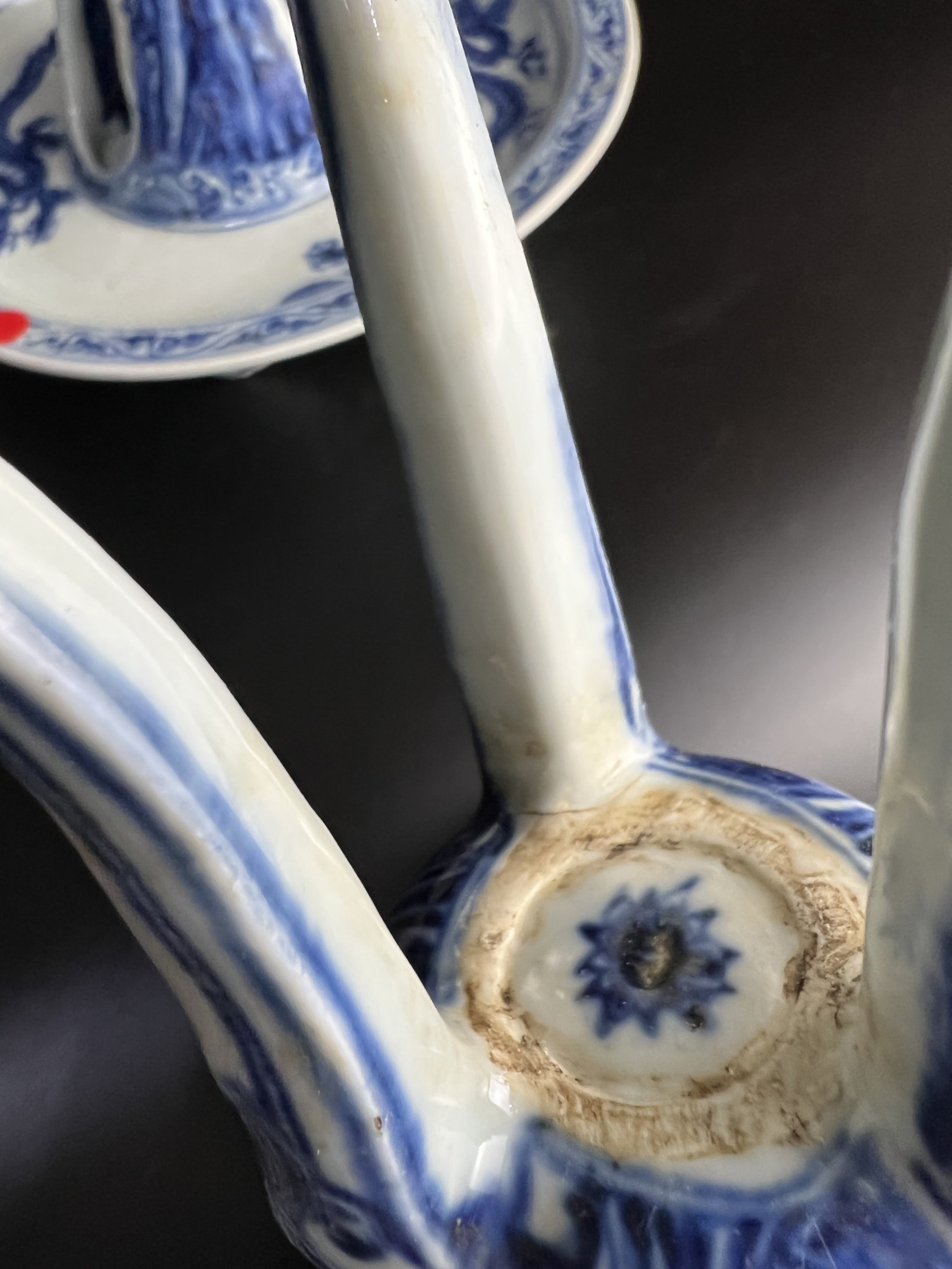 Image 11 of 19
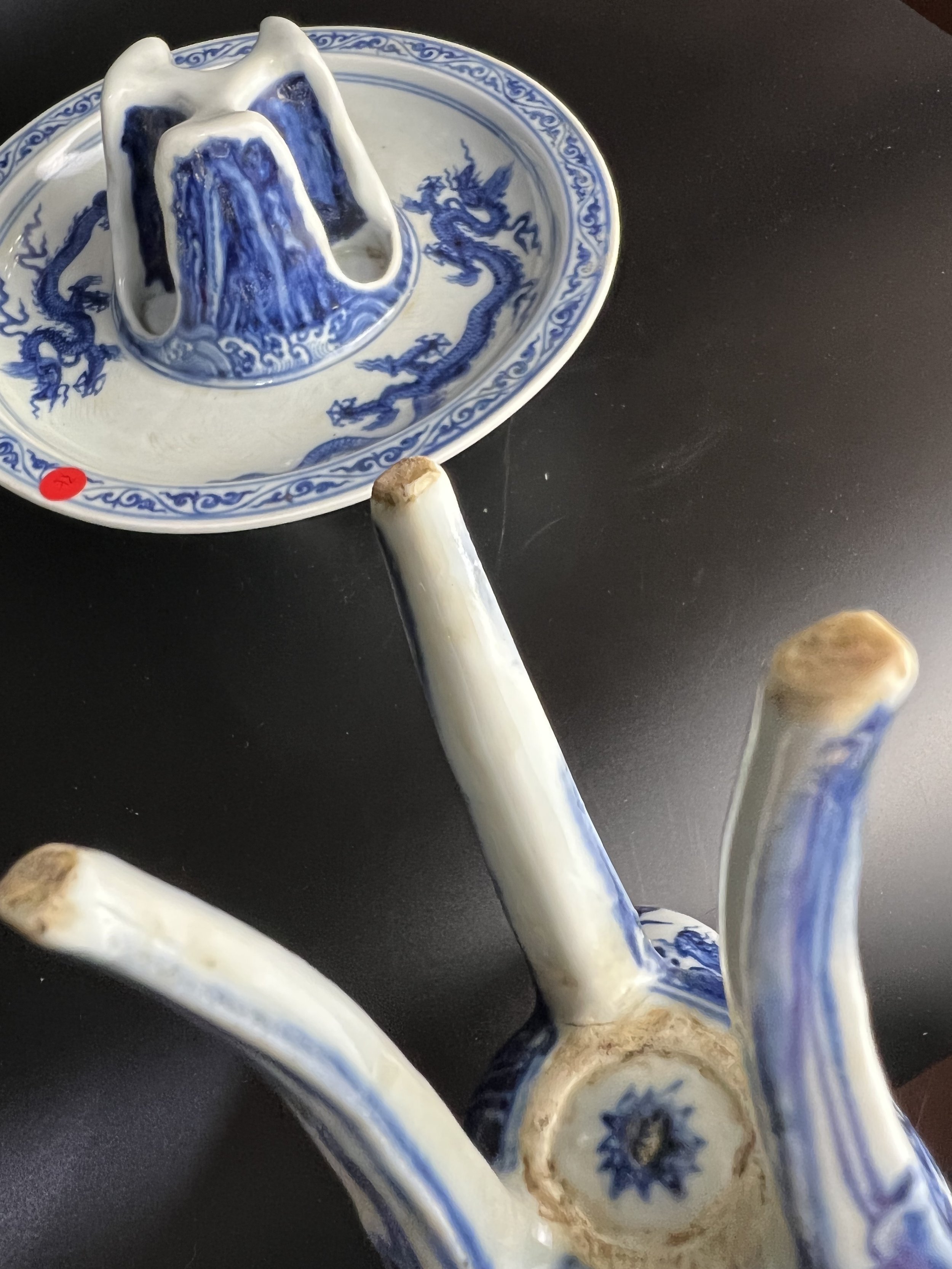 Image 12 of 19
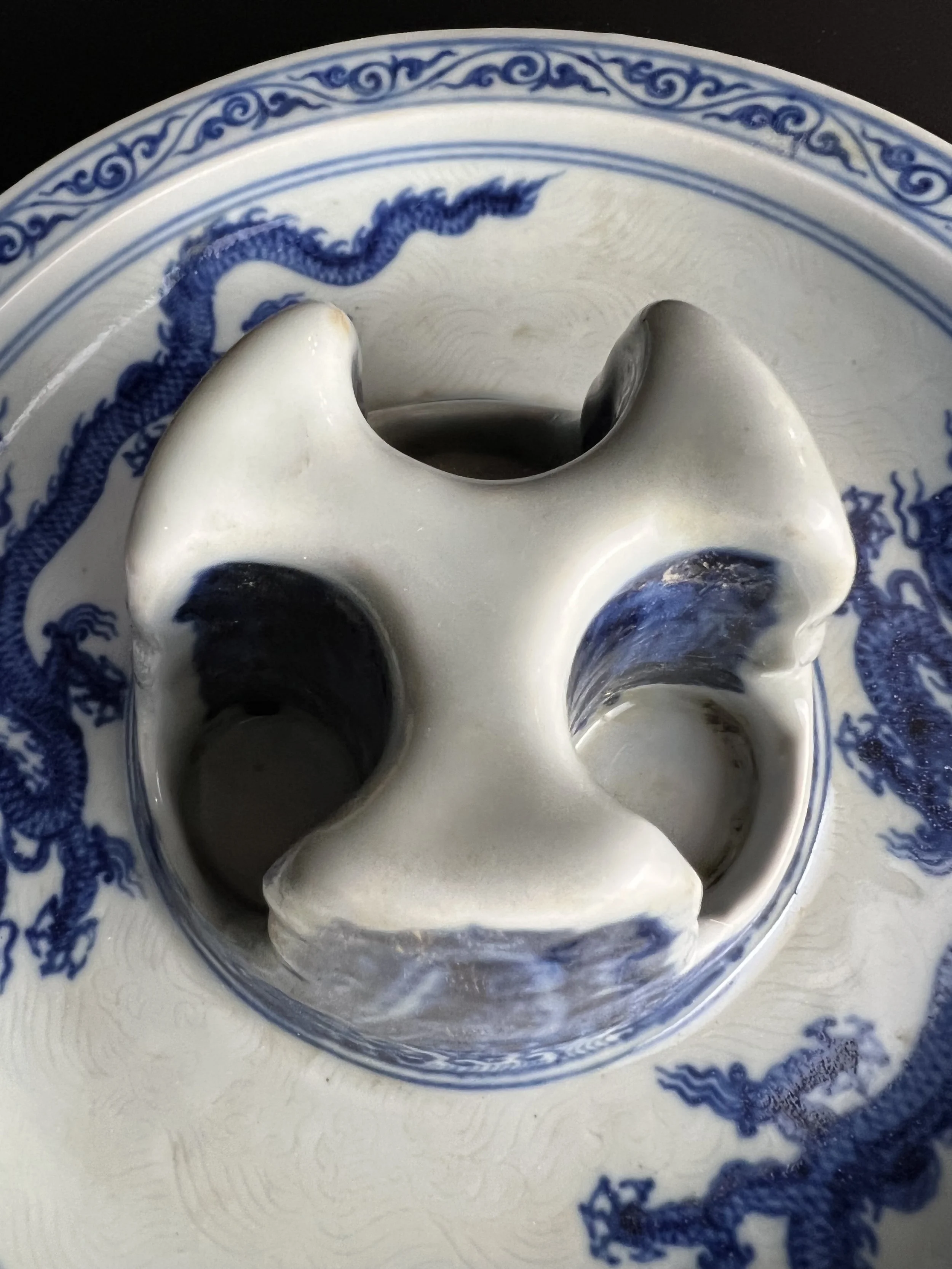 Image 13 of 19
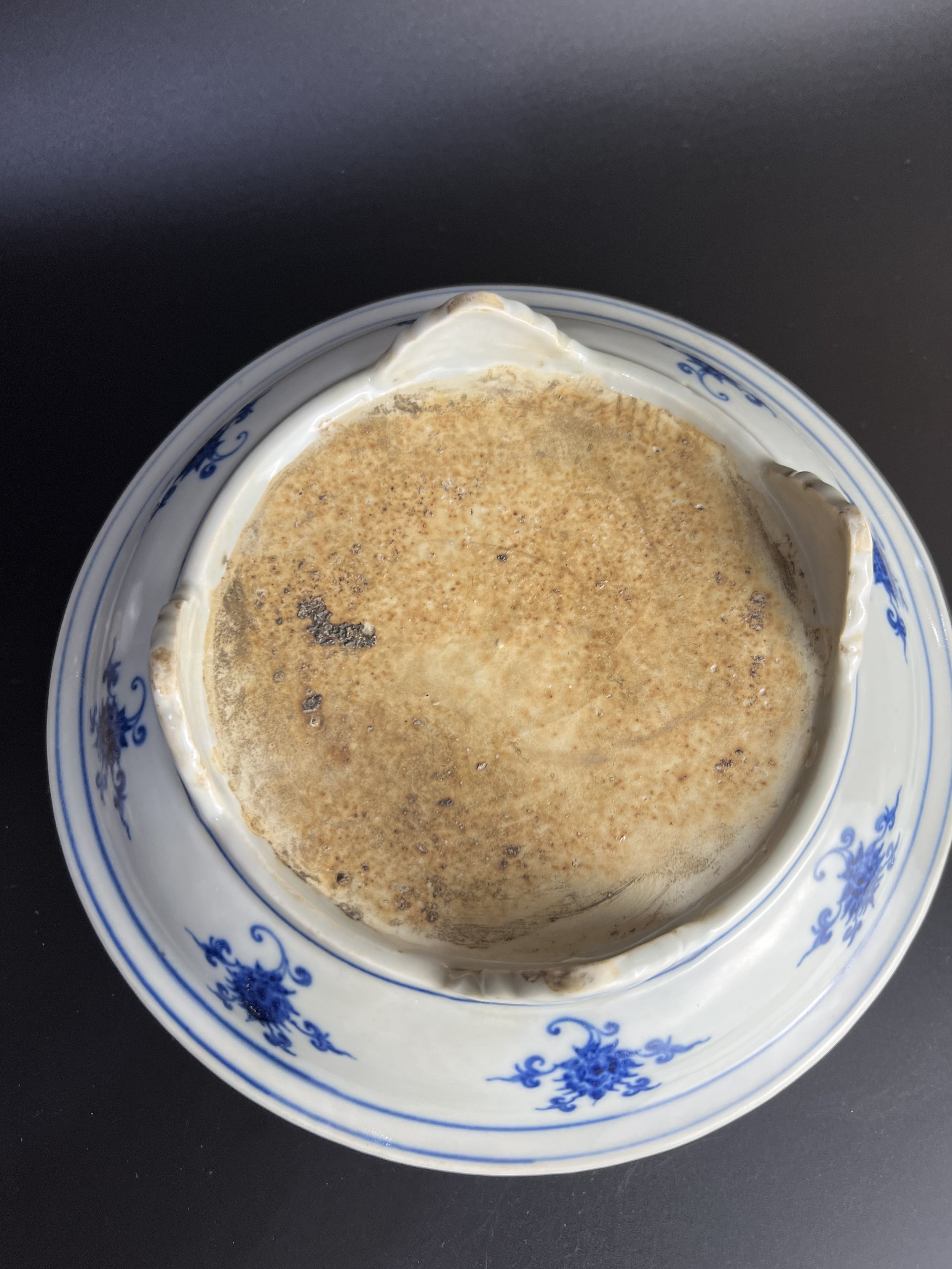 Image 14 of 19
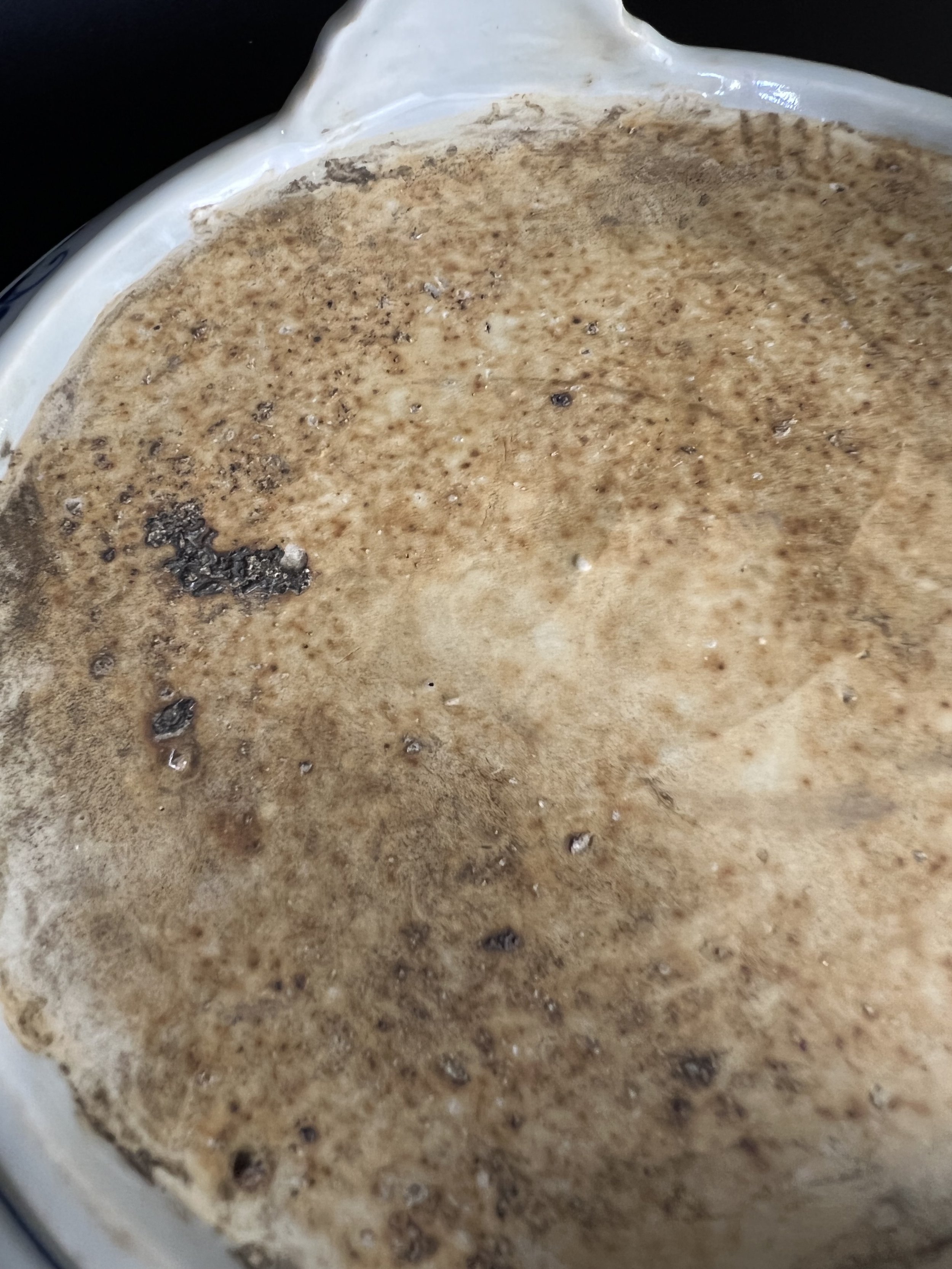 Image 15 of 19
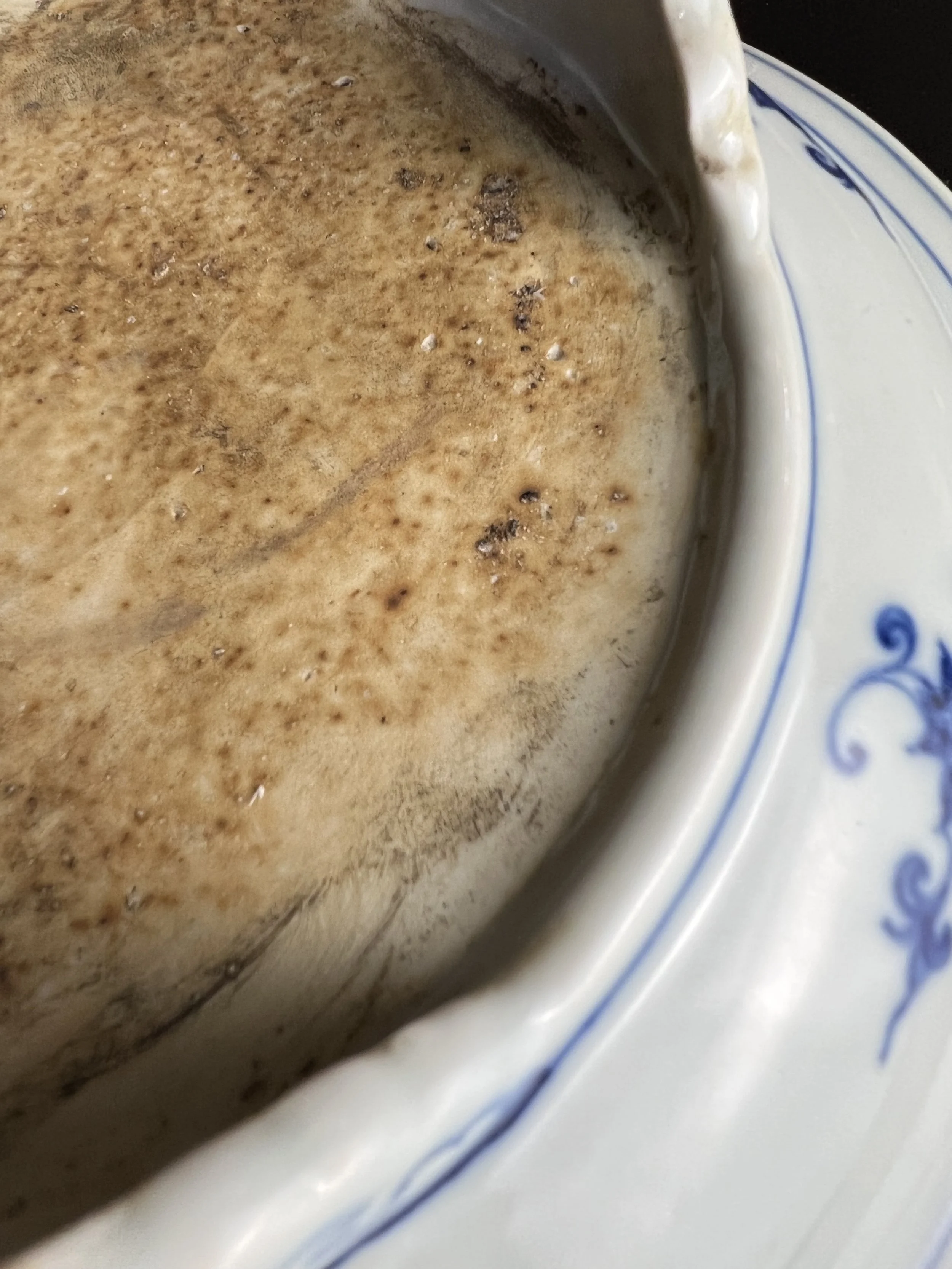 Image 16 of 19
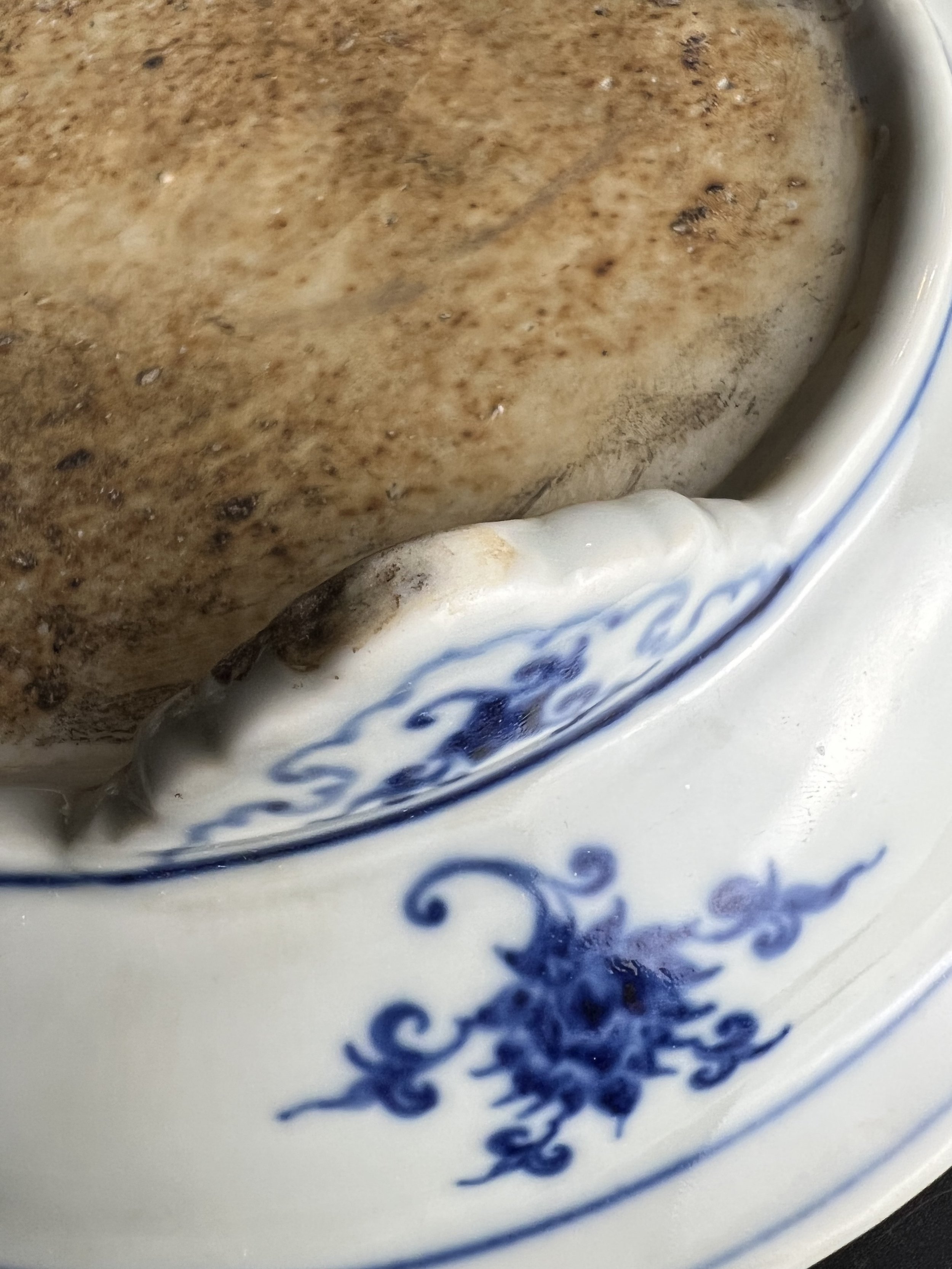 Image 17 of 19
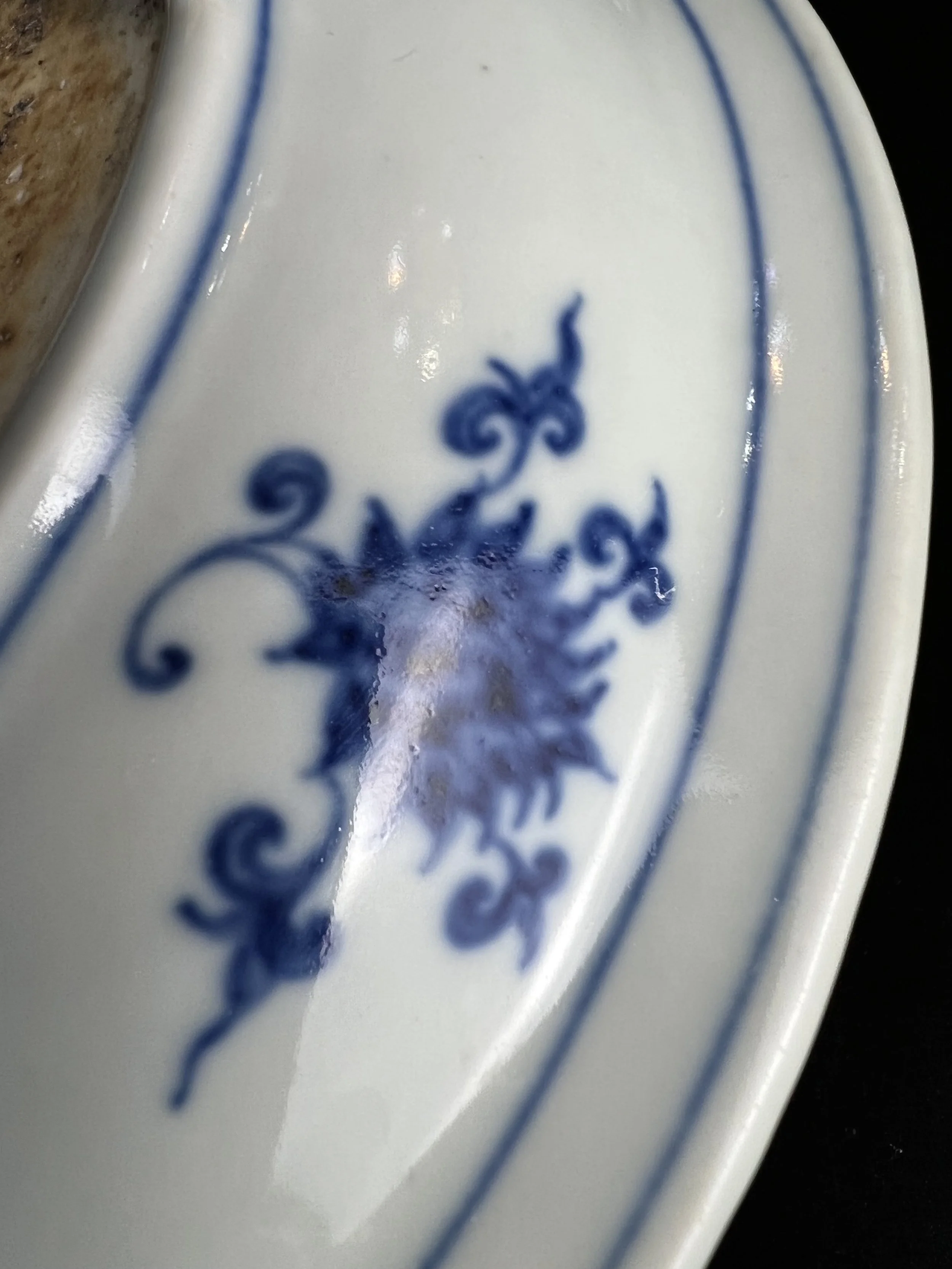 Image 18 of 19
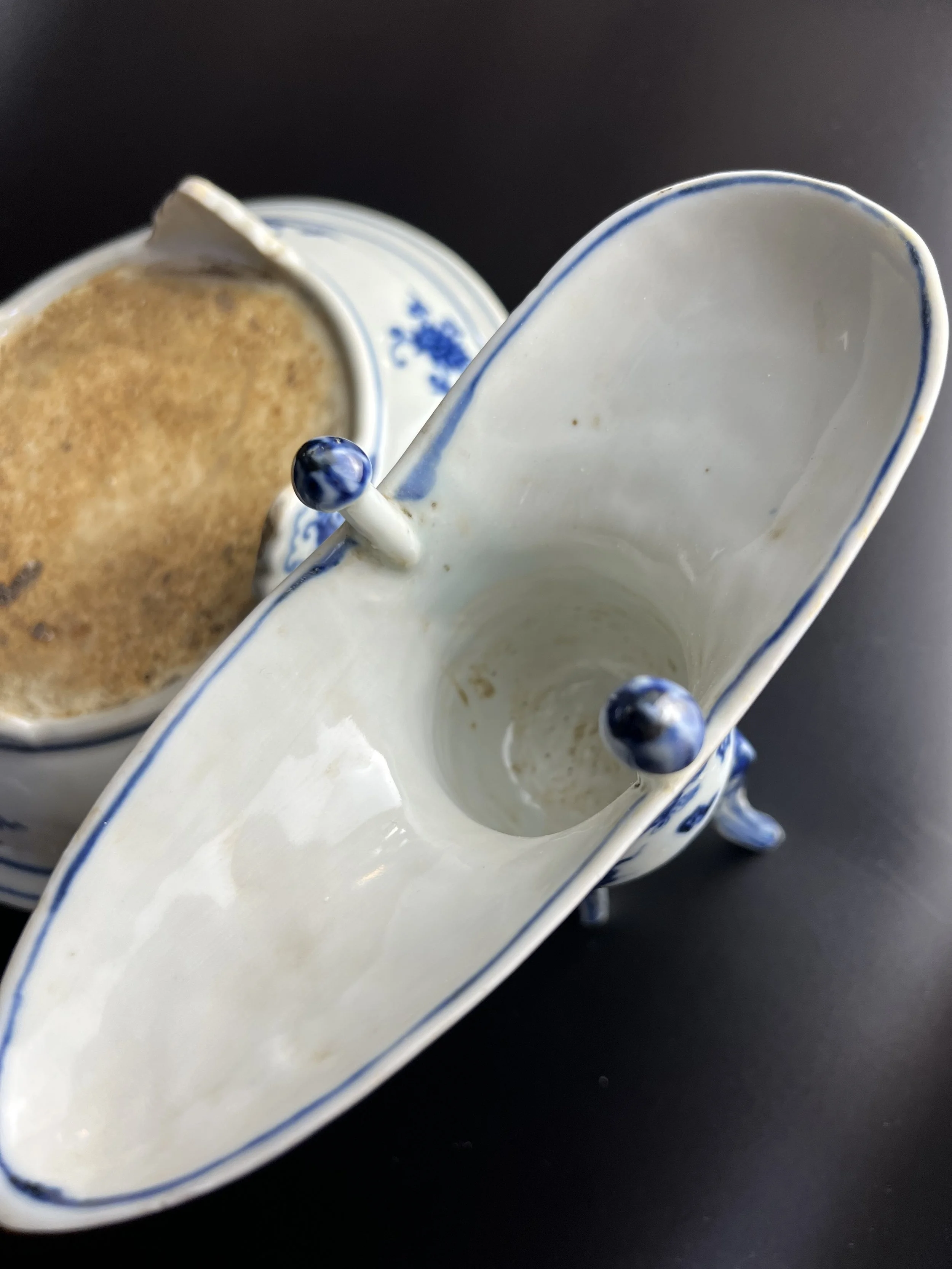 Image 19 of 19