 Image 1 of 11
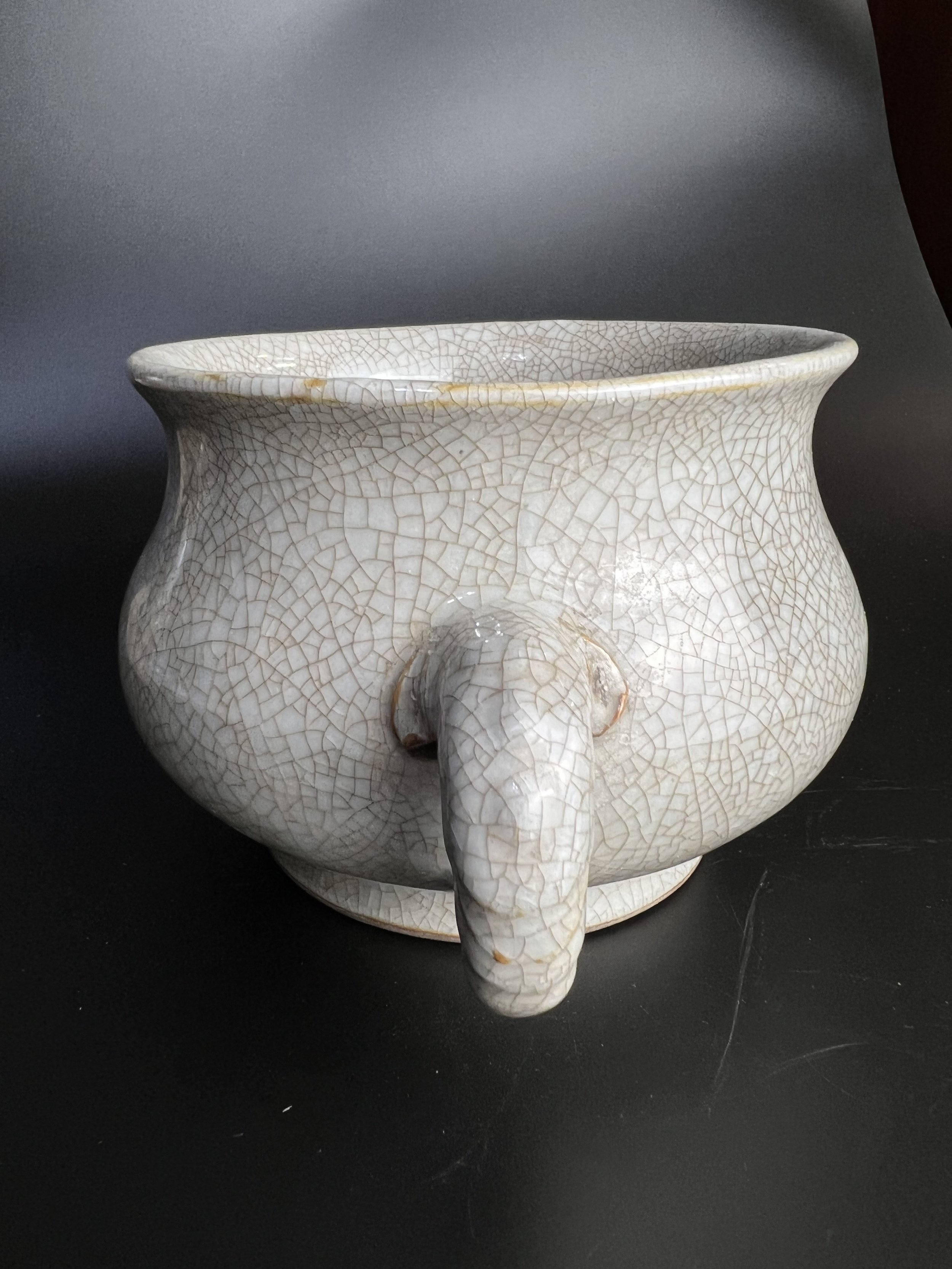 Image 2 of 11
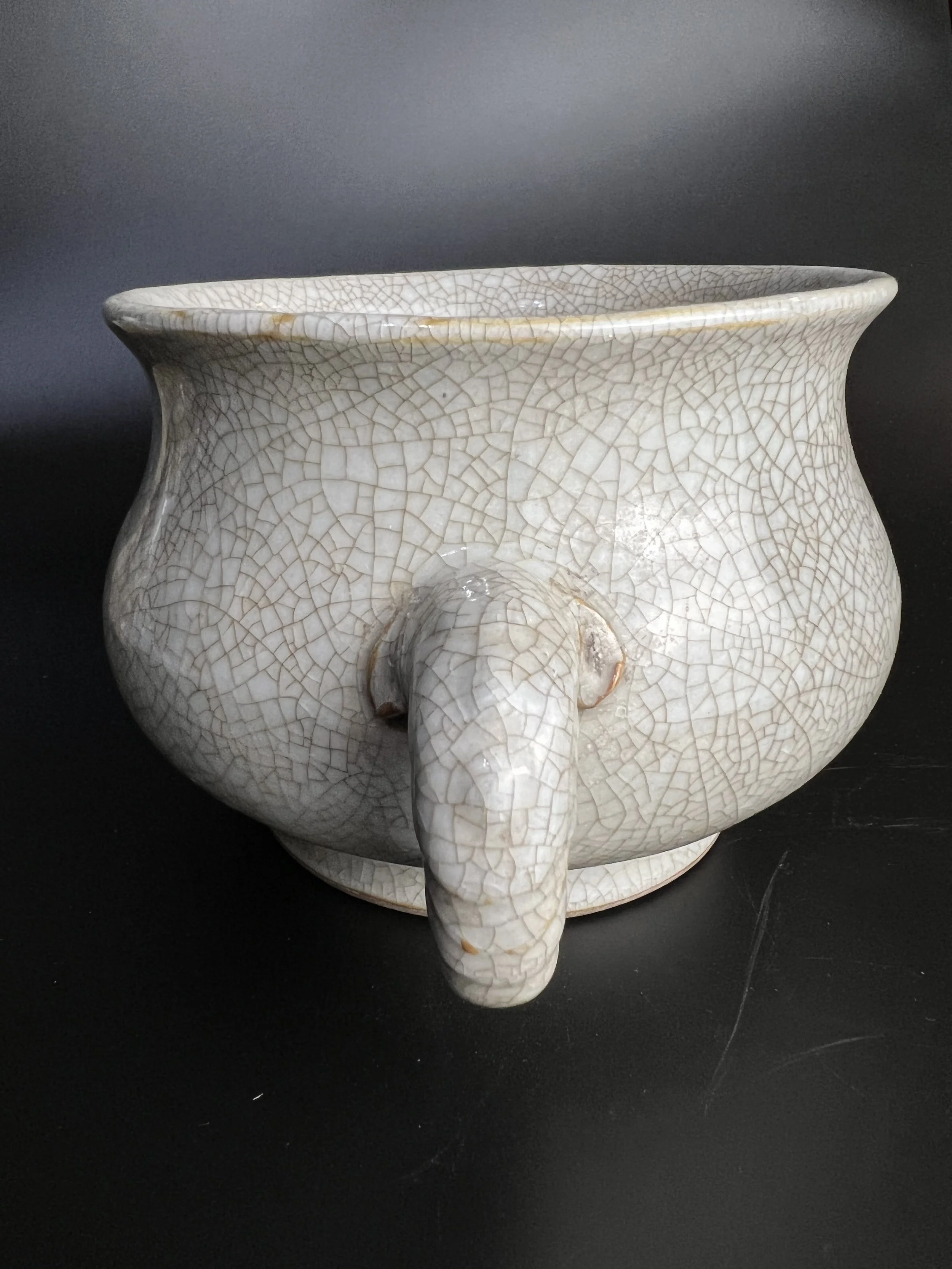 Image 3 of 11
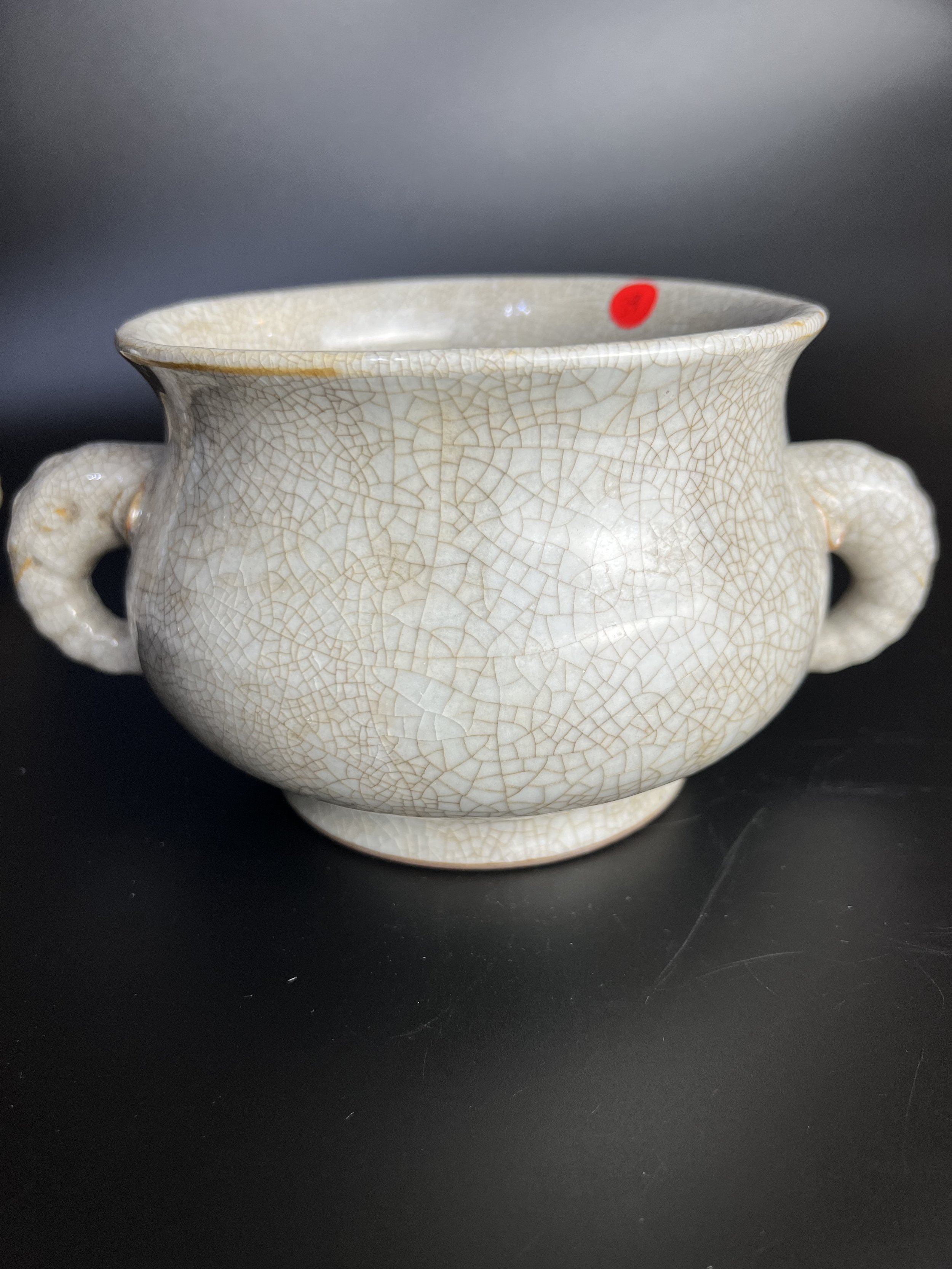 Image 4 of 11
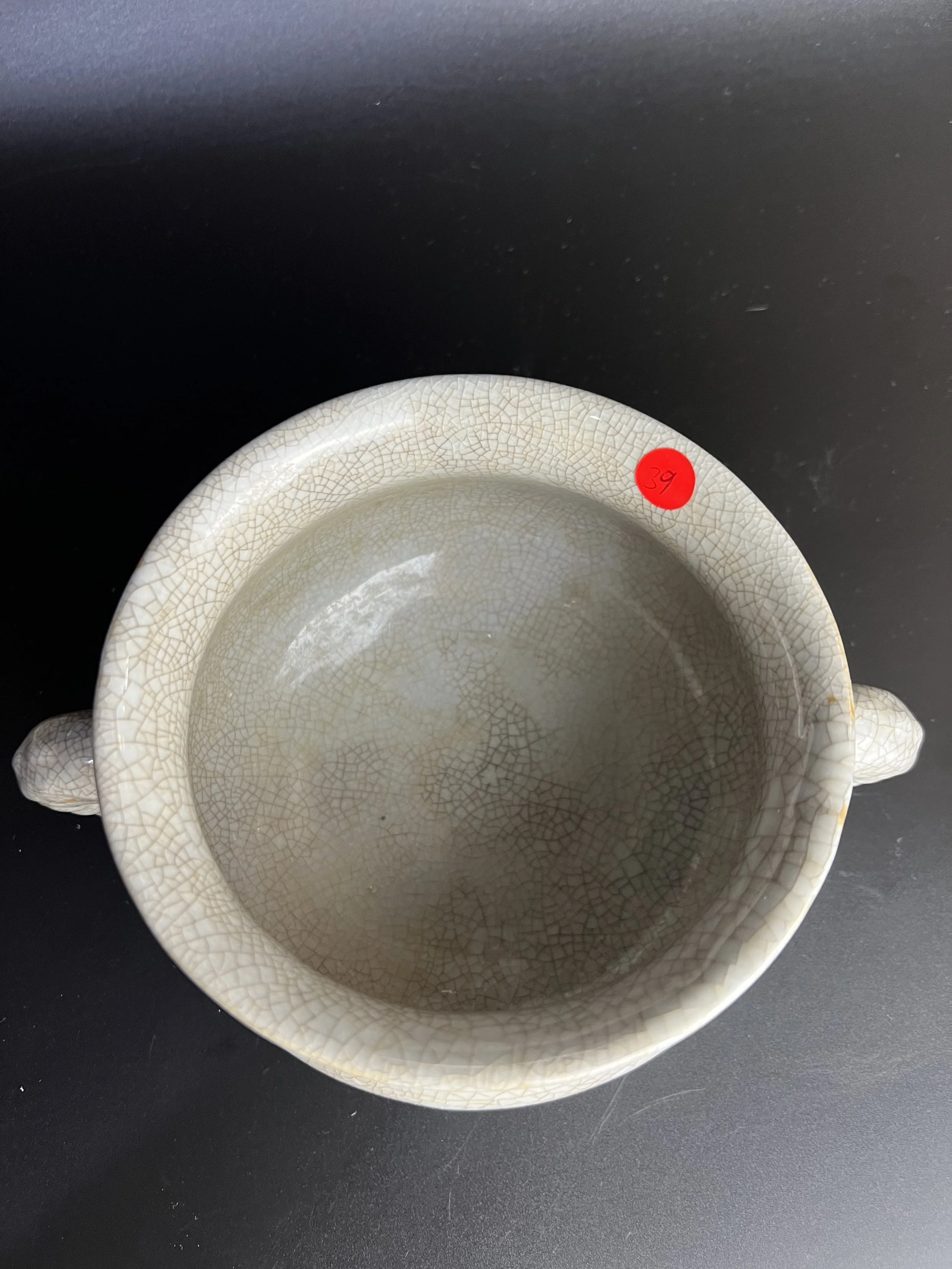 Image 5 of 11
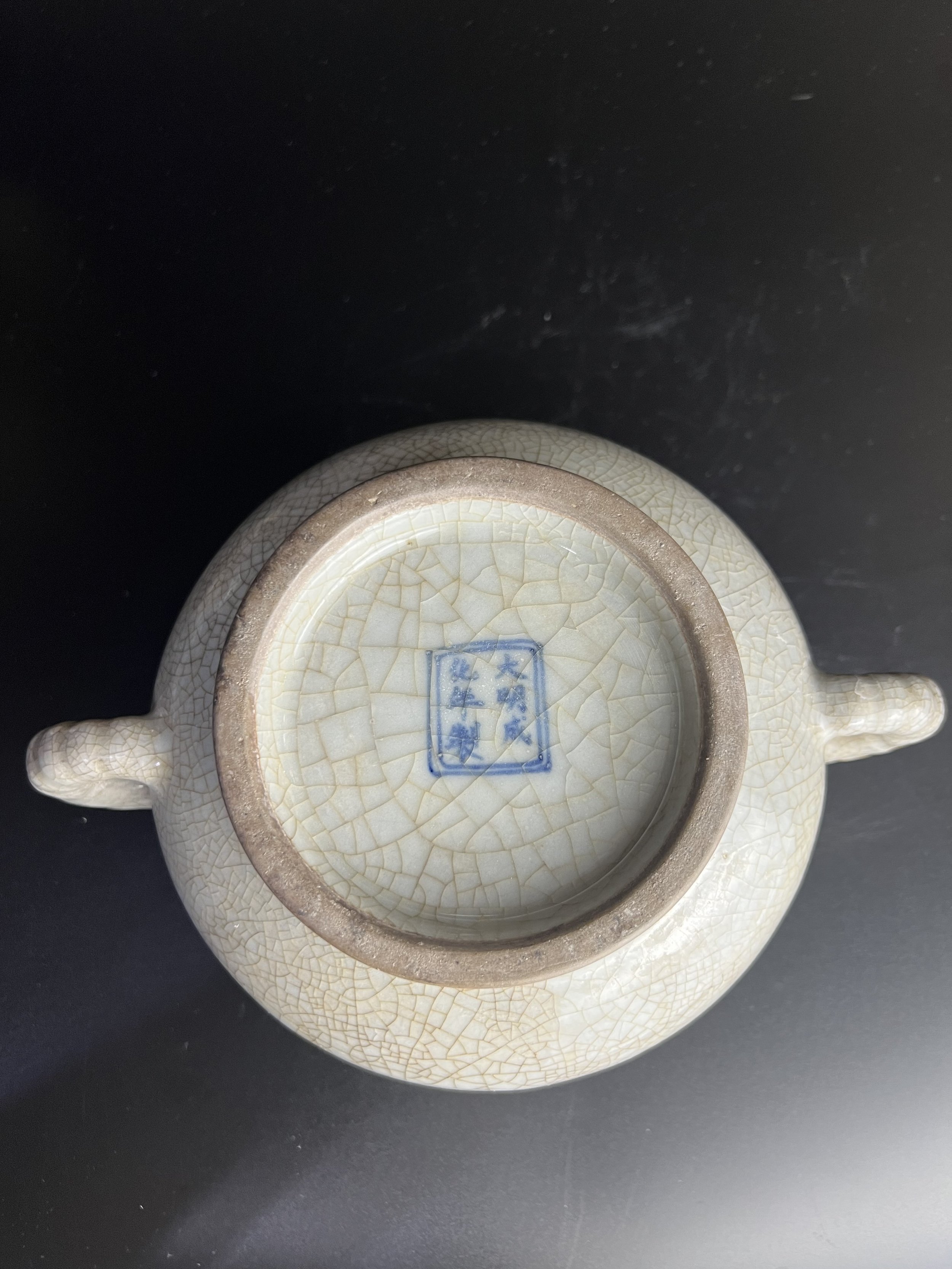 Image 6 of 11
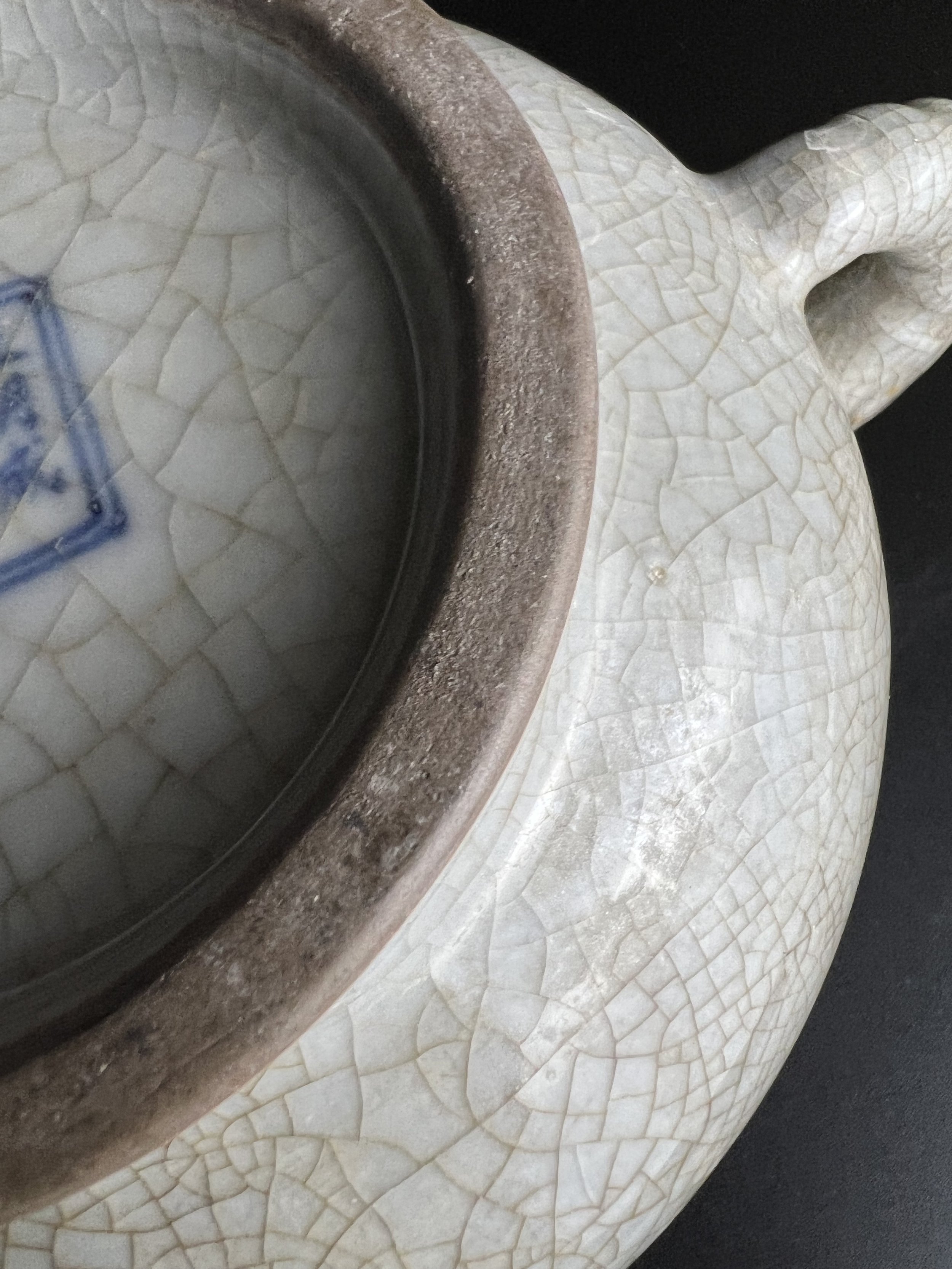 Image 7 of 11
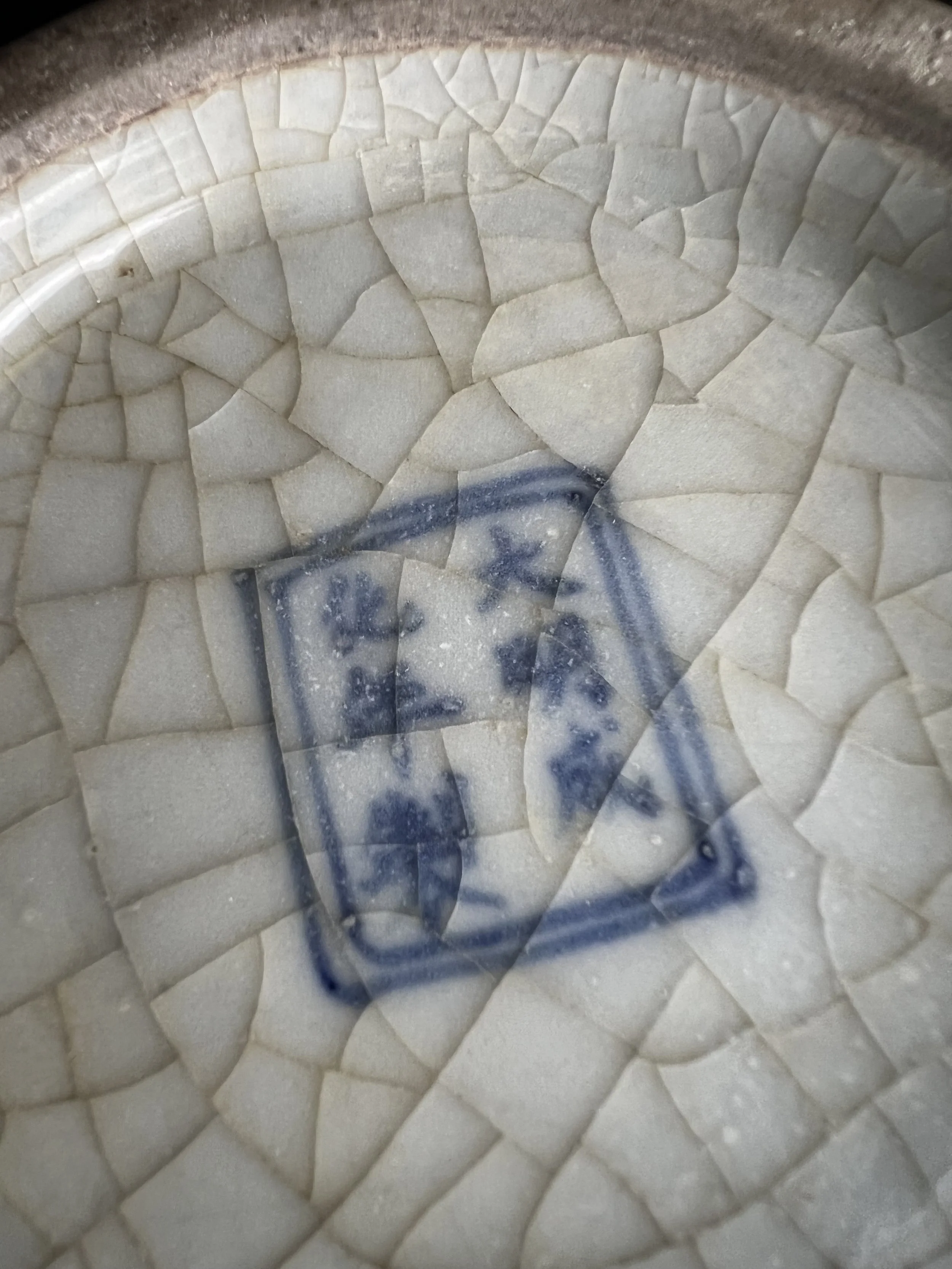 Image 8 of 11
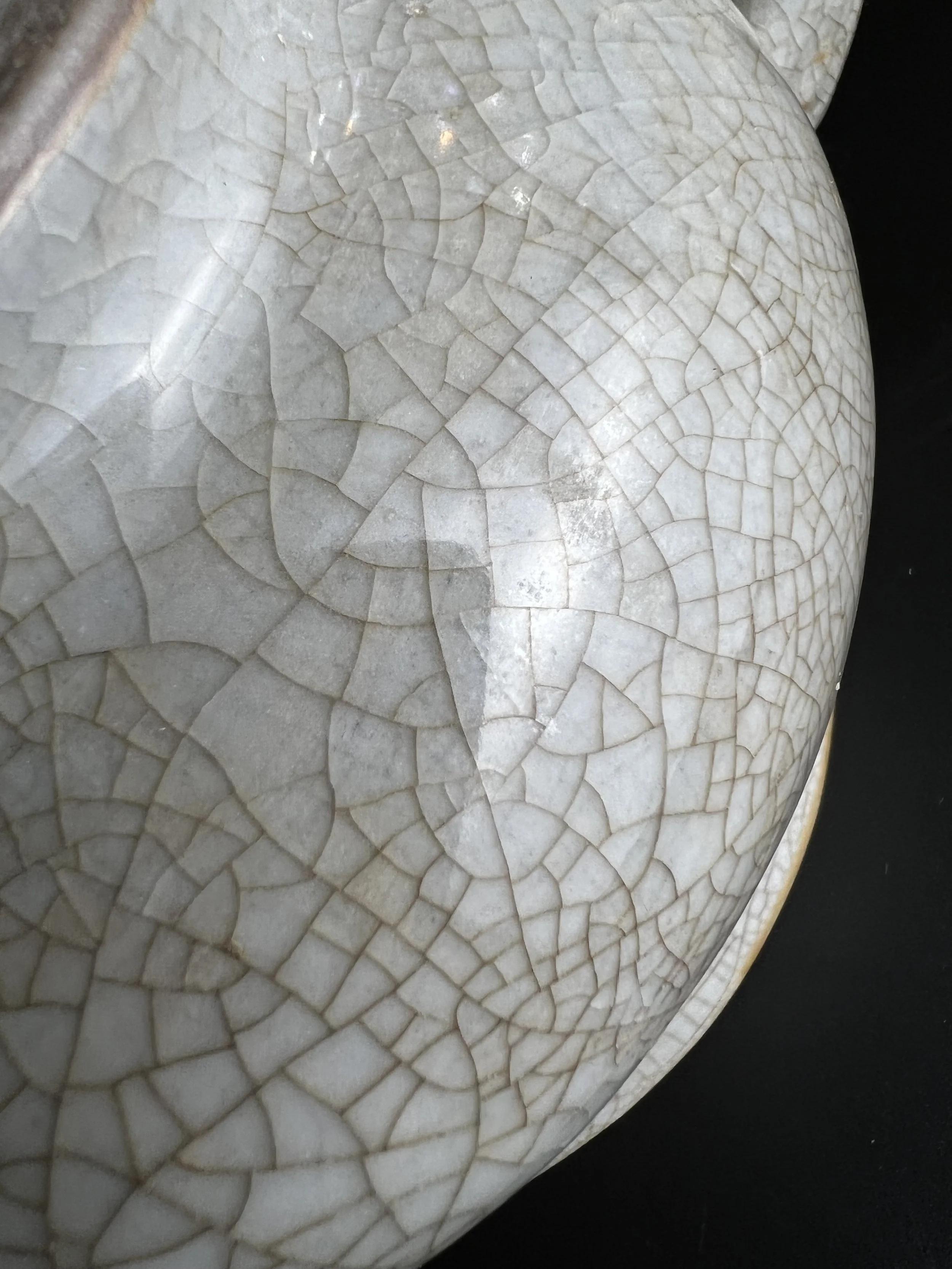 Image 9 of 11
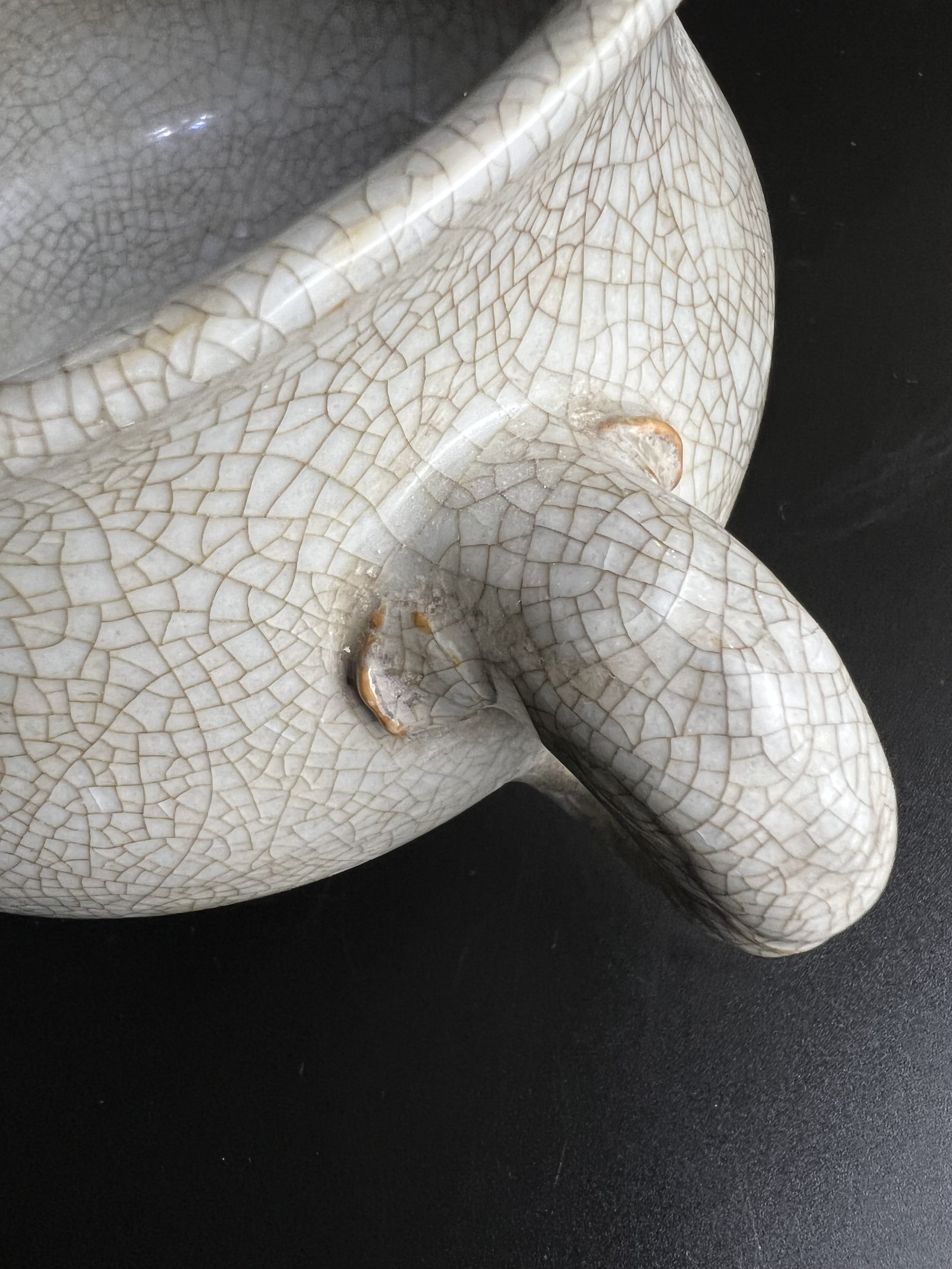 Image 10 of 11
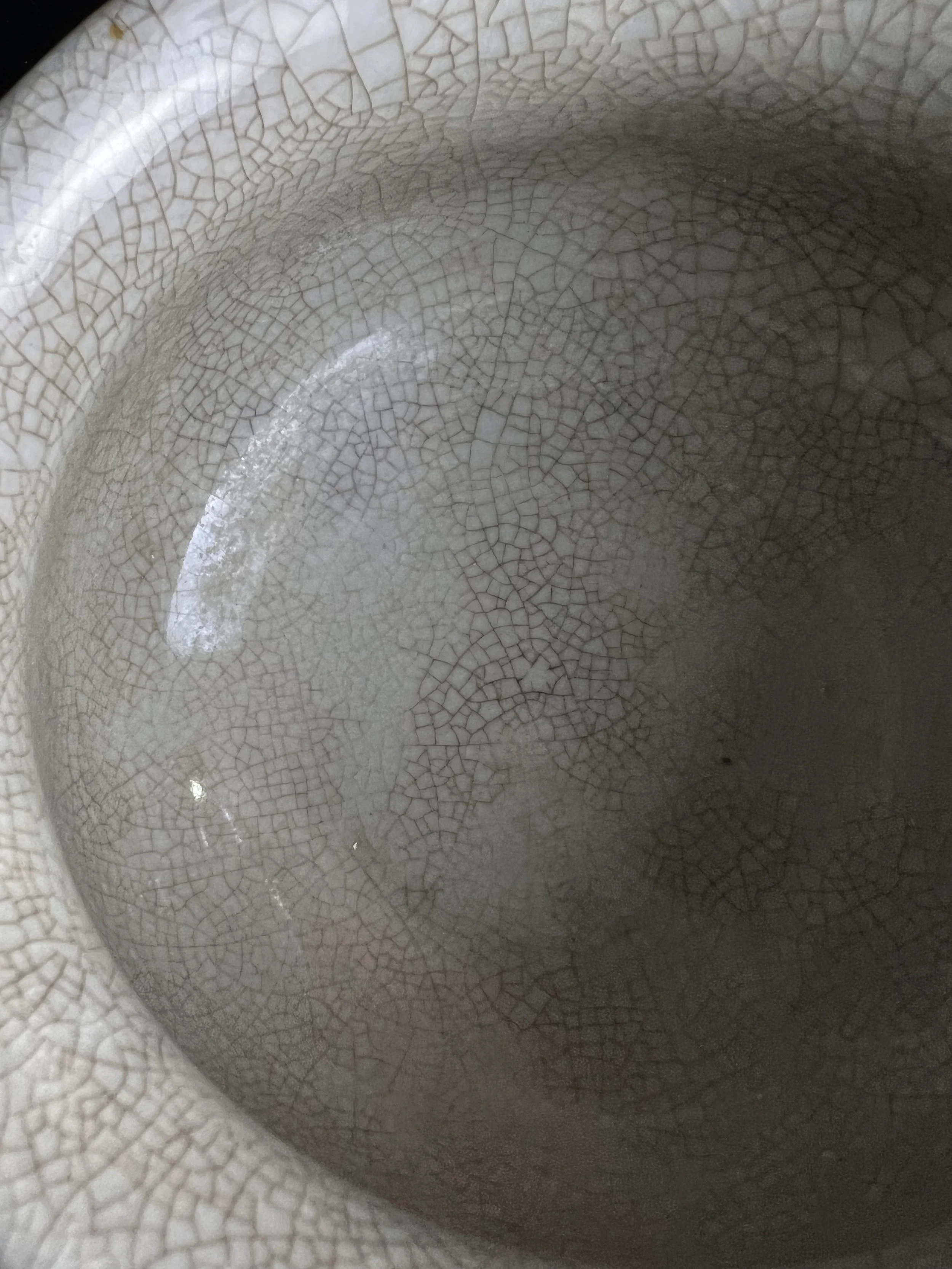 Image 11 of 11
A ‘Ge’-Type Glazed Censer with Elephant-Head Handles, Chenghua Mark and Period
Overview
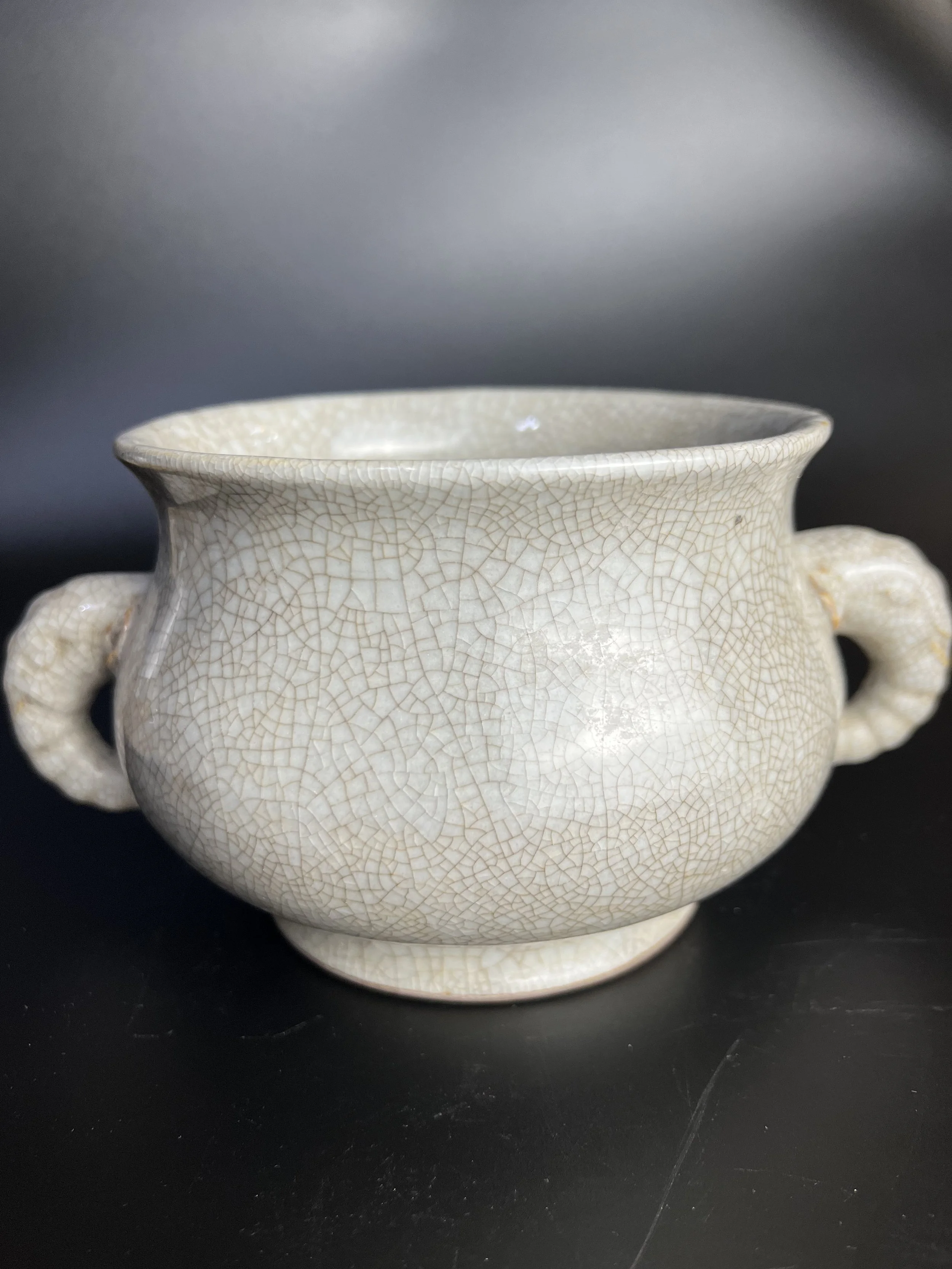
This ‘Ge’-type glazed censer with elephant-head handles, bearing the Chenghua six-character mark, stands at 8 cm in height with a mouth diameter of 10 cm. It is a quintessential example of archaistic glaze imitation from the Ming Chenghua imperial kilns. Its form derives from ancient bronze censers, dignified yet exquisitely delicate, adorned on both sides with elephant-head handles symbolizing “peace and prosperity manifested by the elephant” (taiping you xiang). The vessel is completely covered, inside and out, with an imitation of Song Dynasty 'Ge'-ware crackle glaze. The glaze color is a pale powder-blue, featuring the characteristic “golden threads and iron wires” crackle pattern, warm and lustrous like ancient jade. The underglaze-blue double-rectangular mark on the base is executed with consummate calligraphic skill, harmonizing perfectly with the glaze's subdued elegance. This censer integrates the refinement of Chenghua porcelain, the depth of archaistic art, and auspicious symbolism. It is not only an outstanding achievement of the Chenghua imperial kilns' innovative homage to antiquity but also an ideal object for a scholar's studio display during the Ming period, representing the highest aesthetic achievement of Ming Dynasty 'Ge'-type glaze imitation.
I. Overview of Core Characteristics
Feature DimensionSpecific DescriptionObject Designation‘Ge’-Type Glazed Censer with Elephant-Head Handles, Chenghua mark and periodHistorical PeriodMing Dynasty, Chenghua reign (1465-1487 AD)DimensionsHeight: 8 cm, Mouth Diameter: 10 cm, Overall Width (including handles): 15 cm. A玲珑 (exquisite and small) size, suitable for desk appreciation.Basic FormFlared mouth, short constricted neck, rounded扁鼓腹 (flattened globular body), standing on a ring foot. The proportions are balanced, the lines smooth and rounded, combining an archaic simplicity with the period's elegance.Glaze Color & CrackleImitated 'Ge'-ware Glaze: Applied fully inside and out. The glaze color is a淡雅的粉青色 (subtle, elegant powder-blue). The glaze is thick, lustrous, moist, with a soft luster and an unctuous quality. The surface is covered with a crackle pattern. The “golden threads and iron wires” characteristic is distinct: large black crack lines interlace with finer yellowish lines, appearing completely natural, successfully capturing the spirit of Song 'Ge' ware.MarkThe base center bears the underglaze-blue six-character mark in two columns of regular script: "Da Ming Chenghua Nian Zhi", enclosed within a double rectangular frame in underglaze blue. The calligraphy is柔中带刚 (gentle yet firm), the characters upright and挺拔 (straight), typical of standard Chenghua imperial marks.Special DecorationDouble Elephant-Head Handles: The shoulders on both sides are applied with elephant-head-shaped handles. The trunks curl to form rings; the modeling is realistic and lively. The handles share the same glaze color, integrating seamlessly with the body. They symbolize “peace and prosperity manifested by the elephant” (taiping you xiang), representing auspiciousness and good fortune.Body MaterialThe body is fine, white, and纯 (pure), meticulously refined. It produces a clear, ringing sound when tapped—the typical “Chenghua body.” Though covered by thick glaze, its quality is visible at the unglazed foot.
II. In-Depth Analysis of Artistry and Craftsmanship
1. Paradigm of Chenghua Archaism
Archaistic Origins: The Ming fashion of imitating famous Song kilns began in the Yongle period and flourished under Chenghua. The Chenghua Emperor possessed highly refined artistic taste and admired Song elegance, thus ordering the imperial kilns to imitate 'Ge' ware and other celebrated Song products. This censer was not a simple formal copy but aimed to capture the glaze color, texture, and literati sensibility of Song porcelain. It is a creative product of “imitating antiquity without being constrained by it,” guided by courtly aesthetics.
Period Style: Compared to the robust simplicity of Song 'Ge' ware, Chenghua 'Ge'-type glaze objects exhibit a more exquisite and elegant form: the body is thinner, the lines softer, reflecting the consistently阴柔细腻 (subtle, delicate) beauty of Chenghua porcelain.
2. The Art of Glaze and Crackle
Glaze Achievement: Chenghua imitation 'Ge'-ware glaze technology reached a state of perfection. The glaze formula and firing process were extremely precise, enabling the firing of this thick, opaque, warm, and jade-like powder-blue glaze. Unlike Song 'Ge' ware's “purple mouth and iron foot,” Chenghua imitations usually have a white body, so the “purple mouth” effect is less pronounced, emphasizing the beauty of the glaze itself.
Crackle Technique: The “golden threads and iron wires” crackle is the soul of 'Ge'-type glaze. Potters needed precise control over the glaze formula, thickness, and kiln cooling rate to induce natural cracking after firing. The initially formed larger cracks (iron wires) were artificially stained blackish-brown. The later-formed finer cracks (golden threads) turned浅黄色 (light yellow) over time due to soil penetration or oxidation. Their interweaving creates a natural picture. Chenghua imitations often have a more regular and fine crackle pattern than Song 'Ge' ware, with a slightly stronger graphic quality.
3. Form and Symbolism of the Elephant-Handled Censer
Form Origins: The censer form originates from Shang-Zhou bronze gui or Song ceramic censers, serving as important vessels for incense ceremonies and altar displays through the ages. The Chenghua period miniaturized and refined it into a treasured desk object for the scholar's studio.
Symbolism of Elephant Handles: The elephant, homophonous with “auspicious” (xiang), is an auspicious beast representing peace under heaven and abundant harvests. The double elephant-head handles not only add three-dimensionality and dignity to the object but also imbue it with the profound auspicious wish for “everlasting peace and prosperity” (taiping you xiang), reflecting the court's desire for a stable, flourishing reign and enduring blessings.
4. Period Hallmark of the Underglaze-Blue Mark
Writing an underglaze-blue regular script mark on the base of a 'Ge'-type glazed object was an innovation and characteristic feature of the Chenghua period. This censer's mark uses the typical Chenghua 'Pingtangqing' pigment, producing a subtle, soft, greyish-blue color that forms a restrained yet elegant contrast with the warm powder-blue glaze. The meticulously written double-rectangle mark is the most direct evidence for dating its period and confirming its imperial status.
III. Historical Context and Proposed Function
Courtly Scholar's Object: Such small, exquisite archaistic censers were not ordinary utilitarian ware. They were likely display objects in the Chenghua court or imperial studies, used either for焚香怡情 (incense burning for enjoyment) or simply for appreciation. They embody the emperor's own高雅艺术趣味 (refined artistic taste) and were important members of the “scholar's studio accouterments” (wenfang qinggong) system.
Vessel of Antiquarian Sentiment: This censer is a bridge connecting Song literati aesthetics with Ming courtly taste. It demonstrates how, against a backdrop of relative national contraction, Chenghua court art turned towards the pursuit of inner spirit, classical resonance, and technical perfection.
Masterpiece of Technical Fusion: It perfectly merges the most celebrated Song 'Ge' ware glaze color, the classic form of ancient bronzes, the supreme body-making and underglaze-blue mark technology of the Chenghua period, and auspicious cultural symbolism. It is a标志性的 (iconic) “technical composite,” representing the Chenghua imperial kilns' all-capable, all-excellent firing prowess.
IV. Authentication Key Points
Chenghua 'Ge'-type glaze objects have always been highly prized, leading to continuous later imitation (most expertly during the Qing Yongzheng and Qianlong reigns). Authentication requires careful examination of the following aspects:
Glaze Texture: Original pieces have a glaze surface that is unctuous like jade, with an inner, subdued luster and an oily quality. Later imitations (especially post-late Qing) often have a thinner glaze, an overly bright (“brassy”) or dry luster, lacking the warm treasured glow.
Crackle Pattern: Original crackle is natural and flowing; the distribution of “iron wires” and “golden threads” is well-spaced and dense where appropriate; staining appears natural and sinks into the texture. Imitation crackle often appears stiff, mechanical, overly uniform, with staining floating on the surface.
Body Texture: Original body is fine, white, and has a strong glutinous-rice quality. The unglazed foot rim is neatly finished and has a润泽感 (moist, smooth feel). Imitation bodies may be too hard/white (modern porcelain) or coarse/soft (old imitations), with unnaturally distributed 'fiery red' spots.
Underglaze-Blue Mark: This is the core authentication point. Original marks use the subtle 'Pingtangqing' blue; the calligraphic style is柔和中见筋骨 (gentle yet showing bone structure), with neat double-frame lines. Yongzheng imitations may have a brighter blue (domestic Zhejiang cobalt) and more meticulously neat,秀挺 (elegant and upright) characters; late Qing/Republic period imitations often have软弱 (weak) calligraphy and浮 (floating) blue color.
Overall Vitality: Although archaistic, originals possess a distinct period aura, emitting an overall sense of tranquility, elegance, and refined scholarly refinement. Imitations often fail to capture this spirit, appearing either too rigid or verging on gaudiness.
Conclusion
This Chenghua 'Ge'-type glazed censer with elephant-head handles, though small in stature, possesses vast artistic significance. It crystallizes the幽玄古意 (profound, mysterious antique charm) of Song aesthetics, carries the极致雅趣 (ultimate refined taste) of the Chenghua court, and showcases the sublime skill of the Jingdezhen imperial kilns. It is more than a censer; it is a three-dimensional sculpture to be held in the palm, appreciated through touch and contemplation—a milestone work marking the peak of Chinese archaistic ceramic art. Its serene glaze color, mysterious crackle, and exquisite form, tempered by over five hundred years, still profoundly convey that timeless,纯粹的艺术魅力 (pure artistic allure).
明成化仿哥釉象耳炉
概述
此件 “大明成化年制”款仿哥釉象耳炉,高8厘米,口径10厘米,为明代成化朝御窑仿古釉色之典范。其造型取法上古铜炉,端庄秀巧,两侧饰以象耳,寓意“太平有象”。通体内外满施仿宋代哥窑之开片釉,釉色粉青,金丝铁线,温润如古玉。底部青花双框款识,笔法精绝,与幽雅釉色相得益彰。此炉集成化瓷器之精巧、仿古艺术之深邃与吉祥寓意于一体,不仅是成化官窑慕古创新的杰出成果,更是明代文人雅士书斋陈设之理想器用,代表了明代仿哥釉瓷器的最高审美境界。
一、 核心特征总览
特征维度具体描述器物定名明成化 仿哥釉象耳炉历史年代明成化时期(1465-1487年)器物尺寸高8厘米,口径10厘米,通宽(含双耳)15厘米。尺寸玲珑,适于案头清玩。基本器型撇口,短束颈,扁鼓腹,下承圈足。造型比例匀称,线条流畅圆润,兼具古拙感与时代秀气。釉色与开片仿哥釉:内外满施,釉色呈淡雅的粉青色,釉质肥厚莹润,光泽柔和,有酥油光感。釉面布满开片纹,“金丝铁线” 特征明显,即黑色大纹片与黄色细纹片交织,自然天成,深得宋哥窑神韵。款识炉底中心以青花书 “大明成化年制” 六字双行楷书款,外围青花双长方框。款字笔法柔中带刚,字体挺拔,为典型的成化官窑标准款识。特殊装饰双象耳:炉身两侧肩部贴塑象首形耳,象鼻弯卷成环,造型写实生动。象耳施同色釉,与器身融为一体,寓意“太平有象”,吉庆祥瑞。胎质胎体细腻洁白,淘炼精纯,叩之声音清脆,为典型的“成化胎骨”,虽被厚釉覆盖,然露足处可见其精良。
二、 艺术与工艺深度解析
1. 成化仿古之典范
仿古源流:明代仿宋名窑之风始于永乐,盛于成化。成化皇帝艺术品味极高,追慕宋人雅韵,故命御窑厂仿制哥窑等宋代名品。此炉并非简单摹形,而是旨在捕捉宋瓷的釉色、质感与文人气息,是宫廷审美主导下“仿古而不泥古”的创造性产物。
时代风格:与宋代哥窑的雄浑古朴相比,成化仿哥釉器物在造型上更显精巧秀雅,胎体更薄,线条更柔,体现了成化瓷器一贯的阴柔细腻之美。
2. 釉色与开片的艺术
釉质成就:成化仿哥釉技术已臻化境。其釉料配方与烧成工艺极为讲究,方能烧出这种肥厚失透、温润如玉的粉青釉色,与哥窑的“紫口铁足”不同,成化仿品多为白胎,故口足处呈“紫口”效果不显,更突出釉色本身之美。
开片技法:“金丝铁线”的开片是仿哥釉的灵魂。工匠需精准控制釉的配方、厚度及窑炉冷却速度,使釉面在烧成后自然开裂。先形成的大裂纹(铁线)经人工浸染呈黑褐色,后形成的小裂纹(金丝)在岁月中受土沁或氧化呈浅黄色,二者交织,形成天然画卷。成化仿品的开片往往比宋哥窑更为规整、细密,图案感稍强。
3. 象耳炉的形制与象征
造型溯源:炉之造型源自商周青铜簋或宋代瓷炉,是历代文人香事、供案的重要器型。成化朝将其小型化、精美化,成为书斋案头珍玩。
象耳寓意:象,谐音“祥”,是瑞兽,代表天下太平、五谷丰登。双象耳装饰,不仅增添了器物的立体感与庄严感,更赋予了“太平有象”这一深厚的吉祥寓意,反映了宫廷对盛世永固、福泽绵长的祈愿。
4. 青花款识的时代烙印
在仿哥釉器底书写青花楷书款,是成化朝的创举和典型特征。此炉青花款使用成化时期典型的“平等青”料,发色淡雅柔和,蓝中闪灰,与温润的粉青釉形成含蓄而优雅的对比。双框款式的书写一丝不苟,是判断其年代与官窑身份的最直接证据。
三、 历史内涵与用途推测
宫廷文房雅器:此类小巧精雅的仿古炉,并非寻常日用器。它极可能是成化宫廷或皇室书房中的陈设品,或用于焚香怡情,或单纯作为赏玩之物,是皇帝本人高雅艺术趣味的体现,也是“文房清供”体系中的重要成员。
慕古情怀的载体:此炉是连接宋代文人美学与明代宫廷趣味的一座桥梁。它展现了成化时期在国力相对收缩的背景下,宫廷艺术转向对内在精神、古典韵味及工艺极致的追求。
工艺融合的杰作:它将宋代最负盛名的哥窑釉色、上古青铜器的经典造型、明代成化顶尖的制胎与青花款识工艺,以及吉祥文化寓意完美融合,是一件标志性的“工艺复合体”,代表了成化官窑无所不能、无所不精的烧造实力。
四、 鉴藏要点
成化仿哥釉器历来名贵,后世仿制不绝(尤以清雍正、乾隆朝仿品最精),鉴藏需从以下几方面细辨:
釉面质感:真品釉面肥润如玉,光泽内敛,有酥油感。后仿品(尤其晚清以后)釉面常偏薄、偏亮(贼光)或干涩,缺乏温润的宝光。
开片纹路:真品开片自然流畅,“铁线”与“金丝”分布疏密有致,浸色自然,深入肌理。仿品开片常显生硬、机械,裂纹过于均匀,染色浮于表面。
胎体质感:真品胎质细腻洁白,糯米感强。圈足露胎处修整规整,有润泽感。仿品胎质或过坚过白(现代瓷),或粗糙松软(老仿),火石红分布不自然。
青花款识:此为鉴定核心。真品青花发色淡雅(平等青),书写笔法柔和中见筋骨,双框线条规整。雍正仿品青花发色可能更艳(国产浙料),字体更为工整秀挺;晚清民国仿品款识常书写软弱,青花色漂浮。
整体气韵:真品虽为仿古,但时代气息鲜明,整体散发一种静谧、高雅、精巧的文人书卷气。仿品往往在神韵上难以企及,或过于呆板,或流于俗艳。
结语
此成化仿哥釉象耳炉,体量虽小,却气象万千。它凝结了宋代美学的幽玄古意,承载了明代成化宫廷的极致雅趣,更展现了景德镇御窑鬼斧神工的技艺。它不仅是香炉,更是一件可置于掌中摩挲品鉴的立体雕塑,一件标志着中国仿古陶瓷艺术高峰的里程碑式作品。其静穆的釉色、玄妙的开片与精巧的造型,历经五百余年光阴淬炼,至今仍能让人深切感受到那份超越时代的、纯粹的艺术魅力。
Overview
This ‘Ge’-type glazed censer with elephant-head handles, bearing the Chenghua six-character mark, stands at 8 cm in height with a mouth diameter of 10 cm. It is a quintessential example of archaistic glaze imitation from the Ming Chenghua imperial kilns. Its form derives from ancient bronze censers, dignified yet exquisitely delicate, adorned on both sides with elephant-head handles symbolizing “peace and prosperity manifested by the elephant” (taiping you xiang). The vessel is completely covered, inside and out, with an imitation of Song Dynasty 'Ge'-ware crackle glaze. The glaze color is a pale powder-blue, featuring the characteristic “golden threads and iron wires” crackle pattern, warm and lustrous like ancient jade. The underglaze-blue double-rectangular mark on the base is executed with consummate calligraphic skill, harmonizing perfectly with the glaze's subdued elegance. This censer integrates the refinement of Chenghua porcelain, the depth of archaistic art, and auspicious symbolism. It is not only an outstanding achievement of the Chenghua imperial kilns' innovative homage to antiquity but also an ideal object for a scholar's studio display during the Ming period, representing the highest aesthetic achievement of Ming Dynasty 'Ge'-type glaze imitation.
I. Overview of Core Characteristics
Feature DimensionSpecific DescriptionObject Designation‘Ge’-Type Glazed Censer with Elephant-Head Handles, Chenghua mark and periodHistorical PeriodMing Dynasty, Chenghua reign (1465-1487 AD)DimensionsHeight: 8 cm, Mouth Diameter: 10 cm, Overall Width (including handles): 15 cm. A玲珑 (exquisite and small) size, suitable for desk appreciation.Basic FormFlared mouth, short constricted neck, rounded扁鼓腹 (flattened globular body), standing on a ring foot. The proportions are balanced, the lines smooth and rounded, combining an archaic simplicity with the period's elegance.Glaze Color & CrackleImitated 'Ge'-ware Glaze: Applied fully inside and out. The glaze color is a淡雅的粉青色 (subtle, elegant powder-blue). The glaze is thick, lustrous, moist, with a soft luster and an unctuous quality. The surface is covered with a crackle pattern. The “golden threads and iron wires” characteristic is distinct: large black crack lines interlace with finer yellowish lines, appearing completely natural, successfully capturing the spirit of Song 'Ge' ware.MarkThe base center bears the underglaze-blue six-character mark in two columns of regular script: "Da Ming Chenghua Nian Zhi", enclosed within a double rectangular frame in underglaze blue. The calligraphy is柔中带刚 (gentle yet firm), the characters upright and挺拔 (straight), typical of standard Chenghua imperial marks.Special DecorationDouble Elephant-Head Handles: The shoulders on both sides are applied with elephant-head-shaped handles. The trunks curl to form rings; the modeling is realistic and lively. The handles share the same glaze color, integrating seamlessly with the body. They symbolize “peace and prosperity manifested by the elephant” (taiping you xiang), representing auspiciousness and good fortune.Body MaterialThe body is fine, white, and纯 (pure), meticulously refined. It produces a clear, ringing sound when tapped—the typical “Chenghua body.” Though covered by thick glaze, its quality is visible at the unglazed foot.
II. In-Depth Analysis of Artistry and Craftsmanship
1. Paradigm of Chenghua Archaism
Archaistic Origins: The Ming fashion of imitating famous Song kilns began in the Yongle period and flourished under Chenghua. The Chenghua Emperor possessed highly refined artistic taste and admired Song elegance, thus ordering the imperial kilns to imitate 'Ge' ware and other celebrated Song products. This censer was not a simple formal copy but aimed to capture the glaze color, texture, and literati sensibility of Song porcelain. It is a creative product of “imitating antiquity without being constrained by it,” guided by courtly aesthetics.
Period Style: Compared to the robust simplicity of Song 'Ge' ware, Chenghua 'Ge'-type glaze objects exhibit a more exquisite and elegant form: the body is thinner, the lines softer, reflecting the consistently阴柔细腻 (subtle, delicate) beauty of Chenghua porcelain.
2. The Art of Glaze and Crackle
Glaze Achievement: Chenghua imitation 'Ge'-ware glaze technology reached a state of perfection. The glaze formula and firing process were extremely precise, enabling the firing of this thick, opaque, warm, and jade-like powder-blue glaze. Unlike Song 'Ge' ware's “purple mouth and iron foot,” Chenghua imitations usually have a white body, so the “purple mouth” effect is less pronounced, emphasizing the beauty of the glaze itself.
Crackle Technique: The “golden threads and iron wires” crackle is the soul of 'Ge'-type glaze. Potters needed precise control over the glaze formula, thickness, and kiln cooling rate to induce natural cracking after firing. The initially formed larger cracks (iron wires) were artificially stained blackish-brown. The later-formed finer cracks (golden threads) turned浅黄色 (light yellow) over time due to soil penetration or oxidation. Their interweaving creates a natural picture. Chenghua imitations often have a more regular and fine crackle pattern than Song 'Ge' ware, with a slightly stronger graphic quality.
3. Form and Symbolism of the Elephant-Handled Censer
Form Origins: The censer form originates from Shang-Zhou bronze gui or Song ceramic censers, serving as important vessels for incense ceremonies and altar displays through the ages. The Chenghua period miniaturized and refined it into a treasured desk object for the scholar's studio.
Symbolism of Elephant Handles: The elephant, homophonous with “auspicious” (xiang), is an auspicious beast representing peace under heaven and abundant harvests. The double elephant-head handles not only add three-dimensionality and dignity to the object but also imbue it with the profound auspicious wish for “everlasting peace and prosperity” (taiping you xiang), reflecting the court's desire for a stable, flourishing reign and enduring blessings.
4. Period Hallmark of the Underglaze-Blue Mark
Writing an underglaze-blue regular script mark on the base of a 'Ge'-type glazed object was an innovation and characteristic feature of the Chenghua period. This censer's mark uses the typical Chenghua 'Pingtangqing' pigment, producing a subtle, soft, greyish-blue color that forms a restrained yet elegant contrast with the warm powder-blue glaze. The meticulously written double-rectangle mark is the most direct evidence for dating its period and confirming its imperial status.
III. Historical Context and Proposed Function
Courtly Scholar's Object: Such small, exquisite archaistic censers were not ordinary utilitarian ware. They were likely display objects in the Chenghua court or imperial studies, used either for焚香怡情 (incense burning for enjoyment) or simply for appreciation. They embody the emperor's own高雅艺术趣味 (refined artistic taste) and were important members of the “scholar's studio accouterments” (wenfang qinggong) system.
Vessel of Antiquarian Sentiment: This censer is a bridge connecting Song literati aesthetics with Ming courtly taste. It demonstrates how, against a backdrop of relative national contraction, Chenghua court art turned towards the pursuit of inner spirit, classical resonance, and technical perfection.
Masterpiece of Technical Fusion: It perfectly merges the most celebrated Song 'Ge' ware glaze color, the classic form of ancient bronzes, the supreme body-making and underglaze-blue mark technology of the Chenghua period, and auspicious cultural symbolism. It is a标志性的 (iconic) “technical composite,” representing the Chenghua imperial kilns' all-capable, all-excellent firing prowess.
IV. Authentication Key Points
Chenghua 'Ge'-type glaze objects have always been highly prized, leading to continuous later imitation (most expertly during the Qing Yongzheng and Qianlong reigns). Authentication requires careful examination of the following aspects:
Glaze Texture: Original pieces have a glaze surface that is unctuous like jade, with an inner, subdued luster and an oily quality. Later imitations (especially post-late Qing) often have a thinner glaze, an overly bright (“brassy”) or dry luster, lacking the warm treasured glow.
Crackle Pattern: Original crackle is natural and flowing; the distribution of “iron wires” and “golden threads” is well-spaced and dense where appropriate; staining appears natural and sinks into the texture. Imitation crackle often appears stiff, mechanical, overly uniform, with staining floating on the surface.
Body Texture: Original body is fine, white, and has a strong glutinous-rice quality. The unglazed foot rim is neatly finished and has a润泽感 (moist, smooth feel). Imitation bodies may be too hard/white (modern porcelain) or coarse/soft (old imitations), with unnaturally distributed 'fiery red' spots.
Underglaze-Blue Mark: This is the core authentication point. Original marks use the subtle 'Pingtangqing' blue; the calligraphic style is柔和中见筋骨 (gentle yet showing bone structure), with neat double-frame lines. Yongzheng imitations may have a brighter blue (domestic Zhejiang cobalt) and more meticulously neat,秀挺 (elegant and upright) characters; late Qing/Republic period imitations often have软弱 (weak) calligraphy and浮 (floating) blue color.
Overall Vitality: Although archaistic, originals possess a distinct period aura, emitting an overall sense of tranquility, elegance, and refined scholarly refinement. Imitations often fail to capture this spirit, appearing either too rigid or verging on gaudiness.
Conclusion
This Chenghua 'Ge'-type glazed censer with elephant-head handles, though small in stature, possesses vast artistic significance. It crystallizes the幽玄古意 (profound, mysterious antique charm) of Song aesthetics, carries the极致雅趣 (ultimate refined taste) of the Chenghua court, and showcases the sublime skill of the Jingdezhen imperial kilns. It is more than a censer; it is a three-dimensional sculpture to be held in the palm, appreciated through touch and contemplation—a milestone work marking the peak of Chinese archaistic ceramic art. Its serene glaze color, mysterious crackle, and exquisite form, tempered by over five hundred years, still profoundly convey that timeless,纯粹的艺术魅力 (pure artistic allure).
明成化仿哥釉象耳炉
概述
此件 “大明成化年制”款仿哥釉象耳炉,高8厘米,口径10厘米,为明代成化朝御窑仿古釉色之典范。其造型取法上古铜炉,端庄秀巧,两侧饰以象耳,寓意“太平有象”。通体内外满施仿宋代哥窑之开片釉,釉色粉青,金丝铁线,温润如古玉。底部青花双框款识,笔法精绝,与幽雅釉色相得益彰。此炉集成化瓷器之精巧、仿古艺术之深邃与吉祥寓意于一体,不仅是成化官窑慕古创新的杰出成果,更是明代文人雅士书斋陈设之理想器用,代表了明代仿哥釉瓷器的最高审美境界。
一、 核心特征总览
特征维度具体描述器物定名明成化 仿哥釉象耳炉历史年代明成化时期(1465-1487年)器物尺寸高8厘米,口径10厘米,通宽(含双耳)15厘米。尺寸玲珑,适于案头清玩。基本器型撇口,短束颈,扁鼓腹,下承圈足。造型比例匀称,线条流畅圆润,兼具古拙感与时代秀气。釉色与开片仿哥釉:内外满施,釉色呈淡雅的粉青色,釉质肥厚莹润,光泽柔和,有酥油光感。釉面布满开片纹,“金丝铁线” 特征明显,即黑色大纹片与黄色细纹片交织,自然天成,深得宋哥窑神韵。款识炉底中心以青花书 “大明成化年制” 六字双行楷书款,外围青花双长方框。款字笔法柔中带刚,字体挺拔,为典型的成化官窑标准款识。特殊装饰双象耳:炉身两侧肩部贴塑象首形耳,象鼻弯卷成环,造型写实生动。象耳施同色釉,与器身融为一体,寓意“太平有象”,吉庆祥瑞。胎质胎体细腻洁白,淘炼精纯,叩之声音清脆,为典型的“成化胎骨”,虽被厚釉覆盖,然露足处可见其精良。
二、 艺术与工艺深度解析
1. 成化仿古之典范
仿古源流:明代仿宋名窑之风始于永乐,盛于成化。成化皇帝艺术品味极高,追慕宋人雅韵,故命御窑厂仿制哥窑等宋代名品。此炉并非简单摹形,而是旨在捕捉宋瓷的釉色、质感与文人气息,是宫廷审美主导下“仿古而不泥古”的创造性产物。
时代风格:与宋代哥窑的雄浑古朴相比,成化仿哥釉器物在造型上更显精巧秀雅,胎体更薄,线条更柔,体现了成化瓷器一贯的阴柔细腻之美。
2. 釉色与开片的艺术
釉质成就:成化仿哥釉技术已臻化境。其釉料配方与烧成工艺极为讲究,方能烧出这种肥厚失透、温润如玉的粉青釉色,与哥窑的“紫口铁足”不同,成化仿品多为白胎,故口足处呈“紫口”效果不显,更突出釉色本身之美。
开片技法:“金丝铁线”的开片是仿哥釉的灵魂。工匠需精准控制釉的配方、厚度及窑炉冷却速度,使釉面在烧成后自然开裂。先形成的大裂纹(铁线)经人工浸染呈黑褐色,后形成的小裂纹(金丝)在岁月中受土沁或氧化呈浅黄色,二者交织,形成天然画卷。成化仿品的开片往往比宋哥窑更为规整、细密,图案感稍强。
3. 象耳炉的形制与象征
造型溯源:炉之造型源自商周青铜簋或宋代瓷炉,是历代文人香事、供案的重要器型。成化朝将其小型化、精美化,成为书斋案头珍玩。
象耳寓意:象,谐音“祥”,是瑞兽,代表天下太平、五谷丰登。双象耳装饰,不仅增添了器物的立体感与庄严感,更赋予了“太平有象”这一深厚的吉祥寓意,反映了宫廷对盛世永固、福泽绵长的祈愿。
4. 青花款识的时代烙印
在仿哥釉器底书写青花楷书款,是成化朝的创举和典型特征。此炉青花款使用成化时期典型的“平等青”料,发色淡雅柔和,蓝中闪灰,与温润的粉青釉形成含蓄而优雅的对比。双框款式的书写一丝不苟,是判断其年代与官窑身份的最直接证据。
三、 历史内涵与用途推测
宫廷文房雅器:此类小巧精雅的仿古炉,并非寻常日用器。它极可能是成化宫廷或皇室书房中的陈设品,或用于焚香怡情,或单纯作为赏玩之物,是皇帝本人高雅艺术趣味的体现,也是“文房清供”体系中的重要成员。
慕古情怀的载体:此炉是连接宋代文人美学与明代宫廷趣味的一座桥梁。它展现了成化时期在国力相对收缩的背景下,宫廷艺术转向对内在精神、古典韵味及工艺极致的追求。
工艺融合的杰作:它将宋代最负盛名的哥窑釉色、上古青铜器的经典造型、明代成化顶尖的制胎与青花款识工艺,以及吉祥文化寓意完美融合,是一件标志性的“工艺复合体”,代表了成化官窑无所不能、无所不精的烧造实力。
四、 鉴藏要点
成化仿哥釉器历来名贵,后世仿制不绝(尤以清雍正、乾隆朝仿品最精),鉴藏需从以下几方面细辨:
釉面质感:真品釉面肥润如玉,光泽内敛,有酥油感。后仿品(尤其晚清以后)釉面常偏薄、偏亮(贼光)或干涩,缺乏温润的宝光。
开片纹路:真品开片自然流畅,“铁线”与“金丝”分布疏密有致,浸色自然,深入肌理。仿品开片常显生硬、机械,裂纹过于均匀,染色浮于表面。
胎体质感:真品胎质细腻洁白,糯米感强。圈足露胎处修整规整,有润泽感。仿品胎质或过坚过白(现代瓷),或粗糙松软(老仿),火石红分布不自然。
青花款识:此为鉴定核心。真品青花发色淡雅(平等青),书写笔法柔和中见筋骨,双框线条规整。雍正仿品青花发色可能更艳(国产浙料),字体更为工整秀挺;晚清民国仿品款识常书写软弱,青花色漂浮。
整体气韵:真品虽为仿古,但时代气息鲜明,整体散发一种静谧、高雅、精巧的文人书卷气。仿品往往在神韵上难以企及,或过于呆板,或流于俗艳。
结语
此成化仿哥釉象耳炉,体量虽小,却气象万千。它凝结了宋代美学的幽玄古意,承载了明代成化宫廷的极致雅趣,更展现了景德镇御窑鬼斧神工的技艺。它不仅是香炉,更是一件可置于掌中摩挲品鉴的立体雕塑,一件标志着中国仿古陶瓷艺术高峰的里程碑式作品。其静穆的釉色、玄妙的开片与精巧的造型,历经五百余年光阴淬炼,至今仍能让人深切感受到那份超越时代的、纯粹的艺术魅力。