 Image 1 of 11
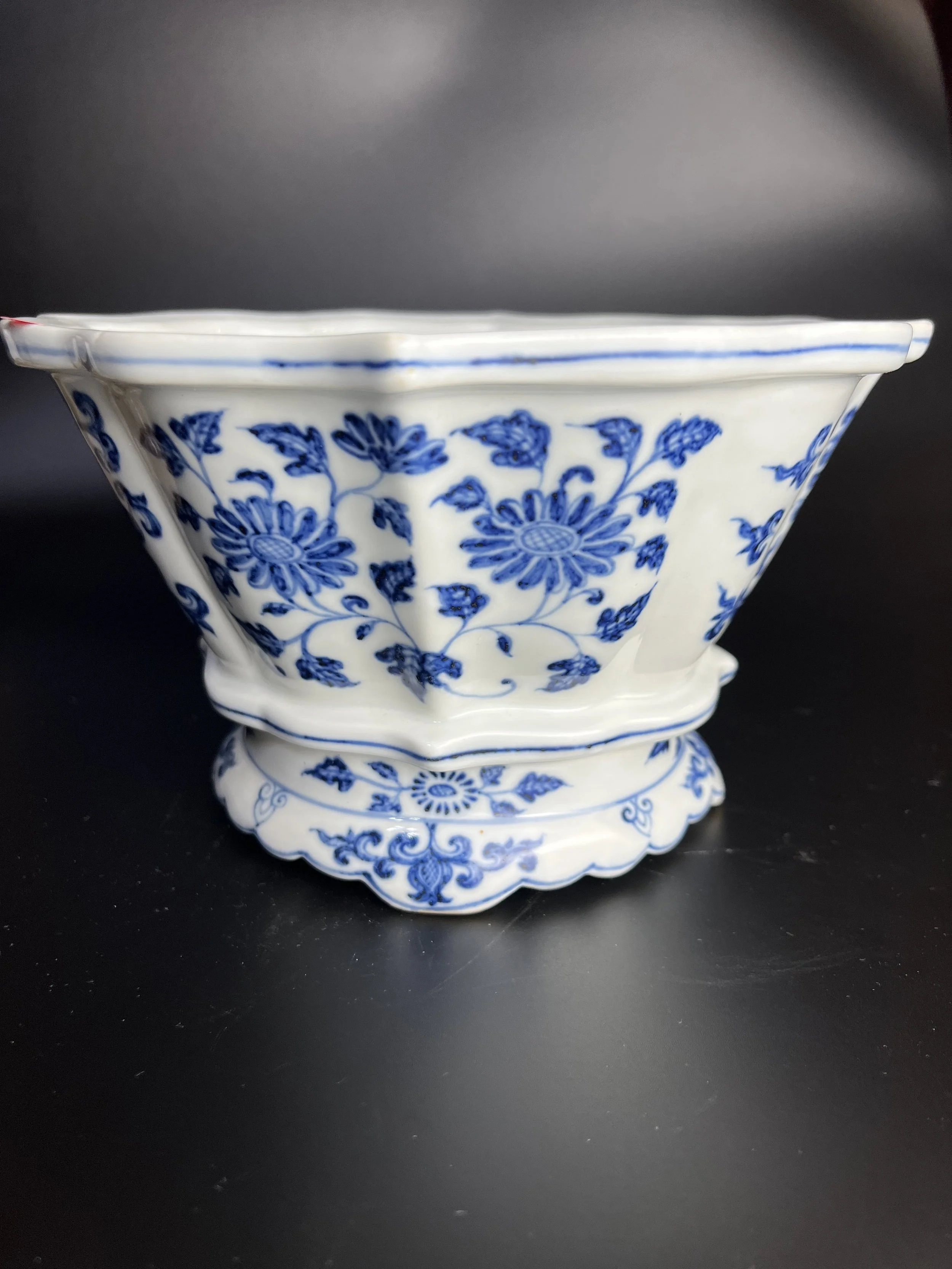 Image 2 of 11
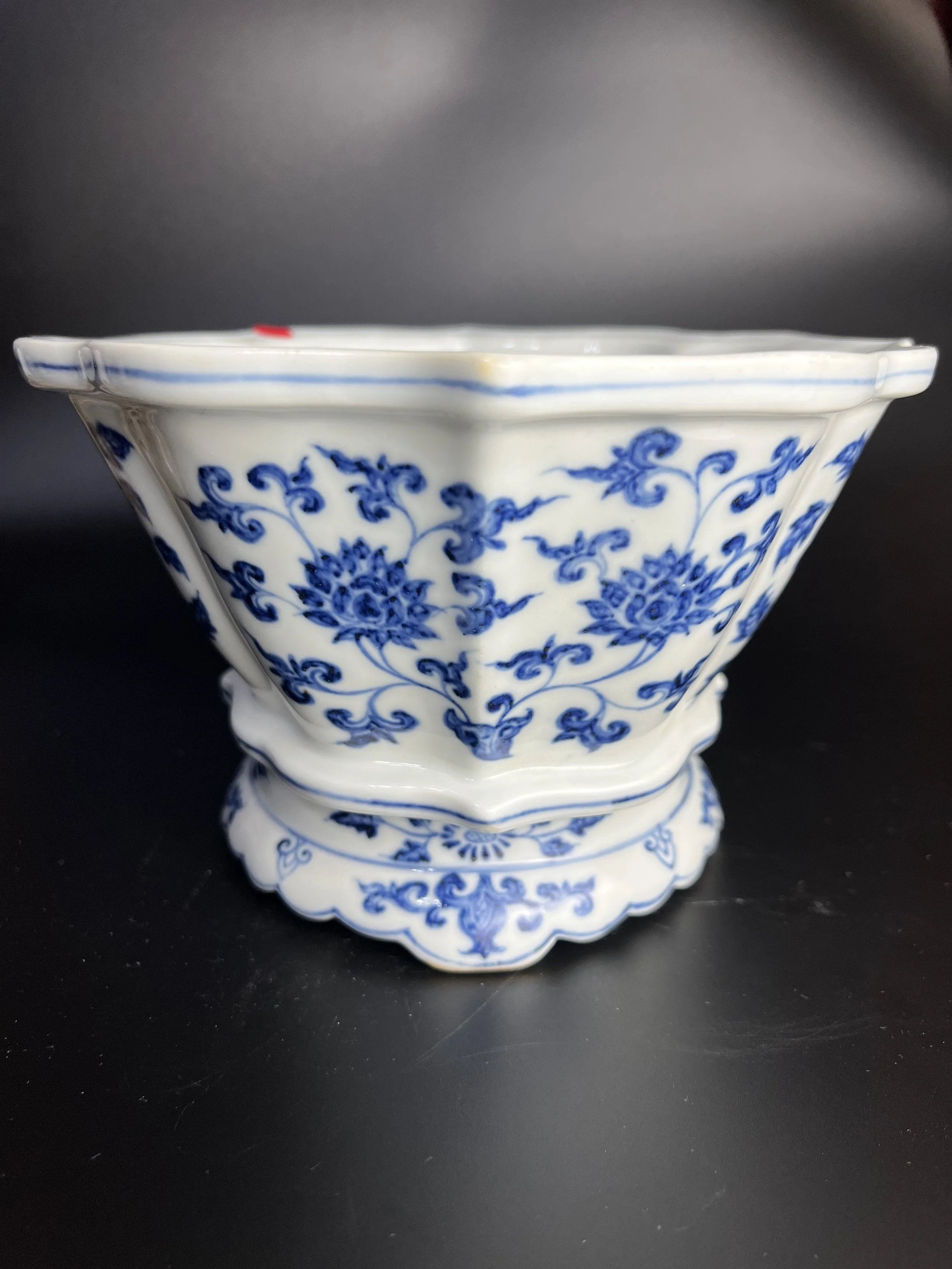 Image 3 of 11
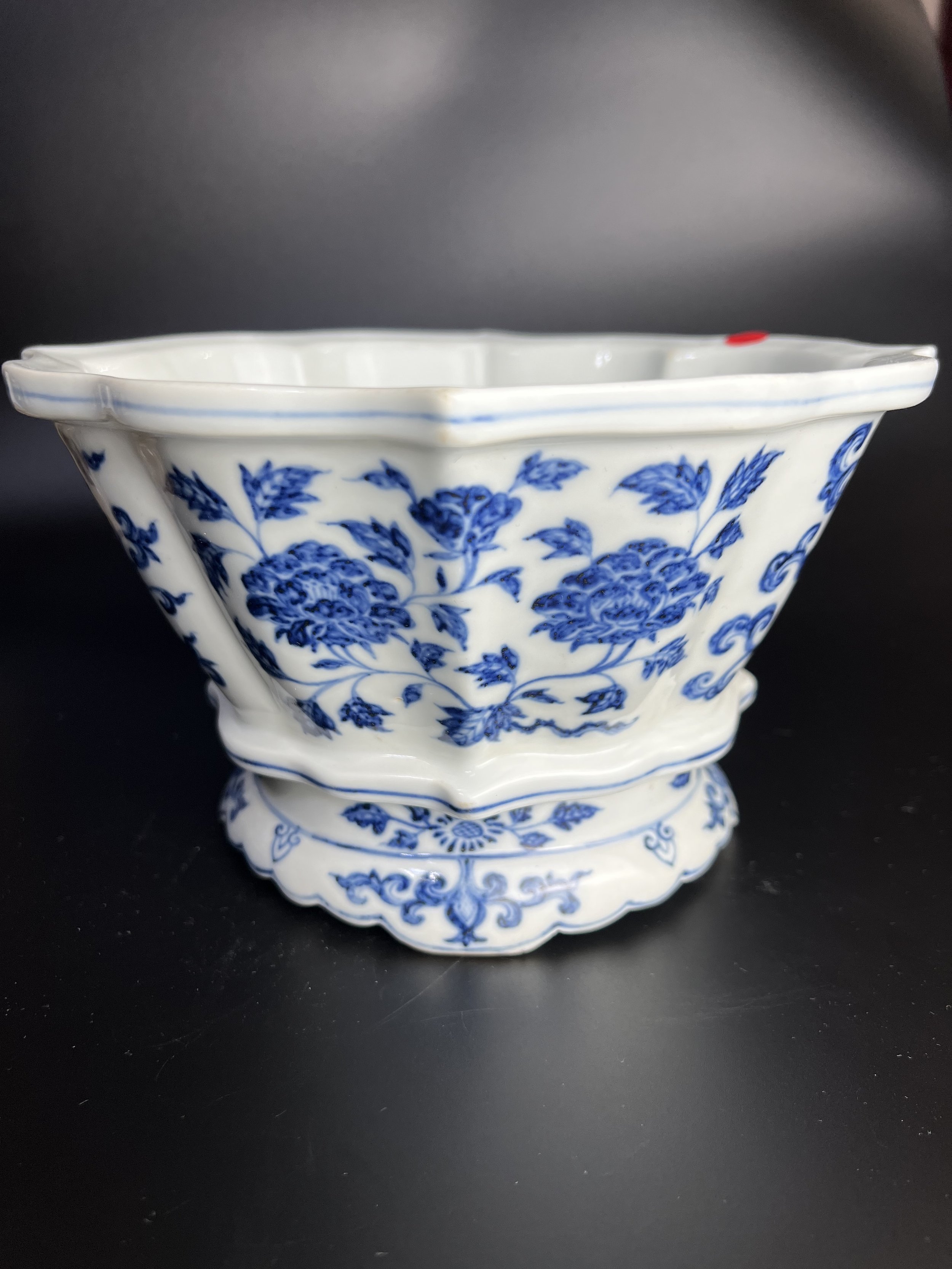 Image 4 of 11
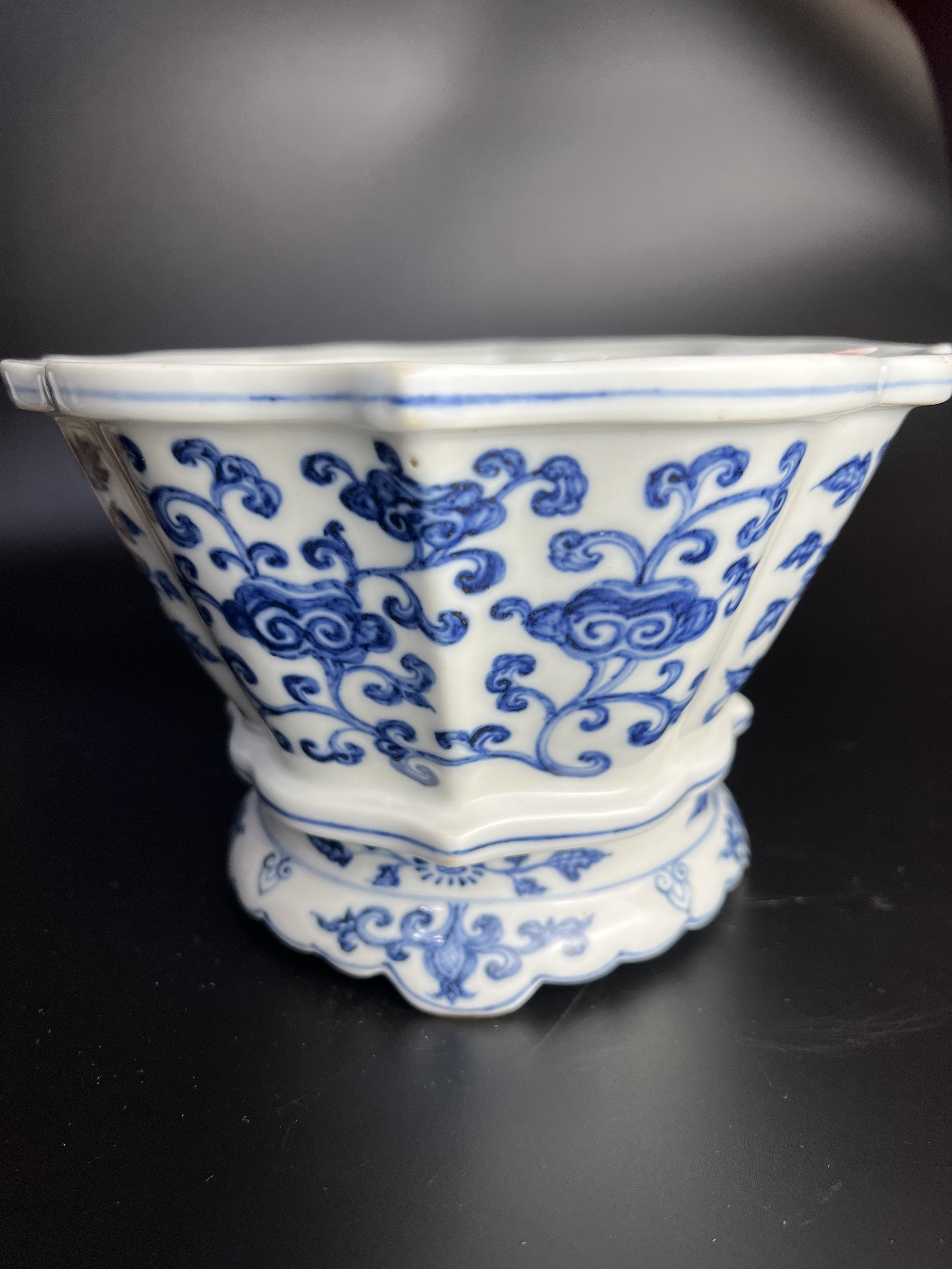 Image 5 of 11
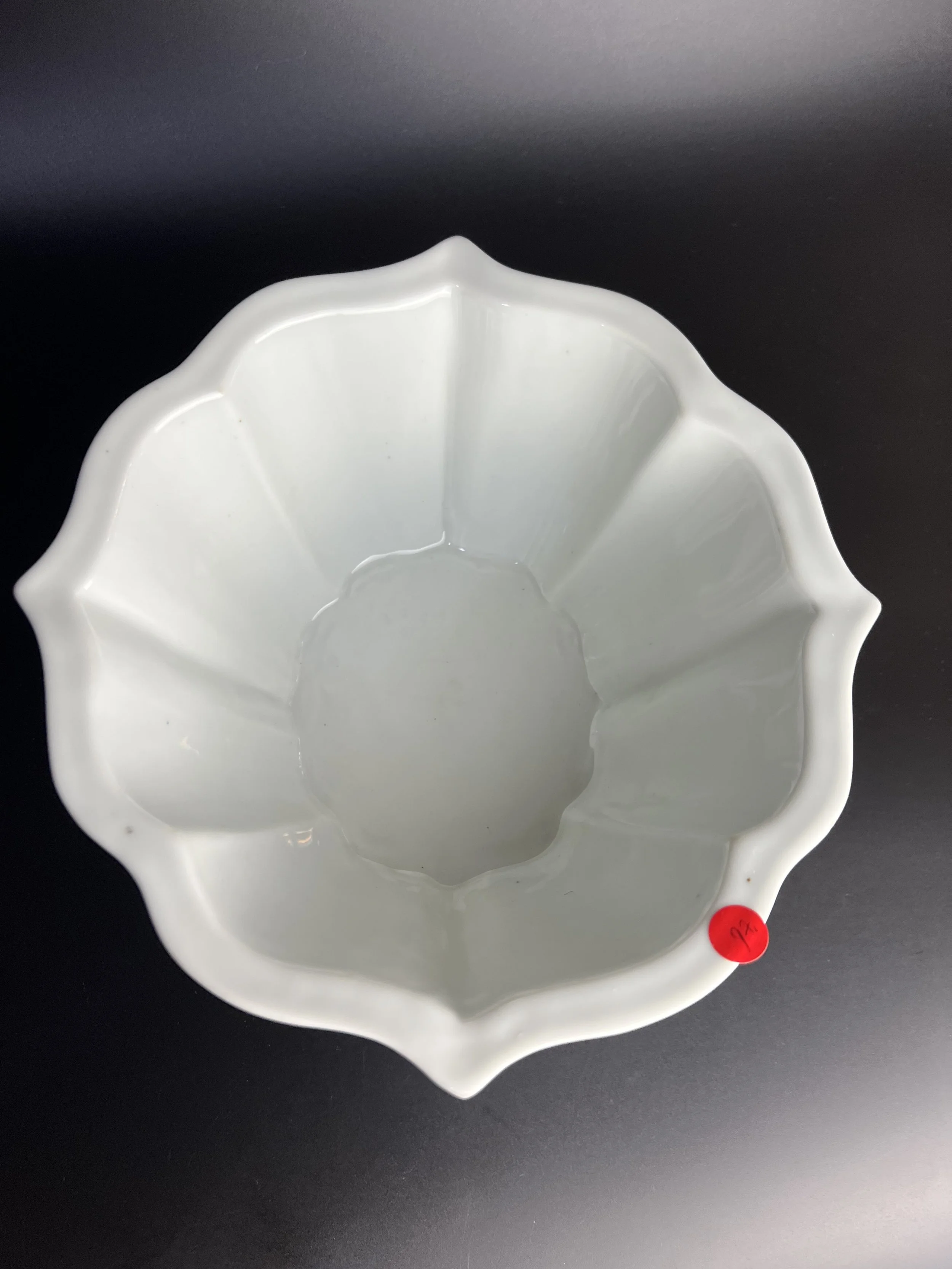 Image 6 of 11
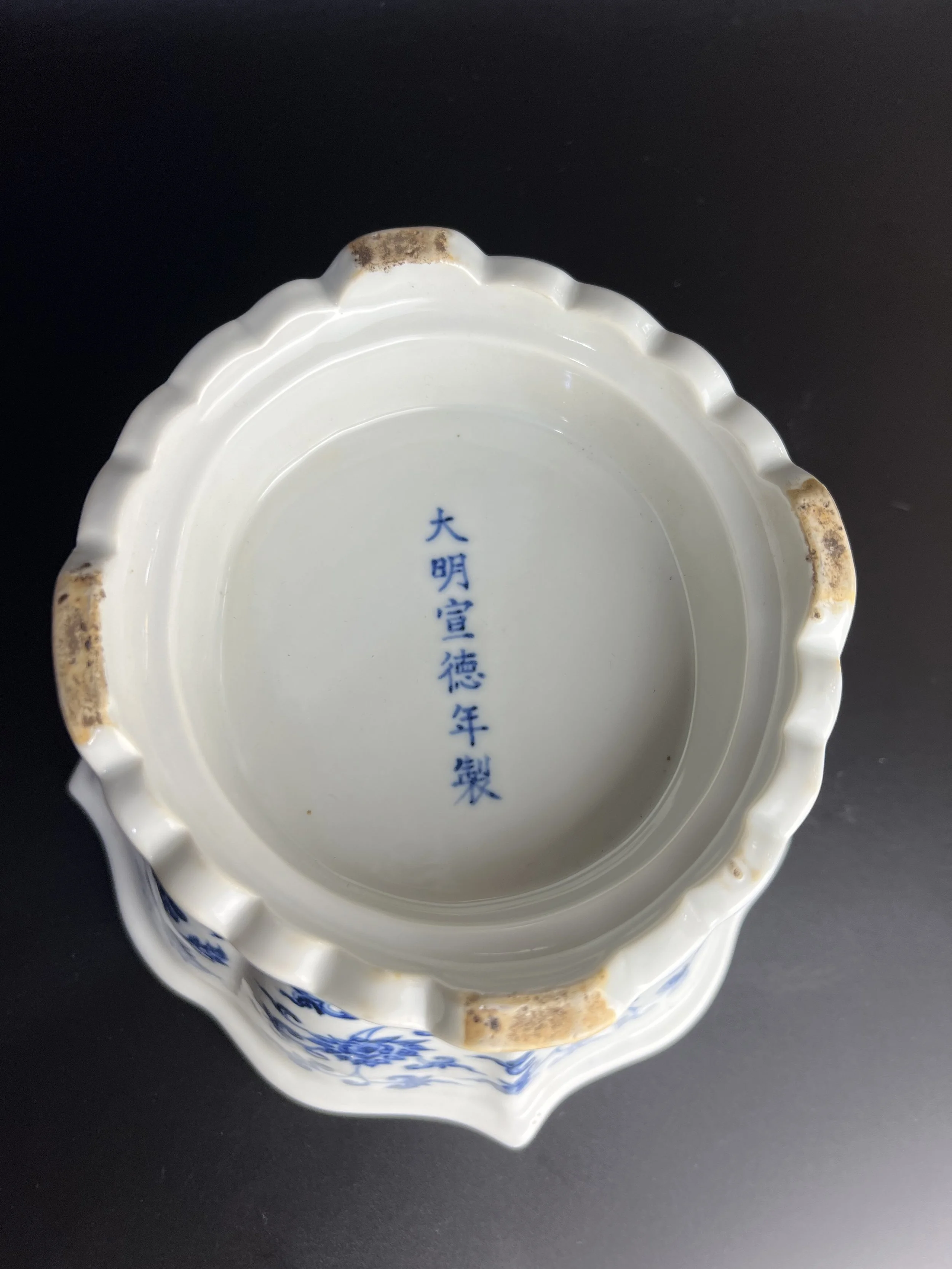 Image 7 of 11
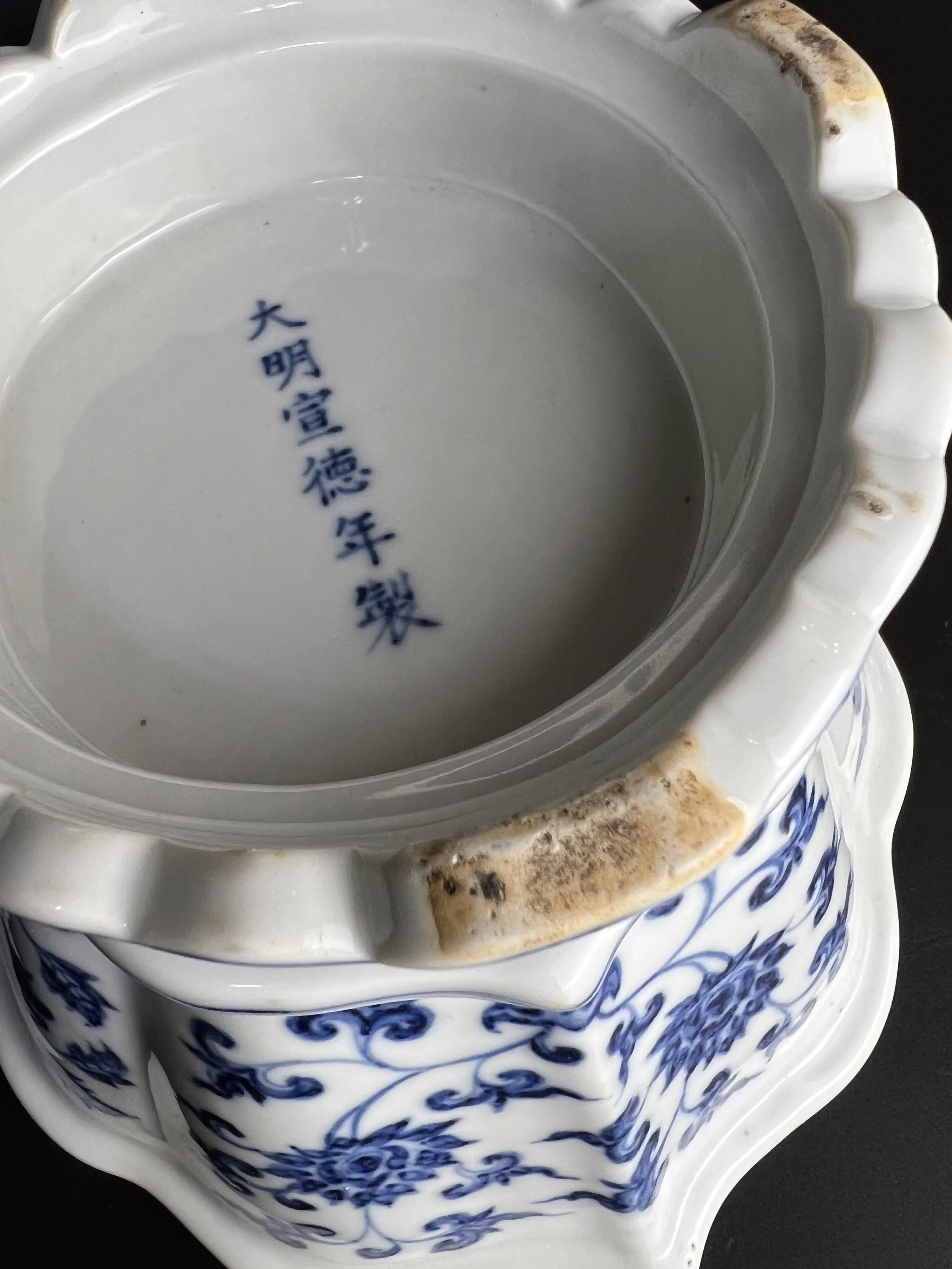 Image 8 of 11
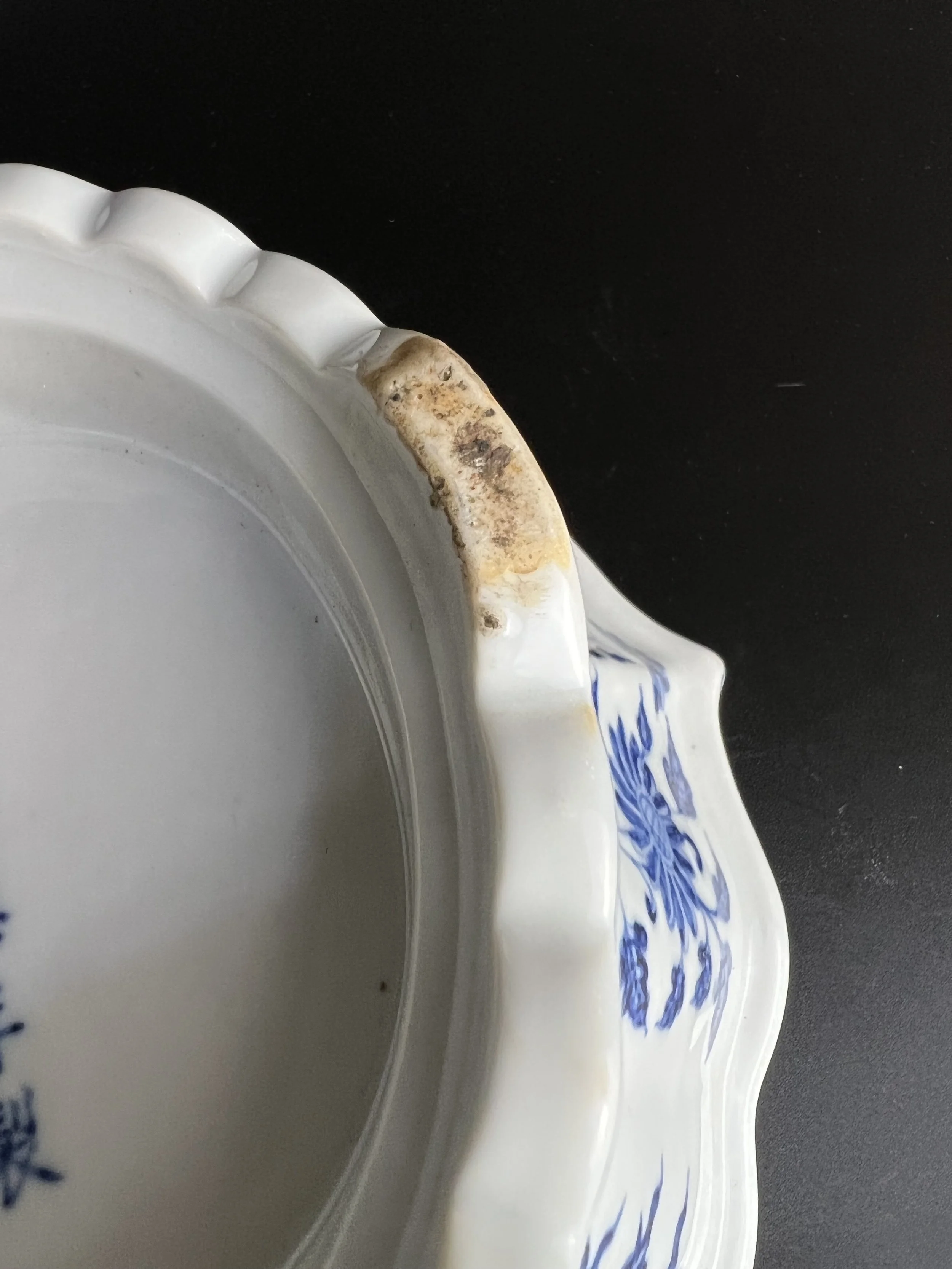 Image 9 of 11
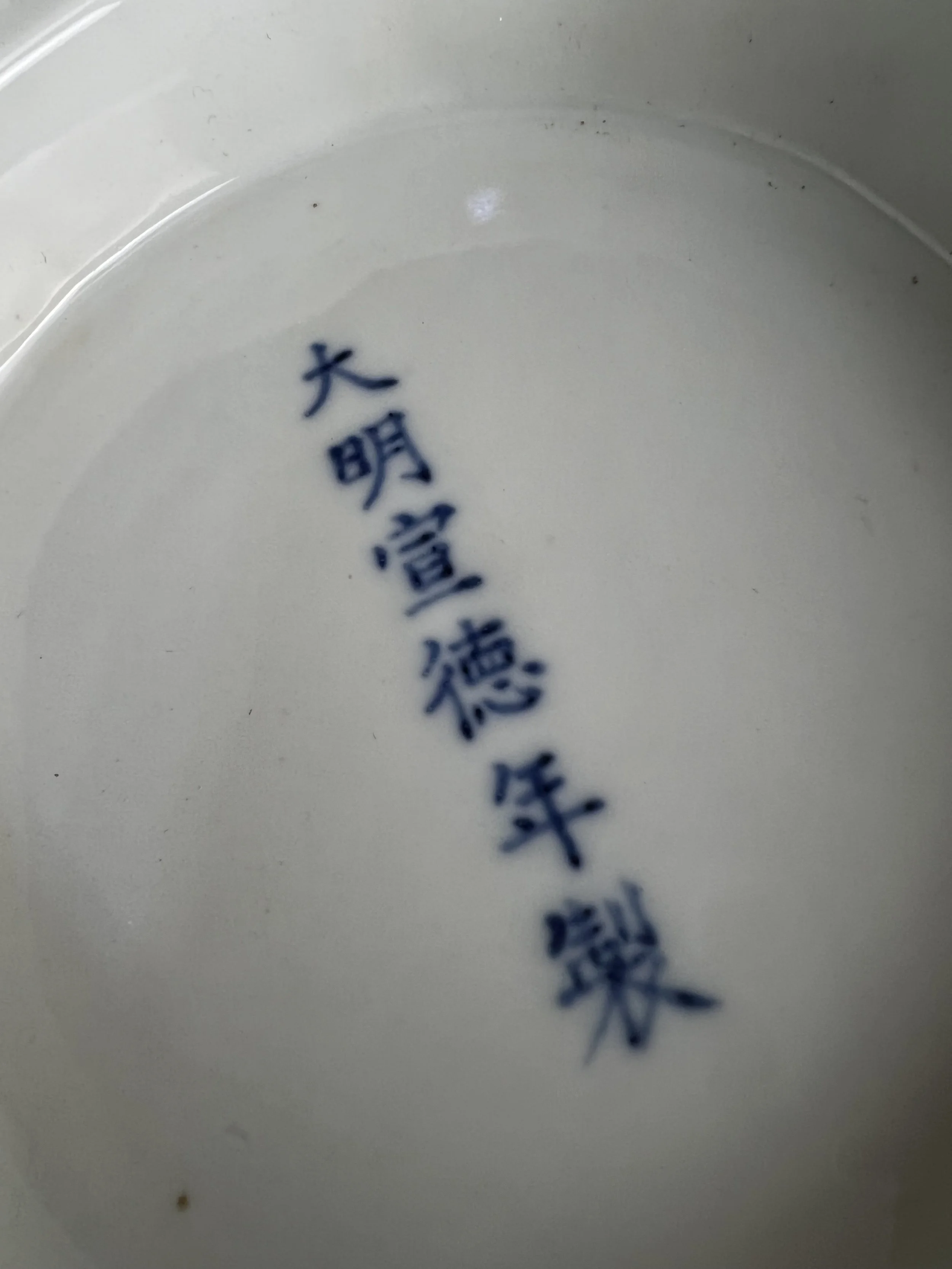 Image 10 of 11
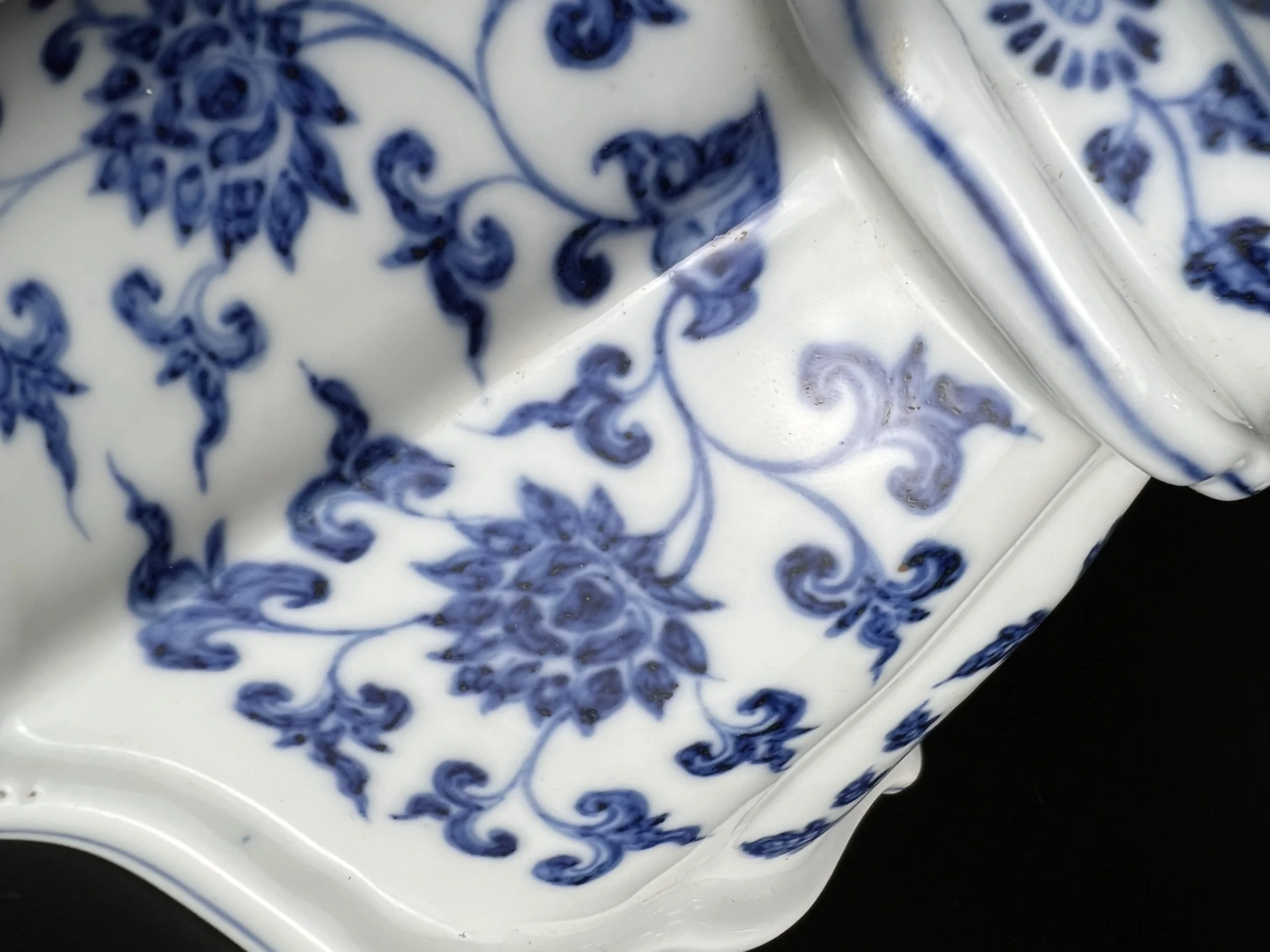 Image 11 of 11
A Blue-and-White Begonia-Shaped Flowerpot with Interlocking Floral Scrolls, Xuande Mark and Period
Overview
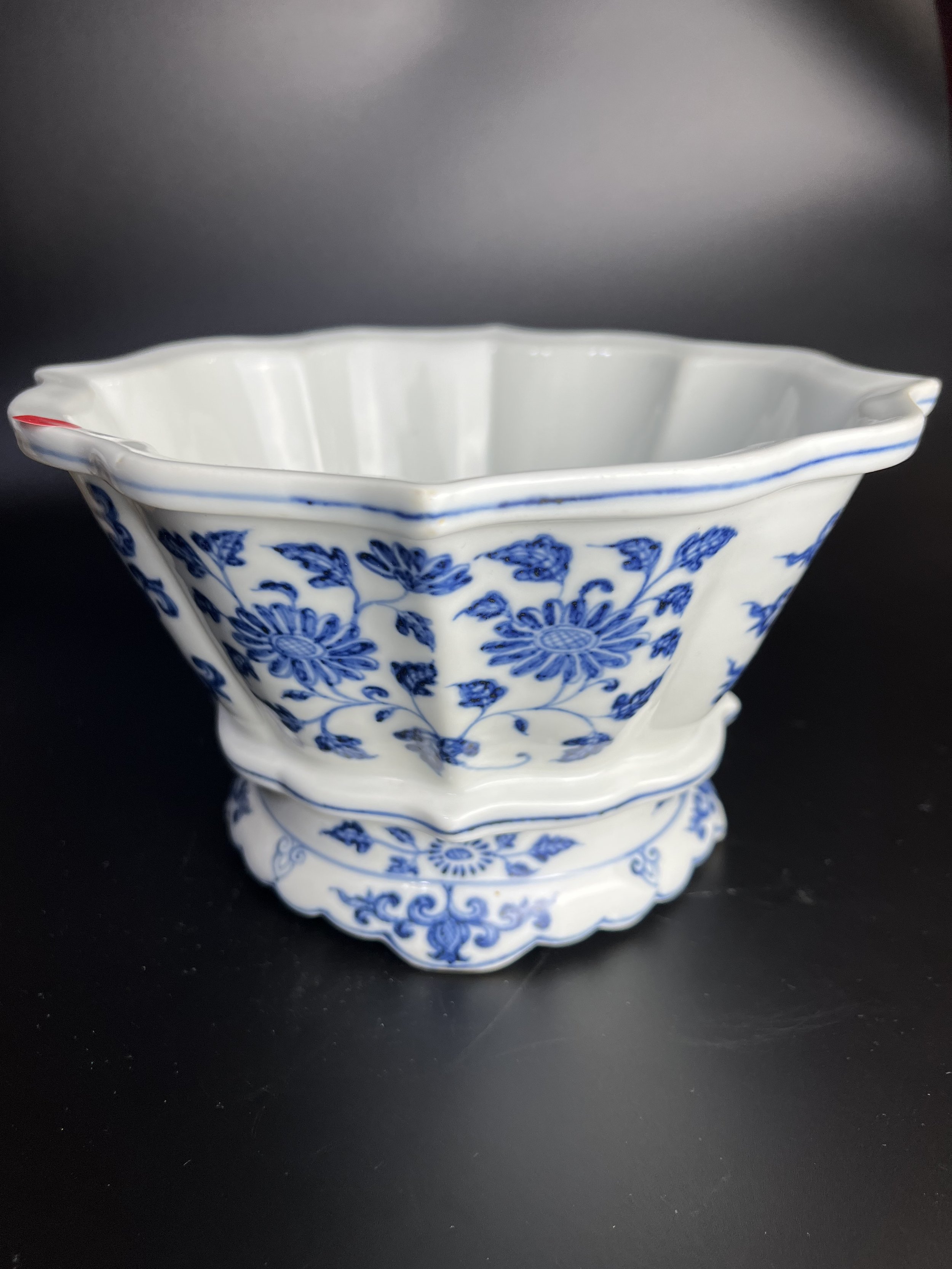
This blue-and-white begonia-shaped flowerpot with interlocking floral scrolls, bearing the Xuande six-character mark, is 14 cm in height and 20 cm in diameter. It is a classic example of Xuande imperial blue-and-white ware, serving both decorative and practical purposes. Its form is distinctive, modeled after the four-lobed begonia flower shape, featuring an eight-lobed, foliated rim (lingkou) that is both stable and exquisite. The entire vessel is painted in imported 'Sumali' blue with interlocking lotus, peony, chrysanthemum, and ruyi cloud-head motifs. The decoration is dense yet orderly, executed with powerful and unrestrained brushwork. The blue is rich and vibrant with prominent 'iron-rust' speckles, and the glaze is lustrous and moist. The unique foot design combines the supreme craftsmanship, signature cobalt-blue hue, and ingenious form characteristic of Xuande imperial kilns, making it an exceptionally rare and treasured example of Xuande floral vessels.
I. Overview of Core Characteristics
Feature DimensionSpecific DescriptionObject DesignationBlue-and-White Begonia-Shaped Flowerpot with Interlocking Floral Scrolls, Xuande mark and periodHistorical PeriodMing Dynasty, Xuande reign (1426-1435 AD)DimensionsHeight: approx. 14 cm, Diameter: approx. 20 cmBasic FormBegonia-shaped (haitangshi): The top view shows a four-lobed begonia flower form. The rim is an eight-lobed, foliated, and everted type, commonly called a 'begonia mouth' (haitangkou). The body follows this lobed form, with deep sides and a ring foot. The elegant shape originates from similar Jun ware vessels of the Song dynasty.Foot CharacteristicsRing Foot: The base consists of a broad, thick ring foot for stable placement. Most uniquely, the underside of the foot ring bears four distinct, spur-like protrusions or 'resting points'. These may be traces from spur supports during firing or a deliberate design feature, intended to prevent the fully-glazed foot from sticking to the kiln shelf during firing and to ensure a steady, level stance.Decorative LayoutThe exterior is fully covered with interlocking floral scrolls. The primary flowers are lotus, peony, and chrysanthemum, interspersed with ruyi (wish-granting) cloud-head motifs. The patterns are linked by graceful, turning scrolls, creating a design that is dense yet orderly, with clear layers. The interior and rim may be decorated with simpler scroll or wave patterns.Cobalt-blue HueUses imported 'Sumali' blue pigment. The color is rich, vibrant翠 (emerald-greenish blue), with a purplish tinge. Areas of heavy application show 'iron-rust speckles' that sink into the body, accompanied by a distinct 'diffusion' effect. These are typical early Xuande blue-and-white characteristics.Glaze and BodyThe glaze is thick, lustrous, and moist, white with a bluish cast ('bright blue glaze' texture). The body is substantial, heavy, and solid, with a fine texture. 'Fiery red' (huoshi hong) spots are visible on unglazed areas.MarkThe base center bears the underglaze-blue six-character mark "Da Ming Xuande Nian Zhi" in a single horizontal line of regular script (kaishu), without borders. The calligraphy is neat and vigorous. This single-line horizontal arrangement is a relatively rare style among Xuande imperial marks, making it highly distinctive.
II. In-Depth Analysis of Artistry and Craftsmanship
1. Exquisite and Elegant Form with Practical Design
Begonia-Mouth Form: The biomimetic design, modeled after a begonia flower, elevates this flowerpot beyond a simple circular shape. Its varied lines make it visually more delicate and elegant. The eight-lobed, foliated rim adds three-dimensionality and decorative appeal, reflecting the imperial pursuit of formal beauty in utensils.
Unique Foot Construction: The four resting points on the foot base are a significant technical hallmark of this pot. This likely results from using a "spur-support firing" method, allowing the foot rim to be fully glazed (enhancing aesthetics) while preventing it from fusing to the kiln furniture. It demonstrates the Xuande kiln artisans' superior ingenuity in solving firing challenges for complex forms. This feature is often overlooked or incorrectly rendered in later imitations.
2. Opulent and Grand Decoration and Painting
Motif Combination: Lotus (purity), peony (wealth and honor), and chrysanthemum (longevity) form the most common floral trio in Ming imperial ware, symbolizing "eternal spring" and "wealth and longevity." Combined with ruyi cloud-heads, the auspicious meaning is further enhanced. The continuous interlocking scrolls symbolize "endless regeneration."
Painting Style: The painter employed a technique emphasizing both delicate outlining and washes. The floral outlines are fluid and powerful, the leaves turn naturally, and the color filling is precise. The natural diffusion of the Sumali blue creates a misty, ink-wash ambiance at the edges of the patterns, imparting a sense of ink-play artistry within the overall neatness. This embodies the Xuande period style that balances robust strength with洒脱 (unrestrained) vitality.
3. Signature Xuande Blue-and-White Characteristics
The cobalt-blue color is the core authentication point. This flowerpot's blue should exhibit typical Sumali traits:
Rich with a Purplish Tinge: A sapphire-like, brilliant, and eye-catching blue.
'Iron-Rust Speckles' and Metallic Sheen: Where brushstrokes are heavy or converge, iron particles in the pigment crystallize, forming sunken, blackish-brown speckles with a metallic, tin-like sheen when viewed obliquely; they are palpable to the touch.
Natural Diffusion: A hazy, ink-wash-like bleeding effect at the edges of lines creates rich tonal layers.
4. Rare Single-Line Horizontal Mark
While it is said that "Xuande reign marks appear all over the vessel," most are six-character marks in two vertical columns within double circles or square frames. The six-character single-line horizontal arrangement on this pot's base is extremely rare, representing a special category among Xuande marks. Its calligraphic style retains the浑厚有力 (vigorous and powerful) character of Xuande marks, serving as a key criterion for assessing its authenticity and rank.
III. Historical Context and Usage
Reflection of Imperial Horticultural Taste: This flowerpot, with its moderate size and elegant form, was certainly not intended for common use. It was likely an imperial vessel used in the Forbidden City or imperial gardens for cultivating seasonal flowers or penjing (miniature landscapes). It is direct evidence of the refined courtly life and horticultural pursuits of the Xuande period, elevating a practical function to the level of artistic display.
Microcosm of Xuande Aesthetics and Craftsmanship: This pot combines biomimetic design (begonia mouth), complex forming techniques (eight-lobed rim), top-quality cobalt (Sumali blue), classic decoration (interlocking florals), and a special mark into one object. It can be considered a concentrated showcase of the technical and artistic achievements of Xuande imperial kilns. Its historical and artistic value far surpasses that of ordinary bowls and dishes.
Rarity and Preciousness: Xuande imperial flowerpots are themselves extremely rare among surviving works. Those with a clear reign mark, in excellent condition, and with distinct features are even rarer. The unique form and mark of this flowerpot make it an important physical artifact for studying the diversity of Xuande imperial kiln production and court life utensils.
IV. Authentication Key Points
Such important vessels have many later imitations. Authentication requires careful attention to detail:
Form and Base: Genuine pieces have流畅柔和 (fluid and soft) begonia-mouth lines and symmetrical, neat lobes. The four resting points should appear natural, with signs of old wear. Imitations often have stiff forms, and the points appear contrived or are missing.
Cobalt Blue and 'Iron-Rust Speckles': Originals show natural diffusion; the 'iron-rust speckles' are sunken beneath the glaze and randomly distributed. Imitations often have生硬 (stiff) diffusion, and the speckles are mostly artificially applied, sitting on the surface.
Decoration and Brushwork Spirit: Originals exhibit酣畅淋漓 (free and easy) painting with powerful, turning scrolls. Imitations often have拘谨 (constrained) brushwork,绵软 (weak) lines, and lack vital spirit.
Mark Comparison: The font, strokes, and spacing of the "Da Ming Xuande Nian Zhi" single-line mark must be carefully compared with standard examples in museum collections. Imitation marks often lack the proper spirit, with软弱 (feeble) brushstrokes.
Body, Glaze, and Aging: Originals have a heavy body, a温润 (warm and moist) glaze surface, and signs of natural aging. Imitations may have bodies that are too light or heavy, with glazes that are either too bright ('brassy') or artificially aged in an unnatural manner.
Conclusion
This Xuande blue-and-white begonia-shaped flowerpot is not merely a courtly vessel for gardening; it is an artistic sculpture承载 (carrying) the essential craftsmanship and aesthetic ideals of the Xuande heyday. Its unique begonia form, rich and沉稳 (steady) blue, opulent yet orderly decoration, and the nearly singular example of a single-line horizontal mark together establish its irreplaceable rarity. It silently speaks of the meticulously nurtured spring colors within the Ming palace six hundred years ago and the awe-inspiring pinnacle that era achieved in the art of ceramics.
明宣德青花缠枝花卉纹海棠式花盆
概述
此件 “大明宣德年制”款青花缠枝花卉纹海棠式花盆,高14厘米,口径20厘米,为明代宣德朝官窑青花之典型陈设器兼实用器。其造型别致,取四出海棠花形,呈八瓣菱口,稳重而精巧。通体以进口“苏麻离青”料绘制缠枝莲花、牡丹、菊花及如意云头纹,纹饰繁密有序,笔法洒脱有力,青花发色浓艳,铁锈斑明显,釉面肥润,底足设计独特,集宣德官窑顶级工艺、标志性青花发色与精妙造型于一体,是极为罕见的宣德御窑花器珍品。
一、 核心特征总览
特征维度具体描述器物定名明宣德 青花缠枝花卉纹海棠式花盆历史年代明宣德时期(1426-1435年)器物尺寸高约14厘米,口径约20厘米。基本器型海棠式:俯视呈四出海棠花形,口沿作八瓣菱花式折沿,俗称“海棠口”。器身随形起伏,深腹,下承圈足。造型源于宋代钧窑同类器,典雅秀逸。足部特征圈足:底足为宽厚圈足,着地平稳。最为独特的是,圈足底部带有四个明显的支钉状凸起点,或为垫烧痕迹,亦为刻意设计,旨在防止圈足满釉烧结时粘连垫饼,并确保放置平稳。纹饰布局外壁满绘缠枝花卉纹,主要花卉为莲花、牡丹、菊花,间饰如意云头纹。图案以婉转流畅的缠枝串连,布局繁而不乱,层次分明。内壁及口沿或饰以简略的卷草纹或浪花纹。青花发色使用进口“苏麻离青”料,发色浓艳青翠,蓝中泛紫,色浓处铁锈斑深入胎骨,并伴有明显的“晕散”效果,为典型宣德早期青花特征。釉面胎质釉面肥厚莹润,白中闪青,呈“亮青釉”质感。胎体厚重坚实,胎质细腻,露胎处可见火石红色。款识外底心以青料书 “大明宣德年制” 六字单行楷书款,无边栏。字体工整,笔力遒劲,为宣德官窑款识中较少见的单行横排式样,极具特色。
二、 艺术与工艺深度解析
1. 精巧典雅的造型与实用设计
海棠口造型:仿生海棠花形的设计,使这件花盆脱离了简单的圆形制式,线条富有变化,视觉上更显精巧优雅。八瓣菱口增添了立体感与装饰性,体现了宫廷用器对形式美的极致追求。
独特的足部工艺:圈足底部的四个支点是此盆的重要工艺标志。这可能是采用“支钉垫烧”法的结果,目的是让圈足端面满釉(提高美观度)的同时,避免与窑具粘连,显示了宣德窑工在解决复杂器形烧造难题上的高超智慧。这一特征在后世仿品中常被忽视或处理不当。
2. 富丽磅礴的纹饰与绘画
纹饰组合:莲花(高洁)、牡丹(富贵)、菊花(长寿)是明代官窑最常见的花卉组合,寓意“四季长春”、“富贵长寿”。与如意云头纹结合,更添吉祥含义。缠枝纹连绵不断,寓意“生生不息”。
绘画风格:画工采用小笔触勾勒渲染并重的技法。花卉勾勒线条流畅有力,叶片翻转自然,填色准确。苏麻离青料产生的自然晕散,使花纹边缘如墨韵般氤氲,画面在工整中透露出水墨淋漓的意趣,体现了宣德青花雄健与洒脱并存的时代风格。
3. 标志性的宣德青花特征
青花发色是核心鉴定点。此盆青花应具备典型苏麻离青特征:
浓艳泛紫:色泽如蓝宝石,鲜艳夺目。
铁锈斑与锡光:在纹饰笔触浓重交汇处,青料中的铁元素结晶析出,形成黑褐色、下沉的斑点,侧视有金属锡光,抚之凹凸不平。
自然晕散:线条边缘有水墨画般的晕染效果,层次丰富。
4. 罕见的单行横排款识
宣德官窑款识有“宣德年款遍器身”之说,但多为双行六字楷书竖排,外围双圈或方框。此盆底款的六字单行横排式样极为少见,是宣德款识中的特殊品类。书写风格仍保持宣德款的浑厚有力,是判断其真伪与等级的关键依据。
三、 历史内涵与使用场景
宫廷园艺雅趣的体现:此花盆尺寸适中,造型典雅,绝非民间用器。它应是紫禁城或皇家园林中,用于栽培时令花卉、盆景的御用器皿,是宣德朝宫廷精致生活与园林雅趣的直接见证,将实用功能提升至艺术陈设的高度。
宣德审美与工艺的缩影:此盆融合了仿生造型(海棠口)、复杂成型工艺(八瓣菱口)、顶级青料(苏麻离青)、经典纹饰(缠枝花卉)及特殊款识于一身,堪称宣德官窑技术与艺术成就的集中展示,其历史与艺术价值远超普通碗盘。
存世稀少的珍贵性:宣德御窑花盆类器物本身传世极少,带明确年款且品相完好、特征鲜明者更是凤毛麟角。此件花盆的独特造型与款识,使其成为研究宣德官窑产品多样性及宫廷生活用器的重要实物资料。
四、 鉴藏要点
此类重器后世仿品甚多,鉴藏需从细微处着眼:
造型与足底:真品海棠口线条流畅柔和,八瓣对称工整。四个支点应自然、磨损痕迹老旧。仿品造型常显呆板,支点做作或缺失。
青花与铁锈斑:真品青花晕散自然,铁锈斑沉入釉下,分布随机。仿品晕散生硬,铁锈斑多为人工点染,浮于表面。
纹饰笔意:真品绘画酣畅淋漓,缠枝婉转有力。仿品笔法拘谨,线条绵软,缺乏神韵。
款识比对:“大明宣德年制”单行款的字体、笔划、间距需与馆藏标准器仔细比对。仿款字形多失其神,笔力软弱。
胎釉与老化:真品胎骨厚重,釉面温润,有自然老旧痕迹。仿品胎体或轻或过重,釉面火光未褪或做旧不自然。
结语
此宣德青花海棠式花盆,不仅是一件用于莳花弄草的宫廷实用器,更是一件承载着宣德盛世工艺精华与美学理想的艺术雕塑。它那独特的海棠造型、浓艳沉着的青花、磅礴而有序的纹饰,以及堪称孤例的单行横排款识,共同构筑了其无可替代的珍罕性。它静静地诉说着六百年前,大明宫廷中那一抹被精心呵护的春色,以及那个时代在陶瓷艺术上所能企及的、令人叹为观止的巅峰境界。
Overview
This blue-and-white begonia-shaped flowerpot with interlocking floral scrolls, bearing the Xuande six-character mark, is 14 cm in height and 20 cm in diameter. It is a classic example of Xuande imperial blue-and-white ware, serving both decorative and practical purposes. Its form is distinctive, modeled after the four-lobed begonia flower shape, featuring an eight-lobed, foliated rim (lingkou) that is both stable and exquisite. The entire vessel is painted in imported 'Sumali' blue with interlocking lotus, peony, chrysanthemum, and ruyi cloud-head motifs. The decoration is dense yet orderly, executed with powerful and unrestrained brushwork. The blue is rich and vibrant with prominent 'iron-rust' speckles, and the glaze is lustrous and moist. The unique foot design combines the supreme craftsmanship, signature cobalt-blue hue, and ingenious form characteristic of Xuande imperial kilns, making it an exceptionally rare and treasured example of Xuande floral vessels.
I. Overview of Core Characteristics
Feature DimensionSpecific DescriptionObject DesignationBlue-and-White Begonia-Shaped Flowerpot with Interlocking Floral Scrolls, Xuande mark and periodHistorical PeriodMing Dynasty, Xuande reign (1426-1435 AD)DimensionsHeight: approx. 14 cm, Diameter: approx. 20 cmBasic FormBegonia-shaped (haitangshi): The top view shows a four-lobed begonia flower form. The rim is an eight-lobed, foliated, and everted type, commonly called a 'begonia mouth' (haitangkou). The body follows this lobed form, with deep sides and a ring foot. The elegant shape originates from similar Jun ware vessels of the Song dynasty.Foot CharacteristicsRing Foot: The base consists of a broad, thick ring foot for stable placement. Most uniquely, the underside of the foot ring bears four distinct, spur-like protrusions or 'resting points'. These may be traces from spur supports during firing or a deliberate design feature, intended to prevent the fully-glazed foot from sticking to the kiln shelf during firing and to ensure a steady, level stance.Decorative LayoutThe exterior is fully covered with interlocking floral scrolls. The primary flowers are lotus, peony, and chrysanthemum, interspersed with ruyi (wish-granting) cloud-head motifs. The patterns are linked by graceful, turning scrolls, creating a design that is dense yet orderly, with clear layers. The interior and rim may be decorated with simpler scroll or wave patterns.Cobalt-blue HueUses imported 'Sumali' blue pigment. The color is rich, vibrant翠 (emerald-greenish blue), with a purplish tinge. Areas of heavy application show 'iron-rust speckles' that sink into the body, accompanied by a distinct 'diffusion' effect. These are typical early Xuande blue-and-white characteristics.Glaze and BodyThe glaze is thick, lustrous, and moist, white with a bluish cast ('bright blue glaze' texture). The body is substantial, heavy, and solid, with a fine texture. 'Fiery red' (huoshi hong) spots are visible on unglazed areas.MarkThe base center bears the underglaze-blue six-character mark "Da Ming Xuande Nian Zhi" in a single horizontal line of regular script (kaishu), without borders. The calligraphy is neat and vigorous. This single-line horizontal arrangement is a relatively rare style among Xuande imperial marks, making it highly distinctive.
II. In-Depth Analysis of Artistry and Craftsmanship
1. Exquisite and Elegant Form with Practical Design
Begonia-Mouth Form: The biomimetic design, modeled after a begonia flower, elevates this flowerpot beyond a simple circular shape. Its varied lines make it visually more delicate and elegant. The eight-lobed, foliated rim adds three-dimensionality and decorative appeal, reflecting the imperial pursuit of formal beauty in utensils.
Unique Foot Construction: The four resting points on the foot base are a significant technical hallmark of this pot. This likely results from using a "spur-support firing" method, allowing the foot rim to be fully glazed (enhancing aesthetics) while preventing it from fusing to the kiln furniture. It demonstrates the Xuande kiln artisans' superior ingenuity in solving firing challenges for complex forms. This feature is often overlooked or incorrectly rendered in later imitations.
2. Opulent and Grand Decoration and Painting
Motif Combination: Lotus (purity), peony (wealth and honor), and chrysanthemum (longevity) form the most common floral trio in Ming imperial ware, symbolizing "eternal spring" and "wealth and longevity." Combined with ruyi cloud-heads, the auspicious meaning is further enhanced. The continuous interlocking scrolls symbolize "endless regeneration."
Painting Style: The painter employed a technique emphasizing both delicate outlining and washes. The floral outlines are fluid and powerful, the leaves turn naturally, and the color filling is precise. The natural diffusion of the Sumali blue creates a misty, ink-wash ambiance at the edges of the patterns, imparting a sense of ink-play artistry within the overall neatness. This embodies the Xuande period style that balances robust strength with洒脱 (unrestrained) vitality.
3. Signature Xuande Blue-and-White Characteristics
The cobalt-blue color is the core authentication point. This flowerpot's blue should exhibit typical Sumali traits:
Rich with a Purplish Tinge: A sapphire-like, brilliant, and eye-catching blue.
'Iron-Rust Speckles' and Metallic Sheen: Where brushstrokes are heavy or converge, iron particles in the pigment crystallize, forming sunken, blackish-brown speckles with a metallic, tin-like sheen when viewed obliquely; they are palpable to the touch.
Natural Diffusion: A hazy, ink-wash-like bleeding effect at the edges of lines creates rich tonal layers.
4. Rare Single-Line Horizontal Mark
While it is said that "Xuande reign marks appear all over the vessel," most are six-character marks in two vertical columns within double circles or square frames. The six-character single-line horizontal arrangement on this pot's base is extremely rare, representing a special category among Xuande marks. Its calligraphic style retains the浑厚有力 (vigorous and powerful) character of Xuande marks, serving as a key criterion for assessing its authenticity and rank.
III. Historical Context and Usage
Reflection of Imperial Horticultural Taste: This flowerpot, with its moderate size and elegant form, was certainly not intended for common use. It was likely an imperial vessel used in the Forbidden City or imperial gardens for cultivating seasonal flowers or penjing (miniature landscapes). It is direct evidence of the refined courtly life and horticultural pursuits of the Xuande period, elevating a practical function to the level of artistic display.
Microcosm of Xuande Aesthetics and Craftsmanship: This pot combines biomimetic design (begonia mouth), complex forming techniques (eight-lobed rim), top-quality cobalt (Sumali blue), classic decoration (interlocking florals), and a special mark into one object. It can be considered a concentrated showcase of the technical and artistic achievements of Xuande imperial kilns. Its historical and artistic value far surpasses that of ordinary bowls and dishes.
Rarity and Preciousness: Xuande imperial flowerpots are themselves extremely rare among surviving works. Those with a clear reign mark, in excellent condition, and with distinct features are even rarer. The unique form and mark of this flowerpot make it an important physical artifact for studying the diversity of Xuande imperial kiln production and court life utensils.
IV. Authentication Key Points
Such important vessels have many later imitations. Authentication requires careful attention to detail:
Form and Base: Genuine pieces have流畅柔和 (fluid and soft) begonia-mouth lines and symmetrical, neat lobes. The four resting points should appear natural, with signs of old wear. Imitations often have stiff forms, and the points appear contrived or are missing.
Cobalt Blue and 'Iron-Rust Speckles': Originals show natural diffusion; the 'iron-rust speckles' are sunken beneath the glaze and randomly distributed. Imitations often have生硬 (stiff) diffusion, and the speckles are mostly artificially applied, sitting on the surface.
Decoration and Brushwork Spirit: Originals exhibit酣畅淋漓 (free and easy) painting with powerful, turning scrolls. Imitations often have拘谨 (constrained) brushwork,绵软 (weak) lines, and lack vital spirit.
Mark Comparison: The font, strokes, and spacing of the "Da Ming Xuande Nian Zhi" single-line mark must be carefully compared with standard examples in museum collections. Imitation marks often lack the proper spirit, with软弱 (feeble) brushstrokes.
Body, Glaze, and Aging: Originals have a heavy body, a温润 (warm and moist) glaze surface, and signs of natural aging. Imitations may have bodies that are too light or heavy, with glazes that are either too bright ('brassy') or artificially aged in an unnatural manner.
Conclusion
This Xuande blue-and-white begonia-shaped flowerpot is not merely a courtly vessel for gardening; it is an artistic sculpture承载 (carrying) the essential craftsmanship and aesthetic ideals of the Xuande heyday. Its unique begonia form, rich and沉稳 (steady) blue, opulent yet orderly decoration, and the nearly singular example of a single-line horizontal mark together establish its irreplaceable rarity. It silently speaks of the meticulously nurtured spring colors within the Ming palace six hundred years ago and the awe-inspiring pinnacle that era achieved in the art of ceramics.
明宣德青花缠枝花卉纹海棠式花盆
概述
此件 “大明宣德年制”款青花缠枝花卉纹海棠式花盆,高14厘米,口径20厘米,为明代宣德朝官窑青花之典型陈设器兼实用器。其造型别致,取四出海棠花形,呈八瓣菱口,稳重而精巧。通体以进口“苏麻离青”料绘制缠枝莲花、牡丹、菊花及如意云头纹,纹饰繁密有序,笔法洒脱有力,青花发色浓艳,铁锈斑明显,釉面肥润,底足设计独特,集宣德官窑顶级工艺、标志性青花发色与精妙造型于一体,是极为罕见的宣德御窑花器珍品。
一、 核心特征总览
特征维度具体描述器物定名明宣德 青花缠枝花卉纹海棠式花盆历史年代明宣德时期(1426-1435年)器物尺寸高约14厘米,口径约20厘米。基本器型海棠式:俯视呈四出海棠花形,口沿作八瓣菱花式折沿,俗称“海棠口”。器身随形起伏,深腹,下承圈足。造型源于宋代钧窑同类器,典雅秀逸。足部特征圈足:底足为宽厚圈足,着地平稳。最为独特的是,圈足底部带有四个明显的支钉状凸起点,或为垫烧痕迹,亦为刻意设计,旨在防止圈足满釉烧结时粘连垫饼,并确保放置平稳。纹饰布局外壁满绘缠枝花卉纹,主要花卉为莲花、牡丹、菊花,间饰如意云头纹。图案以婉转流畅的缠枝串连,布局繁而不乱,层次分明。内壁及口沿或饰以简略的卷草纹或浪花纹。青花发色使用进口“苏麻离青”料,发色浓艳青翠,蓝中泛紫,色浓处铁锈斑深入胎骨,并伴有明显的“晕散”效果,为典型宣德早期青花特征。釉面胎质釉面肥厚莹润,白中闪青,呈“亮青釉”质感。胎体厚重坚实,胎质细腻,露胎处可见火石红色。款识外底心以青料书 “大明宣德年制” 六字单行楷书款,无边栏。字体工整,笔力遒劲,为宣德官窑款识中较少见的单行横排式样,极具特色。
二、 艺术与工艺深度解析
1. 精巧典雅的造型与实用设计
海棠口造型:仿生海棠花形的设计,使这件花盆脱离了简单的圆形制式,线条富有变化,视觉上更显精巧优雅。八瓣菱口增添了立体感与装饰性,体现了宫廷用器对形式美的极致追求。
独特的足部工艺:圈足底部的四个支点是此盆的重要工艺标志。这可能是采用“支钉垫烧”法的结果,目的是让圈足端面满釉(提高美观度)的同时,避免与窑具粘连,显示了宣德窑工在解决复杂器形烧造难题上的高超智慧。这一特征在后世仿品中常被忽视或处理不当。
2. 富丽磅礴的纹饰与绘画
纹饰组合:莲花(高洁)、牡丹(富贵)、菊花(长寿)是明代官窑最常见的花卉组合,寓意“四季长春”、“富贵长寿”。与如意云头纹结合,更添吉祥含义。缠枝纹连绵不断,寓意“生生不息”。
绘画风格:画工采用小笔触勾勒渲染并重的技法。花卉勾勒线条流畅有力,叶片翻转自然,填色准确。苏麻离青料产生的自然晕散,使花纹边缘如墨韵般氤氲,画面在工整中透露出水墨淋漓的意趣,体现了宣德青花雄健与洒脱并存的时代风格。
3. 标志性的宣德青花特征
青花发色是核心鉴定点。此盆青花应具备典型苏麻离青特征:
浓艳泛紫:色泽如蓝宝石,鲜艳夺目。
铁锈斑与锡光:在纹饰笔触浓重交汇处,青料中的铁元素结晶析出,形成黑褐色、下沉的斑点,侧视有金属锡光,抚之凹凸不平。
自然晕散:线条边缘有水墨画般的晕染效果,层次丰富。
4. 罕见的单行横排款识
宣德官窑款识有“宣德年款遍器身”之说,但多为双行六字楷书竖排,外围双圈或方框。此盆底款的六字单行横排式样极为少见,是宣德款识中的特殊品类。书写风格仍保持宣德款的浑厚有力,是判断其真伪与等级的关键依据。
三、 历史内涵与使用场景
宫廷园艺雅趣的体现:此花盆尺寸适中,造型典雅,绝非民间用器。它应是紫禁城或皇家园林中,用于栽培时令花卉、盆景的御用器皿,是宣德朝宫廷精致生活与园林雅趣的直接见证,将实用功能提升至艺术陈设的高度。
宣德审美与工艺的缩影:此盆融合了仿生造型(海棠口)、复杂成型工艺(八瓣菱口)、顶级青料(苏麻离青)、经典纹饰(缠枝花卉)及特殊款识于一身,堪称宣德官窑技术与艺术成就的集中展示,其历史与艺术价值远超普通碗盘。
存世稀少的珍贵性:宣德御窑花盆类器物本身传世极少,带明确年款且品相完好、特征鲜明者更是凤毛麟角。此件花盆的独特造型与款识,使其成为研究宣德官窑产品多样性及宫廷生活用器的重要实物资料。
四、 鉴藏要点
此类重器后世仿品甚多,鉴藏需从细微处着眼:
造型与足底:真品海棠口线条流畅柔和,八瓣对称工整。四个支点应自然、磨损痕迹老旧。仿品造型常显呆板,支点做作或缺失。
青花与铁锈斑:真品青花晕散自然,铁锈斑沉入釉下,分布随机。仿品晕散生硬,铁锈斑多为人工点染,浮于表面。
纹饰笔意:真品绘画酣畅淋漓,缠枝婉转有力。仿品笔法拘谨,线条绵软,缺乏神韵。
款识比对:“大明宣德年制”单行款的字体、笔划、间距需与馆藏标准器仔细比对。仿款字形多失其神,笔力软弱。
胎釉与老化:真品胎骨厚重,釉面温润,有自然老旧痕迹。仿品胎体或轻或过重,釉面火光未褪或做旧不自然。
结语
此宣德青花海棠式花盆,不仅是一件用于莳花弄草的宫廷实用器,更是一件承载着宣德盛世工艺精华与美学理想的艺术雕塑。它那独特的海棠造型、浓艳沉着的青花、磅礴而有序的纹饰,以及堪称孤例的单行横排款识,共同构筑了其无可替代的珍罕性。它静静地诉说着六百年前,大明宫廷中那一抹被精心呵护的春色,以及那个时代在陶瓷艺术上所能企及的、令人叹为观止的巅峰境界。