 Image 1 of 10
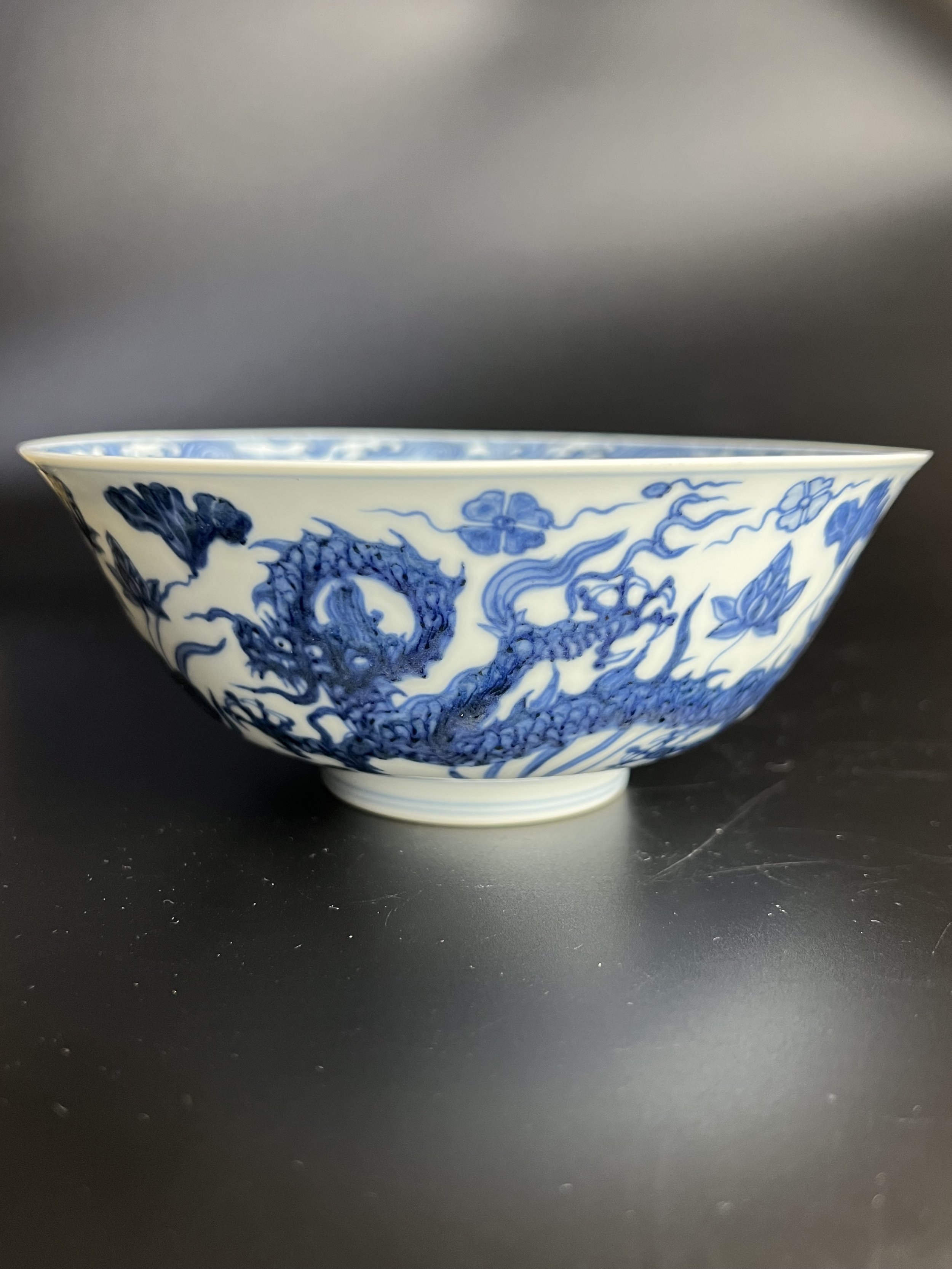 Image 2 of 10
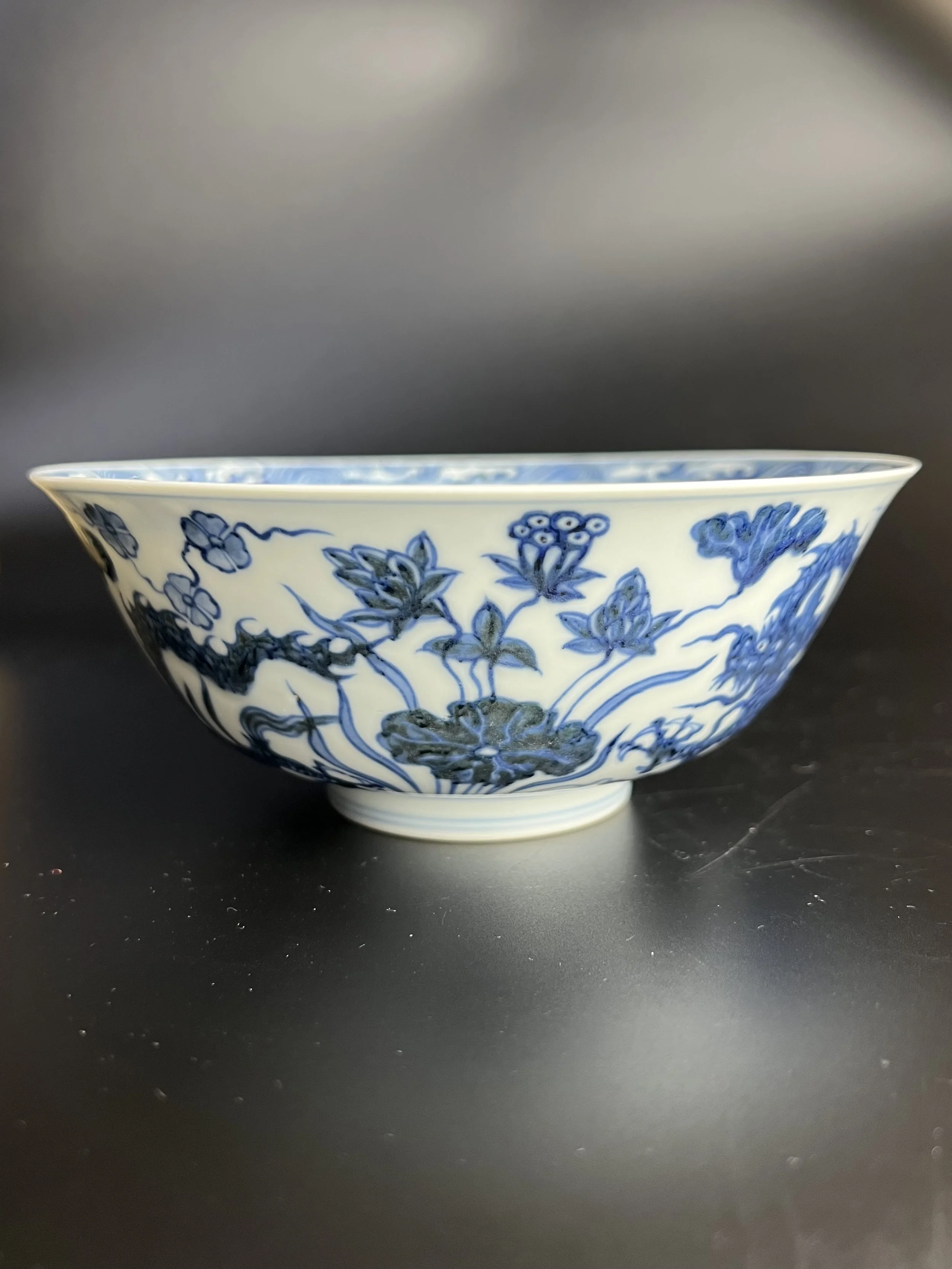 Image 3 of 10
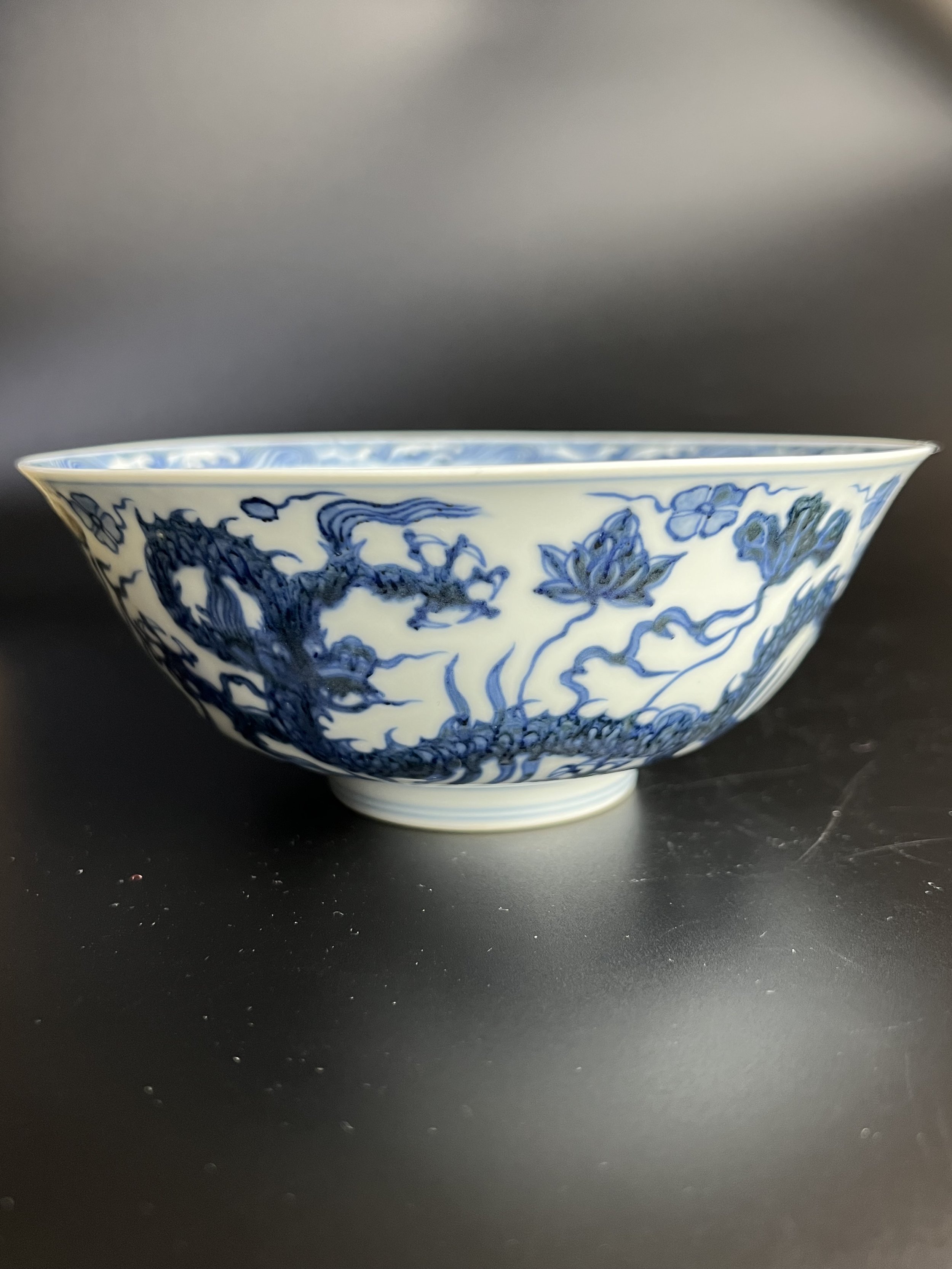 Image 4 of 10
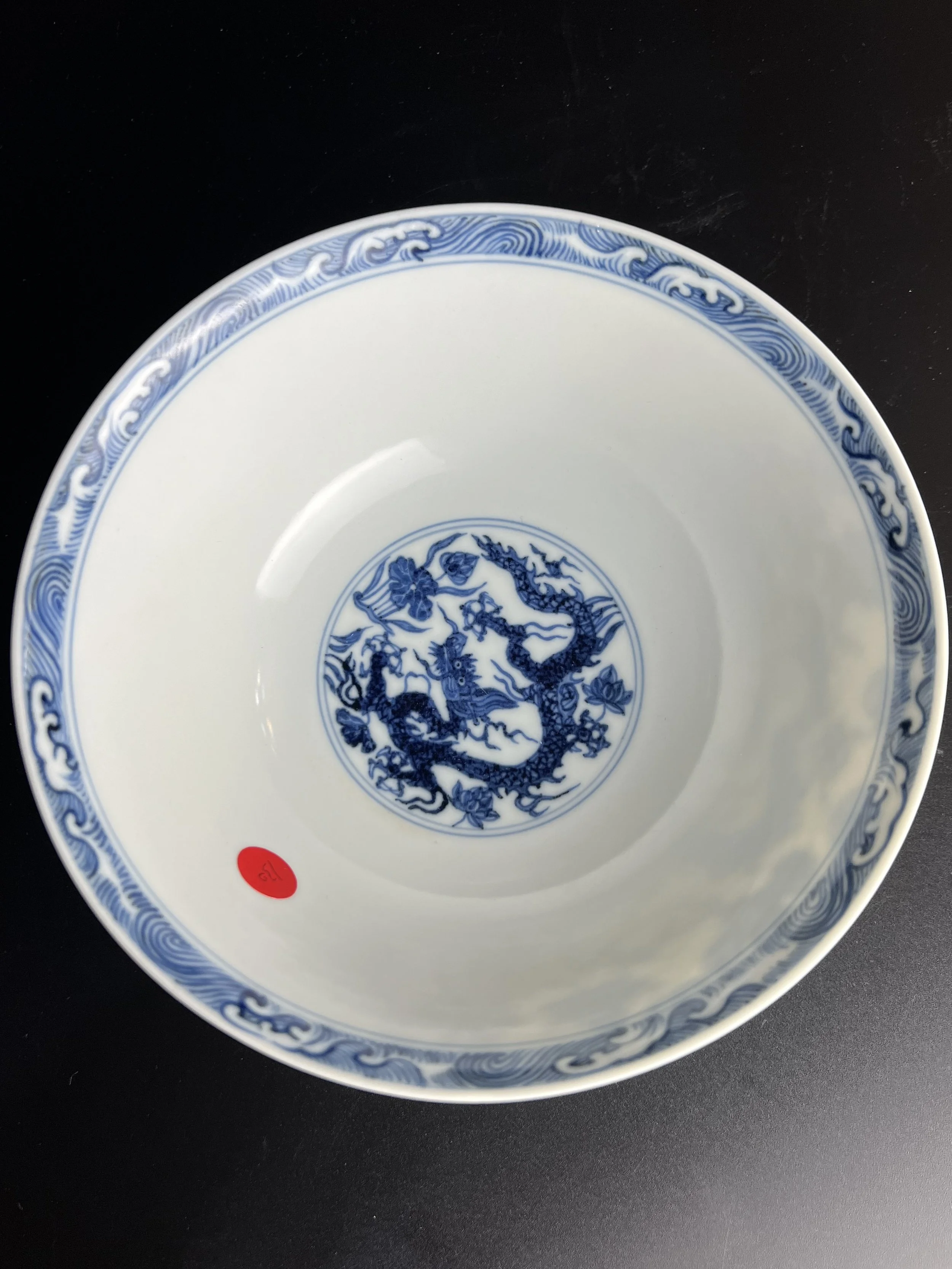 Image 5 of 10
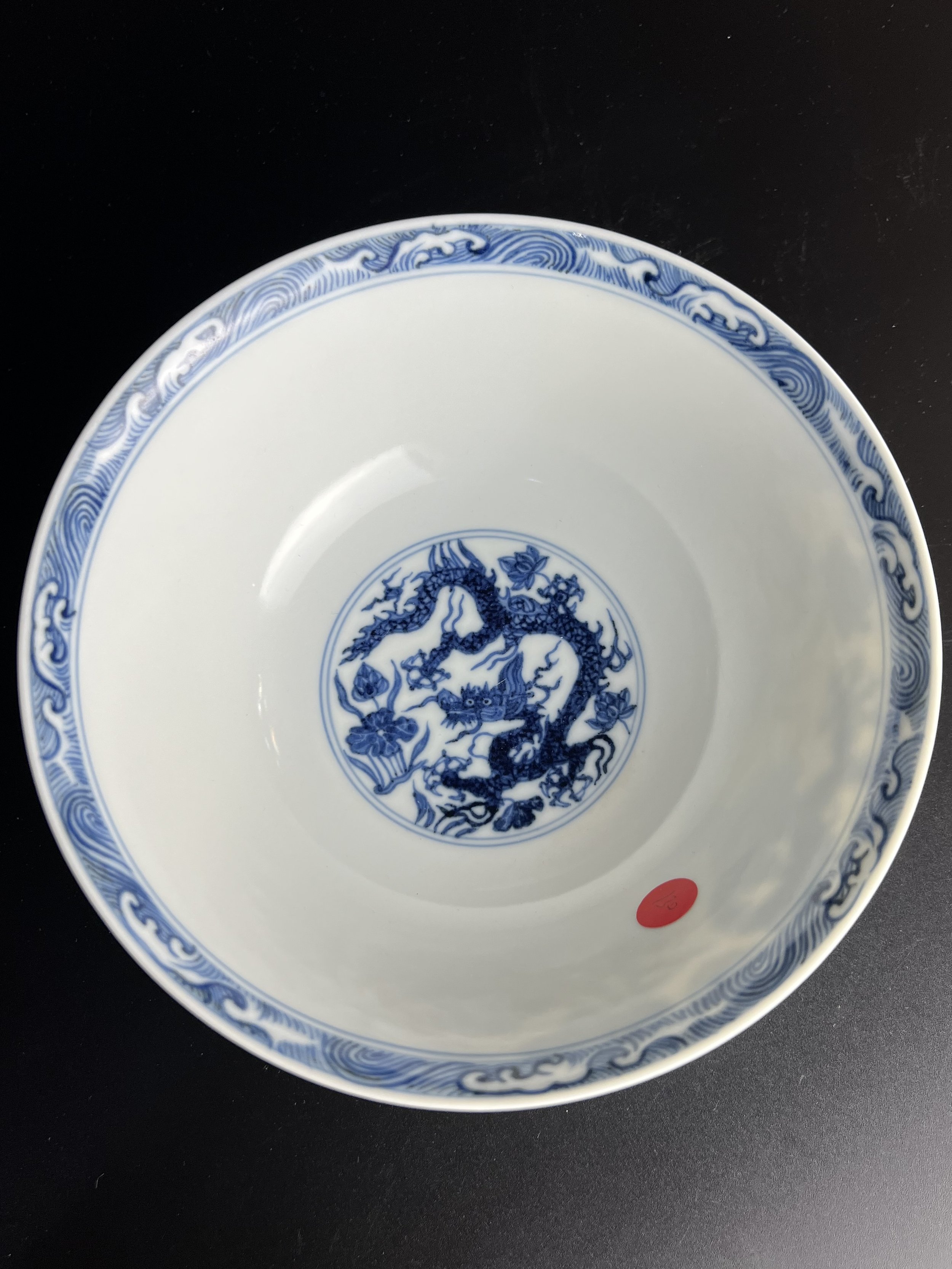 Image 6 of 10
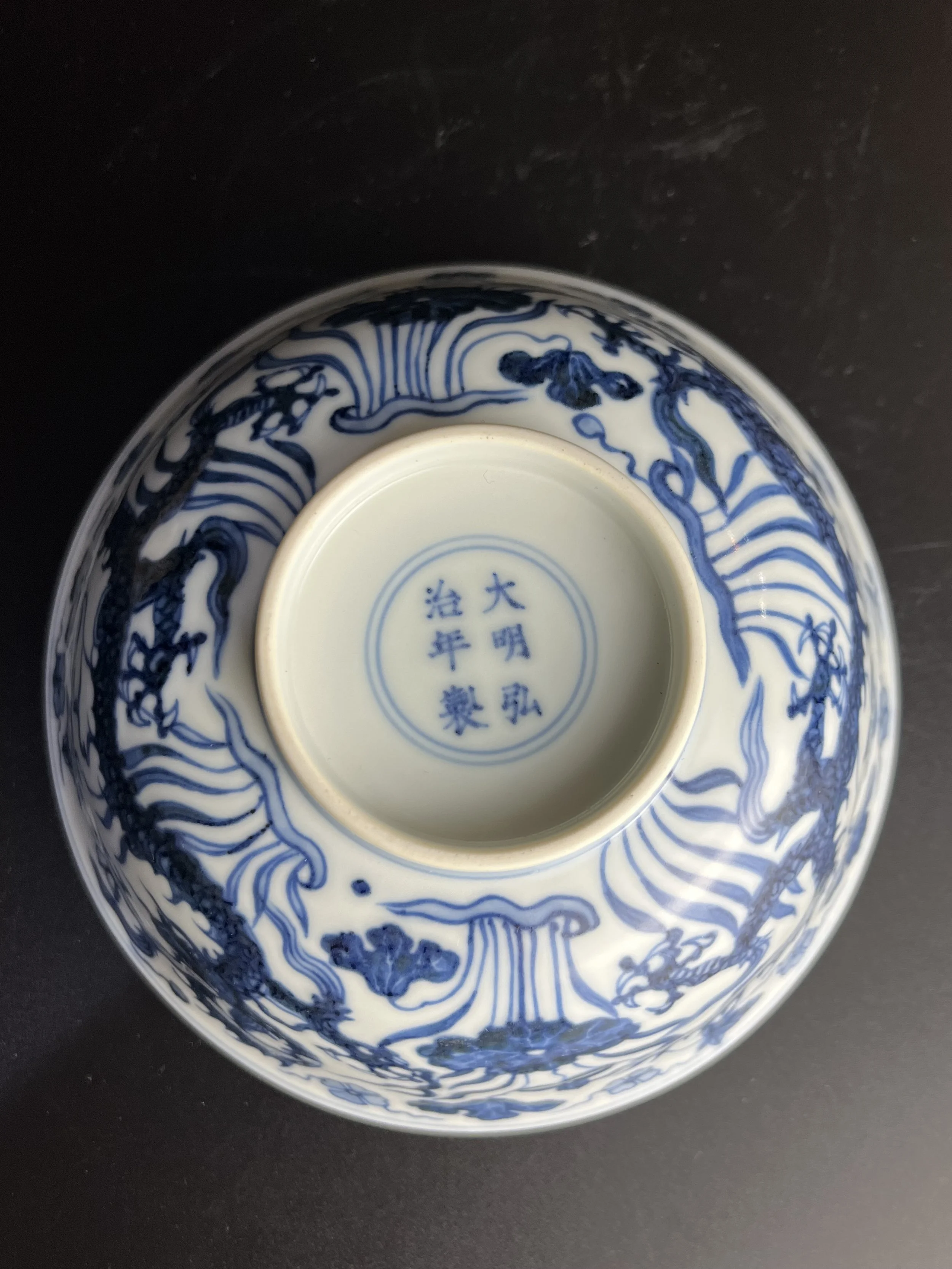 Image 7 of 10
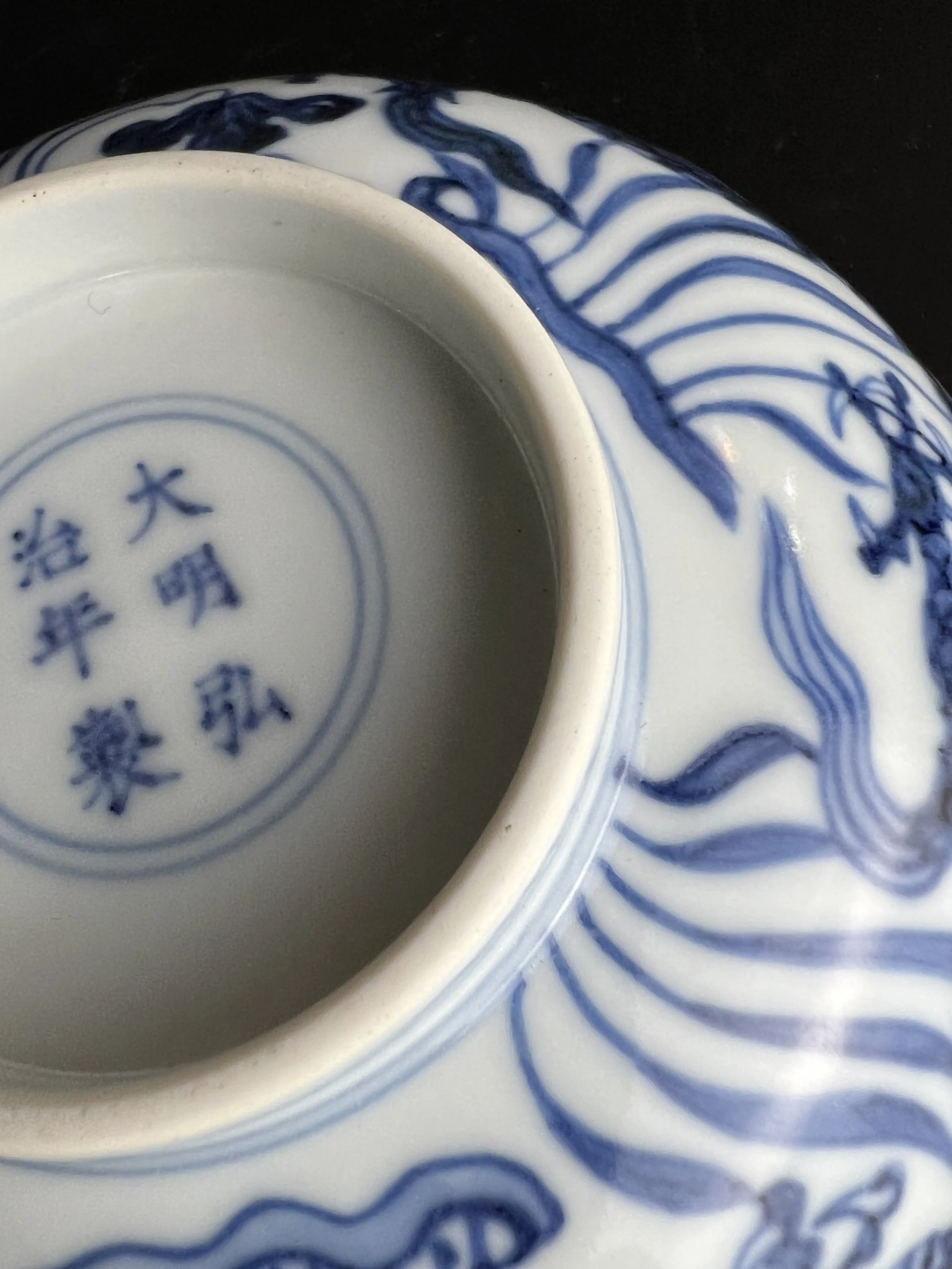 Image 8 of 10
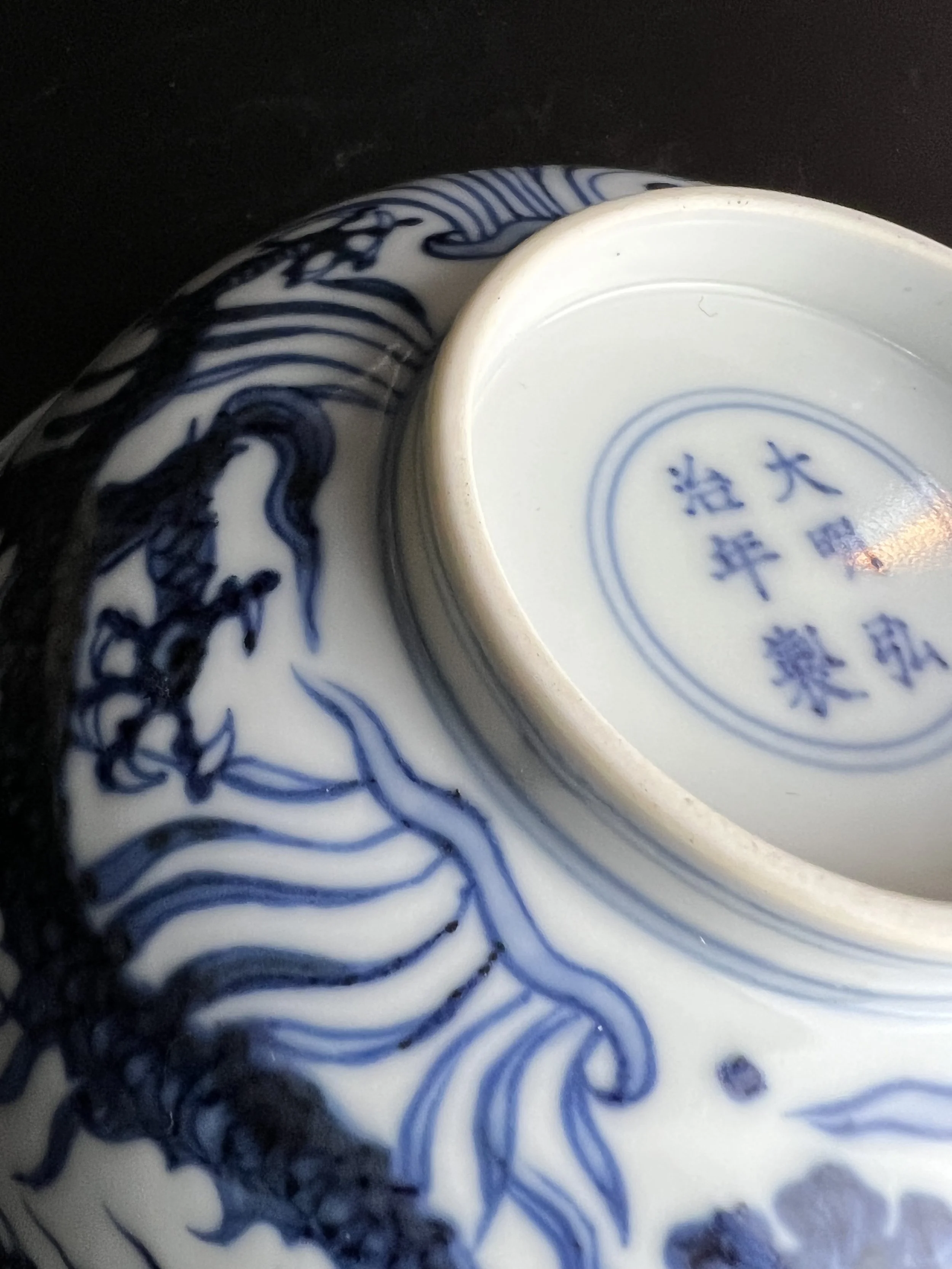 Image 9 of 10
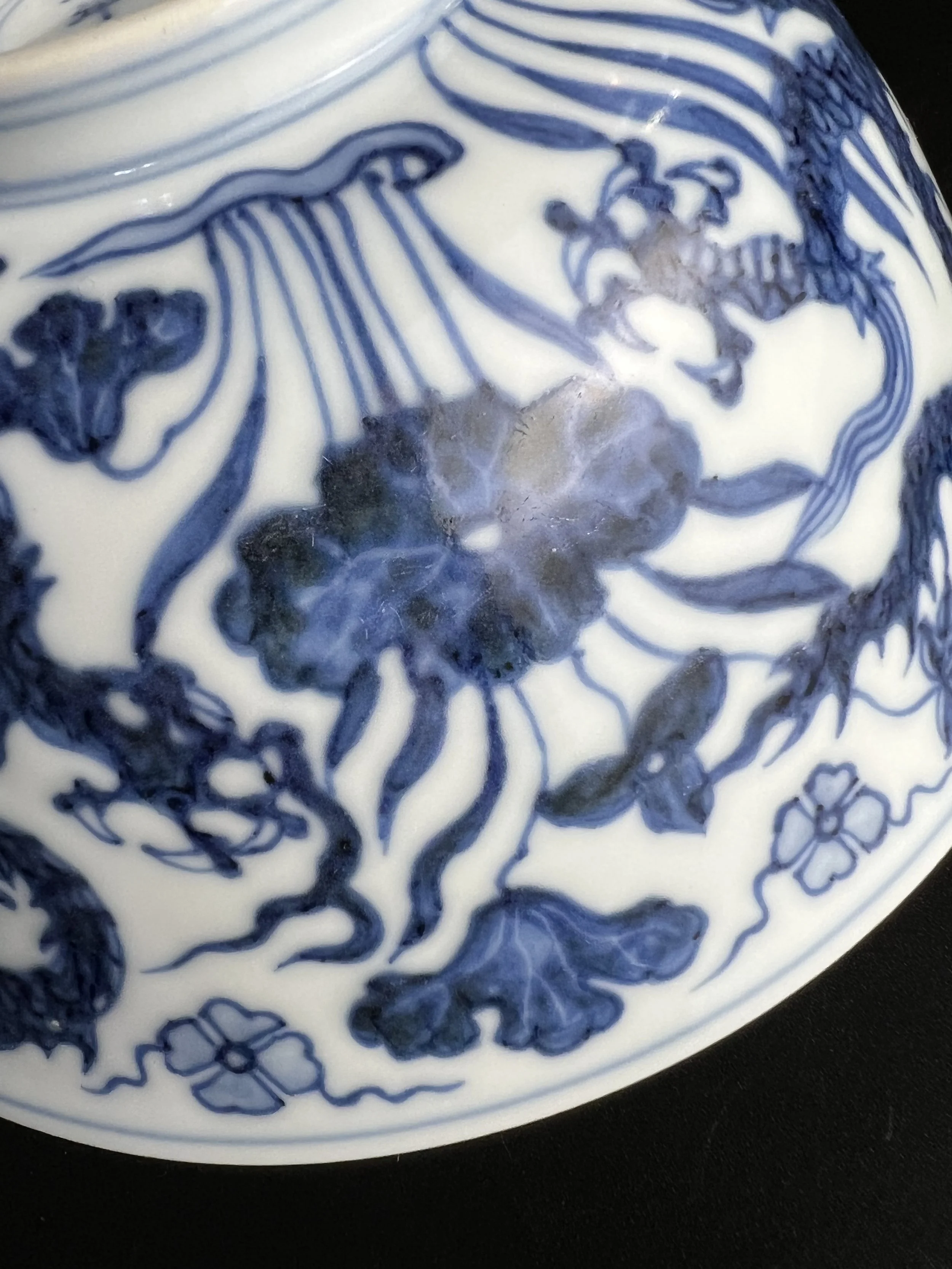 Image 10 of 10
A Blue-and-White Bowl with Design of Dragon among Lotus in a Pond, Hongzhi Mark and Period
Overview
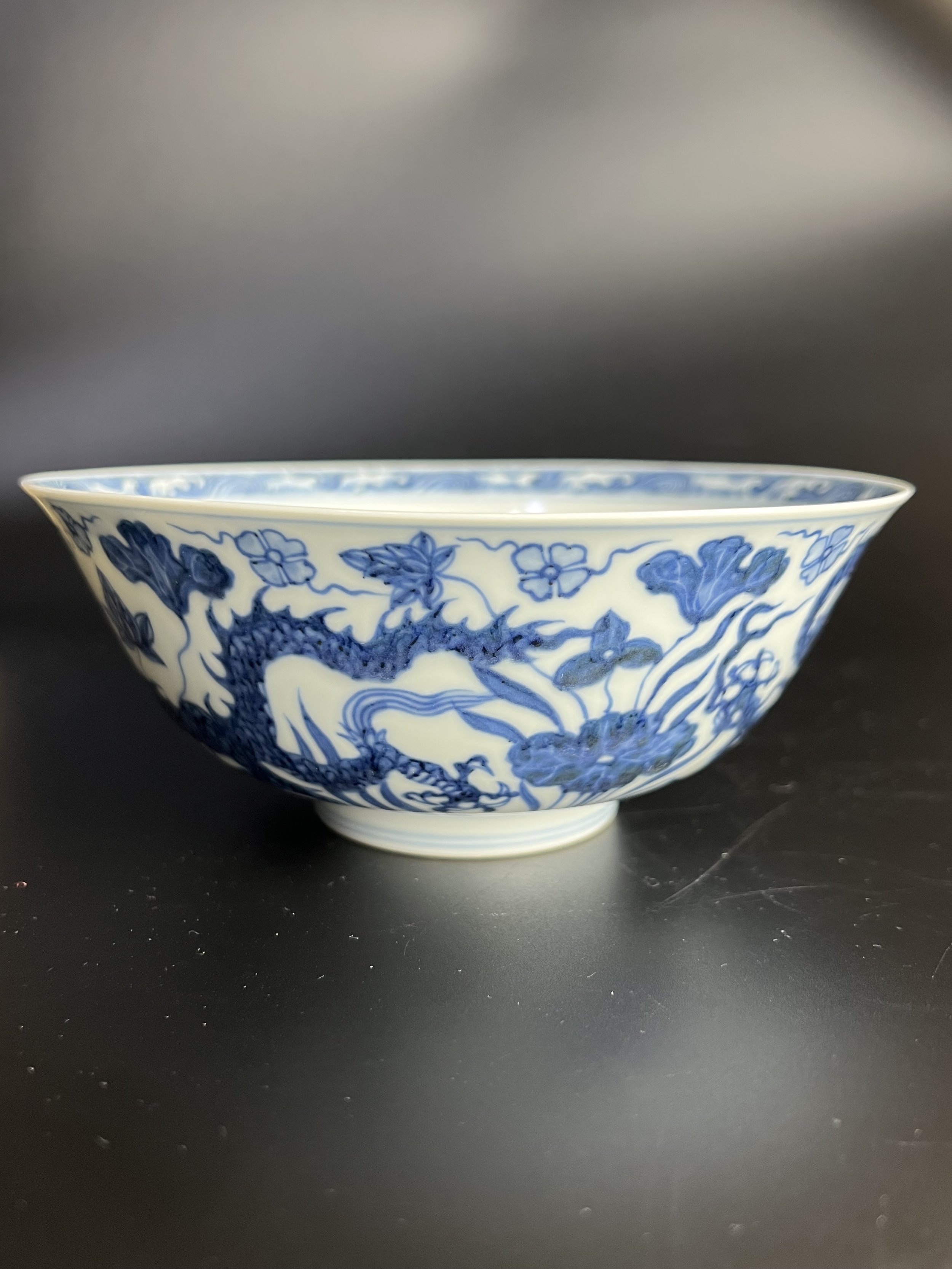
This underglaze-blue bowl decorated with a dragon among lotus and pond weeds, bearing the Hongzhi six-character mark, has a diameter of 18 cm and is a classic example of imperial blue-and-white ware from the Ming Hongzhi reign. Its form is regular, elegant, and refined. The decoration is refreshingly spacious in composition, featuring the theme of a "dragon among lotus flowers." It innovatively incorporates the scenery of a pond with lotus leaves. The brushwork is delicate and fluid, the blue hue subdued and soft, and the glaze surface unctuous and lustrous. This bowl perfectly embodies the Hongzhi imperial kilns' inheritance of the Chenghua legacy and their pursuit of a reserved, understated aesthetic, showcasing their superb ceramic craftsmanship. It is a representative masterpiece from the transitional period of mid-Ming blue-and-white porcelain, marking a shift from intricate decoration to simplified elegance.
I. Overview of Core Characteristics
Feature DimensionSpecific DescriptionObject DesignationBlue-and-White Bowl with Design of Dragon among Lotus in a Pond, Hongzhi mark and periodHistorical PeriodMing Dynasty, Hongzhi reign (1488-1505 AD)DimensionsDiameter: 18 cmBasic FormFlaring mouth, rounded sides, ring foot. The shape is dignified, well-proportioned, and rounded. The body is evenly thin, feeling light in hand.Decorative LayoutInterior: The center medallion depicts a coiled dragon winding among lotus flowers and leaves, set against a background of rippling water waves, forming a complete small scene of a "dragon in a lotus pond." Interior Rim: A band of crashing wave or "sea and rocky outcrop" (haishui jiangya) pattern. Exterior: Possibly undecorated, or correspondingly decorated with scrolling lotus or dragon-and-cloud patterns (inferred from common combinations).Cobalt-blue HueUses domestic 'Pingtangqing' cobalt. The color is淡雅清丽 (subtle, elegant, and bright), a greyish-blue that is stable, without diffusion or iron-speckling. The drawn lines are clear, exhibiting the typical "pale outline" blue-and-white style of the Chenghua and Hongzhi periods.Glaze, Body, and FootThe glaze is thick, lustrous, and moist—pure white, warm, and smooth, exhibiting the distinctive "lard-white" or "creamy-white" texture with a soft luster. The body is exceptionally fine, white, and meticulously refined. The ring foot is smoothly pared; the foot wall is relatively narrow. The unglazed areas reveal the fine, "glutinous rice" body texture.MarkWithin a double-blue circle at the base center, the underglaze-blue six-character mark in two columns of regular script reads: "Da Ming Hongzhi Nian Zhi". The calligraphy is delicate, elegant, and flowing, with slender, soft yet assured strokes, and a spacious layout. It is the standard Hongzhi imperial mark.
II. In-Depth Analysis of Artistry and Craftsmanship
1. Elegant Form and Refined Body/Glaze
Stylistic Features: Hongzhi bowls inherited the delicate style of the Chenghua period. This bowl, with an 18 cm diameter, is moderately sized with soft, graceful lines, fluidly curved sides, and a meticulously finished ring foot. The overall impression is one of轻盈秀雅 (lightness, elegance, and grace), a typical "palace bowl" form.
Achievement in Body and Glaze: The quality of Hongzhi porcelain body and glaze is considered among the finest of the Ming dynasty. The glaze is exceptionally thick, glossy, and moist, white with a very slight bluish tinge, and feels like婴儿肌肤 (a baby's skin) to the touch (the famed "Hongzhi tender yellow" glaze shares this base quality, though this piece is blue-and-white). The body is thin and lightweight with good translucency, and the potting is very regular, representing the pinnacle of Ming dynasty clay refining techniques.
2. Fresh and Refined Decoration and Painting Concept
Main Motif: "Dragon among lotus" is a classic pattern, but this bowl ingeniously sets the scene in a "pond." The center medallion features a coiled five-clawed dragon, its form elegant, with eyes looking forward, its demeanor gentle yet still dignified, winding among upright lotus flowers and spreading leaves, all set above delicate wave patterns. This concept merges the dragon motif with a natural landscape, creating a lively scene with a profound, serene意境 (artistic conception). It transforms the fierce and powerful Yongle-Xuande dragon into a motif with more literati painting charm.
Painting Technique: The classic "pale outline and double contour" method is used. Delicate, even lines outline the forms, which are then filled with very pale cobalt wash. The veins of the lotus leaves and the dragon's scales are rendered with meticulous care; the brushwork is precise and fluid. The scene is fresh, free from vulgarity, spacious, and ethereal, fully reflecting the Hongzhi period's aesthetic preference for restraint and understatement over ostentation. The wave pattern on the rim is executed with similarly fine, fluid strokes, harmonizing with the main decoration.
3. Signature 'Pingtangqing' Cobalt Color
The bowl's blue color is key to its period attribution. The 'Pingtangqing' (also known as 'Pond Blue') pigment produces a subtle, clear, bright, and stable color—a pure greyish-blue without the black speckles or diffusion of imported cobalt. This hue, set against the rich white glaze, appears exceptionally soft and pleasing to the eye, creating the unique, misty, and elegant beauty characteristic of the Hongzhi and Chenghua periods.
4. Delicate Reign Mark
The base mark consists of six characters in two columns of regular script within a double circle. The calligraphy is delicate, elegant, and flowing; the strokes are slender yet confident, and the spacing is open. The character for "Zhi" (治) often shows the "water" radical slightly lower than the "Tai" component, and the character for "Nian" (年) has a specific posture. The overall style of the mark continues directly from the Chenghua marks but with a slightly softer touch, giving it a distinct period character.
III. Historical Context and Usage
Exquisite Craftsmanship Amid Court Frugality: The Hongzhi Emperor advocated for frugality, leading to a sharp reduction in the output of imperial kilns. However, quality standards were not lowered; instead, under the principle of "fewer but finer," body and glaze technology reached its peak. This bowl is a product of this drive for "perfection within refinement." Though not lavishly decorated, its quality is superlative.
Court Utensil for Daily Use: Exquisitely made bowls with such refined decoration were likely used for daily meals or as ritual offerings in the palace. The dragon symbolizes the imperial house, while the lotus signifies purity and integrity. This may have subtly aligned with the Hongzhi Emperor's personal character and governance ideals, elevating the bowl beyond mere tableware and imbuing it with ritual and didactic meaning.
Aesthetic Pivot Between Eras: Hongzhi porcelain stands between the纤巧 (delicate refinement) of Chenghua and the敦厚 (solid, substantial) and繁缛 (intricate) styles of the Zhengde and Jiajing periods. This bowl perfectly preserves the technical essence and aesthetic style of Chenghua, serving as a key witness to the mid-Ming aesthetic transition. Its subtle blue, rich glaze, and fresh painting had a profound influence on later periods, including the archaistic porcelain of the Qing Yongzheng reign.
IV. Authentication Key Points
Hongzhi imperial wares are relatively rare. As this bowl combines several key period characteristics, authentication should focus on:
Glaze and Cobalt: The genuine glaze must be the thick, moist "lard-white," and the cobalt must be the淡雅闪灰 (subtle, elegant, greyish-blue) 'Pingtangqing' hue. Imitations often have a glaze that is too white or too glossy, and a cobalt color that is either浮艳 (flashy and garish) or暗沉 (muddy and dull).
Painting Style: Genuine pieces feature delicate, fine painting with fluid, natural brushstrokes; the dragon is elegant, the lotus pure. Imitations often have孱弱 (feeble) brushwork,僵滞 (stiff) lines, and compositions that are overly crowded, losing the sense of spaciousness.
Body, Foot, and Mark: The genuine body is fine, and the foot rim is smoothly rounded. The reign mark is the most critical element for authentication; the calligraphic style, character structure, and spirit must be carefully compared with verified examples. Imitation marks are often生硬 (stiffly) written, with粗钝 (thick and blunt) strokes or incorrect character forms.
Overall Vitality: Genuine pieces possess an overall quality of静谧、温润、高雅 (tranquility, warmth, and elegance)—an era-specific aura that is most difficult to imitate.
Conclusion
This Hongzhi blue-and-white bowl with its dragon among lotus in a pond, distinguished by its extraordinary body and glaze quality, its soft and subtle cobalt-blue hue, its fresh and meaningful decoration, and its clear, standard imperial mark, is a treasure among Hongzhi imperial porcelain. It does not captivate with dazzling brilliance but moves the viewer with its内在的温润如玉 (inner jade-like warmth) and绘事的精妙入微 (exquisite, detailed painting). It represents the perfect fusion of the mid-Ming imperial court's高雅品味 (refined taste) and顶尖制瓷工艺 (pinnacle ceramic craftsmanship), truly a典范 (paradigm) of "utmost elegance and refinement" in Eastern aesthetics.
明弘治青花龙穿莲花荷叶池纹碗
概述
此件 “大明弘治年制”款青花龙穿莲花荷叶池纹碗,口径18厘米,为明代弘治朝官窑青花之典范。其造型规整秀雅,纹饰构图疏朗清新,以“龙穿莲花”为主题,并创新性地融合池塘荷叶之景,笔触纤细流畅,青花发色淡雅柔和,釉面肥润如脂,完美体现了弘治官窑承袭成化遗韵、追求含蓄内敛的审美趣味与高超制瓷水准,是明代中期青花瓷由繁入简的转型期代表作。
一、 核心特征总览
特征维度具体描述器物定名明弘治 青花龙穿莲花荷叶池纹碗历史年代明弘治时期 (1488-1505年)器物尺寸口径18厘米基本器型敞口,弧腹,圈足。造型端庄圆润,比例协调,胎体匀薄,手感轻盈。纹饰布局碗内:碗心绘一团龙穿梭于莲花与荷叶之间,背景衬以荡漾水波,构成一幅完整的“龙穿莲池”小景。内口沿:饰一周海浪纹或海水江崖纹。碗外壁:或光素,或相应装饰缠枝莲、云龙等纹样(依据常见组合推断)。青花发色使用国产“平等青”料,发色淡雅清丽,蓝中闪灰,呈色稳定,无晕散与铁锈斑,绘线清晰,具有典型的成化、弘治“淡描青花”风格。釉面胎足釉面肥厚莹润,洁白温润,呈现特有的“猪油白”或“乳白”质感,光泽柔和。胎质细腻洁白,淘炼极精。圈足修削圆润,足墙较窄,露胎处可见细腻的“糯米胎”。款识碗底心青花双圈内,书 “大明弘治年制” 六字双行楷书款。字体清秀飘逸,笔道纤细柔和,布局疏朗,为弘治官窑标准款识。
二、 艺术与工艺深度解析
1. 秀美的造型与精良的胎釉
造型特征:弘治碗类器物继承了成化的纤巧风格。此碗口径18厘米,尺寸适中,线条柔美,弧腹流畅,圈足处理细致讲究,整体给人以轻盈秀雅、亭亭玉立之感,是典型的“宫碗”制式。
胎釉成就:弘治瓷器的胎釉质量被誉为明代之冠。其釉质极其肥厚莹润,白中微微闪青,抚之如婴儿肌肤,有“弘治娇黄”之釉底(虽此为青花,然釉质相同)。胎体轻薄,透光性佳,且修胎规整,代表了明代淘练工艺的巅峰水平。
2. 清新雅致的纹饰与画意
主题纹饰:“龙穿莲花”是经典纹样,但此碗巧妙地将场景设定为“池塘”。碗心绘一弓身盘绕的五爪团龙,龙形清秀,双目平视,姿态温婉而不失威仪,穿梭于亭亭玉立的莲花与舒展的荷叶之间,下方衬以细腻的水波纹。这一构思将龙纹与自然景致相结合,画面生动,意境幽远,一改永宣龙纹的凶猛强悍,更具文人画意趣。
绘画技法:采用典型的“淡描双勾”法。以纤细均匀的线条勾勒轮廓,再以极淡的青料平涂渲染。莲花荷叶的脉络、龙鳞的描绘皆一丝不苟,笔触精准而流畅,画面清新脱俗,疏朗空灵,充分体现了弘治朝含蓄内敛、不事张扬的审美取向。口沿的海浪纹用笔同样纤细流畅,与主题纹饰和谐统一。
3. 标志性的“平等青”发色
此碗青花呈色是断代的关键。所用“平等青”(陂塘青)料,发色淡雅、清亮、稳定,蓝中泛灰,呈色纯净,无进口料的黑斑与晕散。这种呈色与肥腴的白釉相衬,显得格外柔和悦目,形成了弘治、成化两朝独有的“云遮雾罩”般朦胧雅致的美感。
4. 清秀款识
底款为六字双行楷书,外围双圈。字体书写清秀飘逸,笔划纤细而有力,间距疏朗。“治”字的三点水常低于“台”部,“年”字书写有特定姿态。整体款识风格与成化款一脉相承,但笔力稍显柔软,独具时代风貌。
三、 历史内涵与使用场景
宫廷节俭风尚下的精工:弘治皇帝提倡节俭,官窑烧造数量锐减,但并未降低质量要求,反而在“少而精”的原则下,将胎釉工艺推向极致。此碗正是此背景下“精益求精”的产物,虽无繁缛装饰,但品质超群。
宫廷日常用器:此类制作精良、纹饰雅致的碗,应为宫廷日常膳食或祭祀供器。龙纹象征皇室,莲花寓意高洁清廉,与弘治帝的个人品行及治国理念或有暗合,使其超越了普通餐具,具有一定的礼制与教化内涵。
承上启下的美学坐标:弘治瓷器处于成化的纤巧与正德、嘉靖的敦厚、繁缛之间。此碗完美保留了成化的技术精髓与美学风格,是明代中期审美过渡的关键见证。其淡雅的青花、肥润的釉面与清新的画意,对后世乃至清代雍正时期的仿古瓷产生了深远影响。
四、 鉴藏要点
弘治官窑传世品较少,此碗集多项时代特征于一身,鉴藏需重点关注:
釉面与青花:真品釉面必是肥厚莹润的“猪油白”,青花必是淡雅闪灰的平等青发色。仿品釉面常过白或过亮,青花色浮艳或暗沉。
绘画风格:真品画风纤细工丽,笔触流畅自然,龙纹秀美,莲荷清雅。仿品笔力孱弱,线条呆滞,纹饰布局往往过于饱满,失去疏朗之气。
胎足与款识:真品胎质细腻,足端修削圆润。款识字体是鉴定重中之重,需仔细比对真款笔法、结构与神韵。仿款常书写生硬、笔画粗钝或字形错误。
整体气韵:真品具有一种静谧、温润、高雅的整体气质,这种时代气息最难模仿。
结语
此弘治青花龙穿莲花荷叶池纹碗,以其超凡脱俗的胎釉品质、淡雅柔和的青花发色、清新隽永的纹饰画意以及标准明确的官窑款识,成为弘治朝官窑瓷器中的瑰宝。它并非以浓艳夺目,而是以内在的温润如玉、绘事的精妙入微打动人心,是明代中期皇室高雅品味与顶尖制瓷工艺相融合的完美体现,堪称“至雅至精”的东方美学典范。
Overview
This underglaze-blue bowl decorated with a dragon among lotus and pond weeds, bearing the Hongzhi six-character mark, has a diameter of 18 cm and is a classic example of imperial blue-and-white ware from the Ming Hongzhi reign. Its form is regular, elegant, and refined. The decoration is refreshingly spacious in composition, featuring the theme of a "dragon among lotus flowers." It innovatively incorporates the scenery of a pond with lotus leaves. The brushwork is delicate and fluid, the blue hue subdued and soft, and the glaze surface unctuous and lustrous. This bowl perfectly embodies the Hongzhi imperial kilns' inheritance of the Chenghua legacy and their pursuit of a reserved, understated aesthetic, showcasing their superb ceramic craftsmanship. It is a representative masterpiece from the transitional period of mid-Ming blue-and-white porcelain, marking a shift from intricate decoration to simplified elegance.
I. Overview of Core Characteristics
Feature DimensionSpecific DescriptionObject DesignationBlue-and-White Bowl with Design of Dragon among Lotus in a Pond, Hongzhi mark and periodHistorical PeriodMing Dynasty, Hongzhi reign (1488-1505 AD)DimensionsDiameter: 18 cmBasic FormFlaring mouth, rounded sides, ring foot. The shape is dignified, well-proportioned, and rounded. The body is evenly thin, feeling light in hand.Decorative LayoutInterior: The center medallion depicts a coiled dragon winding among lotus flowers and leaves, set against a background of rippling water waves, forming a complete small scene of a "dragon in a lotus pond." Interior Rim: A band of crashing wave or "sea and rocky outcrop" (haishui jiangya) pattern. Exterior: Possibly undecorated, or correspondingly decorated with scrolling lotus or dragon-and-cloud patterns (inferred from common combinations).Cobalt-blue HueUses domestic 'Pingtangqing' cobalt. The color is淡雅清丽 (subtle, elegant, and bright), a greyish-blue that is stable, without diffusion or iron-speckling. The drawn lines are clear, exhibiting the typical "pale outline" blue-and-white style of the Chenghua and Hongzhi periods.Glaze, Body, and FootThe glaze is thick, lustrous, and moist—pure white, warm, and smooth, exhibiting the distinctive "lard-white" or "creamy-white" texture with a soft luster. The body is exceptionally fine, white, and meticulously refined. The ring foot is smoothly pared; the foot wall is relatively narrow. The unglazed areas reveal the fine, "glutinous rice" body texture.MarkWithin a double-blue circle at the base center, the underglaze-blue six-character mark in two columns of regular script reads: "Da Ming Hongzhi Nian Zhi". The calligraphy is delicate, elegant, and flowing, with slender, soft yet assured strokes, and a spacious layout. It is the standard Hongzhi imperial mark.
II. In-Depth Analysis of Artistry and Craftsmanship
1. Elegant Form and Refined Body/Glaze
Stylistic Features: Hongzhi bowls inherited the delicate style of the Chenghua period. This bowl, with an 18 cm diameter, is moderately sized with soft, graceful lines, fluidly curved sides, and a meticulously finished ring foot. The overall impression is one of轻盈秀雅 (lightness, elegance, and grace), a typical "palace bowl" form.
Achievement in Body and Glaze: The quality of Hongzhi porcelain body and glaze is considered among the finest of the Ming dynasty. The glaze is exceptionally thick, glossy, and moist, white with a very slight bluish tinge, and feels like婴儿肌肤 (a baby's skin) to the touch (the famed "Hongzhi tender yellow" glaze shares this base quality, though this piece is blue-and-white). The body is thin and lightweight with good translucency, and the potting is very regular, representing the pinnacle of Ming dynasty clay refining techniques.
2. Fresh and Refined Decoration and Painting Concept
Main Motif: "Dragon among lotus" is a classic pattern, but this bowl ingeniously sets the scene in a "pond." The center medallion features a coiled five-clawed dragon, its form elegant, with eyes looking forward, its demeanor gentle yet still dignified, winding among upright lotus flowers and spreading leaves, all set above delicate wave patterns. This concept merges the dragon motif with a natural landscape, creating a lively scene with a profound, serene意境 (artistic conception). It transforms the fierce and powerful Yongle-Xuande dragon into a motif with more literati painting charm.
Painting Technique: The classic "pale outline and double contour" method is used. Delicate, even lines outline the forms, which are then filled with very pale cobalt wash. The veins of the lotus leaves and the dragon's scales are rendered with meticulous care; the brushwork is precise and fluid. The scene is fresh, free from vulgarity, spacious, and ethereal, fully reflecting the Hongzhi period's aesthetic preference for restraint and understatement over ostentation. The wave pattern on the rim is executed with similarly fine, fluid strokes, harmonizing with the main decoration.
3. Signature 'Pingtangqing' Cobalt Color
The bowl's blue color is key to its period attribution. The 'Pingtangqing' (also known as 'Pond Blue') pigment produces a subtle, clear, bright, and stable color—a pure greyish-blue without the black speckles or diffusion of imported cobalt. This hue, set against the rich white glaze, appears exceptionally soft and pleasing to the eye, creating the unique, misty, and elegant beauty characteristic of the Hongzhi and Chenghua periods.
4. Delicate Reign Mark
The base mark consists of six characters in two columns of regular script within a double circle. The calligraphy is delicate, elegant, and flowing; the strokes are slender yet confident, and the spacing is open. The character for "Zhi" (治) often shows the "water" radical slightly lower than the "Tai" component, and the character for "Nian" (年) has a specific posture. The overall style of the mark continues directly from the Chenghua marks but with a slightly softer touch, giving it a distinct period character.
III. Historical Context and Usage
Exquisite Craftsmanship Amid Court Frugality: The Hongzhi Emperor advocated for frugality, leading to a sharp reduction in the output of imperial kilns. However, quality standards were not lowered; instead, under the principle of "fewer but finer," body and glaze technology reached its peak. This bowl is a product of this drive for "perfection within refinement." Though not lavishly decorated, its quality is superlative.
Court Utensil for Daily Use: Exquisitely made bowls with such refined decoration were likely used for daily meals or as ritual offerings in the palace. The dragon symbolizes the imperial house, while the lotus signifies purity and integrity. This may have subtly aligned with the Hongzhi Emperor's personal character and governance ideals, elevating the bowl beyond mere tableware and imbuing it with ritual and didactic meaning.
Aesthetic Pivot Between Eras: Hongzhi porcelain stands between the纤巧 (delicate refinement) of Chenghua and the敦厚 (solid, substantial) and繁缛 (intricate) styles of the Zhengde and Jiajing periods. This bowl perfectly preserves the technical essence and aesthetic style of Chenghua, serving as a key witness to the mid-Ming aesthetic transition. Its subtle blue, rich glaze, and fresh painting had a profound influence on later periods, including the archaistic porcelain of the Qing Yongzheng reign.
IV. Authentication Key Points
Hongzhi imperial wares are relatively rare. As this bowl combines several key period characteristics, authentication should focus on:
Glaze and Cobalt: The genuine glaze must be the thick, moist "lard-white," and the cobalt must be the淡雅闪灰 (subtle, elegant, greyish-blue) 'Pingtangqing' hue. Imitations often have a glaze that is too white or too glossy, and a cobalt color that is either浮艳 (flashy and garish) or暗沉 (muddy and dull).
Painting Style: Genuine pieces feature delicate, fine painting with fluid, natural brushstrokes; the dragon is elegant, the lotus pure. Imitations often have孱弱 (feeble) brushwork,僵滞 (stiff) lines, and compositions that are overly crowded, losing the sense of spaciousness.
Body, Foot, and Mark: The genuine body is fine, and the foot rim is smoothly rounded. The reign mark is the most critical element for authentication; the calligraphic style, character structure, and spirit must be carefully compared with verified examples. Imitation marks are often生硬 (stiffly) written, with粗钝 (thick and blunt) strokes or incorrect character forms.
Overall Vitality: Genuine pieces possess an overall quality of静谧、温润、高雅 (tranquility, warmth, and elegance)—an era-specific aura that is most difficult to imitate.
Conclusion
This Hongzhi blue-and-white bowl with its dragon among lotus in a pond, distinguished by its extraordinary body and glaze quality, its soft and subtle cobalt-blue hue, its fresh and meaningful decoration, and its clear, standard imperial mark, is a treasure among Hongzhi imperial porcelain. It does not captivate with dazzling brilliance but moves the viewer with its内在的温润如玉 (inner jade-like warmth) and绘事的精妙入微 (exquisite, detailed painting). It represents the perfect fusion of the mid-Ming imperial court's高雅品味 (refined taste) and顶尖制瓷工艺 (pinnacle ceramic craftsmanship), truly a典范 (paradigm) of "utmost elegance and refinement" in Eastern aesthetics.
明弘治青花龙穿莲花荷叶池纹碗
概述
此件 “大明弘治年制”款青花龙穿莲花荷叶池纹碗,口径18厘米,为明代弘治朝官窑青花之典范。其造型规整秀雅,纹饰构图疏朗清新,以“龙穿莲花”为主题,并创新性地融合池塘荷叶之景,笔触纤细流畅,青花发色淡雅柔和,釉面肥润如脂,完美体现了弘治官窑承袭成化遗韵、追求含蓄内敛的审美趣味与高超制瓷水准,是明代中期青花瓷由繁入简的转型期代表作。
一、 核心特征总览
特征维度具体描述器物定名明弘治 青花龙穿莲花荷叶池纹碗历史年代明弘治时期 (1488-1505年)器物尺寸口径18厘米基本器型敞口,弧腹,圈足。造型端庄圆润,比例协调,胎体匀薄,手感轻盈。纹饰布局碗内:碗心绘一团龙穿梭于莲花与荷叶之间,背景衬以荡漾水波,构成一幅完整的“龙穿莲池”小景。内口沿:饰一周海浪纹或海水江崖纹。碗外壁:或光素,或相应装饰缠枝莲、云龙等纹样(依据常见组合推断)。青花发色使用国产“平等青”料,发色淡雅清丽,蓝中闪灰,呈色稳定,无晕散与铁锈斑,绘线清晰,具有典型的成化、弘治“淡描青花”风格。釉面胎足釉面肥厚莹润,洁白温润,呈现特有的“猪油白”或“乳白”质感,光泽柔和。胎质细腻洁白,淘炼极精。圈足修削圆润,足墙较窄,露胎处可见细腻的“糯米胎”。款识碗底心青花双圈内,书 “大明弘治年制” 六字双行楷书款。字体清秀飘逸,笔道纤细柔和,布局疏朗,为弘治官窑标准款识。
二、 艺术与工艺深度解析
1. 秀美的造型与精良的胎釉
造型特征:弘治碗类器物继承了成化的纤巧风格。此碗口径18厘米,尺寸适中,线条柔美,弧腹流畅,圈足处理细致讲究,整体给人以轻盈秀雅、亭亭玉立之感,是典型的“宫碗”制式。
胎釉成就:弘治瓷器的胎釉质量被誉为明代之冠。其釉质极其肥厚莹润,白中微微闪青,抚之如婴儿肌肤,有“弘治娇黄”之釉底(虽此为青花,然釉质相同)。胎体轻薄,透光性佳,且修胎规整,代表了明代淘练工艺的巅峰水平。
2. 清新雅致的纹饰与画意
主题纹饰:“龙穿莲花”是经典纹样,但此碗巧妙地将场景设定为“池塘”。碗心绘一弓身盘绕的五爪团龙,龙形清秀,双目平视,姿态温婉而不失威仪,穿梭于亭亭玉立的莲花与舒展的荷叶之间,下方衬以细腻的水波纹。这一构思将龙纹与自然景致相结合,画面生动,意境幽远,一改永宣龙纹的凶猛强悍,更具文人画意趣。
绘画技法:采用典型的“淡描双勾”法。以纤细均匀的线条勾勒轮廓,再以极淡的青料平涂渲染。莲花荷叶的脉络、龙鳞的描绘皆一丝不苟,笔触精准而流畅,画面清新脱俗,疏朗空灵,充分体现了弘治朝含蓄内敛、不事张扬的审美取向。口沿的海浪纹用笔同样纤细流畅,与主题纹饰和谐统一。
3. 标志性的“平等青”发色
此碗青花呈色是断代的关键。所用“平等青”(陂塘青)料,发色淡雅、清亮、稳定,蓝中泛灰,呈色纯净,无进口料的黑斑与晕散。这种呈色与肥腴的白釉相衬,显得格外柔和悦目,形成了弘治、成化两朝独有的“云遮雾罩”般朦胧雅致的美感。
4. 清秀款识
底款为六字双行楷书,外围双圈。字体书写清秀飘逸,笔划纤细而有力,间距疏朗。“治”字的三点水常低于“台”部,“年”字书写有特定姿态。整体款识风格与成化款一脉相承,但笔力稍显柔软,独具时代风貌。
三、 历史内涵与使用场景
宫廷节俭风尚下的精工:弘治皇帝提倡节俭,官窑烧造数量锐减,但并未降低质量要求,反而在“少而精”的原则下,将胎釉工艺推向极致。此碗正是此背景下“精益求精”的产物,虽无繁缛装饰,但品质超群。
宫廷日常用器:此类制作精良、纹饰雅致的碗,应为宫廷日常膳食或祭祀供器。龙纹象征皇室,莲花寓意高洁清廉,与弘治帝的个人品行及治国理念或有暗合,使其超越了普通餐具,具有一定的礼制与教化内涵。
承上启下的美学坐标:弘治瓷器处于成化的纤巧与正德、嘉靖的敦厚、繁缛之间。此碗完美保留了成化的技术精髓与美学风格,是明代中期审美过渡的关键见证。其淡雅的青花、肥润的釉面与清新的画意,对后世乃至清代雍正时期的仿古瓷产生了深远影响。
四、 鉴藏要点
弘治官窑传世品较少,此碗集多项时代特征于一身,鉴藏需重点关注:
釉面与青花:真品釉面必是肥厚莹润的“猪油白”,青花必是淡雅闪灰的平等青发色。仿品釉面常过白或过亮,青花色浮艳或暗沉。
绘画风格:真品画风纤细工丽,笔触流畅自然,龙纹秀美,莲荷清雅。仿品笔力孱弱,线条呆滞,纹饰布局往往过于饱满,失去疏朗之气。
胎足与款识:真品胎质细腻,足端修削圆润。款识字体是鉴定重中之重,需仔细比对真款笔法、结构与神韵。仿款常书写生硬、笔画粗钝或字形错误。
整体气韵:真品具有一种静谧、温润、高雅的整体气质,这种时代气息最难模仿。
结语
此弘治青花龙穿莲花荷叶池纹碗,以其超凡脱俗的胎釉品质、淡雅柔和的青花发色、清新隽永的纹饰画意以及标准明确的官窑款识,成为弘治朝官窑瓷器中的瑰宝。它并非以浓艳夺目,而是以内在的温润如玉、绘事的精妙入微打动人心,是明代中期皇室高雅品味与顶尖制瓷工艺相融合的完美体现,堪称“至雅至精”的东方美学典范。