 Image 1 of 8
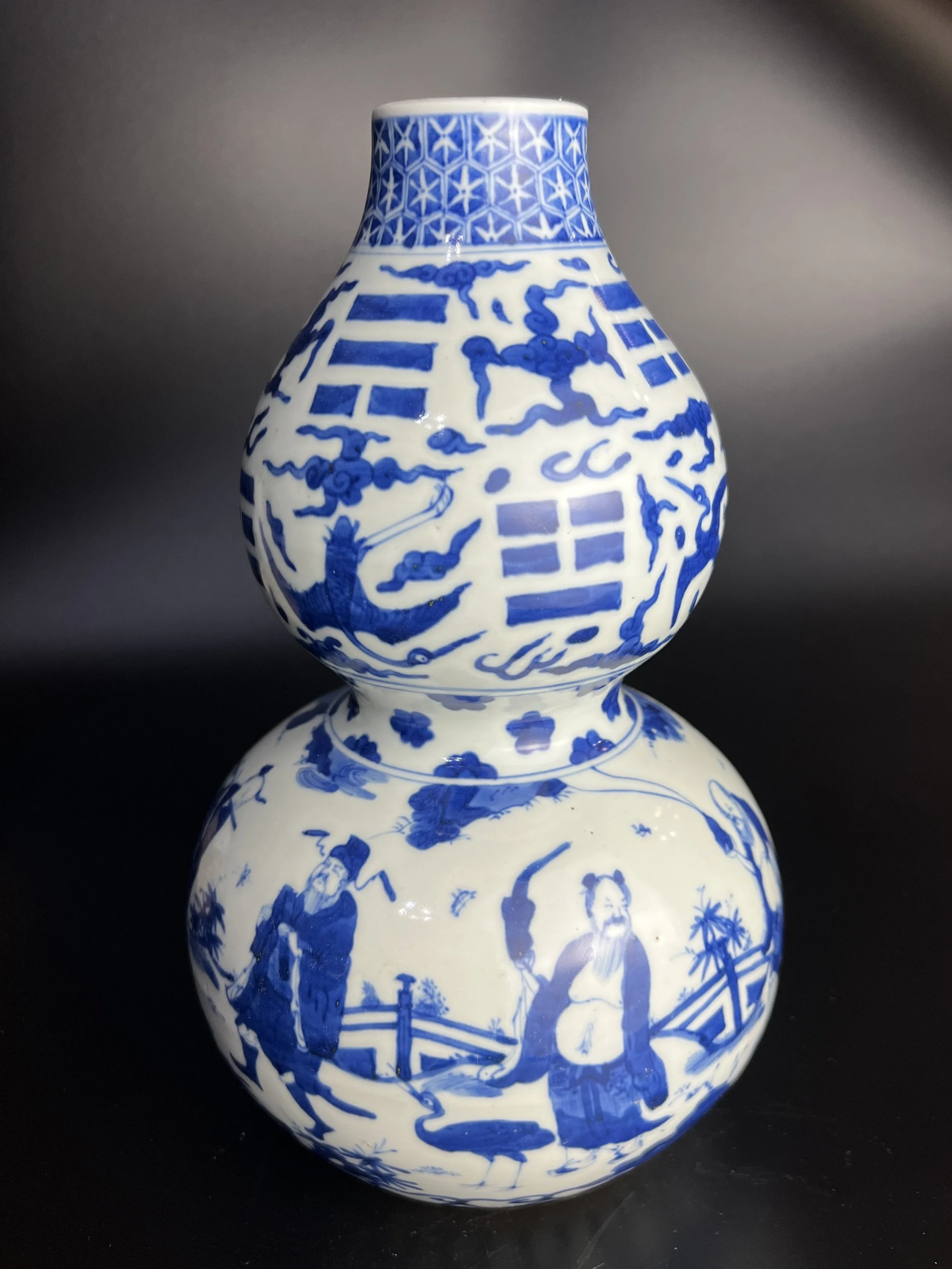 Image 2 of 8
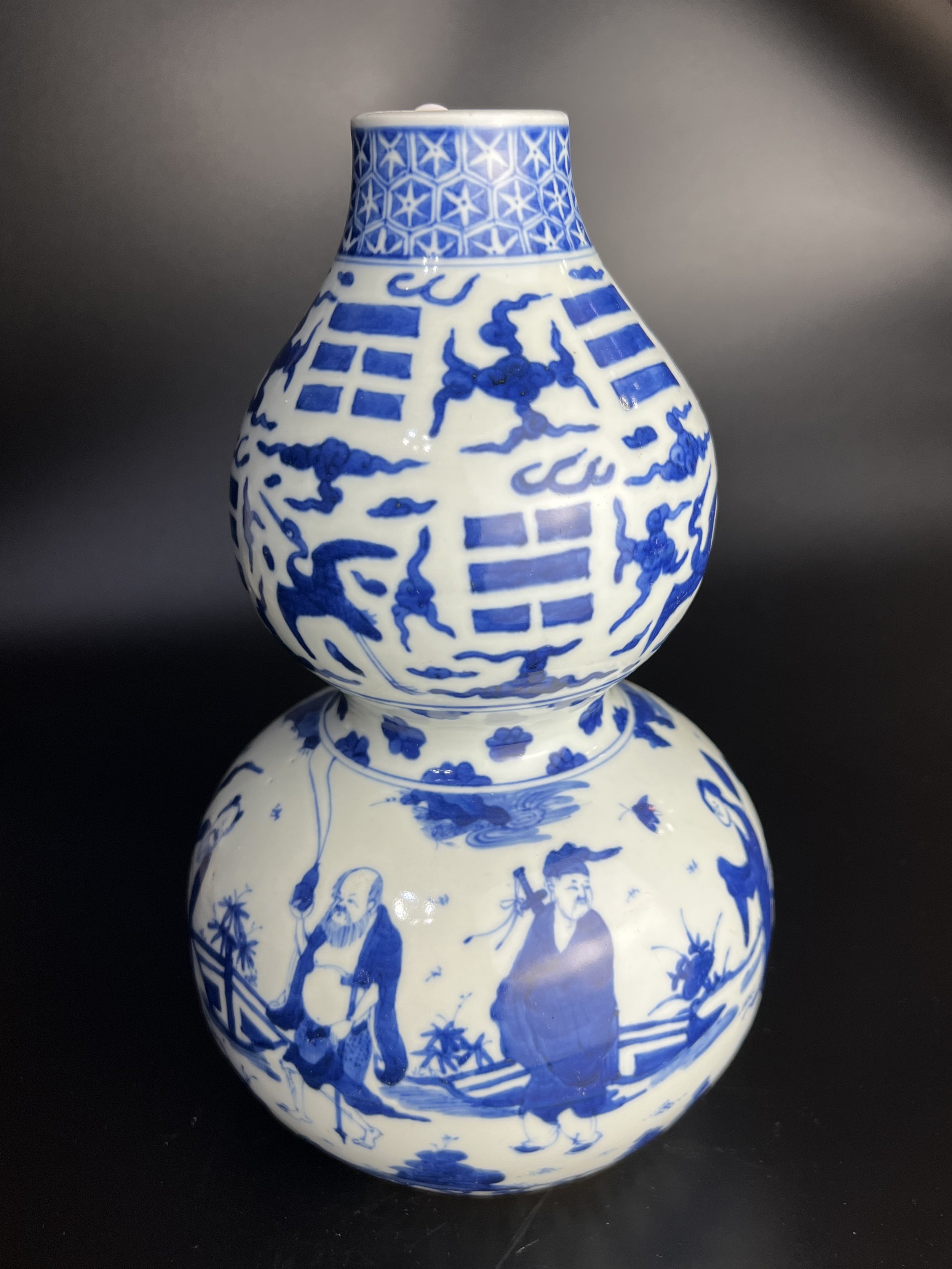 Image 3 of 8
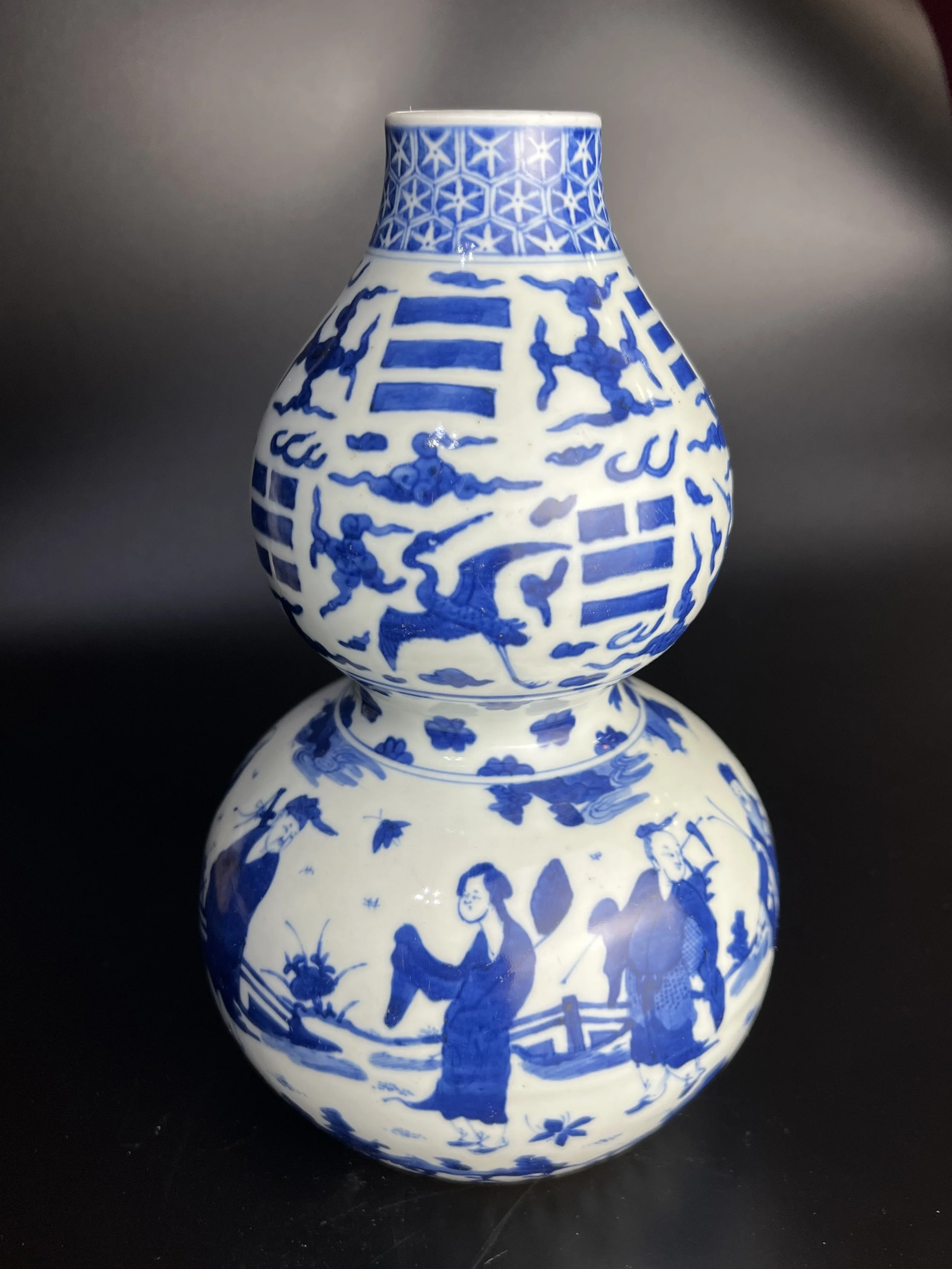 Image 4 of 8
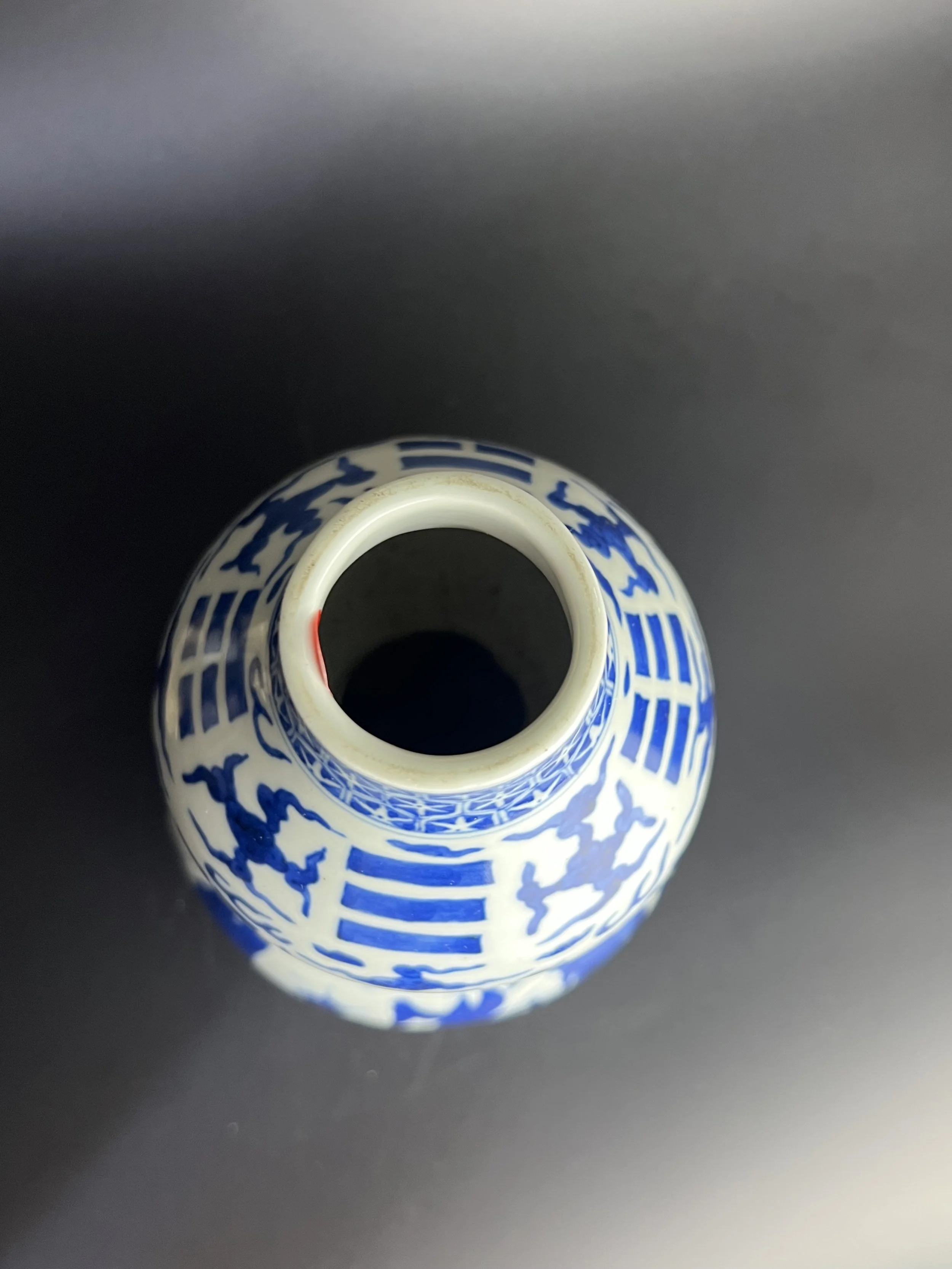 Image 5 of 8
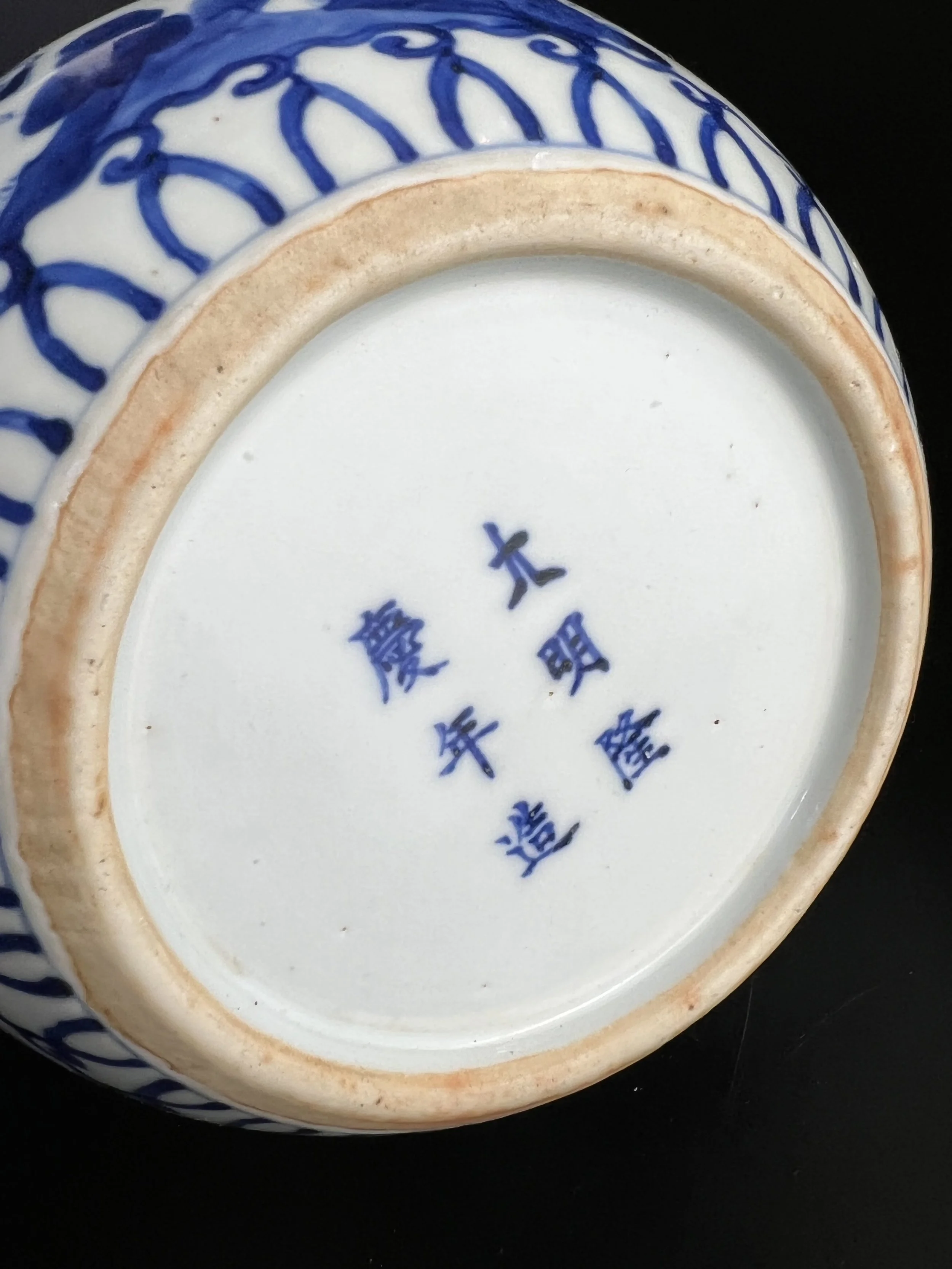 Image 6 of 8
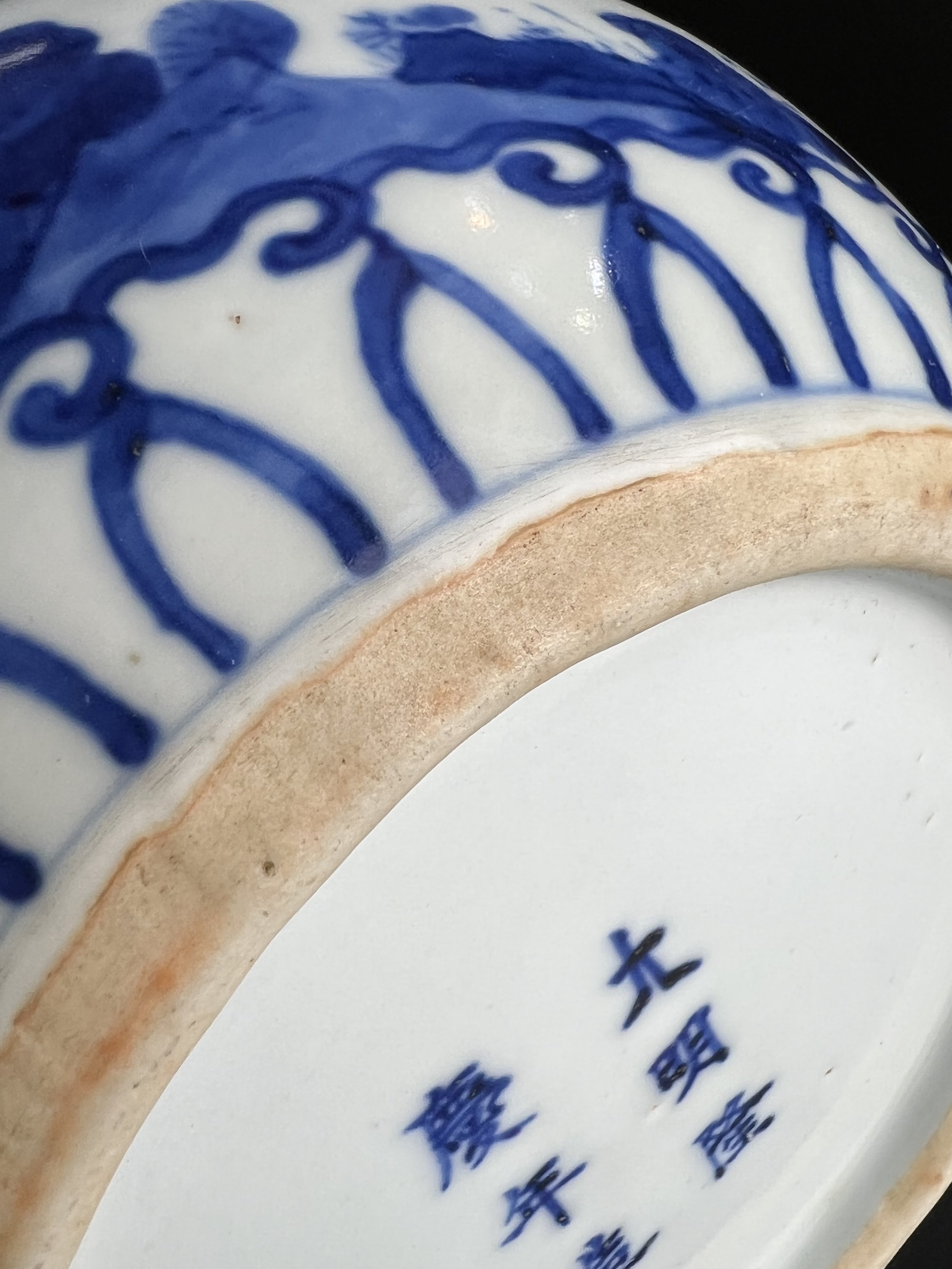 Image 7 of 8
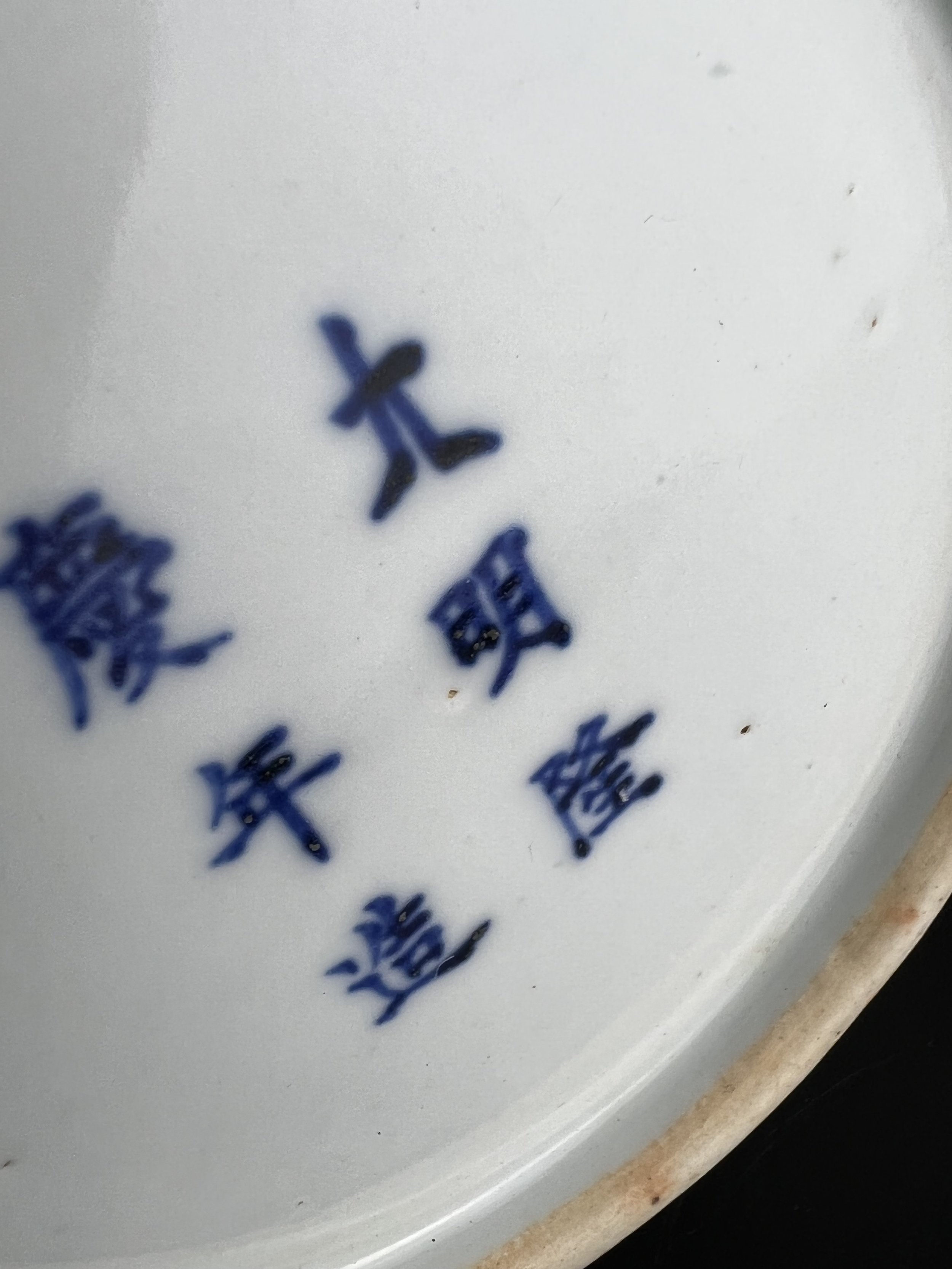 Image 8 of 8
A Blue-and-White Double-Gourd Vase with the ‘Eight Immortals’ and the ‘Eight Trigrams’, Longqing Mark and Period
Overview
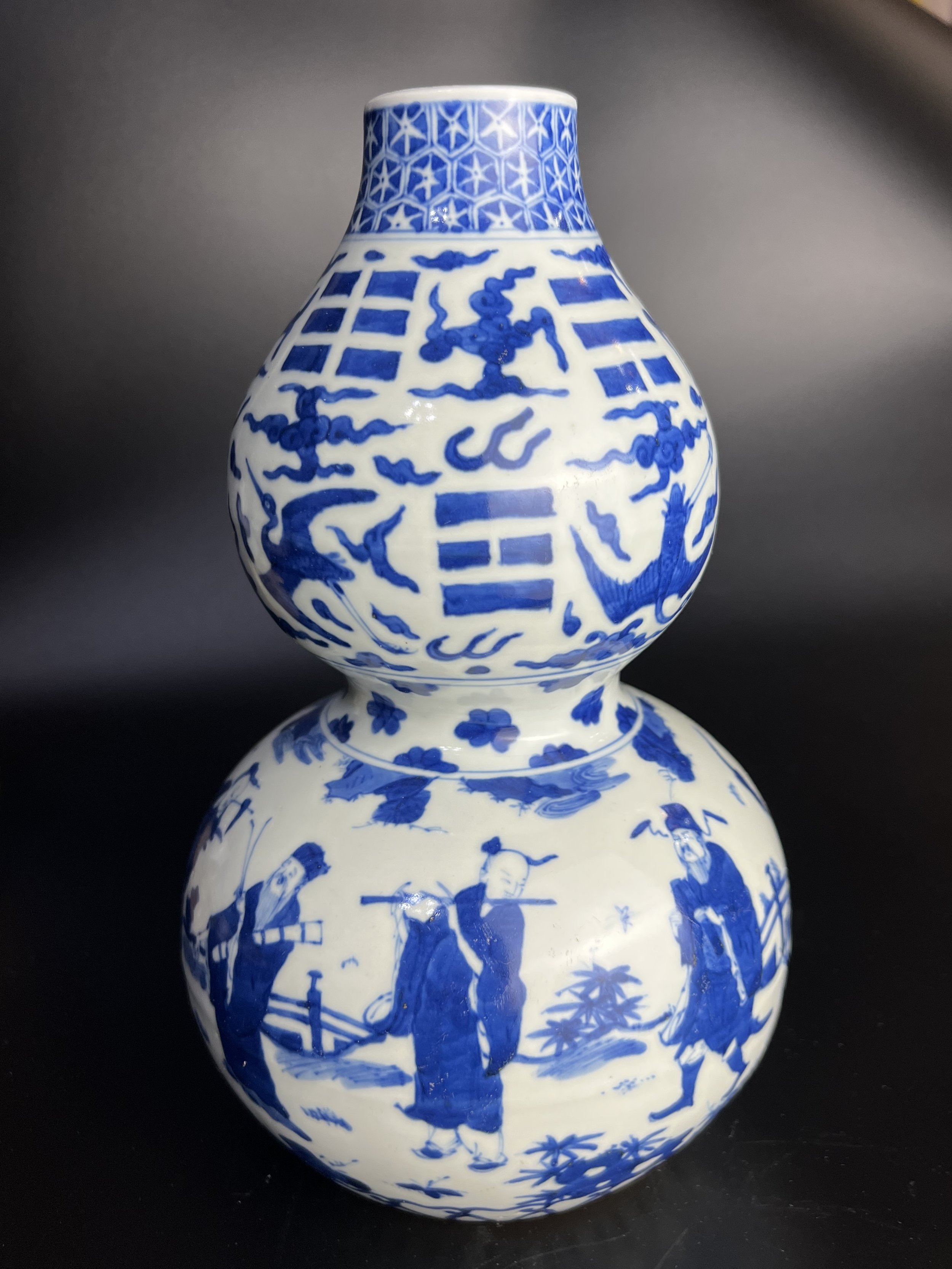
This blue-and-white double-gourd vase decorated with the ‘Eight Immortals’ and the ‘Eight Trigrams’, bearing the Longqing six-character mark, stands at 27 cm tall and represents a classic example of imperial blue-and-white ware from the Ming Longqing reign. Featuring the elegant double-gourd form, its decoration presents a distinct and iconic theme: the upper section depicts Daoist trigrams, cranes, and clouds, while the lower section illustrates the Eight Immortals. This amalgamation of religious symbolism, auspicious meaning, and masterful ceramic technique is quintessential. With its rich, purplish-blue hue, meticulous painting, and neatly written reign mark, this vase perfectly embodies the technical standards of the Longqing imperial kilns, which inherited the Jiajing style while establishing their own character. It serves as a vital artifact for studying the influence of Daoist culture on court art in the mid-to-late Ming Dynasty.
I. Overview of Core Characteristics
Feature DimensionSpecific DescriptionObject DesignationBlue-and-White Double-Gourd Vase with the ‘Eight Immortals’ and the ‘Eight Trigrams’, Longqing mark and periodHistorical PeriodMing Dynasty, Longqing reign (1567-1572 AD)DimensionsHeight: 27 cmBasic FormStandard double-gourd (hulu) vase shape: a smaller upper globule and a larger lower globule separated by a constricted waist, standing on a ring foot. The form is饱满 (full and rounded) with flowing lines, symbolizing "good fortune and prosperity" (fulu).Decorative LayoutUpper Section (Top Globule): The main decoration features the Bagua (Eight Trigrams) symbols, interspersed with four clusters of cloud scrolls and flying crane motifs. Lower Section (Bottom Globule): The main body is painted with a continuous scene of the Eight Daoist Immortals (Tieguai Li, Han Zhongli, Zhang Guolao, Lan Caihe, He Xiangu, Lü Dongbin, Han Xiangzi, Cao Guojiu), each holding their attribute, depicted in lively postures. Waist: Typically decorated with scrolling vines or a geometric 'brocade' ground pattern.Cobalt-blue HueUses the typical "Mohammedan blue" (Huiqing) pigment characteristic of the Jiajing and Longqing periods. The color is a rich, vibrant翠绿-blue (emerald-greenish blue) with a distinct purplish tinge, pure and stable, representing the quintessential "Longqing blue" tone.Glaze, Body, and FootThe glaze is thick, lustrous, and moist, white with a bluish cast (bright blue glaze). The ring foot is unglazed; the exposed body reveals a fine, white, and well-refined porcelain texture, with faint ‘fiery red’ (huoshi hong) spots. The center of the base is covered with white glaze.MarkWithin a double-blue circle at the base center, the underglaze-blue six-character mark in two columns of regular script reads: "Da Ming Longqing Nian Zao". The calligraphy is neat, with clear, deliberate strokes. The character for "Long" has distinctive period traits, and the use of "Zao" (made) is unique to Longqing marks (other reigns typically use "Zhi").
II. In-Depth Analysis of Artistry and Craftsmanship
1. Auspicious Form and Unique Mark
Double-Gourd Form: The double-gourd vase (also called a 'great fortune vase'), homophonous with "good fortune and prosperity" (fulu) and resembling the character for "auspicious" (ji), became extremely popular from the Jiajing reign onward. This vase, at 27 cm, is moderately sized with a dignified form and well-proportioned upper and lower sections, balancing solemnity with elegance—a classic imperial kiln design.
Significant Mark: The Longqing reign lasted only six years, making surviving imperial wares rare. Therefore, porcelain with a definitive Longqing reign mark is particularly precious. The unique "Nian Zao" wording and the neat, slightly质朴 (simple/artless) regular script style provide the most direct and reliable basis for dating.
2. The Culmination of Daoist Thematic Decoration
Decorative Significance: The decoration reflects the prevalent Daoist beliefs in the mid-to-late Ming court and society.
The Eight Trigrams (Bagua): Originating from the I Ching (Book of Changes), these eight symbols represent fundamental cosmic principles, symbolizing the power to ward off evil and ensure stability.
Cranes and Auspicious Clouds: Cranes symbolize longevity and the Daoist immortal realm, while clouds represent good fortune and the celestial sphere, together creating an ethereal atmosphere.
The Eight Immortals: Representing all humanity, each holding their attribute (e.g., gourd, fan, fish-drum, sword), they embody the proverb "The Eight Immortals cross the sea, each revealing their divine power," conveying wishes for longevity and celebration. Combining the trigrams and the Eight Immortals on one vessel constitutes a classic "Daoist thematic decoration."
Painting Technique: Figures are rendered using "outline and fill" combined with limited washes. The Eight Immortals' faces are expressive, their drapery flowing. Despite the dense composition, primary and secondary elements are distinct. The blue outlines are crisp, and the color filling is precise, resulting in a华丽而繁缛 (ornate and intricate) and highly decorative scene.
3. Signature Longqing Blue-and-White Hue
The cobalt color exemplifies the peak performance of the "Mohammedan blue" pigment. Through the kiln masters' skilled formulation and control, the color evolved from the earlier overly brilliant and浮 (floating) purple to a deep, pure, stable bluish-purple—a lovely,幽菁 (deep and serene) shade acclaimed as the classic "Longqing blue." This hue is unique within the Ming blue-and-white spectrum, distinct from the Yongle-Xuande 'Sumali' blue and the Chenghua 'Pingtangqing' blue.
4. Refined Body, Glaze, and Manufacture
The glaze is thick and bright bluish-white, complementing the intense blue. The foot rim is neatly trimmed, and the exposed body shows a glutinous rice-like texture, reflecting the high standards of body preparation maintained into the Jiajing-Longqing period. The base glaze is pure white, providing clear contrast with the blue mark.
III. Historical Context and Proposed Function
Product of Courtly Daoist Fashion: The Jiajing Emperor was a fervent Daoist adherent. Although the Longqing reign was brief, court customs and imperial kiln designs largely continued. Vessels with such strong Daoist themes were likely specially commissioned for court Daoist rituals or as imperial gifts to Daoist priests and temples.
Auspicious Display Vessel: The double-gourd form itself is an auspicious object. Combined with the decoration signifying "the trigrams stabilize heaven and earth, the Eight Immortals bestow longevity," this vase was likely used as a precious display piece in palaces or aristocratic residences, symbolizing the attraction of fortune, prosperity, longevity, and protection.
A Pivotal Piece in Technical Evolution: Longqing imperial ware inherited the legacy of Jiajing while initiating changes that led to the Wanli style. This vase continues Jiajing traditions in pigment use and theme, yet its painting refinement and mark inscription show signs of transition toward the more intricate Wanli aesthetic, giving it significant value for periodization studies.
IV. Authentication Key Points
Longqing imperial wares are rare on the market; pieces that appear are often late Qing or Republic period imitations. Authentication requires careful scrutiny:
First, Examine the Mark: The "Da Ming Longqing Nian Zao" mark is key. Genuine marks feature neat, internally forceful calligraphy with period-specific character forms for "Long," "Qing," and "Zao." Imitation marks often appear weak, stiff, or have incorrect character forms.
Scrutinize the Cobalt Blue: Genuine pieces exhibit a pure, vibrant bluish-purple color that sinks into the glaze, appearing even and stable. Later imitations often use chemical pigments or later formulations of Huiqing and local cobalt, resulting in colors that are either too bright, purple, and浮 (floaty), or too dark/grey, lacking the serene depth of originals.
Compare Painting Style: Originals, despite intricate detail, show clear brushwork, natural figure expressions, and structured composition. Imitations often have粗糙凌乱 (coarse and messy) painting, stiff figures, and绵软无力 (soft and weak) lines.
Verify Body and Glaze: Originals have a fine, white body and a温润 (warm and moist) glaze surface. Imitations may have a slightly coarse body, a glaze that is overly shiny ("brassy") or dry, and unnaturally distributed 'fiery red' spots.
Conclusion
This Longqing blue-and-white double-gourd vase with the Eight Trigrams and Eight Immortals, with its rare and definitive reign mark, its characteristic rich coloration, and its unique, coherent Daoist iconography, stands as a standard reference piece and a treasure among Longqing imperial porcelain. It is not merely a work of exquisite craftsmanship but a three-dimensional historical document承载 (carrying) specific historical, religious, and cultural information from the mid-to-late Ming Dynasty. Its historical and artistic value far surpasses that of ordinary decorative objects.
明隆庆青花「八卦八仙」图葫芦瓶
概述
此件「大明隆庆年造」款青花八卦八仙图葫芦瓶,高27厘米,为明代隆庆朝官窑青花之典范。葫芦瓶形制优美,纹饰主题鲜明独特,上绘道家八卦、仙鹤祥云,下绘八仙人物,集宗教象征、吉祥寓意与精湛瓷艺于一体。其青花发色浓艳泛紫,画工精细,款识书写规整,完美体现了隆庆官窑承袭嘉靖风格又自成一格的工艺水准,是研究明代中后期道教文化影响宫廷艺术的重要实物。
一、 核心特征总览
特征维度具体描述器物定名明隆庆 青花八卦八仙图葫芦瓶历史年代明隆庆时期 (1567-1572年)器物尺寸高27厘米基本器型标准葫芦瓶式,上圆下方,束腰,圈足。造型饱满,线条流畅,寓“福禄”之意。纹饰布局上部(上葫芦):主体绘八卦符号,间饰四组团云纹与展翅仙鹤纹。下部(下葫芦):主体通景绘道教八仙人物(铁拐李、汉钟离、张果老、蓝采和、何仙姑、吕洞宾、韩湘子、曹国舅),各持法宝,姿态生动。腰部:常饰缠枝蔓草或锦地纹。青花发色使用嘉靖、隆庆时期典型的“回青”料,发色浓翠艳丽,蓝中泛紫,色泽纯正稳定,为典型的“隆庆青”色调。釉面胎足釉面肥厚莹润,白中闪青(亮青釉)。圈足露胎处,胎质细腻洁白,淘炼精良,可见浅淡火石红。底部中心施白釉。款识底部中心青花双圈内,书 「大明隆庆年造」 六字双行楷书款。字体工整,笔画顿挫分明,“隆”字书写有其时代特点,“造”字为隆庆款独特用字(他朝多为“制”)。
二、 艺术与工艺深度解析
1. 吉祥的器型与独特的款识
葫芦造型:葫芦瓶(又称“大吉瓶”)因谐音“福禄”,且形似“吉”字,自嘉靖以来极为流行。此瓶高27厘米,尺寸适中,形体端庄,上下两部比例协调,兼具庄重与灵秀之美,是典型官窑制式。
重要款识:隆庆一朝仅六年,传世官窑器物稀少,故带明确隆庆年款的瓷器尤为珍贵。其款识中独特的 “年造” 字样,以及工整中略带稚拙的楷书笔法,是断代的最直接、最可靠的依据。
2. 道教主题纹饰的集大成体现
纹饰内涵:此瓶纹饰是明代中后期宫廷及社会崇奉道教思想的集中反映。
八卦纹:源于《周易》,是代表宇宙间八大基本现象的符号,具有驱邪避祸、镇宅安邦的象征意义。
仙鹤与祥云:仙鹤象征长寿与仙道,祥云寓意吉祥与天界,共同烘托仙境氛围。
八仙人物:代表世间众生,各持法器(如葫芦、扇子、渔鼓、宝剑等),寓意“八仙过海,各显神通”,同时暗含祝颂长寿、贺喜之意。将八卦与八仙同绘一器,堪称“道教主题装饰”的经典组合。
绘画技法:人物描绘采用“单线平涂”与局部渲染结合。八仙人物开脸生动,衣纹流畅,虽构图密集但主次分明。青花勾勒线条清晰,填色精准,画面显得工丽而繁缛,极具装饰性。
3. 标志性的隆庆青花发色
此瓶青花色泽是典型的“回青”料巅峰期表现。经过窑工的熟练配比和掌控,发色克服了早期的紫艳浮燥,呈现出一种浓重、纯正、稳定的蓝紫色,幽菁可爱,被誉为“隆庆青”的典型。这种色泽在明代青花体系中独树一帜,既不同于永乐宣德的苏麻离青,也不同于成化的平等青。
4. 精工的胎釉与制作
釉面肥厚亮青,与浓艳的青花相映成辉。圈足修削工整,露胎处可见糯米般的质感,体现了嘉靖、隆庆朝依然保持的高水准制胎工艺。底釉洁白,与款识的青花形成清晰对比。
三、 历史内涵与用途推测
宫廷道教风尚的产物:嘉靖皇帝极度崇信道教,隆庆朝虽短暂,然宫廷习俗及御窑厂制式多有沿袭。此类充满浓厚道教色彩的器物,很可能是为宫廷道教仪式、或皇帝赏赐道士及道教庙观所特制。
吉祥陈设用器:葫芦瓶本身即是吉祥物,结合“八卦定乾坤,八仙佑长寿”的纹饰,此瓶极可能作为宫廷或贵族府邸中寓意福禄长寿、驱邪纳祥的贵重陈设品。
承前启后的工艺坐标:隆庆官窑上承嘉靖之遗风,下启万历之新变。此瓶在青料运用、纹饰题材上延续嘉靖风格,但在画工精细度与款识书写上,又显示出向万历繁缛风格过渡的迹象,具有重要的断代研究价值。
四、 鉴藏要点
隆庆官窑器存世量少,市场偶见亦多为晚清民国仿品,鉴藏需慎辨:
首看款识:“大明隆庆年造”六字款是核心。真款字体工整,笔力内蕴,“隆”、“慶”、“造”等字写法时代特征鲜明。仿款常书写软弱、僵硬或字形错误。
详察青花:真品青花发色应为纯正艳丽的蓝紫色,深入釉骨,色泽匀稳。后世仿品多用化学青料或回青与石子青的后期配方,色泽或过于艳紫漂浮,或偏黑偏灰,缺乏真品之幽菁沉着。
对比画风:真品人物绘画虽繁密,但笔触清晰,人物神态自然,布局有章法。仿品画工常显粗糙凌乱,人物形象呆板,纹饰线条绵软无力。
验证胎釉:真品胎质洁白细腻,釉面温润。仿品胎质可能略粗松,釉面过亮(贼光)或干涩,火石红分布不自然。
结语
此隆庆青花八卦八仙葫芦瓶,以其明确稀少的年款、典型浓艳的发色、独特而完整的道教纹饰组合,成为隆庆朝官窑瓷器中的标准器与珍贵品。它不仅是一件工艺精湛的艺术品,更是一件承载了明代中后期特定历史、宗教与文化信息的立体史书,其历史价值与艺术价值,远超一般陈设赏玩之器。
Overview
This blue-and-white double-gourd vase decorated with the ‘Eight Immortals’ and the ‘Eight Trigrams’, bearing the Longqing six-character mark, stands at 27 cm tall and represents a classic example of imperial blue-and-white ware from the Ming Longqing reign. Featuring the elegant double-gourd form, its decoration presents a distinct and iconic theme: the upper section depicts Daoist trigrams, cranes, and clouds, while the lower section illustrates the Eight Immortals. This amalgamation of religious symbolism, auspicious meaning, and masterful ceramic technique is quintessential. With its rich, purplish-blue hue, meticulous painting, and neatly written reign mark, this vase perfectly embodies the technical standards of the Longqing imperial kilns, which inherited the Jiajing style while establishing their own character. It serves as a vital artifact for studying the influence of Daoist culture on court art in the mid-to-late Ming Dynasty.
I. Overview of Core Characteristics
Feature DimensionSpecific DescriptionObject DesignationBlue-and-White Double-Gourd Vase with the ‘Eight Immortals’ and the ‘Eight Trigrams’, Longqing mark and periodHistorical PeriodMing Dynasty, Longqing reign (1567-1572 AD)DimensionsHeight: 27 cmBasic FormStandard double-gourd (hulu) vase shape: a smaller upper globule and a larger lower globule separated by a constricted waist, standing on a ring foot. The form is饱满 (full and rounded) with flowing lines, symbolizing "good fortune and prosperity" (fulu).Decorative LayoutUpper Section (Top Globule): The main decoration features the Bagua (Eight Trigrams) symbols, interspersed with four clusters of cloud scrolls and flying crane motifs. Lower Section (Bottom Globule): The main body is painted with a continuous scene of the Eight Daoist Immortals (Tieguai Li, Han Zhongli, Zhang Guolao, Lan Caihe, He Xiangu, Lü Dongbin, Han Xiangzi, Cao Guojiu), each holding their attribute, depicted in lively postures. Waist: Typically decorated with scrolling vines or a geometric 'brocade' ground pattern.Cobalt-blue HueUses the typical "Mohammedan blue" (Huiqing) pigment characteristic of the Jiajing and Longqing periods. The color is a rich, vibrant翠绿-blue (emerald-greenish blue) with a distinct purplish tinge, pure and stable, representing the quintessential "Longqing blue" tone.Glaze, Body, and FootThe glaze is thick, lustrous, and moist, white with a bluish cast (bright blue glaze). The ring foot is unglazed; the exposed body reveals a fine, white, and well-refined porcelain texture, with faint ‘fiery red’ (huoshi hong) spots. The center of the base is covered with white glaze.MarkWithin a double-blue circle at the base center, the underglaze-blue six-character mark in two columns of regular script reads: "Da Ming Longqing Nian Zao". The calligraphy is neat, with clear, deliberate strokes. The character for "Long" has distinctive period traits, and the use of "Zao" (made) is unique to Longqing marks (other reigns typically use "Zhi").
II. In-Depth Analysis of Artistry and Craftsmanship
1. Auspicious Form and Unique Mark
Double-Gourd Form: The double-gourd vase (also called a 'great fortune vase'), homophonous with "good fortune and prosperity" (fulu) and resembling the character for "auspicious" (ji), became extremely popular from the Jiajing reign onward. This vase, at 27 cm, is moderately sized with a dignified form and well-proportioned upper and lower sections, balancing solemnity with elegance—a classic imperial kiln design.
Significant Mark: The Longqing reign lasted only six years, making surviving imperial wares rare. Therefore, porcelain with a definitive Longqing reign mark is particularly precious. The unique "Nian Zao" wording and the neat, slightly质朴 (simple/artless) regular script style provide the most direct and reliable basis for dating.
2. The Culmination of Daoist Thematic Decoration
Decorative Significance: The decoration reflects the prevalent Daoist beliefs in the mid-to-late Ming court and society.
The Eight Trigrams (Bagua): Originating from the I Ching (Book of Changes), these eight symbols represent fundamental cosmic principles, symbolizing the power to ward off evil and ensure stability.
Cranes and Auspicious Clouds: Cranes symbolize longevity and the Daoist immortal realm, while clouds represent good fortune and the celestial sphere, together creating an ethereal atmosphere.
The Eight Immortals: Representing all humanity, each holding their attribute (e.g., gourd, fan, fish-drum, sword), they embody the proverb "The Eight Immortals cross the sea, each revealing their divine power," conveying wishes for longevity and celebration. Combining the trigrams and the Eight Immortals on one vessel constitutes a classic "Daoist thematic decoration."
Painting Technique: Figures are rendered using "outline and fill" combined with limited washes. The Eight Immortals' faces are expressive, their drapery flowing. Despite the dense composition, primary and secondary elements are distinct. The blue outlines are crisp, and the color filling is precise, resulting in a华丽而繁缛 (ornate and intricate) and highly decorative scene.
3. Signature Longqing Blue-and-White Hue
The cobalt color exemplifies the peak performance of the "Mohammedan blue" pigment. Through the kiln masters' skilled formulation and control, the color evolved from the earlier overly brilliant and浮 (floating) purple to a deep, pure, stable bluish-purple—a lovely,幽菁 (deep and serene) shade acclaimed as the classic "Longqing blue." This hue is unique within the Ming blue-and-white spectrum, distinct from the Yongle-Xuande 'Sumali' blue and the Chenghua 'Pingtangqing' blue.
4. Refined Body, Glaze, and Manufacture
The glaze is thick and bright bluish-white, complementing the intense blue. The foot rim is neatly trimmed, and the exposed body shows a glutinous rice-like texture, reflecting the high standards of body preparation maintained into the Jiajing-Longqing period. The base glaze is pure white, providing clear contrast with the blue mark.
III. Historical Context and Proposed Function
Product of Courtly Daoist Fashion: The Jiajing Emperor was a fervent Daoist adherent. Although the Longqing reign was brief, court customs and imperial kiln designs largely continued. Vessels with such strong Daoist themes were likely specially commissioned for court Daoist rituals or as imperial gifts to Daoist priests and temples.
Auspicious Display Vessel: The double-gourd form itself is an auspicious object. Combined with the decoration signifying "the trigrams stabilize heaven and earth, the Eight Immortals bestow longevity," this vase was likely used as a precious display piece in palaces or aristocratic residences, symbolizing the attraction of fortune, prosperity, longevity, and protection.
A Pivotal Piece in Technical Evolution: Longqing imperial ware inherited the legacy of Jiajing while initiating changes that led to the Wanli style. This vase continues Jiajing traditions in pigment use and theme, yet its painting refinement and mark inscription show signs of transition toward the more intricate Wanli aesthetic, giving it significant value for periodization studies.
IV. Authentication Key Points
Longqing imperial wares are rare on the market; pieces that appear are often late Qing or Republic period imitations. Authentication requires careful scrutiny:
First, Examine the Mark: The "Da Ming Longqing Nian Zao" mark is key. Genuine marks feature neat, internally forceful calligraphy with period-specific character forms for "Long," "Qing," and "Zao." Imitation marks often appear weak, stiff, or have incorrect character forms.
Scrutinize the Cobalt Blue: Genuine pieces exhibit a pure, vibrant bluish-purple color that sinks into the glaze, appearing even and stable. Later imitations often use chemical pigments or later formulations of Huiqing and local cobalt, resulting in colors that are either too bright, purple, and浮 (floaty), or too dark/grey, lacking the serene depth of originals.
Compare Painting Style: Originals, despite intricate detail, show clear brushwork, natural figure expressions, and structured composition. Imitations often have粗糙凌乱 (coarse and messy) painting, stiff figures, and绵软无力 (soft and weak) lines.
Verify Body and Glaze: Originals have a fine, white body and a温润 (warm and moist) glaze surface. Imitations may have a slightly coarse body, a glaze that is overly shiny ("brassy") or dry, and unnaturally distributed 'fiery red' spots.
Conclusion
This Longqing blue-and-white double-gourd vase with the Eight Trigrams and Eight Immortals, with its rare and definitive reign mark, its characteristic rich coloration, and its unique, coherent Daoist iconography, stands as a standard reference piece and a treasure among Longqing imperial porcelain. It is not merely a work of exquisite craftsmanship but a three-dimensional historical document承载 (carrying) specific historical, religious, and cultural information from the mid-to-late Ming Dynasty. Its historical and artistic value far surpasses that of ordinary decorative objects.
明隆庆青花「八卦八仙」图葫芦瓶
概述
此件「大明隆庆年造」款青花八卦八仙图葫芦瓶,高27厘米,为明代隆庆朝官窑青花之典范。葫芦瓶形制优美,纹饰主题鲜明独特,上绘道家八卦、仙鹤祥云,下绘八仙人物,集宗教象征、吉祥寓意与精湛瓷艺于一体。其青花发色浓艳泛紫,画工精细,款识书写规整,完美体现了隆庆官窑承袭嘉靖风格又自成一格的工艺水准,是研究明代中后期道教文化影响宫廷艺术的重要实物。
一、 核心特征总览
特征维度具体描述器物定名明隆庆 青花八卦八仙图葫芦瓶历史年代明隆庆时期 (1567-1572年)器物尺寸高27厘米基本器型标准葫芦瓶式,上圆下方,束腰,圈足。造型饱满,线条流畅,寓“福禄”之意。纹饰布局上部(上葫芦):主体绘八卦符号,间饰四组团云纹与展翅仙鹤纹。下部(下葫芦):主体通景绘道教八仙人物(铁拐李、汉钟离、张果老、蓝采和、何仙姑、吕洞宾、韩湘子、曹国舅),各持法宝,姿态生动。腰部:常饰缠枝蔓草或锦地纹。青花发色使用嘉靖、隆庆时期典型的“回青”料,发色浓翠艳丽,蓝中泛紫,色泽纯正稳定,为典型的“隆庆青”色调。釉面胎足釉面肥厚莹润,白中闪青(亮青釉)。圈足露胎处,胎质细腻洁白,淘炼精良,可见浅淡火石红。底部中心施白釉。款识底部中心青花双圈内,书 「大明隆庆年造」 六字双行楷书款。字体工整,笔画顿挫分明,“隆”字书写有其时代特点,“造”字为隆庆款独特用字(他朝多为“制”)。
二、 艺术与工艺深度解析
1. 吉祥的器型与独特的款识
葫芦造型:葫芦瓶(又称“大吉瓶”)因谐音“福禄”,且形似“吉”字,自嘉靖以来极为流行。此瓶高27厘米,尺寸适中,形体端庄,上下两部比例协调,兼具庄重与灵秀之美,是典型官窑制式。
重要款识:隆庆一朝仅六年,传世官窑器物稀少,故带明确隆庆年款的瓷器尤为珍贵。其款识中独特的 “年造” 字样,以及工整中略带稚拙的楷书笔法,是断代的最直接、最可靠的依据。
2. 道教主题纹饰的集大成体现
纹饰内涵:此瓶纹饰是明代中后期宫廷及社会崇奉道教思想的集中反映。
八卦纹:源于《周易》,是代表宇宙间八大基本现象的符号,具有驱邪避祸、镇宅安邦的象征意义。
仙鹤与祥云:仙鹤象征长寿与仙道,祥云寓意吉祥与天界,共同烘托仙境氛围。
八仙人物:代表世间众生,各持法器(如葫芦、扇子、渔鼓、宝剑等),寓意“八仙过海,各显神通”,同时暗含祝颂长寿、贺喜之意。将八卦与八仙同绘一器,堪称“道教主题装饰”的经典组合。
绘画技法:人物描绘采用“单线平涂”与局部渲染结合。八仙人物开脸生动,衣纹流畅,虽构图密集但主次分明。青花勾勒线条清晰,填色精准,画面显得工丽而繁缛,极具装饰性。
3. 标志性的隆庆青花发色
此瓶青花色泽是典型的“回青”料巅峰期表现。经过窑工的熟练配比和掌控,发色克服了早期的紫艳浮燥,呈现出一种浓重、纯正、稳定的蓝紫色,幽菁可爱,被誉为“隆庆青”的典型。这种色泽在明代青花体系中独树一帜,既不同于永乐宣德的苏麻离青,也不同于成化的平等青。
4. 精工的胎釉与制作
釉面肥厚亮青,与浓艳的青花相映成辉。圈足修削工整,露胎处可见糯米般的质感,体现了嘉靖、隆庆朝依然保持的高水准制胎工艺。底釉洁白,与款识的青花形成清晰对比。
三、 历史内涵与用途推测
宫廷道教风尚的产物:嘉靖皇帝极度崇信道教,隆庆朝虽短暂,然宫廷习俗及御窑厂制式多有沿袭。此类充满浓厚道教色彩的器物,很可能是为宫廷道教仪式、或皇帝赏赐道士及道教庙观所特制。
吉祥陈设用器:葫芦瓶本身即是吉祥物,结合“八卦定乾坤,八仙佑长寿”的纹饰,此瓶极可能作为宫廷或贵族府邸中寓意福禄长寿、驱邪纳祥的贵重陈设品。
承前启后的工艺坐标:隆庆官窑上承嘉靖之遗风,下启万历之新变。此瓶在青料运用、纹饰题材上延续嘉靖风格,但在画工精细度与款识书写上,又显示出向万历繁缛风格过渡的迹象,具有重要的断代研究价值。
四、 鉴藏要点
隆庆官窑器存世量少,市场偶见亦多为晚清民国仿品,鉴藏需慎辨:
首看款识:“大明隆庆年造”六字款是核心。真款字体工整,笔力内蕴,“隆”、“慶”、“造”等字写法时代特征鲜明。仿款常书写软弱、僵硬或字形错误。
详察青花:真品青花发色应为纯正艳丽的蓝紫色,深入釉骨,色泽匀稳。后世仿品多用化学青料或回青与石子青的后期配方,色泽或过于艳紫漂浮,或偏黑偏灰,缺乏真品之幽菁沉着。
对比画风:真品人物绘画虽繁密,但笔触清晰,人物神态自然,布局有章法。仿品画工常显粗糙凌乱,人物形象呆板,纹饰线条绵软无力。
验证胎釉:真品胎质洁白细腻,釉面温润。仿品胎质可能略粗松,釉面过亮(贼光)或干涩,火石红分布不自然。
结语
此隆庆青花八卦八仙葫芦瓶,以其明确稀少的年款、典型浓艳的发色、独特而完整的道教纹饰组合,成为隆庆朝官窑瓷器中的标准器与珍贵品。它不仅是一件工艺精湛的艺术品,更是一件承载了明代中后期特定历史、宗教与文化信息的立体史书,其历史价值与艺术价值,远超一般陈设赏玩之器。