Overview
This Ming Yongle blue-and-white ‘birds-and-flowers’ ewer, standing at 35 cm, is a classic example of Yongle imperial ware for serving tea or wine. Its elegant form masterfully integrates traditional Chinese ceramic shapes with influences from foreign metalwork, resulting in fluid and upright lines. The entire vessel is densely decorated with exquisite patterns painted in imported ‘Sumali’ blue pigment. The layout is clearly layered, the painting vivid and expressive, and the blue hue richly saturated. This ewer represents the pinnacle of craftsmanship and artistry in blue-and-white porcelain production during the Yongle period and stands as an outstanding artifact of cultural exchange between China and the West.
I. Overview of Core Characteristics
Feature DimensionSpecific DescriptionObject DesignationBlue-and-White ‘Birds-and-Flowers’ Ewer, Yongle mark and periodHistorical PeriodMing Dynasty, Yongle reign (1403-1424 AD)DimensionsHeight: 35 cmBasic FormThe body follows the yuhuchunping (prunus vase) form: flared mouth, slender elongated neck, rounded globular belly, ring foot. A slender, curved spout is attached to one side, connected to the neck by a cloud-shaped bridge; a tall, arched带状柄 (ribbon-like handle) is on the opposite side. The shape derives from Islamic metal ewers, with exceptionally graceful and fluid lines.Decorative LayoutMouth Rim: Simple bow-string lines. Neck: Upper section: a band of banana leaf motifs. Lower section: scrolling floral vine (chihzhi) pattern. Main Body (Belly): Front and rear reserves, each painted with a pair of birds perched on flowering branches, forming the central pictorial scene. Upper Section of Foot: A band of upward-facing lotus petal panels. Spout and Handle: Also fully decorated with scrolling floral and plant patterns.Cobalt-blue HueUses imported ‘Sumali’ blue pigment. The color is intense, vibrant, and翠 (emerald-greenish blue), with a purplish tinge. Rich tonal variations are present; areas of heavy brushwork show distinct crystalline ‘iron-rust speckles’ and a metallic sheen. Natural diffusion is evident.Glaze, Body, and FootThe glaze is thick, lustrous, and moist, white with a bluish cast, exhibiting the ‘bright blue glaze’ (liangqing you) texture. The ring foot is neatly trimmed and平坦 (level); the unglazed area reveals a fine, white porcelain body that is hard and compact, with faint ‘fiery red’ (huoshi hong) spots.MarkThe base is fully glazed and bears no reign mark. This characteristic is consistent with Yongle imperial blue-and-white porcelain, especially for forms influenced by foreign prototypes, and serves as an important dating criterion.
II. In-Depth Analysis of Artistry and Craftsmanship
1. Aesthetic Beauty Fusing Chinese and Western Forms
Form Origins: The shape of this ewer directly references metal ewers from the Islamic world (12th-14th centuries), which the Jingdezhen imperial kilns successfully translated into porcelain during the Yongle period. Its essence lies in the harmonious proportions between the long spout, curved handle, and full belly, and the cloud-shaped bridge connecting the spout to the neck. This bridge solved structural stress points while becoming a distinctive decorative element—a ceramic interpretation of a metal rivet joint.
Linear Rhythm: The overall lines are executed in a single, coherent flow. The elegant straightness of the mouth and neck, the rounded fullness of the belly, and the sweeping curves of the spout and handle create a sense of dynamic movement and tension, showcasing the Yongle potters' superb skill in three-dimensional form and their pursuit of ultimate beauty in shape.
2. Clearly Layered and Auspicious Decoration
Compositional Layout: The decoration employs the classic "multi-tiered banded" structure. The bands on the neck, belly, and foot are distinct, with clear primary and secondary roles. The banana leaf band on the neck and the lotus petal band on the foot visually anchor the composition, while the central bird-and-flower scene on the belly is most prominent.
Painting Theme: The ‘birds-and-flowers’ pattern on the belly is not mere ornamentation but a proper bird-and-flower painting with specific auspicious meanings. A pair of birds on a branch often symbolizes "double happiness arriving," "marital harmony," or "ruler-minister accord." The accompanying flowers (e.g., peony, chrysanthemum, camellia) carry their own connotations of wealth, longevity, etc. The painting style blends realism with expressionism—bird feathers are rendered meticulously, branches sway gently, brimming with vitality.
Detail Treatment: The complete coverage of the spout and handle with painted patterns exemplifies the Yongle imperial kiln's "not a single brushstroke neglected" decorative philosophy. The continuous scrollwork symbolizes "endless regeneration."
3. Typical Yongle Blue-and-White Characteristics
The cobalt-blue coloration is central to authentication. The Sumali blue performs perfectly on this ewer:
Color: A sapphire-like, vivid, and lush blue that appears particularly striking against the white, bluish-tinged glaze.
Texture: Due to its high iron content, the pigment sinks into the body where brushstrokes converge or are heavily applied, forming blackish-brown ‘iron-rust speckles’ with a metallic sheen, slightly凹陷 (indented) to the touch. This is the most crucial period characteristic.
Ambiance: The edges of the blue lines show natural diffusion, akin to ink bleeding on absorbent paper. This imparts a朦胧 (hazy) sense of depth and the expressive ink-wash aesthetic to the painting—rich yet not garish, beautiful yet not vulgar.
4. Refined Body/Glaze and the Feature of "No Mark"
The unglazed foot rim is level and smooth; the body material is white, fine, and feels like glutinous rice flour, reflecting the exceptionally high standard of clay refinement at the time. The fully glazed yet unmarked base is typical of Yongle imperial ware, especially for such syncretic forms, reflecting the confidence of an era that valued "the quality of the vessel over the presence of a mark."
III. Historical Context and Usage
Paragon of Cross-Cultural Exchange: This ewer is direct material evidence of the cultural exchange facilitated by Zheng He's voyages during the Yongle and Xuande periods. It perfectly combines Middle Eastern metalware forms, West Asian scrolling patterns, traditional Chinese bird-and-flower painting themes, and blue-and-white technology. It is a masterpiece of artistic fusion from the nascent era of globalization.
Vessel for Court Banquets: An ewer of such exquisite beauty and complex craftsmanship was undoubtedly used as a wine or tea server at court or in high aristocratic households during significant banquets. Its elegant form facilitated pouring, while its magnificent decoration proclaimed the status of its user.
Embodiment of Yongle Taste: The vessel's overall style balances robust strength with graceful beauty, and dense ornamentation with open spaces. It possesses both exotic flair and a Chinese core, fully embodying the Yongle era's spirit of openness, inclusivity, absorption, and relentless pursuit of perfection—as well as the imperial aesthetic of the time.
IV. Authentication Key Points
Such ewers are famous Yongle products, later imitated (especially during the Qing dynasty's three great reigns). Authentication should focus on:
Form and Vitality: Originals have fluid, vigorous lines and harmonious proportions. Imitations often appear awkward or disproportionate in the joints between spout, handle, and body.
Cobalt Blue and Iron-Rust Speckles: Originals show clear Sumali blue traits; iron-rust speckles are naturally sunken with a subdued sheen. Imitations often use Huiqing or Zhejiang blue—the color may be blue but lacks genuine speckles, or they are artificially applied and look stiff.
Decoration and Brushwork Spirit: Originals feature lively, natural painting with fluid, powerful strokes; the birds and flowers are spirited. Imitations often have拘谨呆板 (stiff and wooden) brushwork.
Body, Glaze, and Foot: Originals have a温润 (warm and moist) glaze and body, with a fine texture on the unglazed parts. Imitations may have bodies that are too hard/white, glazes that are too shiny (‘brassy’) or too dull, and unnaturally distributed ‘fiery red’ spots.
Conclusion
This Yongle blue-and-white ‘birds-and-flowers’ ewer unites practicality and artistry, representing a Yongle imperial masterpiece where form, decoration, glaze, body, and cobalt pigment all reached their peak. It is not merely a vessel for containing fine wine but a sculptural art object that crystallizes the dialogue between civilizations in the early 15th century, showcasing the technological pinnacle and aesthetic ideals of the Ming Empire. Its value transcends time, remaining ever-fresh.
明永乐青花花鸟纹执壶
概述
此件明永乐青花花鸟纹执壶,高35厘米,为永乐御窑经典茶酒器皿。其造型优雅,融合中原瓷器形制与外来金属器影响,线条流畅挺拔。壶身通体以进口苏麻离青料绘制繁密精致的纹饰,布局层次分明,绘画生动传神,青花发色浓艳,代表了永乐时期青花瓷烧造的至高工艺与艺术水平,是中西文化交流的杰出载体。
一、 核心特征总览
特征维度具体描述器物定名明永乐 青花花鸟纹执壶历史年代明永乐时期 (1403-1424年)器物尺寸高35厘米基本器型壶身呈玉壶春瓶式,侈口,细长颈,圆垂腹,圈足。一侧置细长弯曲流,流口与颈部以云形系相连;另一侧置上耸弯曲的带状柄(把手)。造型源自伊斯兰金属执壶,线条极为流畅优美。纹饰布局口沿:简略弦纹。颈部:上部一周蕉叶纹,下部为缠枝花卉纹。腹部主体:前后开光,各绘一对禽鸟立于花枝之上,构成主题花鸟画。圈足上部:一周仰莲瓣纹。流与柄:亦满绘缠枝花草纹饰。青花发色使用进口“苏麻离青”料,发色浓艳青翠,蓝中泛紫,深浅层次丰富,笔触浓重处可见明显的“铁锈斑”结晶与锡光,晕散自然。釉面胎足釉面肥厚莹润,白中闪青,呈“亮青釉”质感。圈足处理平整,露胎处可见细腻洁白的胎体,胎质坚致,有浅淡火石红。款识底部满釉,无任何款识。此特征符合永乐官窑青花瓷,尤其是受外来器型影响的器物常见现象,是重要的断代依据。
二、 艺术与工艺深度解析
1. 融合中西的造型之美
器型源流:此执壶造型直接借鉴了12-14世纪伊斯兰地区的金属执壶,永乐时期景德镇御窑厂将其成功转化为瓷器。其精髓在于长流、曲柄与饱满壶身的和谐比例,以及连接流与颈部的云形系,既解决了力学支撑问题,又成为独特的装饰,是仿金属铆接结构的瓷艺化表现。
线条韵律:整体线条一气呵成,从口颈的秀挺,到腹部的圆润,再到流与柄的弧形曲线,充满了动感与张力,体现了永乐时期制瓷工匠高超的立体造型能力和对形式美的极致追求。
2. 层次分明、寓意吉祥的纹饰
构图布局:纹饰采用经典的“多层带状分割”法,颈部、腹部、足部纹饰带清晰,主次分明。颈部的蕉叶纹与足部的莲瓣纹上下呼应,稳定了视觉重心;腹部的花鸟主题居于中心,最为突出。
绘画主题:腹部所绘“花鸟纹”并非简单装饰,而是具有明确吉祥寓意的花鸟画。双鸟栖枝,常寓意“双喜临门”、“夫妇和美”或“君臣相得”;所配花卉(如牡丹、菊花、茶花等)亦各有富贵、长寿等吉祥含义。画风写实与写意结合,鸟羽细腻,花枝摇曳,生机盎然。
细节处理:流与柄上满绘画纹,体现了永乐官窑“无一笔简略”的装饰风格。缠枝纹连绵不断,寓意“生生不息”。
3. 典型的永乐青花特征
青花色泽是鉴定核心。苏麻离青料在此壶上表现完美:
色泽:呈色如蓝宝石,鲜艳欲滴,在莹白闪青的釉面衬托下,显得格外醒目。
质感:由于高铁,在绘画笔触交汇或重染处,青料深入胎骨,形成黑褐色、带有金属锡光的“铁锈斑”,抚之微凹,此为最重要时代特征。
韵味:青花线条边缘有自然晕散,犹如水墨在宣纸上洇开,使画面产生朦胧的层次感和水墨画的笔墨趣味,秾而不艳,丽而不俗。
4. 精工的胎釉与无款特点
三、 历史内涵与使用场景
中外文化交流的典范:此执壶是明代永乐、宣德时期,郑和下西洋推动中外文化交流的 direct 物质证据。它将中东的金属器造型、西亚的缠枝图案与中国传统的花鸟画题材、青花工艺完美结合,是全球化萌芽时期艺术融合的杰作。
宫廷宴饮之器:如此精美且工艺复杂的执壶,当为宫廷或高级贵族在重大宴飨场合使用的酒器或茶器。其优雅的造型便于持握倾倒,华丽的纹饰则彰显使用者身份。
永乐审美体现:器物整体风格在雄健中蕴含秀美,在繁密中保有疏朗,既有异域风情,又具中式内核,充分体现了永乐盛世开放包容、兼收并蓄又精益求精的时代精神与帝王审美。
四、 鉴藏要点
此类执壶为永乐名品,后世(尤以清三代)有仿,鉴藏需聚焦:
造型气韵:真品线条流畅劲健,比例和谐,仿品往往在流、柄与壶身的衔接处显得生硬或比例失调。
青花与铁锈斑:真品苏麻离青特征明显,铁锈斑自然下沉,锡光内敛。仿品多用回青或浙料,呈色虽蓝但无铁锈斑,或人为点染生硬。
纹饰笔意:真品绘画生动自然,笔触流畅有力,花鸟神采奕奕。仿品笔法常显拘谨呆板。
胎釉底足:真品胎釉温润,露胎处质感细腻。仿品胎质或过坚过白,釉面过亮(贼光)或过哑,火石红分布不自然。
结语
此永乐青花花鸟纹执壶,集实用性与艺术性于一身,是造型、纹饰、胎釉、青花料皆达到顶峰的永乐官窑代表作。它不仅是一件用于盛放琼浆玉液的酒器,更是一件凝结了十五世纪初中外文明对话、展现大明帝国工艺巅峰与美学理想的雕塑性艺术品,其价值超越时空,历久弥新。
Overview
This Ming Yongle blue-and-white ‘birds-and-flowers’ ewer, standing at 35 cm, is a classic example of Yongle imperial ware for serving tea or wine. Its elegant form masterfully integrates traditional Chinese ceramic shapes with influences from foreign metalwork, resulting in fluid and upright lines. The entire vessel is densely decorated with exquisite patterns painted in imported ‘Sumali’ blue pigment. The layout is clearly layered, the painting vivid and expressive, and the blue hue richly saturated. This ewer represents the pinnacle of craftsmanship and artistry in blue-and-white porcelain production during the Yongle period and stands as an outstanding artifact of cultural exchange between China and the West.
I. Overview of Core Characteristics
Feature DimensionSpecific DescriptionObject DesignationBlue-and-White ‘Birds-and-Flowers’ Ewer, Yongle mark and periodHistorical PeriodMing Dynasty, Yongle reign (1403-1424 AD)DimensionsHeight: 35 cmBasic FormThe body follows the yuhuchunping (prunus vase) form: flared mouth, slender elongated neck, rounded globular belly, ring foot. A slender, curved spout is attached to one side, connected to the neck by a cloud-shaped bridge; a tall, arched带状柄 (ribbon-like handle) is on the opposite side. The shape derives from Islamic metal ewers, with exceptionally graceful and fluid lines.Decorative LayoutMouth Rim: Simple bow-string lines. Neck: Upper section: a band of banana leaf motifs. Lower section: scrolling floral vine (chihzhi) pattern. Main Body (Belly): Front and rear reserves, each painted with a pair of birds perched on flowering branches, forming the central pictorial scene. Upper Section of Foot: A band of upward-facing lotus petal panels. Spout and Handle: Also fully decorated with scrolling floral and plant patterns.Cobalt-blue HueUses imported ‘Sumali’ blue pigment. The color is intense, vibrant, and翠 (emerald-greenish blue), with a purplish tinge. Rich tonal variations are present; areas of heavy brushwork show distinct crystalline ‘iron-rust speckles’ and a metallic sheen. Natural diffusion is evident.Glaze, Body, and FootThe glaze is thick, lustrous, and moist, white with a bluish cast, exhibiting the ‘bright blue glaze’ (liangqing you) texture. The ring foot is neatly trimmed and平坦 (level); the unglazed area reveals a fine, white porcelain body that is hard and compact, with faint ‘fiery red’ (huoshi hong) spots.MarkThe base is fully glazed and bears no reign mark. This characteristic is consistent with Yongle imperial blue-and-white porcelain, especially for forms influenced by foreign prototypes, and serves as an important dating criterion.
II. In-Depth Analysis of Artistry and Craftsmanship
1. Aesthetic Beauty Fusing Chinese and Western Forms
Form Origins: The shape of this ewer directly references metal ewers from the Islamic world (12th-14th centuries), which the Jingdezhen imperial kilns successfully translated into porcelain during the Yongle period. Its essence lies in the harmonious proportions between the long spout, curved handle, and full belly, and the cloud-shaped bridge connecting the spout to the neck. This bridge solved structural stress points while becoming a distinctive decorative element—a ceramic interpretation of a metal rivet joint.
Linear Rhythm: The overall lines are executed in a single, coherent flow. The elegant straightness of the mouth and neck, the rounded fullness of the belly, and the sweeping curves of the spout and handle create a sense of dynamic movement and tension, showcasing the Yongle potters' superb skill in three-dimensional form and their pursuit of ultimate beauty in shape.
2. Clearly Layered and Auspicious Decoration
Compositional Layout: The decoration employs the classic "multi-tiered banded" structure. The bands on the neck, belly, and foot are distinct, with clear primary and secondary roles. The banana leaf band on the neck and the lotus petal band on the foot visually anchor the composition, while the central bird-and-flower scene on the belly is most prominent.
Painting Theme: The ‘birds-and-flowers’ pattern on the belly is not mere ornamentation but a proper bird-and-flower painting with specific auspicious meanings. A pair of birds on a branch often symbolizes "double happiness arriving," "marital harmony," or "ruler-minister accord." The accompanying flowers (e.g., peony, chrysanthemum, camellia) carry their own connotations of wealth, longevity, etc. The painting style blends realism with expressionism—bird feathers are rendered meticulously, branches sway gently, brimming with vitality.
Detail Treatment: The complete coverage of the spout and handle with painted patterns exemplifies the Yongle imperial kiln's "not a single brushstroke neglected" decorative philosophy. The continuous scrollwork symbolizes "endless regeneration."
3. Typical Yongle Blue-and-White Characteristics
The cobalt-blue coloration is central to authentication. The Sumali blue performs perfectly on this ewer:
Color: A sapphire-like, vivid, and lush blue that appears particularly striking against the white, bluish-tinged glaze.
Texture: Due to its high iron content, the pigment sinks into the body where brushstrokes converge or are heavily applied, forming blackish-brown ‘iron-rust speckles’ with a metallic sheen, slightly凹陷 (indented) to the touch. This is the most crucial period characteristic.
Ambiance: The edges of the blue lines show natural diffusion, akin to ink bleeding on absorbent paper. This imparts a朦胧 (hazy) sense of depth and the expressive ink-wash aesthetic to the painting—rich yet not garish, beautiful yet not vulgar.
4. Refined Body/Glaze and the Feature of "No Mark"
The unglazed foot rim is level and smooth; the body material is white, fine, and feels like glutinous rice flour, reflecting the exceptionally high standard of clay refinement at the time. The fully glazed yet unmarked base is typical of Yongle imperial ware, especially for such syncretic forms, reflecting the confidence of an era that valued "the quality of the vessel over the presence of a mark."
III. Historical Context and Usage
Paragon of Cross-Cultural Exchange: This ewer is direct material evidence of the cultural exchange facilitated by Zheng He's voyages during the Yongle and Xuande periods. It perfectly combines Middle Eastern metalware forms, West Asian scrolling patterns, traditional Chinese bird-and-flower painting themes, and blue-and-white technology. It is a masterpiece of artistic fusion from the nascent era of globalization.
Vessel for Court Banquets: An ewer of such exquisite beauty and complex craftsmanship was undoubtedly used as a wine or tea server at court or in high aristocratic households during significant banquets. Its elegant form facilitated pouring, while its magnificent decoration proclaimed the status of its user.
Embodiment of Yongle Taste: The vessel's overall style balances robust strength with graceful beauty, and dense ornamentation with open spaces. It possesses both exotic flair and a Chinese core, fully embodying the Yongle era's spirit of openness, inclusivity, absorption, and relentless pursuit of perfection—as well as the imperial aesthetic of the time.
IV. Authentication Key Points
Such ewers are famous Yongle products, later imitated (especially during the Qing dynasty's three great reigns). Authentication should focus on:
Form and Vitality: Originals have fluid, vigorous lines and harmonious proportions. Imitations often appear awkward or disproportionate in the joints between spout, handle, and body.
Cobalt Blue and Iron-Rust Speckles: Originals show clear Sumali blue traits; iron-rust speckles are naturally sunken with a subdued sheen. Imitations often use Huiqing or Zhejiang blue—the color may be blue but lacks genuine speckles, or they are artificially applied and look stiff.
Decoration and Brushwork Spirit: Originals feature lively, natural painting with fluid, powerful strokes; the birds and flowers are spirited. Imitations often have拘谨呆板 (stiff and wooden) brushwork.
Body, Glaze, and Foot: Originals have a温润 (warm and moist) glaze and body, with a fine texture on the unglazed parts. Imitations may have bodies that are too hard/white, glazes that are too shiny (‘brassy’) or too dull, and unnaturally distributed ‘fiery red’ spots.
Conclusion
This Yongle blue-and-white ‘birds-and-flowers’ ewer unites practicality and artistry, representing a Yongle imperial masterpiece where form, decoration, glaze, body, and cobalt pigment all reached their peak. It is not merely a vessel for containing fine wine but a sculptural art object that crystallizes the dialogue between civilizations in the early 15th century, showcasing the technological pinnacle and aesthetic ideals of the Ming Empire. Its value transcends time, remaining ever-fresh.
明永乐青花花鸟纹执壶
概述
此件明永乐青花花鸟纹执壶,高35厘米,为永乐御窑经典茶酒器皿。其造型优雅,融合中原瓷器形制与外来金属器影响,线条流畅挺拔。壶身通体以进口苏麻离青料绘制繁密精致的纹饰,布局层次分明,绘画生动传神,青花发色浓艳,代表了永乐时期青花瓷烧造的至高工艺与艺术水平,是中西文化交流的杰出载体。
一、 核心特征总览
特征维度具体描述器物定名明永乐 青花花鸟纹执壶历史年代明永乐时期 (1403-1424年)器物尺寸高35厘米基本器型壶身呈玉壶春瓶式,侈口,细长颈,圆垂腹,圈足。一侧置细长弯曲流,流口与颈部以云形系相连;另一侧置上耸弯曲的带状柄(把手)。造型源自伊斯兰金属执壶,线条极为流畅优美。纹饰布局口沿:简略弦纹。颈部:上部一周蕉叶纹,下部为缠枝花卉纹。腹部主体:前后开光,各绘一对禽鸟立于花枝之上,构成主题花鸟画。圈足上部:一周仰莲瓣纹。流与柄:亦满绘缠枝花草纹饰。青花发色使用进口“苏麻离青”料,发色浓艳青翠,蓝中泛紫,深浅层次丰富,笔触浓重处可见明显的“铁锈斑”结晶与锡光,晕散自然。釉面胎足釉面肥厚莹润,白中闪青,呈“亮青釉”质感。圈足处理平整,露胎处可见细腻洁白的胎体,胎质坚致,有浅淡火石红。款识底部满釉,无任何款识。此特征符合永乐官窑青花瓷,尤其是受外来器型影响的器物常见现象,是重要的断代依据。
二、 艺术与工艺深度解析
1. 融合中西的造型之美
器型源流:此执壶造型直接借鉴了12-14世纪伊斯兰地区的金属执壶,永乐时期景德镇御窑厂将其成功转化为瓷器。其精髓在于长流、曲柄与饱满壶身的和谐比例,以及连接流与颈部的云形系,既解决了力学支撑问题,又成为独特的装饰,是仿金属铆接结构的瓷艺化表现。
线条韵律:整体线条一气呵成,从口颈的秀挺,到腹部的圆润,再到流与柄的弧形曲线,充满了动感与张力,体现了永乐时期制瓷工匠高超的立体造型能力和对形式美的极致追求。
2. 层次分明、寓意吉祥的纹饰
构图布局:纹饰采用经典的“多层带状分割”法,颈部、腹部、足部纹饰带清晰,主次分明。颈部的蕉叶纹与足部的莲瓣纹上下呼应,稳定了视觉重心;腹部的花鸟主题居于中心,最为突出。
绘画主题:腹部所绘“花鸟纹”并非简单装饰,而是具有明确吉祥寓意的花鸟画。双鸟栖枝,常寓意“双喜临门”、“夫妇和美”或“君臣相得”;所配花卉(如牡丹、菊花、茶花等)亦各有富贵、长寿等吉祥含义。画风写实与写意结合,鸟羽细腻,花枝摇曳,生机盎然。
细节处理:流与柄上满绘画纹,体现了永乐官窑“无一笔简略”的装饰风格。缠枝纹连绵不断,寓意“生生不息”。
3. 典型的永乐青花特征
青花色泽是鉴定核心。苏麻离青料在此壶上表现完美:
色泽:呈色如蓝宝石,鲜艳欲滴,在莹白闪青的釉面衬托下,显得格外醒目。
质感:由于高铁,在绘画笔触交汇或重染处,青料深入胎骨,形成黑褐色、带有金属锡光的“铁锈斑”,抚之微凹,此为最重要时代特征。
韵味:青花线条边缘有自然晕散,犹如水墨在宣纸上洇开,使画面产生朦胧的层次感和水墨画的笔墨趣味,秾而不艳,丽而不俗。
4. 精工的胎釉与无款特点
三、 历史内涵与使用场景
中外文化交流的典范:此执壶是明代永乐、宣德时期,郑和下西洋推动中外文化交流的 direct 物质证据。它将中东的金属器造型、西亚的缠枝图案与中国传统的花鸟画题材、青花工艺完美结合,是全球化萌芽时期艺术融合的杰作。
宫廷宴饮之器:如此精美且工艺复杂的执壶,当为宫廷或高级贵族在重大宴飨场合使用的酒器或茶器。其优雅的造型便于持握倾倒,华丽的纹饰则彰显使用者身份。
永乐审美体现:器物整体风格在雄健中蕴含秀美,在繁密中保有疏朗,既有异域风情,又具中式内核,充分体现了永乐盛世开放包容、兼收并蓄又精益求精的时代精神与帝王审美。
四、 鉴藏要点
此类执壶为永乐名品,后世(尤以清三代)有仿,鉴藏需聚焦:
造型气韵:真品线条流畅劲健,比例和谐,仿品往往在流、柄与壶身的衔接处显得生硬或比例失调。
青花与铁锈斑:真品苏麻离青特征明显,铁锈斑自然下沉,锡光内敛。仿品多用回青或浙料,呈色虽蓝但无铁锈斑,或人为点染生硬。
纹饰笔意:真品绘画生动自然,笔触流畅有力,花鸟神采奕奕。仿品笔法常显拘谨呆板。
胎釉底足:真品胎釉温润,露胎处质感细腻。仿品胎质或过坚过白,釉面过亮(贼光)或过哑,火石红分布不自然。
结语
此永乐青花花鸟纹执壶,集实用性与艺术性于一身,是造型、纹饰、胎釉、青花料皆达到顶峰的永乐官窑代表作。它不仅是一件用于盛放琼浆玉液的酒器,更是一件凝结了十五世纪初中外文明对话、展现大明帝国工艺巅峰与美学理想的雕塑性艺术品,其价值超越时空,历久弥新。
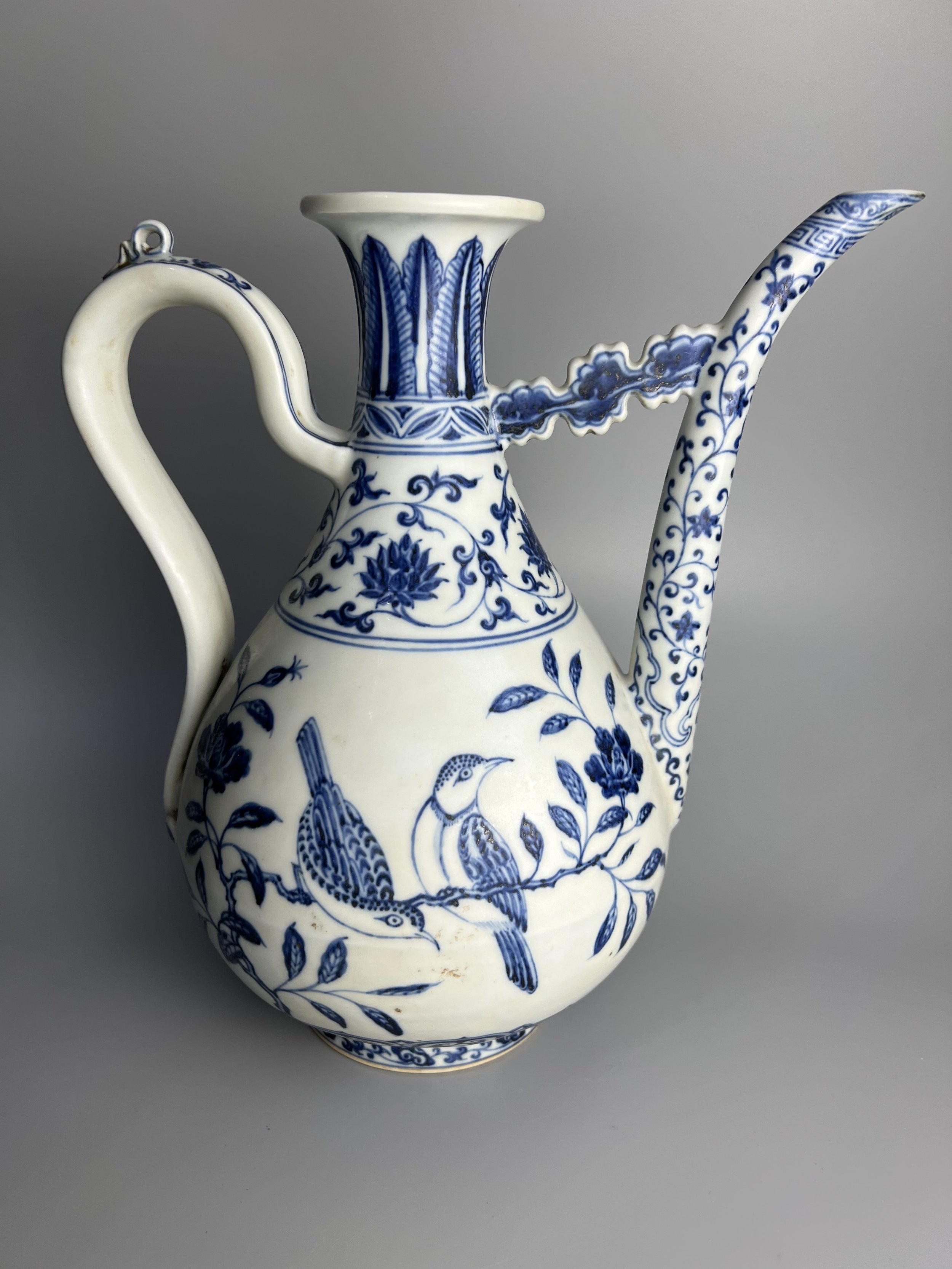 Image 1 of 21
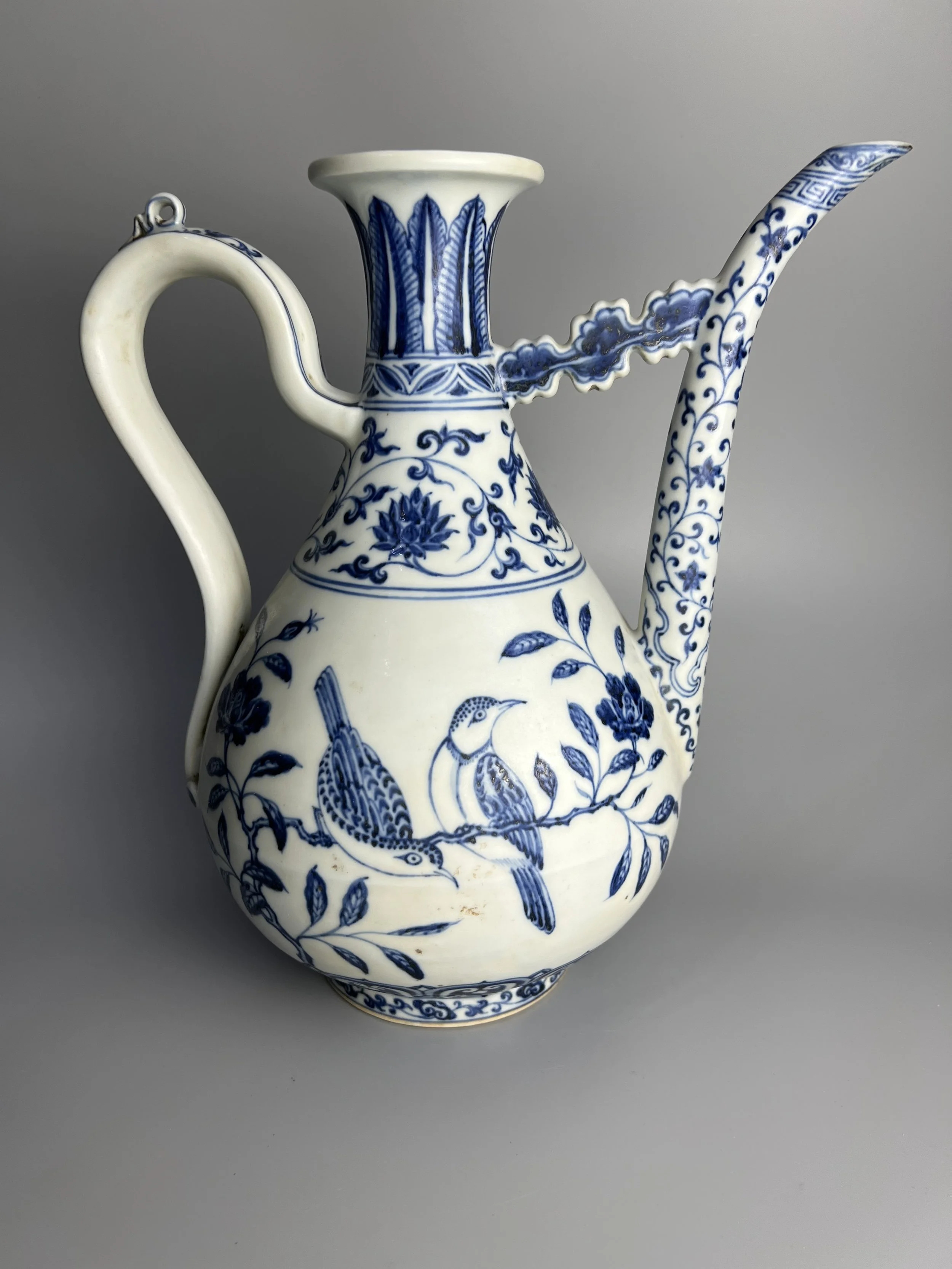 Image 2 of 21
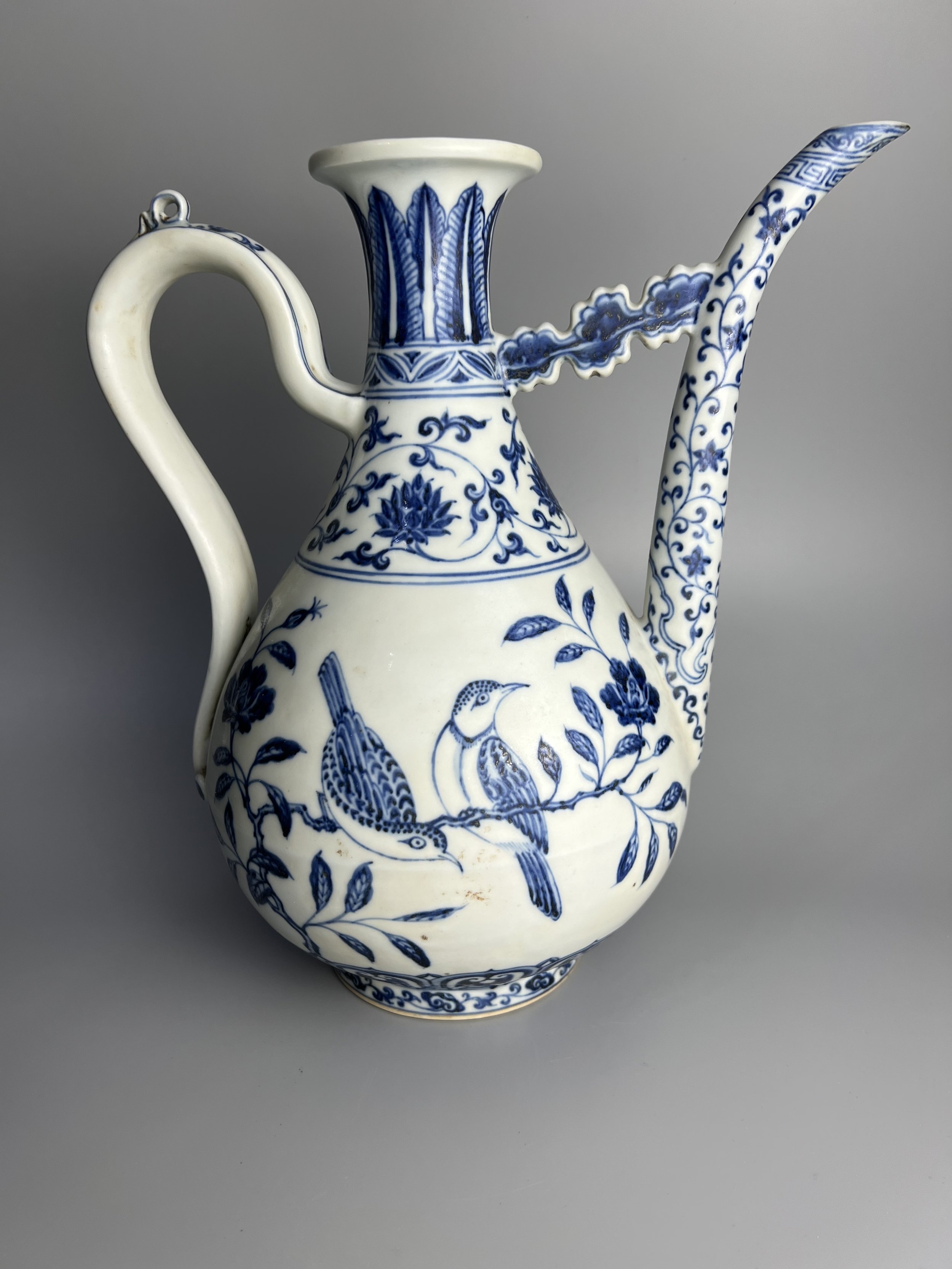 Image 3 of 21
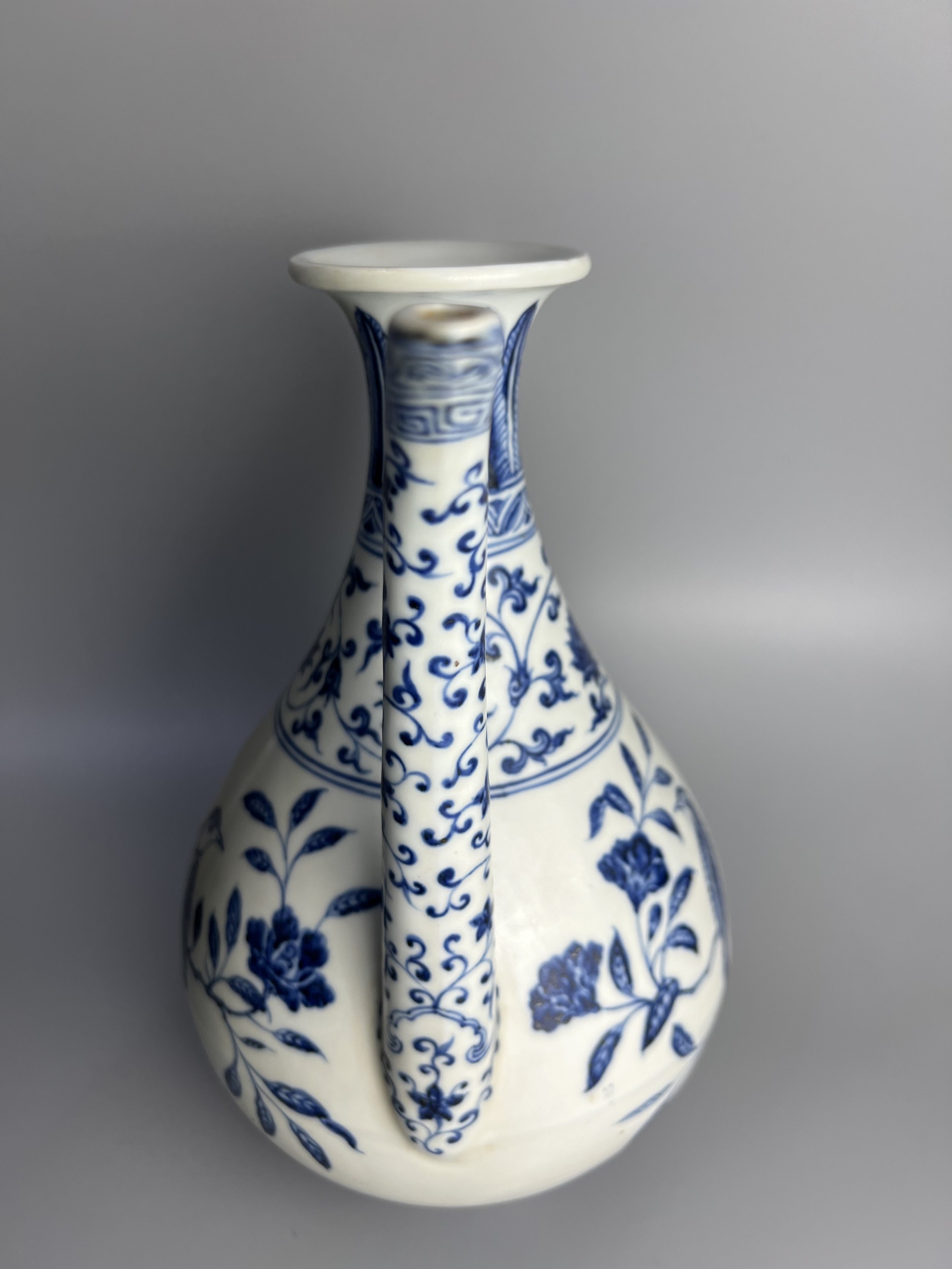 Image 4 of 21
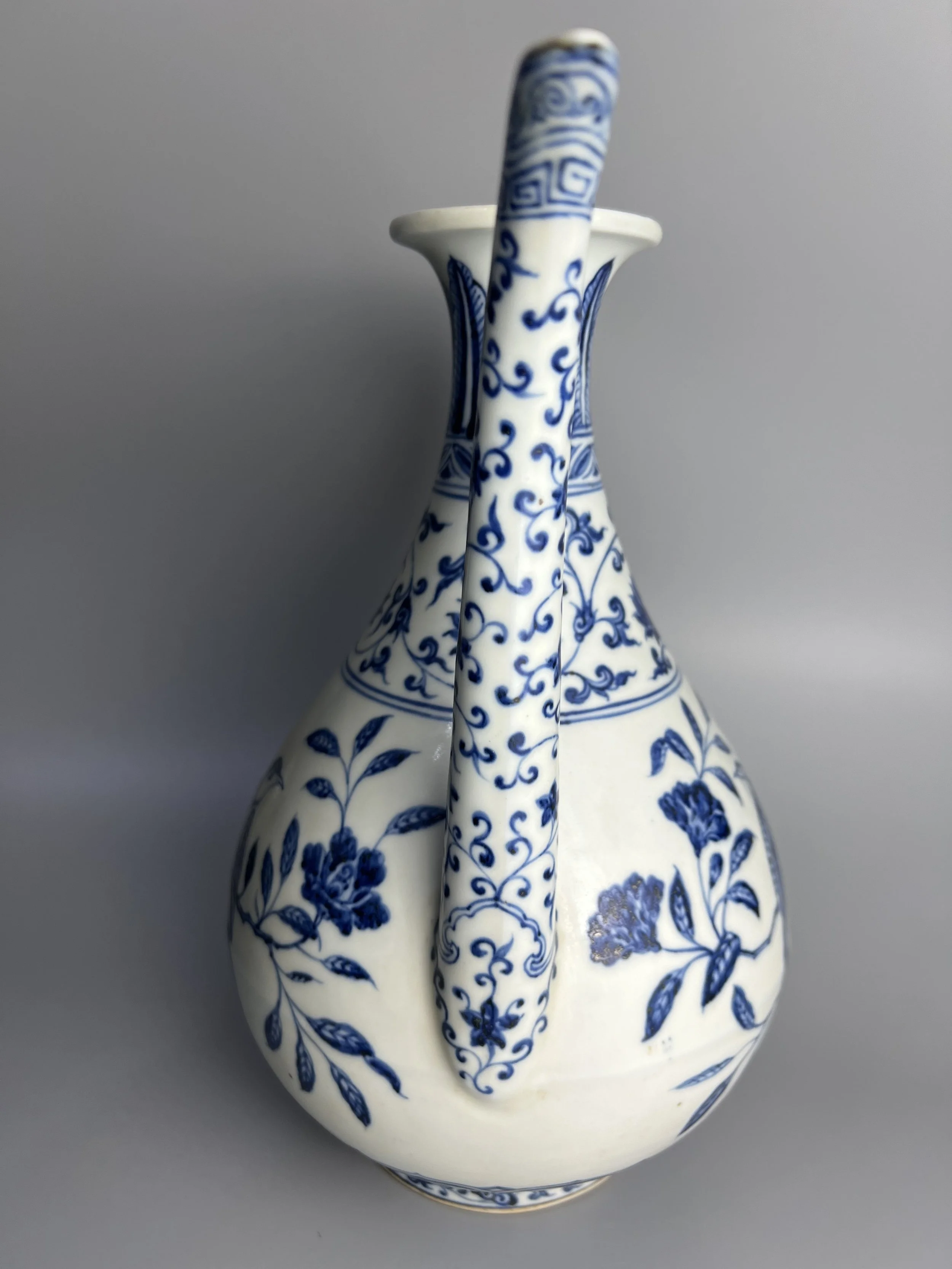 Image 5 of 21
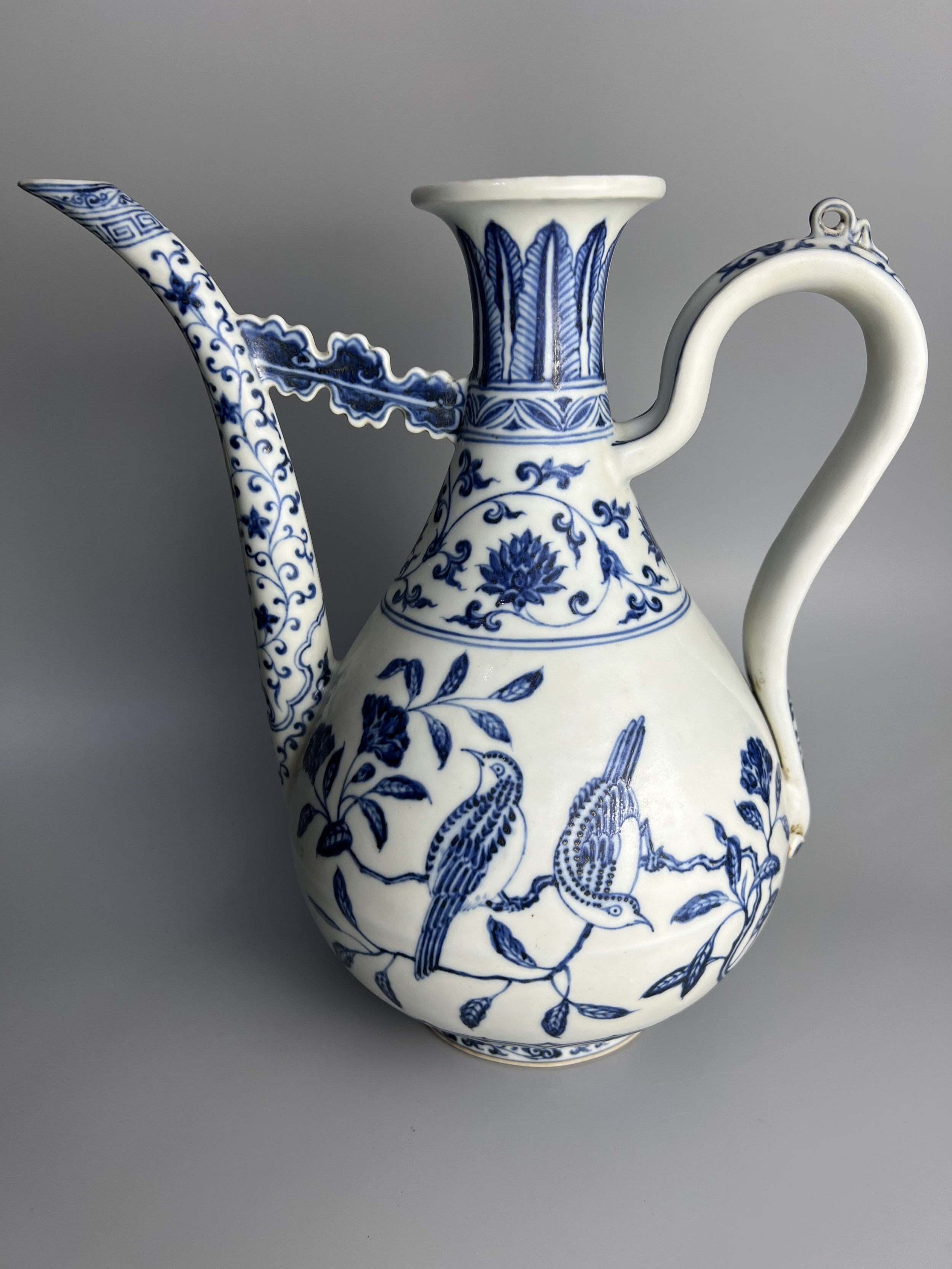 Image 6 of 21
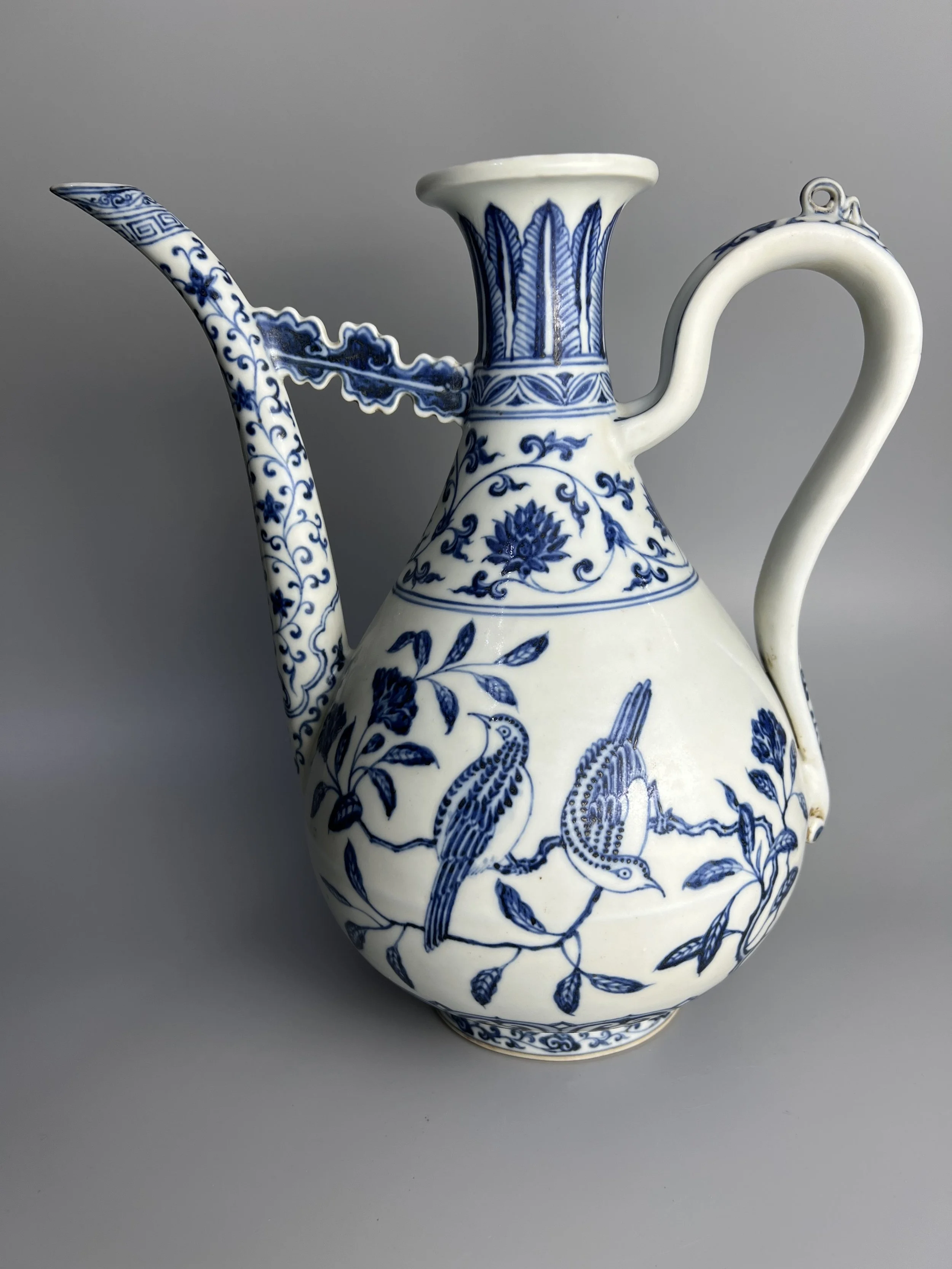 Image 7 of 21
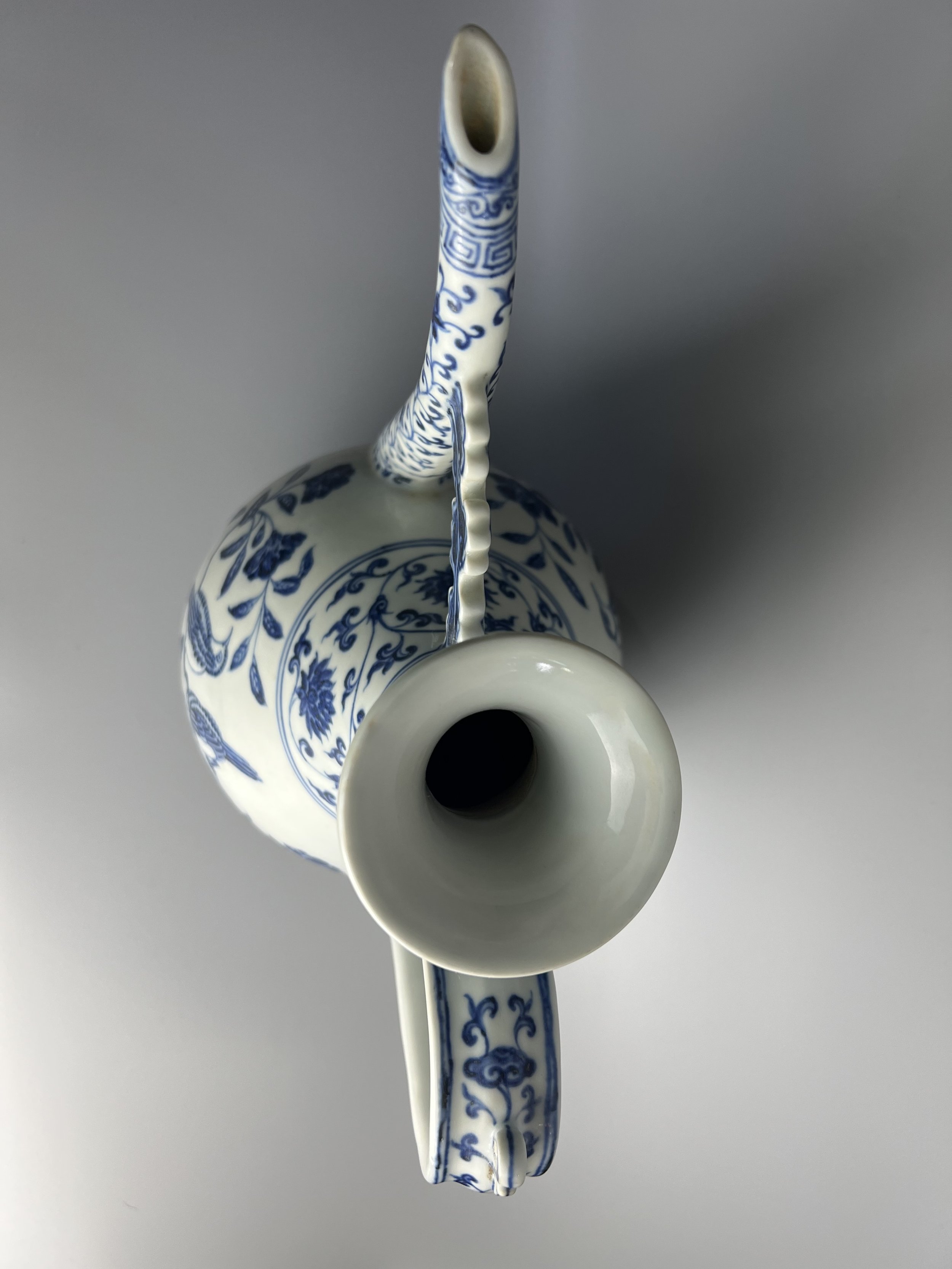 Image 8 of 21
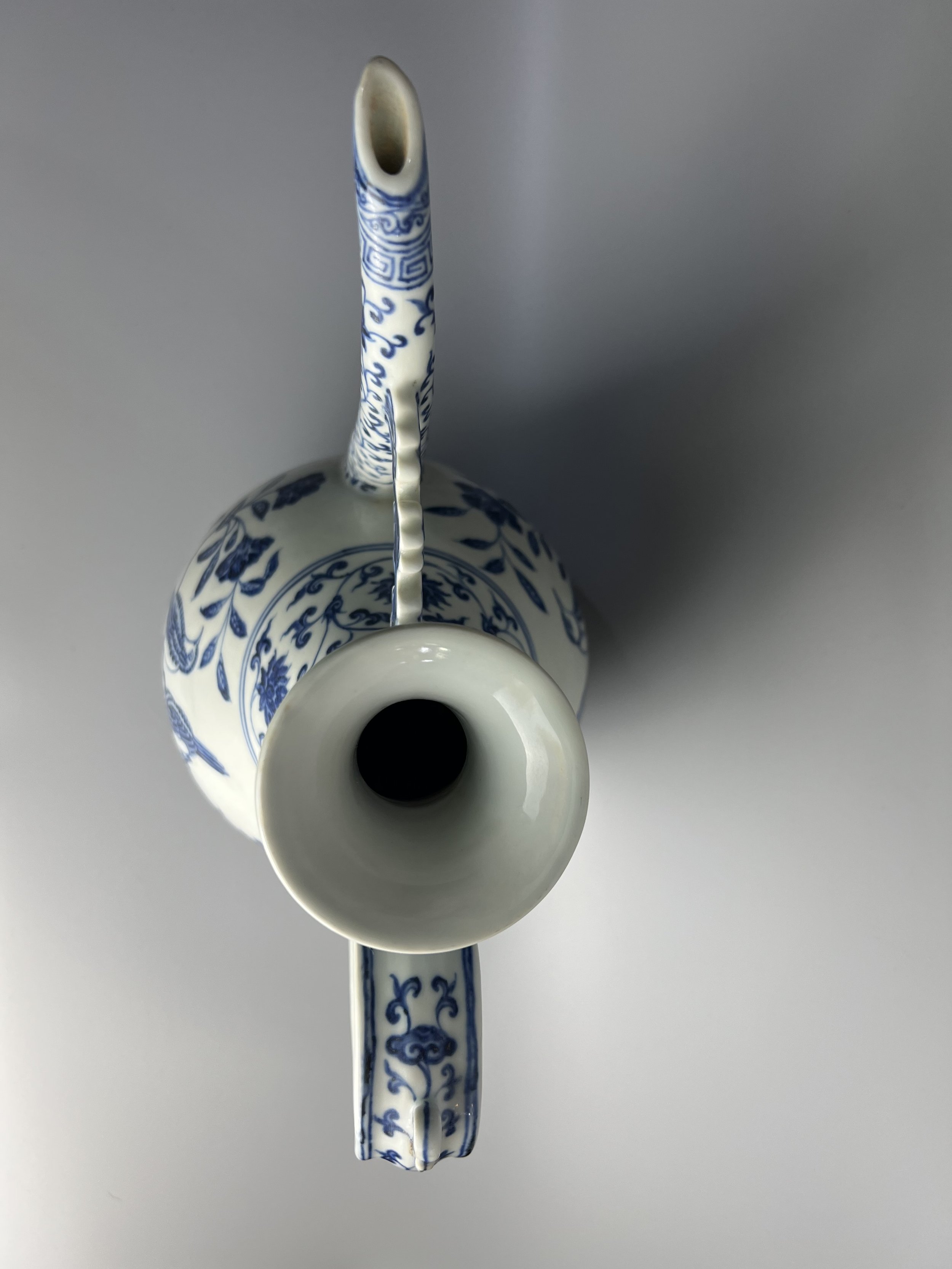 Image 9 of 21
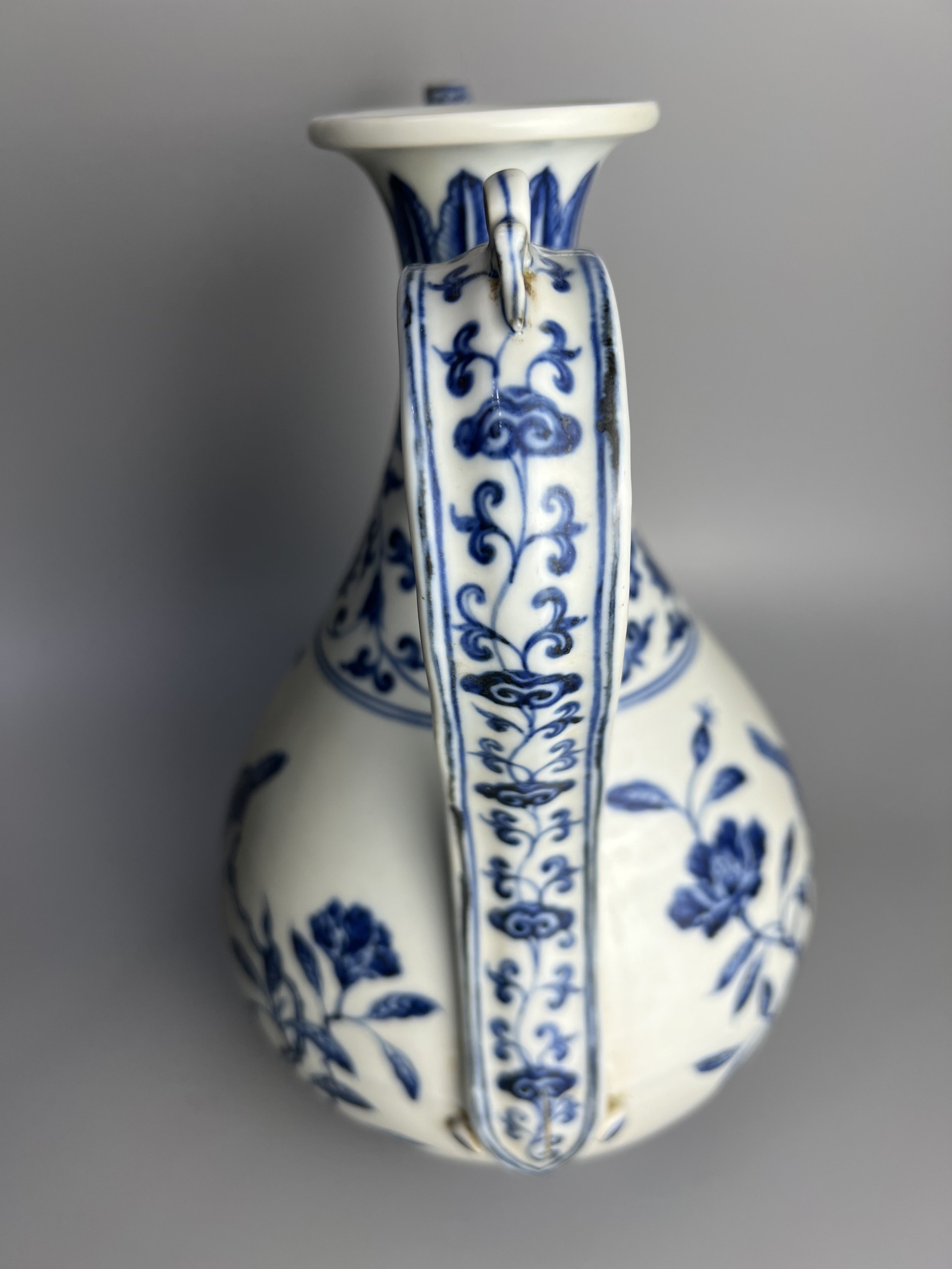 Image 10 of 21
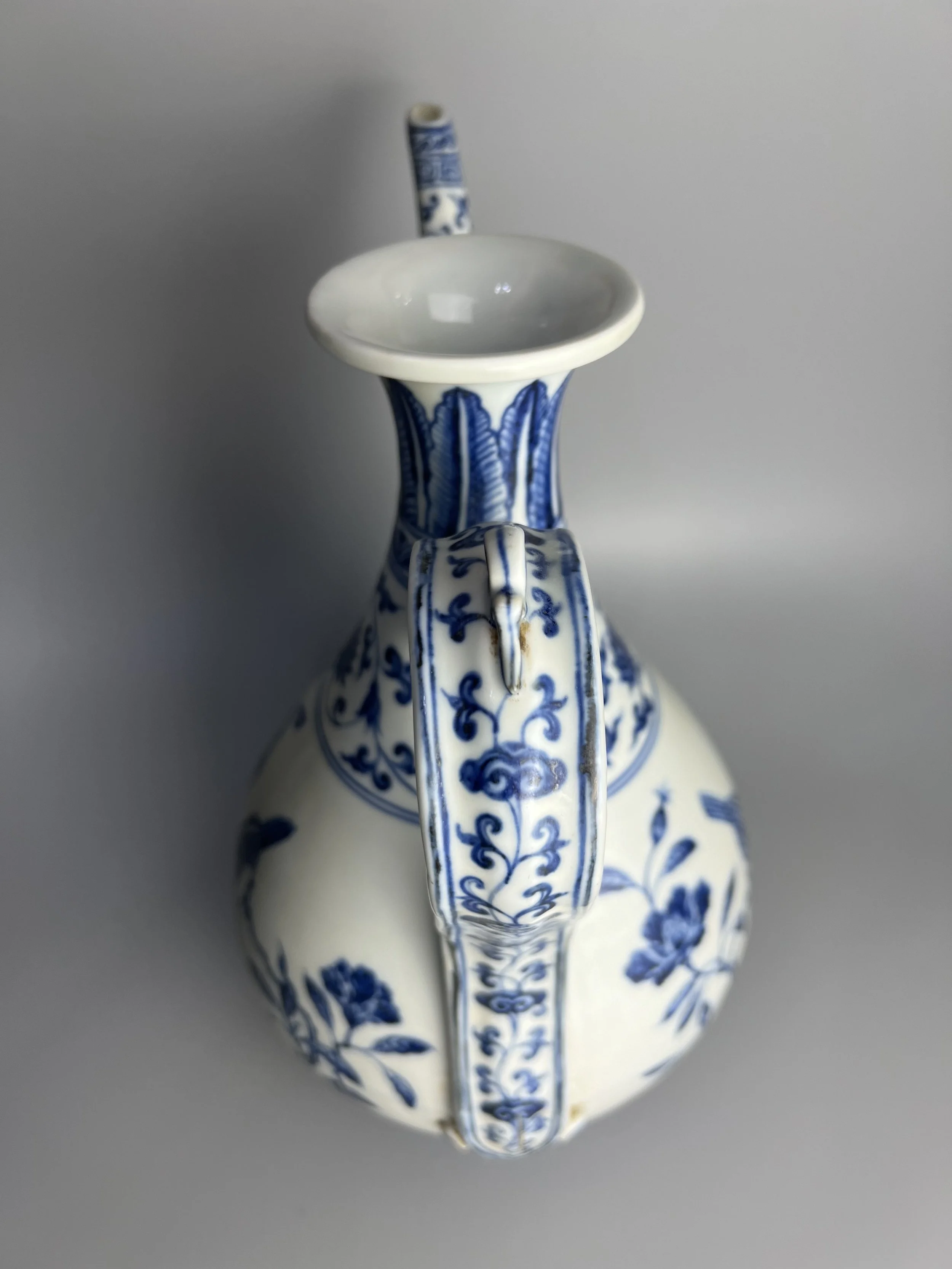 Image 11 of 21
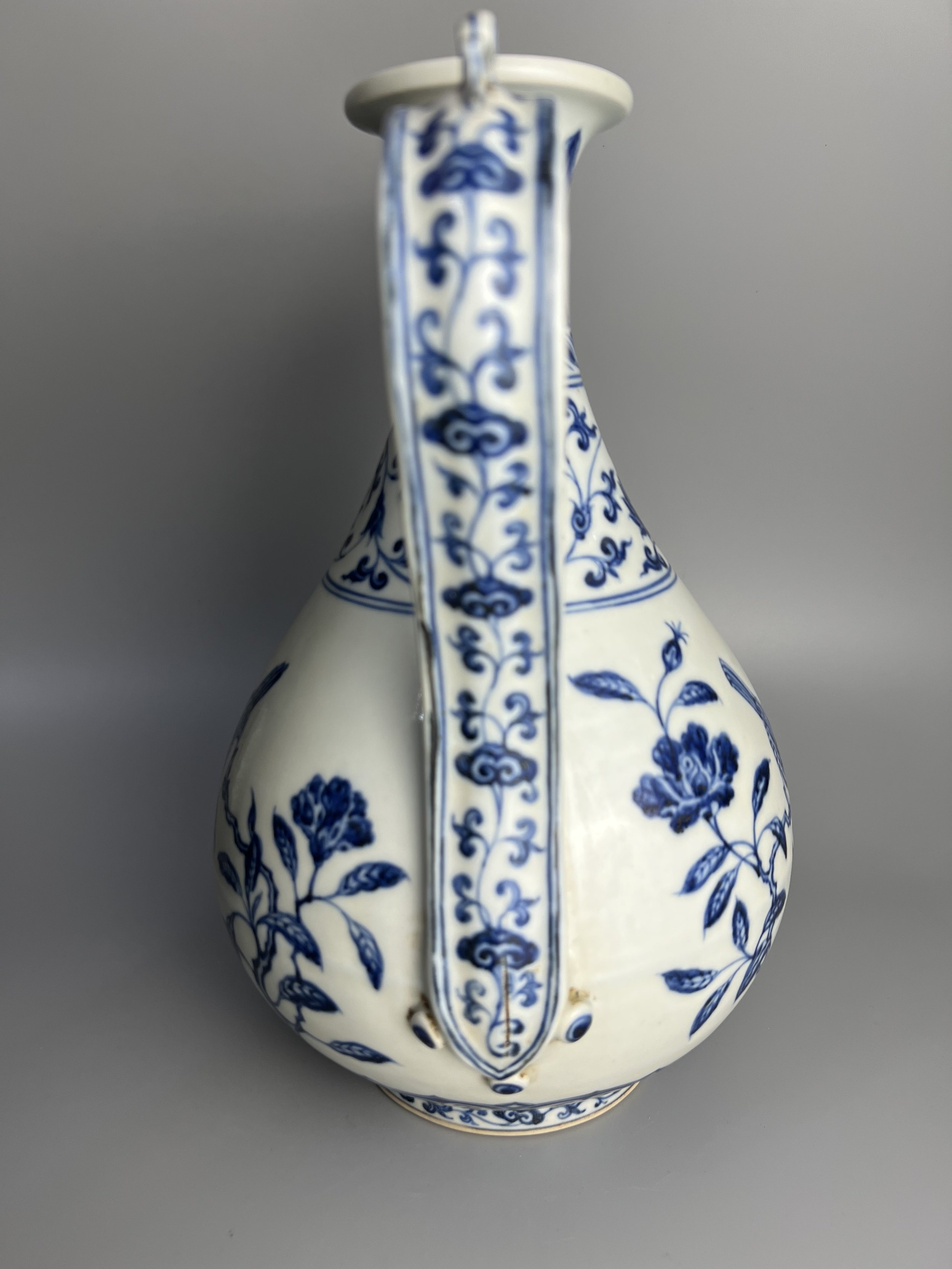 Image 12 of 21
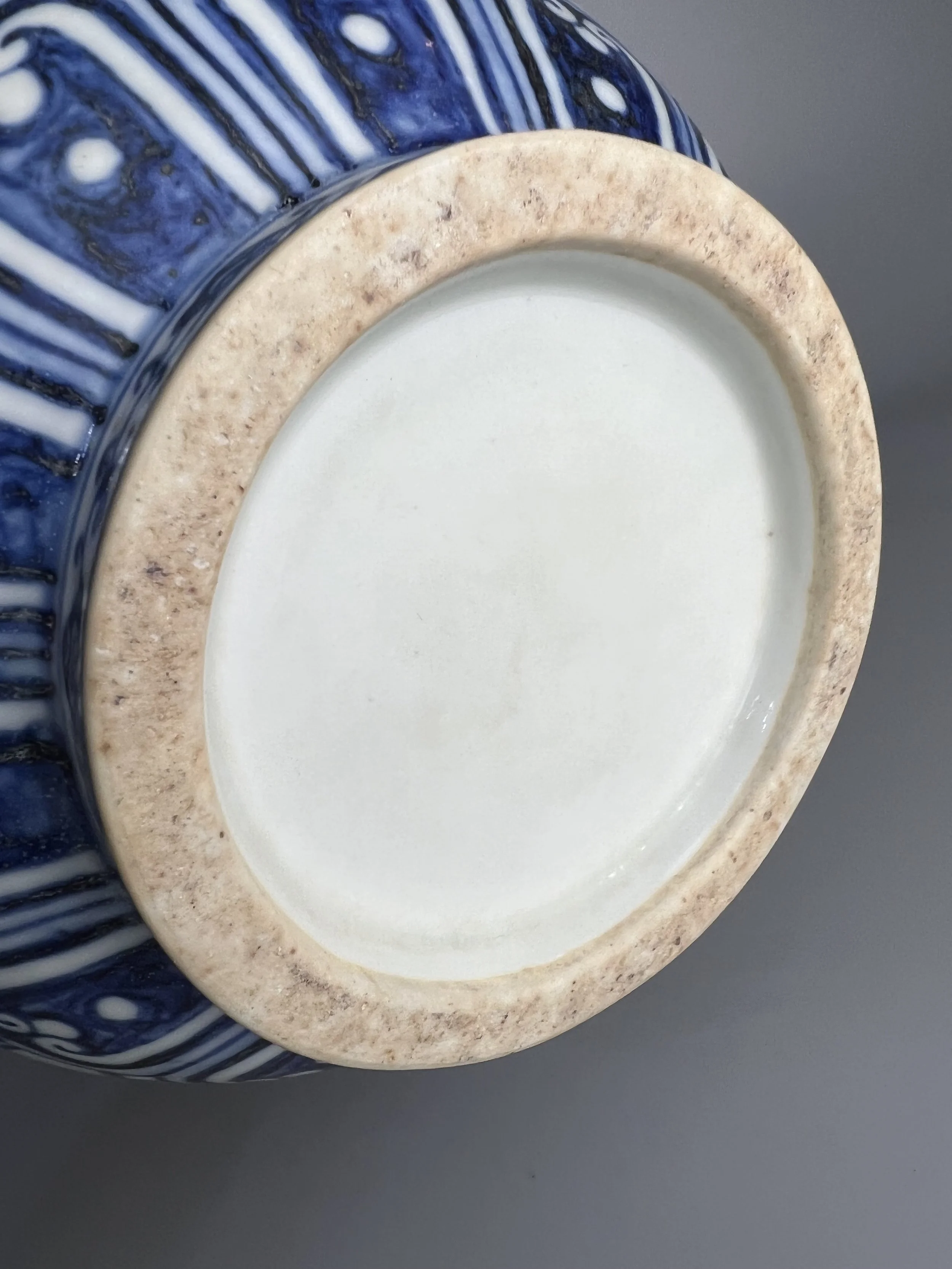 Image 13 of 21
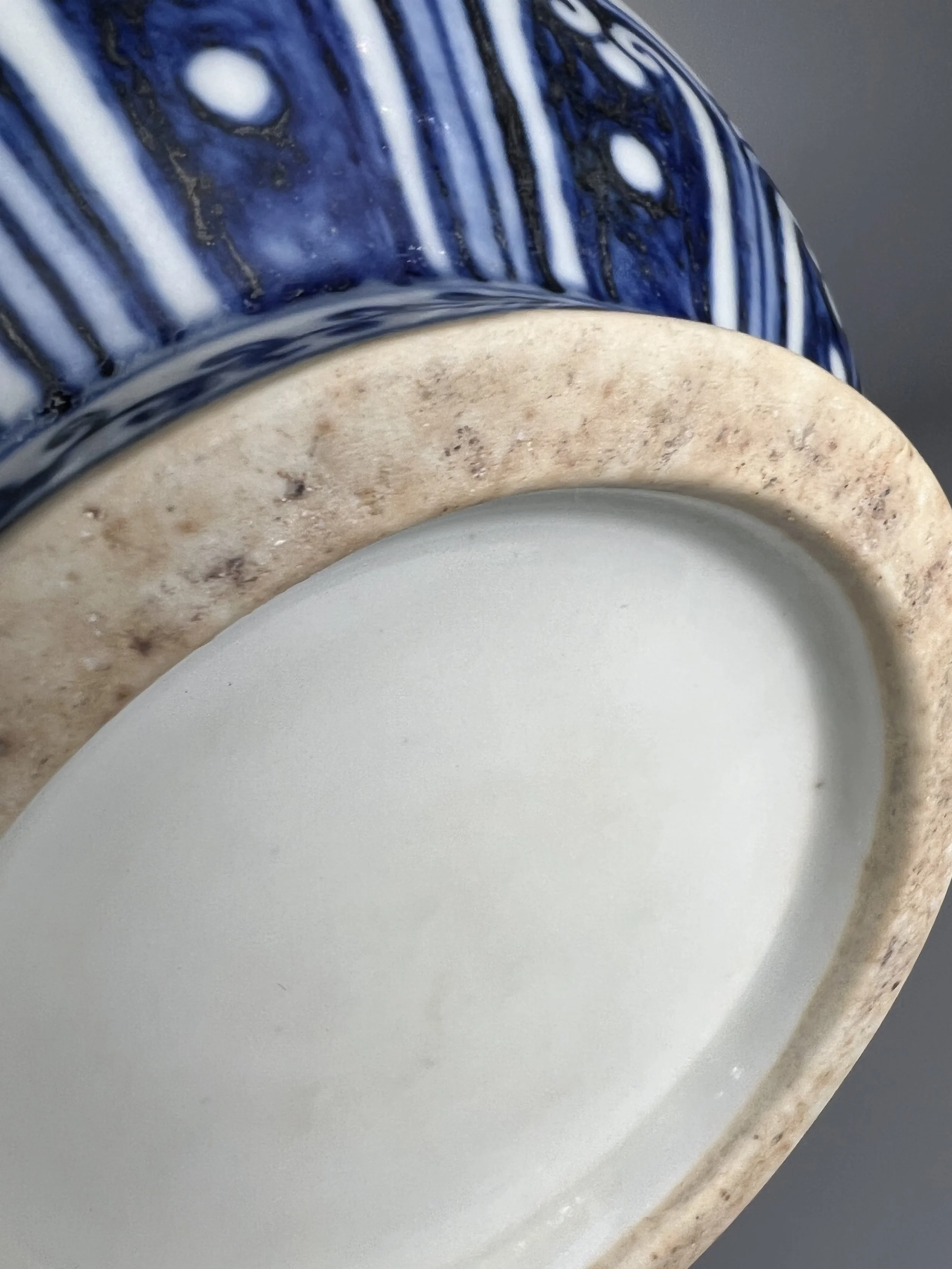 Image 14 of 21
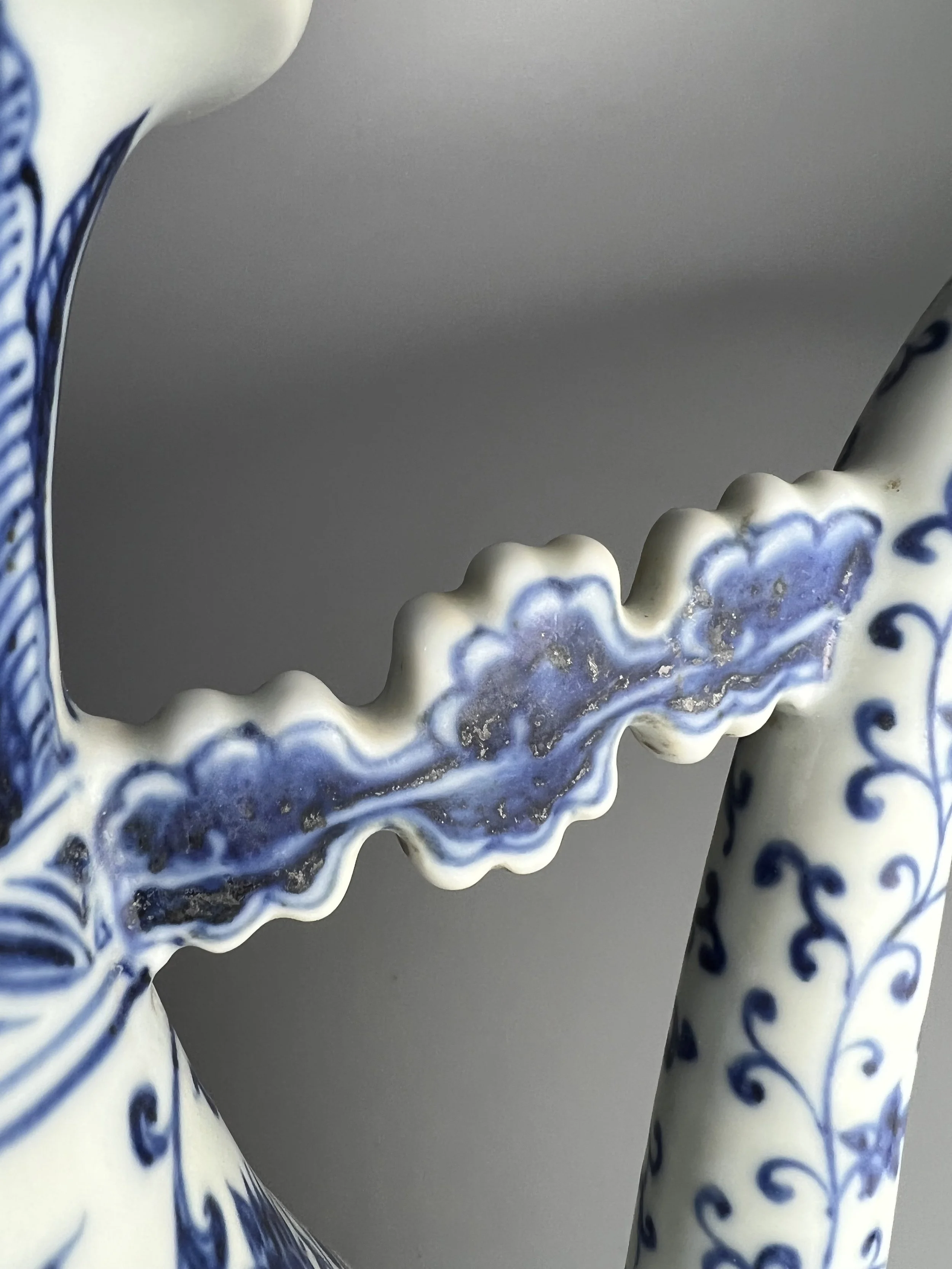 Image 15 of 21
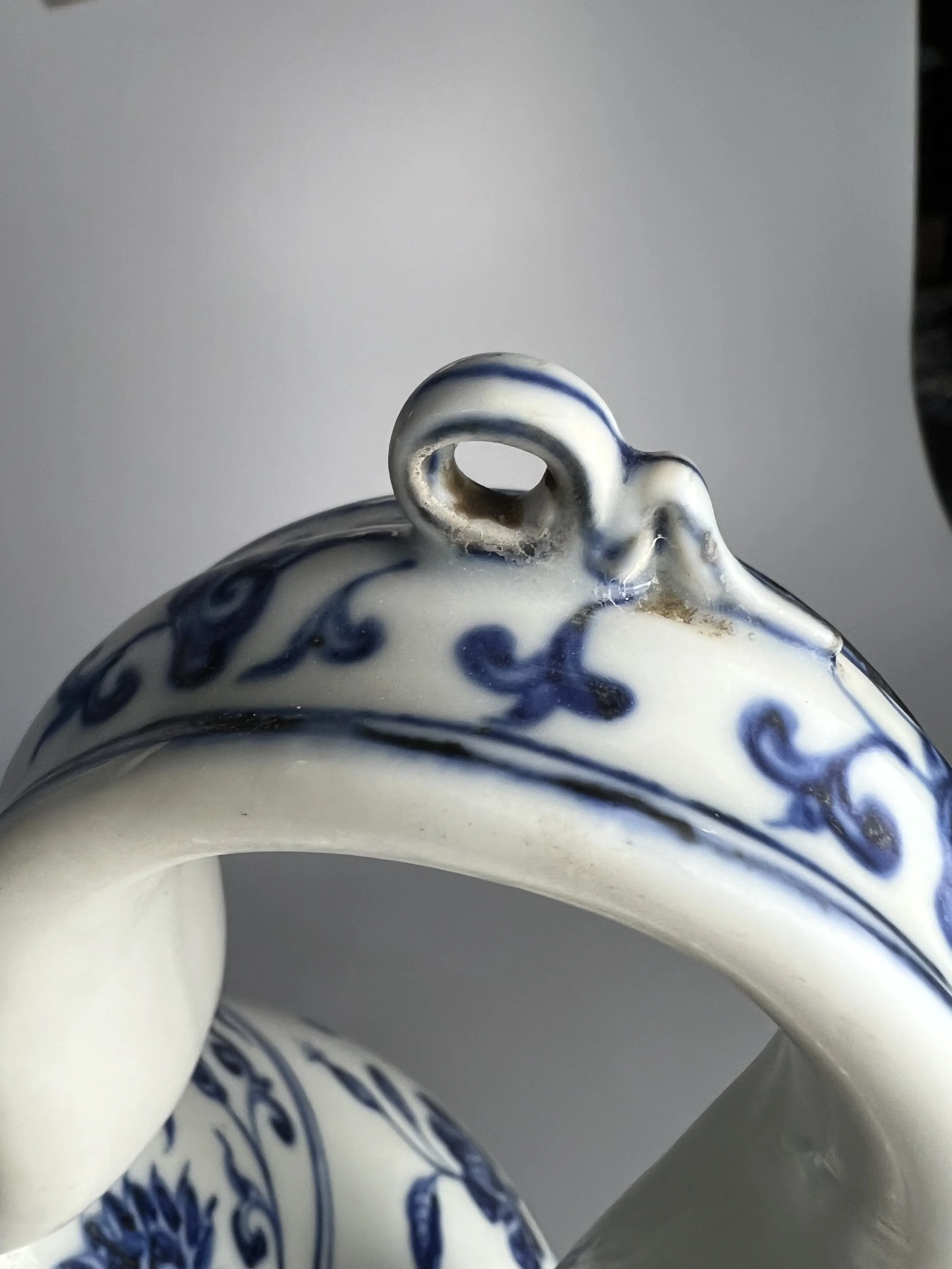 Image 16 of 21
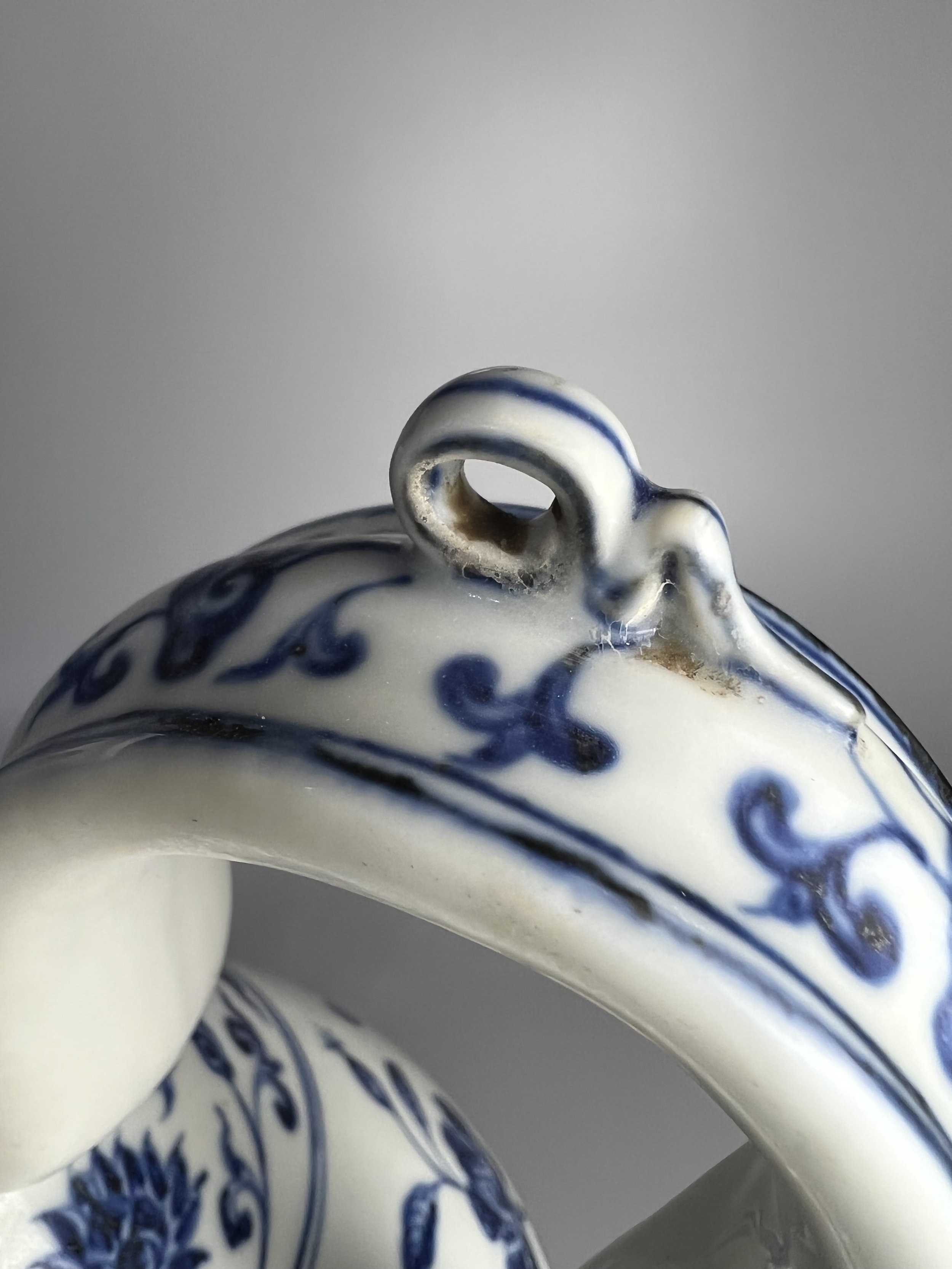 Image 17 of 21
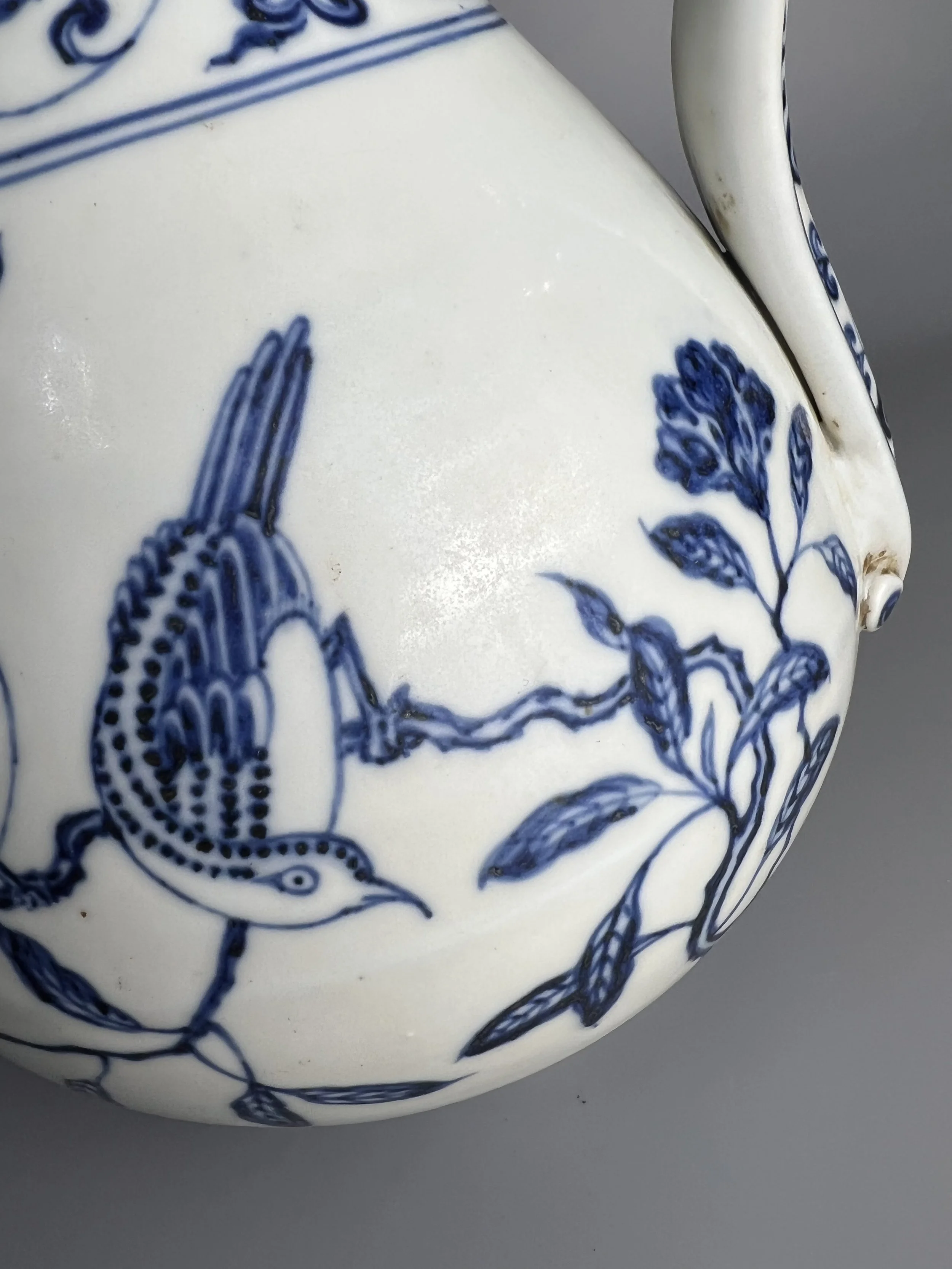 Image 18 of 21
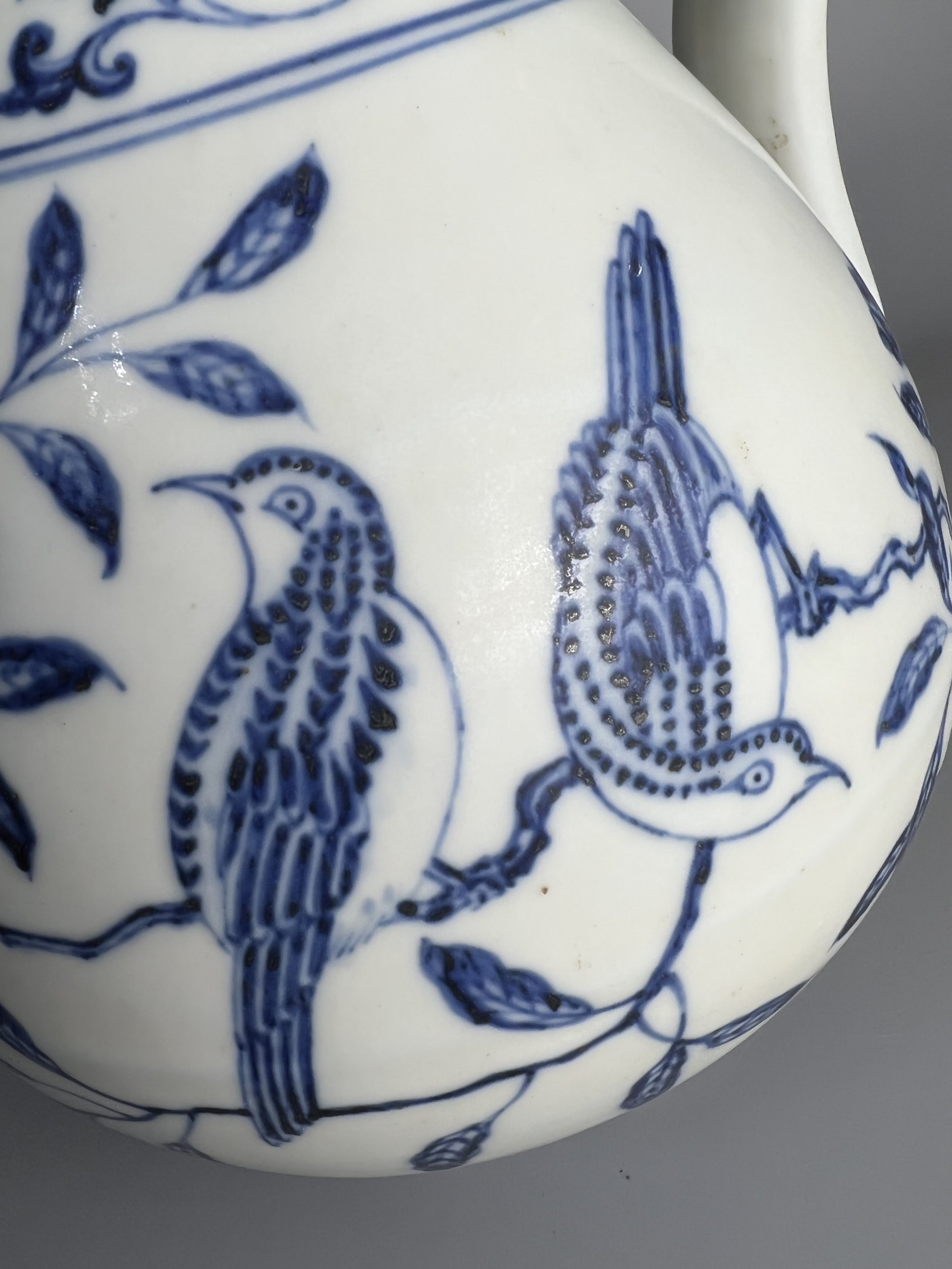 Image 19 of 21
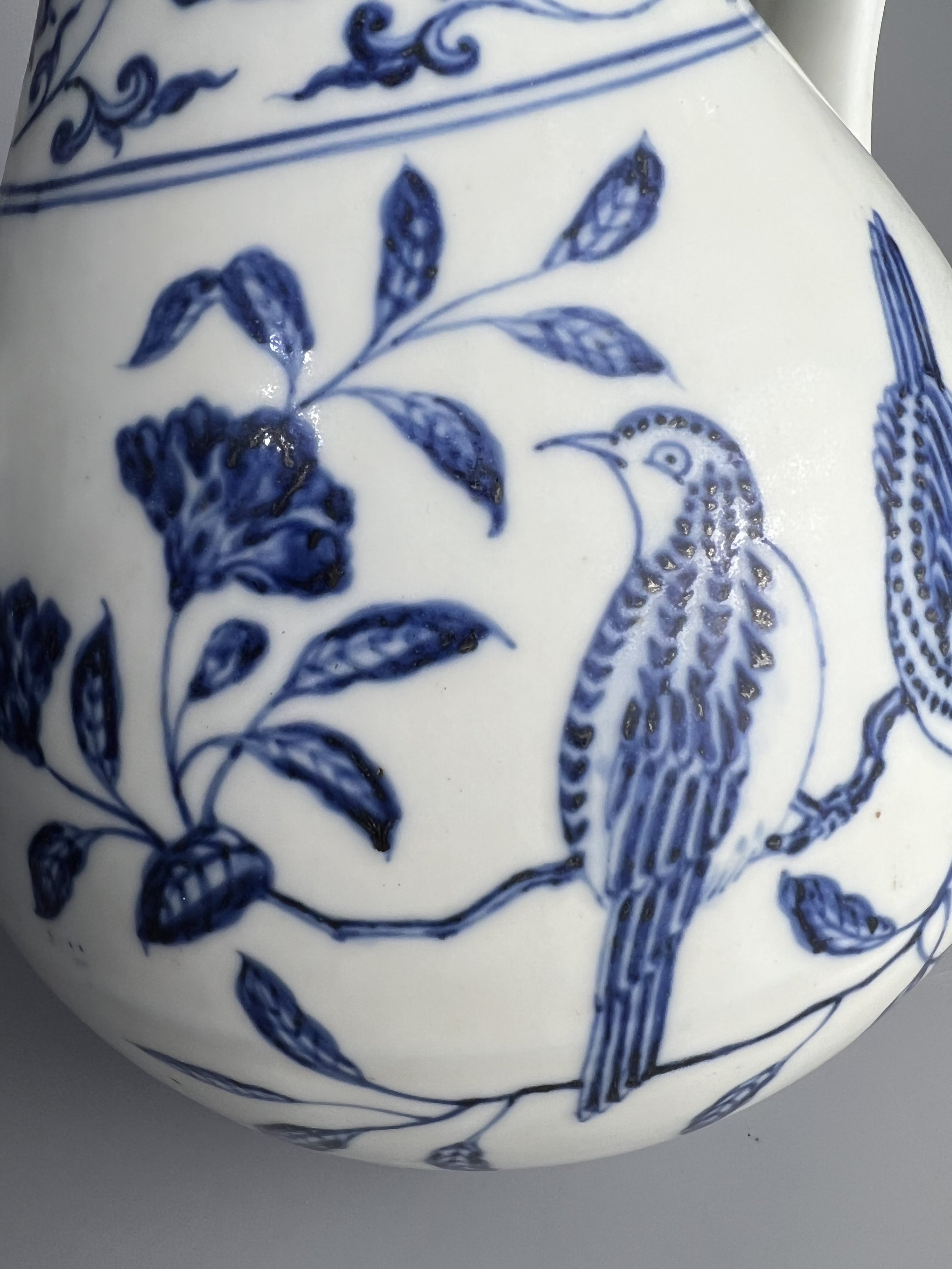 Image 20 of 21
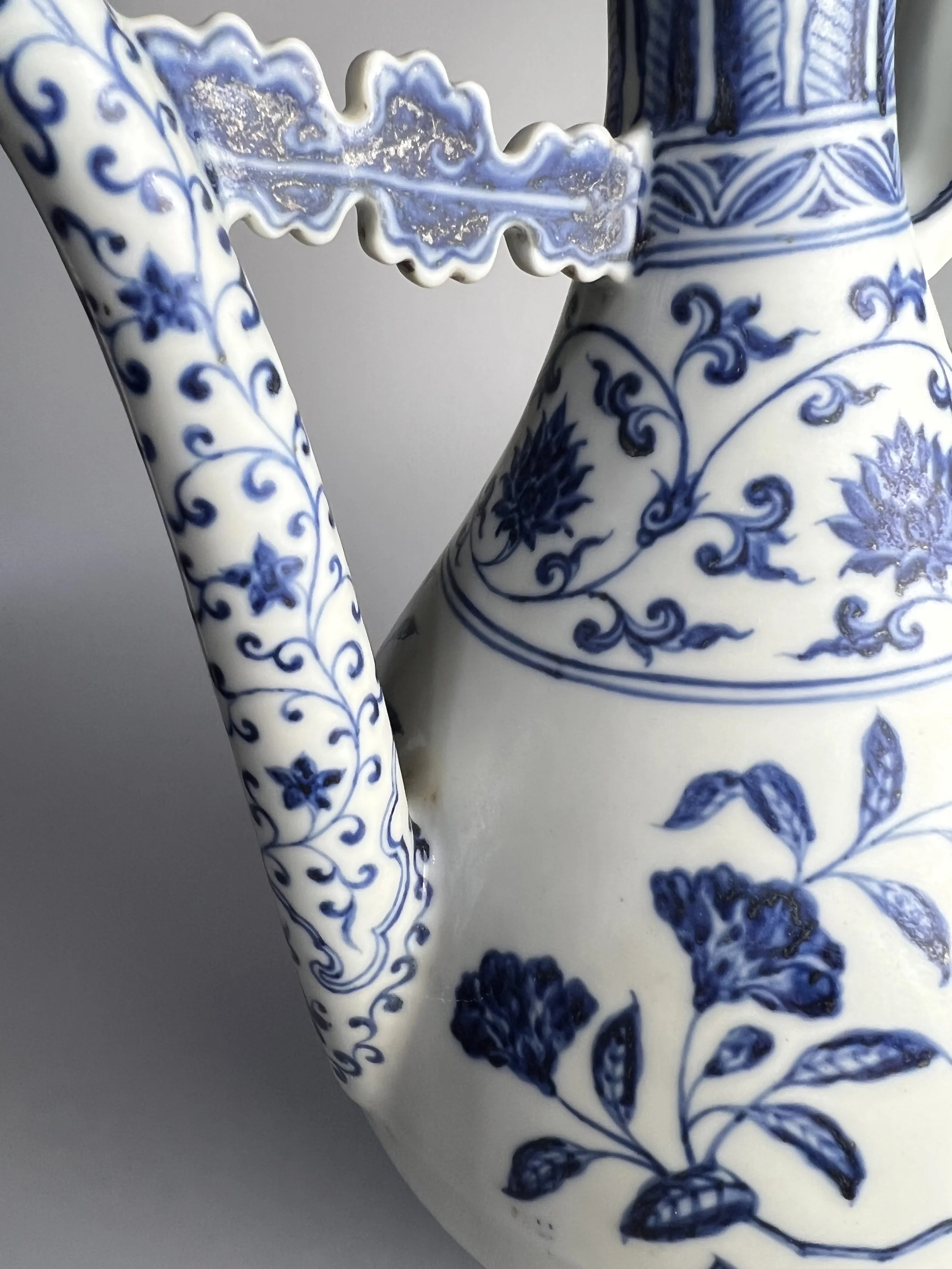 Image 21 of 21