 Image 1 of 8
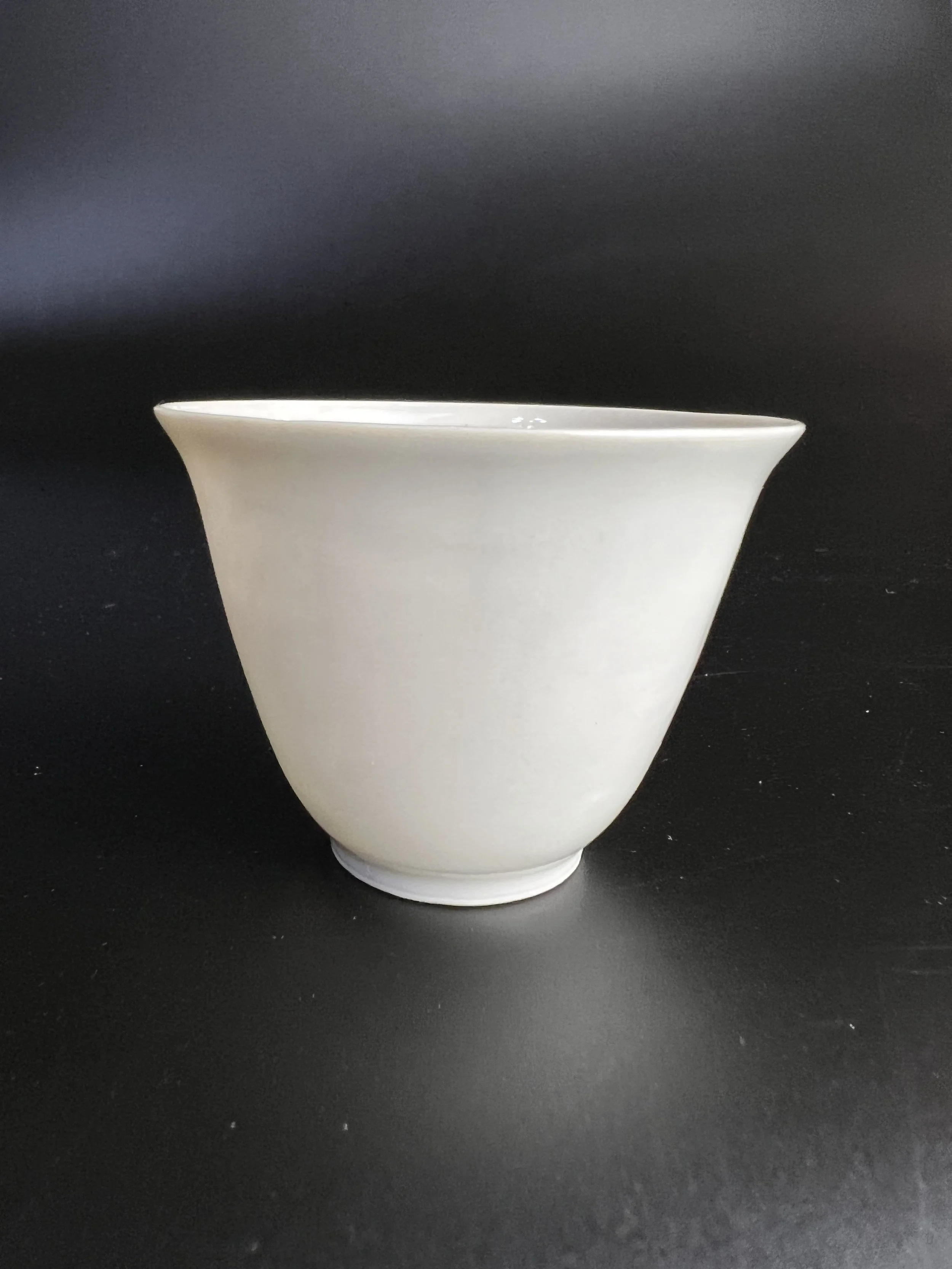 Image 2 of 8
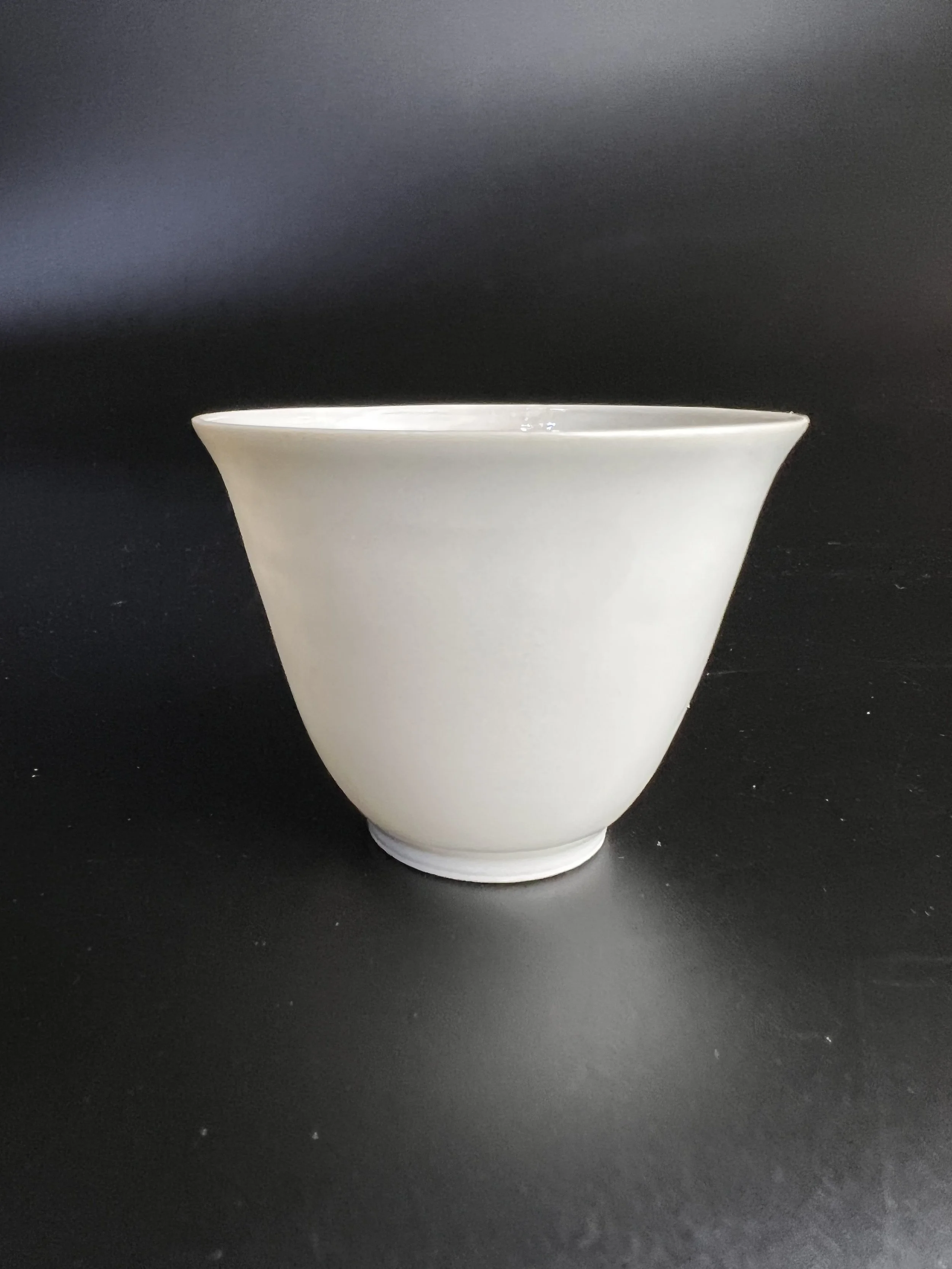 Image 3 of 8
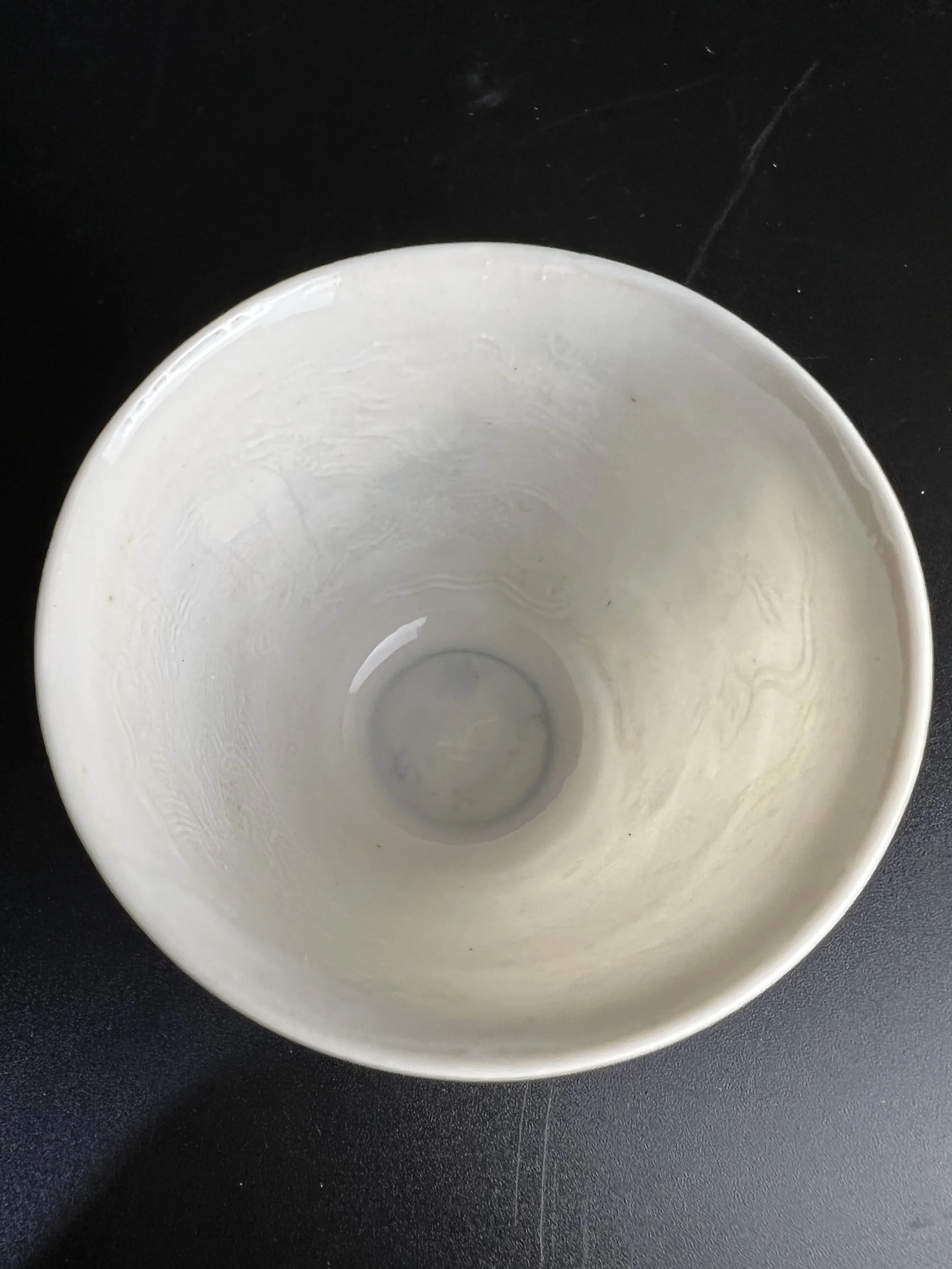 Image 4 of 8
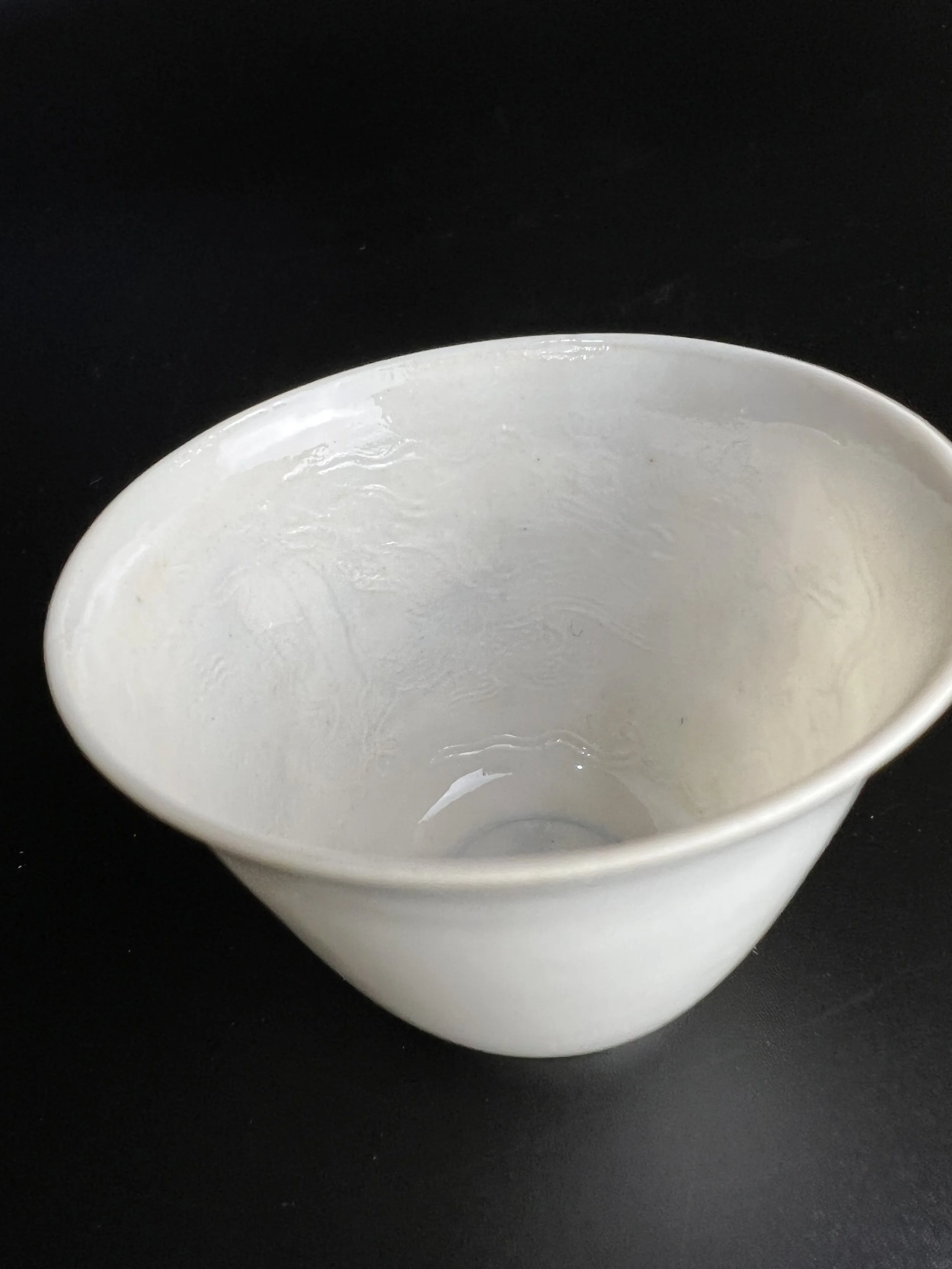 Image 5 of 8
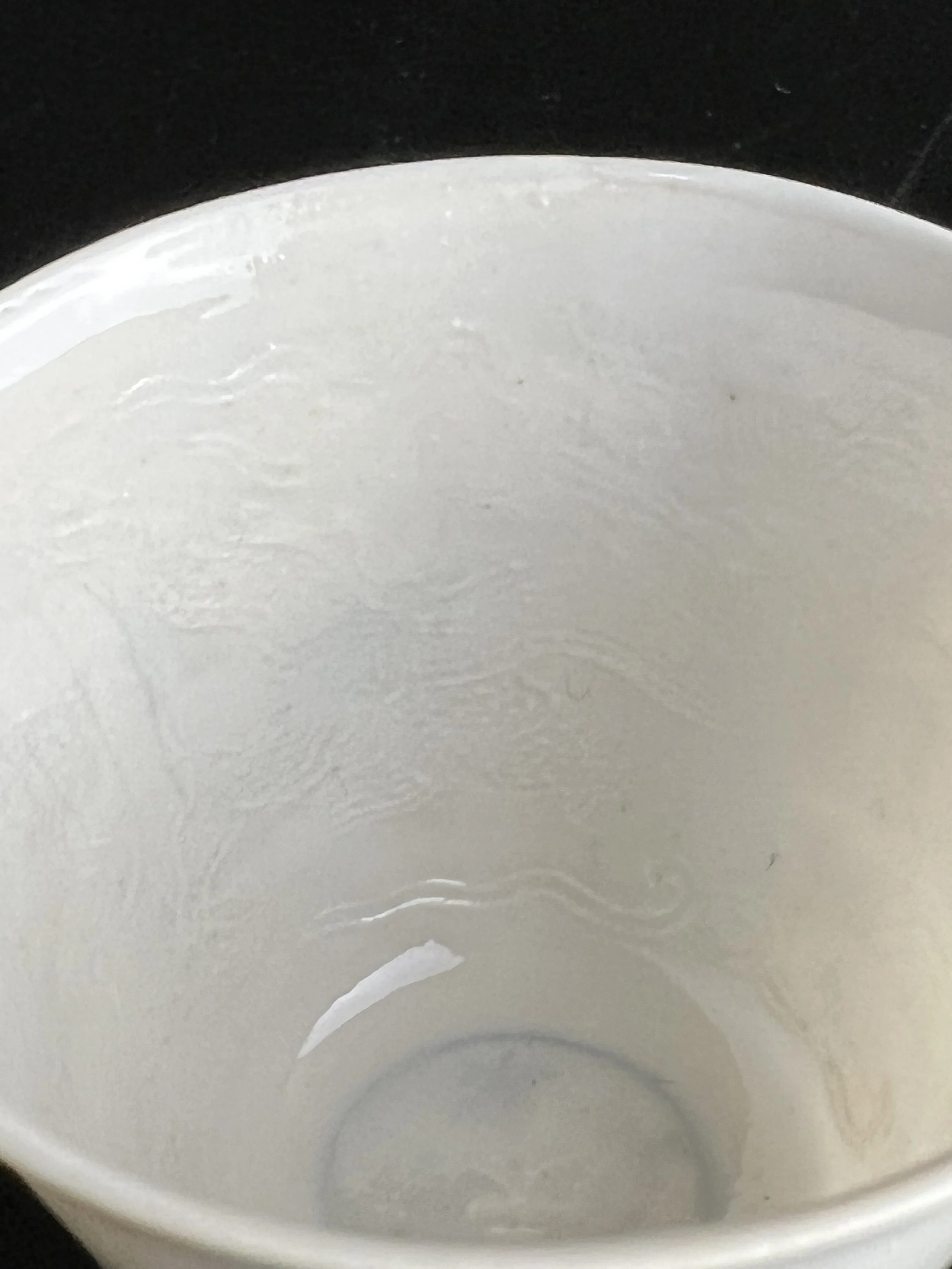 Image 6 of 8
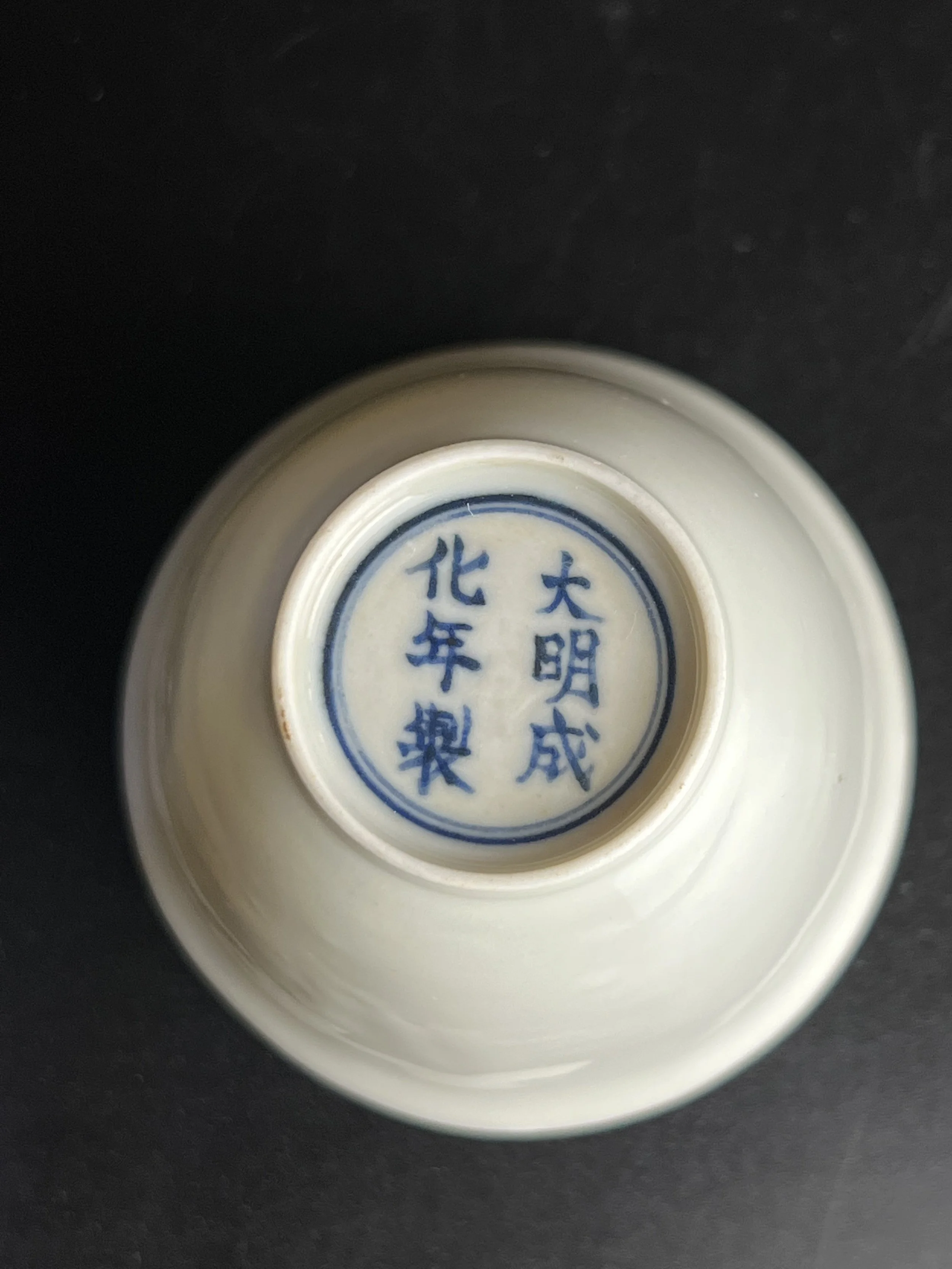 Image 7 of 8
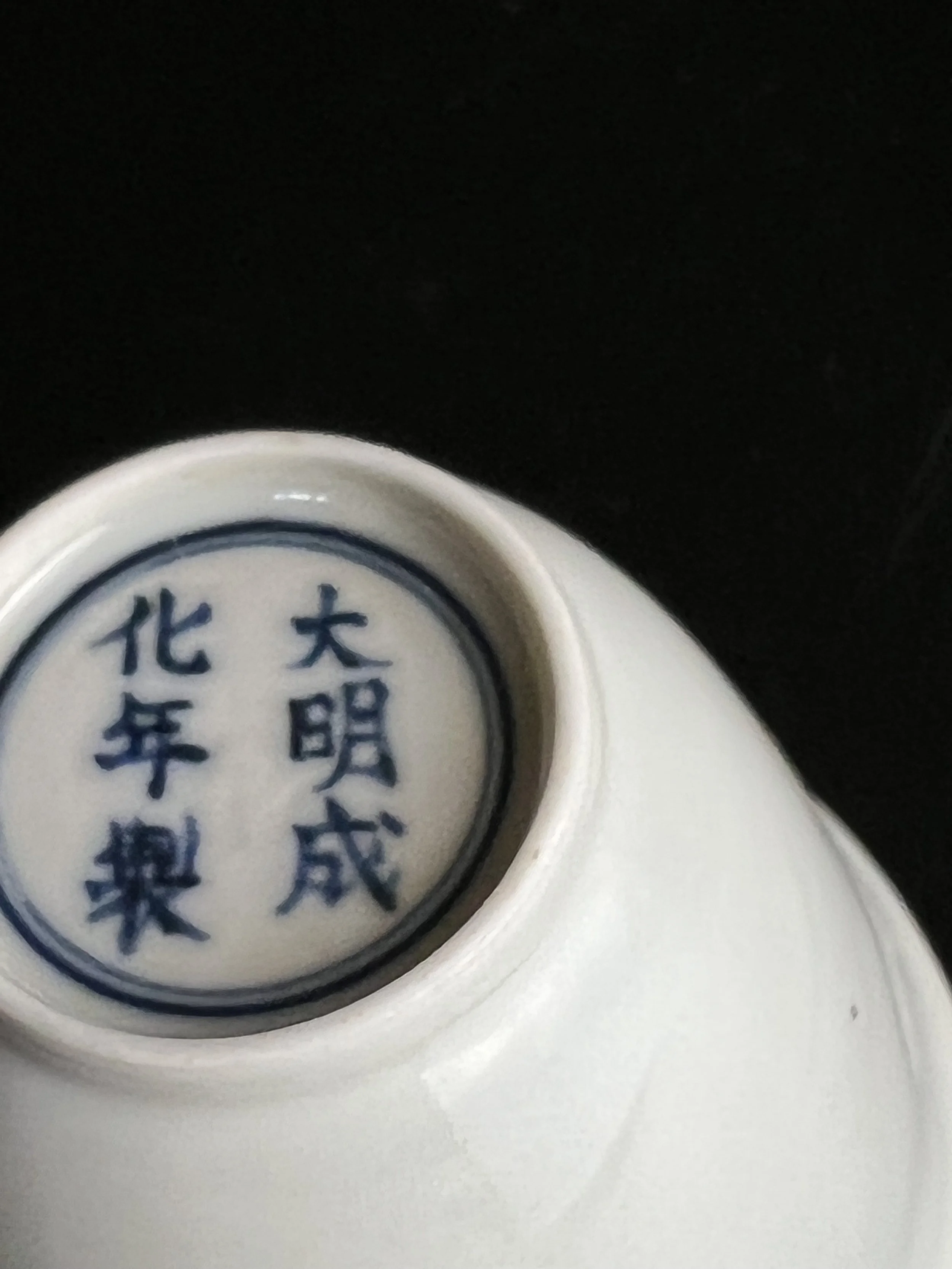 Image 8 of 8
An Appreciation of the Ming Chenghua Anhua (Secret Decoration) Dragon Cup
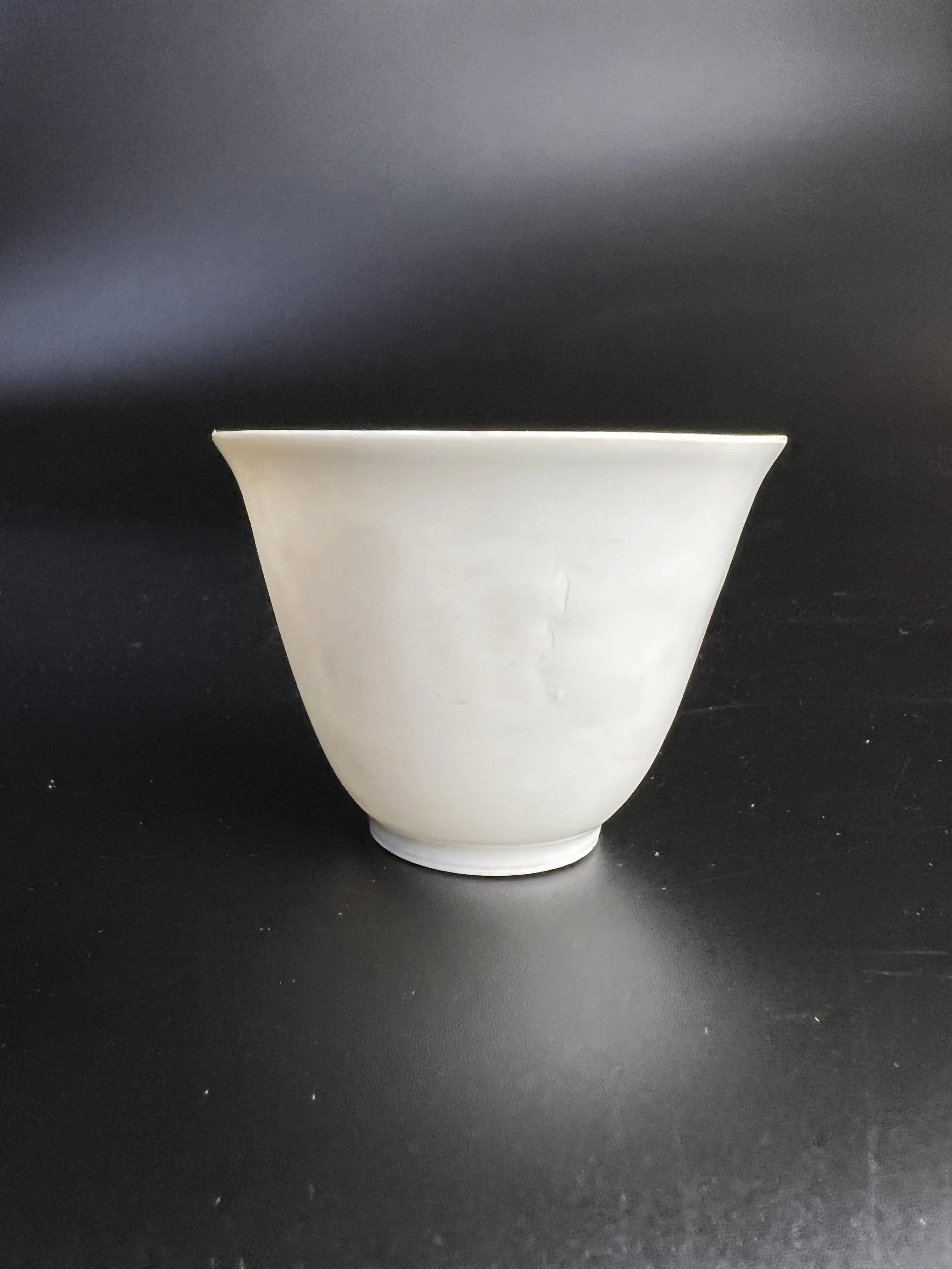
In the resplendent world of Chenghua imperial porcelain, the brilliant beauty of doucai and the delicate charm of yellow glaze are certainly eye-catching. However, white-glazed wares with Anhua (secret/impressed decoration) stand apart with their含蓄之美 (subtle, understated beauty), a realm where "silence speaks louder than sound." This Chenghua Anhua dragon cup, measuring 3.5 cm in diameter and 4 cm in height, is as small and delicate as an egg, with a body as thin as paper. A pair of dragons impressed on the inner wall only reveals its form when caught by the light. It perfectly embodies the highest praise from the Ming dynasty scholar Zhang Yingwen in his work Qingmi Cang (Pure and Secret Collection): "The Anhua wares... are unprecedented since antiquity and are the peerless products of their era." This cup is not only a tangible testament to the Chenghua Emperor's artistic taste but also represents the pinnacle of Ming dynasty Anhua craftsmanship and thin-body technology.
Form and Mark: The Charm of Delicacy
This cup possesses an elegant and refined form. Its mouth is slightly everted, the deep walls curve gracefully inward, and it sits on a recessed foot ring. The overall silhouette is fluid and婉约 (restrainedly elegant), fully embodying the characteristic "lightness, elegance, and refinement" of the Chenghua era. Its exquisite dimensions (a mere 3.5 cm in diameter) mean it can be held perfectly in the palm or rotated between fingers for appreciation. This matches the description in the Tao Shuo (Description of Pottery), which states, "Chenghua kilns are most famous for the eggshell-thin cup," referring precisely to such极品 (ultimate-quality) vessels as thin as eggshells and exquisitely小巧玲珑 (small and exquisite).
The base is coated in a white glaze, which is rich, unctuous, lustrous, and smooth. It bears an underglaze blue inscription of "Da Ming Chenghua Nian Zhi" (大明成化年制 - Made in the Chenghua era of the Great Ming) in six characters arranged in two vertical lines, enclosed within a double blue circle (青花双圈) . The calligraphy has an archaic charm that belies an underlying innocence. Executed with a centered brush tip concealing its energy, it possesses the unique period character of Chenghua imperial marks—lacking the bold vigor of Yongle and Xuande, nor the regularity of Hongzhi and Zhengde, yet within its seemingly artless, childlike charm lies the emperor's personal審定 (approval and finalization).
Inner Wall Anhua: The Unobtrusive Dragon
The most exquisite feature of this cup is the pair of dragons impressed on its inner wall. The term "Anhua" (暗印), also known as "Anhua" (暗花) or "moyin" (模印, impressed decoration), represents a sophisticated technique inherited from the Yongle and Xuande periods and perfected by the Chenghua imperial kilns. The process was exceptionally meticulous: while the clay body was still leather-hard, a craftsman used a mold to impress the dragon design onto the inner wall, creating lines that penetrated the body but not through it. A sweet white glaze was then applied, and after high-temperature firing, the decoration became subtly "hidden" beneath the glaze layer.
The pair of dragons impressed on this cup's inner wall reveals its true form only when viewed against the light or examined under raking light:
Dragon Poses: Two dragons chase each other head to tail, perhaps in pursuit of a flaming pearl. Their bodies are strong, slender, and full of dynamic movement.
Detailed Depiction: The heads are full, the eyes wide open, whiskers elegant, and claws sharp. Although hidden beneath the glaze, every detail is vividly rendered, brimming with life and spirit.
Compositional Concept: The symmetrical layout of the two dragons implies a deeper meaning, possibly symbolizing the harmony of yin and yang or the conveyance of auspiciousness.
This decorative手法 (technique) of "hiding without concealment, revealing without exposure" creates a poetic beauty, reminiscent of the line "the moon breaks through the clouds, flowers play with their shadows." Against the纯净 (pure and clean) white glaze background, it generates an infinite,含蓄蕴藉 (implicit and restrained) artistic charm. This perfectly reflects the Chenghua Emperor's introverted personality and literati aesthetic—not seeking ostentation, but revealing mastery in the finest details.
Technical Marvel: The Dual Challenge of Thin Body and Anhua
The脱胎瓷 (bodiless porcelain, also known as "eggshell porcelain") of the Chenghua era was developed from the Qingbai wares of the Northern Song dynasty. Initial experiments occurred during the Yongle period, but the technology reached maturity during the Chenghua reign. The body of this cup is extremely thin. According to historical records, Chenghua bodiless porcelain could be less than 1 mm thick, truly deserving of the description "as thin as a cicada's wing, as bright as glass, as light as floating clouds."
What makes this piece even more remarkable is the addition of impressed decoration onto such a fragile body. The demands on craftsmanship were almost unimaginably stringent:
Difficulty of Forming: The porcelain clay had to be washed to an extremely pure state to prevent the thin body from cracking.
Skill of Impressing: The force used to impress the dragons had to be精准把控 (precisely controlled). Too much force and the design would穿透 (penetrate) the body; too little and the impression would be too shallow to be visible.
Mastery of Glazing: The glaze layer had to be exactly the right thickness—sufficient to cover the design and create a subtle effect, yet thin enough to allow the decoration to be clearly seen when held to the light.
Peril of Firing: Thin-walled vessels are extremely prone to warping or cracking during high-temperature firing, resulting in a very low success rate.
It is for these reasons that such thin-walled Anhua wares are "rarely found intact in surviving collections." Every Chenghua Anhua dragon cup that remains today is a miracle of the kiln, a survivor against all odds.
The Historical Significance of Anhua Technique
The Anhua technique held a position of great esteem among Ming imperial porcelains. Zhang Yingwen, in his Qingmi Cang, placed it alongside blue-and-white and overglaze red, praising the Anhua wares of the Xuande era as "unprecedented since antiquity and the peerless products of their era." The Chenghua court inherited and developed this skill, particularly in its early productions, where处处可见 (traces can be seen everywhere) of admiration and tribute to the Xuande imperial kilns.
According to scholarly research, the firing of the Chenghua imperial kilns began in the fourth year of the Chenghua reign (1468 AD). A primary motivation was to meet the needs of court Buddhist activities and to bestow gifts upon religious leaders from Tibet. These early imperial porcelains "参照 (followed the precedents) of the Xuande reign" in both form and decoration, using Xuande wares as models. This Anhua dragon cup is highly likely to be a precious example from this period, one that still "retains the artistic spirit and atmosphere of the flourishing Yongle and Xuande eras."
Conclusion
This Ming Chenghua Anhua dragon cup, within its miniature scale of 3.5 cm,凝聚 (condenses) the ultimate craftsmanship and the profound literati aesthetics of the Chenghua imperial kilns. Its body is as thin as paper, yet it carries the weight of over five centuries of history. The dragons are hidden beneath the glaze, yet they reveal their imperial aura in the不经意 (unintentional) play of light and shadow. As the saying goes, "Great form is formless; great sound is soundless." The Chenghua Anhua dragon cup achieves prominence through concealment and splendor through simplicity. It carved its own unique path in the world of Ming and Qing porcelain, creating an eternal legend where "silence at this moment speaks more than sound."
明成化 暗印龙纹杯赏析
在成化御窑璀璨的瓷苑中,斗彩之秾丽、黄釉之娇嫩固然夺目,而白釉暗花器则以"此时无声胜有声"的含蓄之美,独树一帜。这件口径3.5厘米,高4厘米的成化暗印龙纹杯,器型小巧如卵,胎薄似纸,内壁暗印一对龙纹,需借光方见其形,完美诠释了明代文人张应文在《清秘藏》中所赞誉的"暗花者……皆发古未有,为一代绝品"的至高境界。此杯不仅是成化皇帝艺术审美的物化见证,更代表了明代暗花工艺与薄胎技术的巅峰成就。
造型与款识:玲珑之韵
此杯造型隽秀典雅,口部微撇,深腹弧收,下承圈足,通体线条流畅婉约,极具成化一朝"轻盈秀雅"的时代风韵。其尺寸之精巧(口径仅3.5cm),恰可纳入掌心或置于指间把玩,正如《陶说》所形容的"成窑以卵幕杯为最",指的就是这种薄如蛋壳、小巧玲珑的极品佳器。
杯底施白釉,釉质肥腴莹润,书青花 "大明成化年制"六字双行楷书款,外罩青花双圈。款识字体稚拙古朴,中锋运笔,藏锋含蓄,具有成化御窑款识特有的时代气息——既无永乐宣德之雄健,亦无弘治正德之规整,却在看似不经意的稚趣之中,蕴藏着帝王御笔的亲审亲定。
内壁暗印:隐而不彰的龙纹
此杯最精妙之处,在于内壁暗印的一对龙纹。所谓"暗印",亦称"暗花"或"模印",是成化御窑继承永宣时期的高超技艺。其工艺过程极为考究:在坯体尚未完全干燥之际,匠人以印模在器壁内侧压印出龙纹轮廓,线条深入胎骨却不穿透;随后施以甜白釉,经高温烧成后,纹饰便隐隐约约地"藏"于釉层之下。
此杯内壁暗印的一对龙纹,当迎光透视或侧光细察时,方见其真容:
龙形姿态:双龙首尾相逐,或作赶珠状,身形矫健修长,充满动感
细部刻画:龙首饱满,龙睛圆睁,龙须飘逸,龙爪锐利,虽隐于釉下,却毫发毕现,灵动非凡
构图意匠:双龙对称布局,寓含阴阳相合、吉祥如意的深层意蕴
这种"隐而不彰、显而不露"的装饰手法,营造出"云破月来花弄影"的诗意美感,在纯净的白釉背景衬托下,生出无限含蓄蕴藉的艺术魅力。这正是成化皇帝内敛性格与文人审美的最佳写照——不事张扬,却在细微处见真章。
工艺之极:薄胎暗花的双重挑战
成化时期的脱胎瓷(又称"蛋壳瓷")工艺,在北宋影青瓷基础上发展而来,明永乐时初步尝试,至成化年间达到技术成熟阶段。此杯胎体极薄,据文献记载,成化脱胎瓷厚度可至1毫米以内,真可谓"薄似蝉翼,亮如玻璃,轻若浮云"。
更难能可贵的是,在如此纤薄的胎体上进行暗印装饰,对工艺的要求达到了令人难以想象的严苛程度:
制坯之难:胎土需淘洗极为纯净,方能保证薄胎不断裂
印纹之巧:压印龙纹时力度需精准把控,重则透胎,轻则纹浅不显
施釉之妙:釉层厚薄需恰到好处,既要覆盖纹饰以显含蓄之美,又要保证迎光透视时纹饰清晰可见
烧成之险:薄胎器物在高温中极易变形或炸裂,成品率极低
正因如此,此类薄胎暗花器"完整传世者罕见",每一件留存至今的成化暗印龙纹杯,都堪称九死一生的窑火奇迹。
暗花工艺的历史意涵
暗花工艺在明代御窑瓷器中占据着极为尊崇的地位。明人张应文在《清秘藏》中将其与青花、红彩并列,赞誉宣德朝的"暗花者……皆发古未有,为一代绝品"。成化一朝继承并发展了这项技艺,尤其在早期作品当中,处处可见对宣德御窑的追慕与致敬。
据学者考证,成化御窑的烧造始于成化四年(公元1468年),其主要动因之一是满足宫廷礼佛活动及赏赐藏地宗教领袖的需要。这批早期御窑瓷器"参照宣德朝旧例",在造型、纹饰上皆以宣德为范本。这件暗印龙纹杯,很可能便是这一时期"尚存永宣盛世的文艺精神与气息"的珍贵实例。
结语
这件明成化暗印龙纹杯,以3.5厘米的微缩尺幅,凝聚了成化御窑最顶级的工艺智慧与最深邃的文人审美。它胎薄如纸,却承载着五百余年历史的厚重;龙纹隐于釉下,却在不经意的光影流转间显露帝王气象。正所谓"大象无形,大音希声",成化暗印龙纹杯以"隐"为显,以"素"为绚,在明清瓷苑中独辟蹊径,成就了一段"此时无声胜有声"的永恒传奇。
In the resplendent world of Chenghua imperial porcelain, the brilliant beauty of doucai and the delicate charm of yellow glaze are certainly eye-catching. However, white-glazed wares with Anhua (secret/impressed decoration) stand apart with their含蓄之美 (subtle, understated beauty), a realm where "silence speaks louder than sound." This Chenghua Anhua dragon cup, measuring 3.5 cm in diameter and 4 cm in height, is as small and delicate as an egg, with a body as thin as paper. A pair of dragons impressed on the inner wall only reveals its form when caught by the light. It perfectly embodies the highest praise from the Ming dynasty scholar Zhang Yingwen in his work Qingmi Cang (Pure and Secret Collection): "The Anhua wares... are unprecedented since antiquity and are the peerless products of their era." This cup is not only a tangible testament to the Chenghua Emperor's artistic taste but also represents the pinnacle of Ming dynasty Anhua craftsmanship and thin-body technology.
Form and Mark: The Charm of Delicacy
This cup possesses an elegant and refined form. Its mouth is slightly everted, the deep walls curve gracefully inward, and it sits on a recessed foot ring. The overall silhouette is fluid and婉约 (restrainedly elegant), fully embodying the characteristic "lightness, elegance, and refinement" of the Chenghua era. Its exquisite dimensions (a mere 3.5 cm in diameter) mean it can be held perfectly in the palm or rotated between fingers for appreciation. This matches the description in the Tao Shuo (Description of Pottery), which states, "Chenghua kilns are most famous for the eggshell-thin cup," referring precisely to such极品 (ultimate-quality) vessels as thin as eggshells and exquisitely小巧玲珑 (small and exquisite).
The base is coated in a white glaze, which is rich, unctuous, lustrous, and smooth. It bears an underglaze blue inscription of "Da Ming Chenghua Nian Zhi" (大明成化年制 - Made in the Chenghua era of the Great Ming) in six characters arranged in two vertical lines, enclosed within a double blue circle (青花双圈) . The calligraphy has an archaic charm that belies an underlying innocence. Executed with a centered brush tip concealing its energy, it possesses the unique period character of Chenghua imperial marks—lacking the bold vigor of Yongle and Xuande, nor the regularity of Hongzhi and Zhengde, yet within its seemingly artless, childlike charm lies the emperor's personal審定 (approval and finalization).
Inner Wall Anhua: The Unobtrusive Dragon
The most exquisite feature of this cup is the pair of dragons impressed on its inner wall. The term "Anhua" (暗印), also known as "Anhua" (暗花) or "moyin" (模印, impressed decoration), represents a sophisticated technique inherited from the Yongle and Xuande periods and perfected by the Chenghua imperial kilns. The process was exceptionally meticulous: while the clay body was still leather-hard, a craftsman used a mold to impress the dragon design onto the inner wall, creating lines that penetrated the body but not through it. A sweet white glaze was then applied, and after high-temperature firing, the decoration became subtly "hidden" beneath the glaze layer.
The pair of dragons impressed on this cup's inner wall reveals its true form only when viewed against the light or examined under raking light:
Dragon Poses: Two dragons chase each other head to tail, perhaps in pursuit of a flaming pearl. Their bodies are strong, slender, and full of dynamic movement.
Detailed Depiction: The heads are full, the eyes wide open, whiskers elegant, and claws sharp. Although hidden beneath the glaze, every detail is vividly rendered, brimming with life and spirit.
Compositional Concept: The symmetrical layout of the two dragons implies a deeper meaning, possibly symbolizing the harmony of yin and yang or the conveyance of auspiciousness.
This decorative手法 (technique) of "hiding without concealment, revealing without exposure" creates a poetic beauty, reminiscent of the line "the moon breaks through the clouds, flowers play with their shadows." Against the纯净 (pure and clean) white glaze background, it generates an infinite,含蓄蕴藉 (implicit and restrained) artistic charm. This perfectly reflects the Chenghua Emperor's introverted personality and literati aesthetic—not seeking ostentation, but revealing mastery in the finest details.
Technical Marvel: The Dual Challenge of Thin Body and Anhua
The脱胎瓷 (bodiless porcelain, also known as "eggshell porcelain") of the Chenghua era was developed from the Qingbai wares of the Northern Song dynasty. Initial experiments occurred during the Yongle period, but the technology reached maturity during the Chenghua reign. The body of this cup is extremely thin. According to historical records, Chenghua bodiless porcelain could be less than 1 mm thick, truly deserving of the description "as thin as a cicada's wing, as bright as glass, as light as floating clouds."
What makes this piece even more remarkable is the addition of impressed decoration onto such a fragile body. The demands on craftsmanship were almost unimaginably stringent:
Difficulty of Forming: The porcelain clay had to be washed to an extremely pure state to prevent the thin body from cracking.
Skill of Impressing: The force used to impress the dragons had to be精准把控 (precisely controlled). Too much force and the design would穿透 (penetrate) the body; too little and the impression would be too shallow to be visible.
Mastery of Glazing: The glaze layer had to be exactly the right thickness—sufficient to cover the design and create a subtle effect, yet thin enough to allow the decoration to be clearly seen when held to the light.
Peril of Firing: Thin-walled vessels are extremely prone to warping or cracking during high-temperature firing, resulting in a very low success rate.
It is for these reasons that such thin-walled Anhua wares are "rarely found intact in surviving collections." Every Chenghua Anhua dragon cup that remains today is a miracle of the kiln, a survivor against all odds.
The Historical Significance of Anhua Technique
The Anhua technique held a position of great esteem among Ming imperial porcelains. Zhang Yingwen, in his Qingmi Cang, placed it alongside blue-and-white and overglaze red, praising the Anhua wares of the Xuande era as "unprecedented since antiquity and the peerless products of their era." The Chenghua court inherited and developed this skill, particularly in its early productions, where处处可见 (traces can be seen everywhere) of admiration and tribute to the Xuande imperial kilns.
According to scholarly research, the firing of the Chenghua imperial kilns began in the fourth year of the Chenghua reign (1468 AD). A primary motivation was to meet the needs of court Buddhist activities and to bestow gifts upon religious leaders from Tibet. These early imperial porcelains "参照 (followed the precedents) of the Xuande reign" in both form and decoration, using Xuande wares as models. This Anhua dragon cup is highly likely to be a precious example from this period, one that still "retains the artistic spirit and atmosphere of the flourishing Yongle and Xuande eras."
Conclusion
This Ming Chenghua Anhua dragon cup, within its miniature scale of 3.5 cm,凝聚 (condenses) the ultimate craftsmanship and the profound literati aesthetics of the Chenghua imperial kilns. Its body is as thin as paper, yet it carries the weight of over five centuries of history. The dragons are hidden beneath the glaze, yet they reveal their imperial aura in the不经意 (unintentional) play of light and shadow. As the saying goes, "Great form is formless; great sound is soundless." The Chenghua Anhua dragon cup achieves prominence through concealment and splendor through simplicity. It carved its own unique path in the world of Ming and Qing porcelain, creating an eternal legend where "silence at this moment speaks more than sound."
明成化 暗印龙纹杯赏析
在成化御窑璀璨的瓷苑中,斗彩之秾丽、黄釉之娇嫩固然夺目,而白釉暗花器则以"此时无声胜有声"的含蓄之美,独树一帜。这件口径3.5厘米,高4厘米的成化暗印龙纹杯,器型小巧如卵,胎薄似纸,内壁暗印一对龙纹,需借光方见其形,完美诠释了明代文人张应文在《清秘藏》中所赞誉的"暗花者……皆发古未有,为一代绝品"的至高境界。此杯不仅是成化皇帝艺术审美的物化见证,更代表了明代暗花工艺与薄胎技术的巅峰成就。
造型与款识:玲珑之韵
此杯造型隽秀典雅,口部微撇,深腹弧收,下承圈足,通体线条流畅婉约,极具成化一朝"轻盈秀雅"的时代风韵。其尺寸之精巧(口径仅3.5cm),恰可纳入掌心或置于指间把玩,正如《陶说》所形容的"成窑以卵幕杯为最",指的就是这种薄如蛋壳、小巧玲珑的极品佳器。
杯底施白釉,釉质肥腴莹润,书青花 "大明成化年制"六字双行楷书款,外罩青花双圈。款识字体稚拙古朴,中锋运笔,藏锋含蓄,具有成化御窑款识特有的时代气息——既无永乐宣德之雄健,亦无弘治正德之规整,却在看似不经意的稚趣之中,蕴藏着帝王御笔的亲审亲定。
内壁暗印:隐而不彰的龙纹
此杯最精妙之处,在于内壁暗印的一对龙纹。所谓"暗印",亦称"暗花"或"模印",是成化御窑继承永宣时期的高超技艺。其工艺过程极为考究:在坯体尚未完全干燥之际,匠人以印模在器壁内侧压印出龙纹轮廓,线条深入胎骨却不穿透;随后施以甜白釉,经高温烧成后,纹饰便隐隐约约地"藏"于釉层之下。
此杯内壁暗印的一对龙纹,当迎光透视或侧光细察时,方见其真容:
龙形姿态:双龙首尾相逐,或作赶珠状,身形矫健修长,充满动感
细部刻画:龙首饱满,龙睛圆睁,龙须飘逸,龙爪锐利,虽隐于釉下,却毫发毕现,灵动非凡
构图意匠:双龙对称布局,寓含阴阳相合、吉祥如意的深层意蕴
这种"隐而不彰、显而不露"的装饰手法,营造出"云破月来花弄影"的诗意美感,在纯净的白釉背景衬托下,生出无限含蓄蕴藉的艺术魅力。这正是成化皇帝内敛性格与文人审美的最佳写照——不事张扬,却在细微处见真章。
工艺之极:薄胎暗花的双重挑战
成化时期的脱胎瓷(又称"蛋壳瓷")工艺,在北宋影青瓷基础上发展而来,明永乐时初步尝试,至成化年间达到技术成熟阶段。此杯胎体极薄,据文献记载,成化脱胎瓷厚度可至1毫米以内,真可谓"薄似蝉翼,亮如玻璃,轻若浮云"。
更难能可贵的是,在如此纤薄的胎体上进行暗印装饰,对工艺的要求达到了令人难以想象的严苛程度:
制坯之难:胎土需淘洗极为纯净,方能保证薄胎不断裂
印纹之巧:压印龙纹时力度需精准把控,重则透胎,轻则纹浅不显
施釉之妙:釉层厚薄需恰到好处,既要覆盖纹饰以显含蓄之美,又要保证迎光透视时纹饰清晰可见
烧成之险:薄胎器物在高温中极易变形或炸裂,成品率极低
正因如此,此类薄胎暗花器"完整传世者罕见",每一件留存至今的成化暗印龙纹杯,都堪称九死一生的窑火奇迹。
暗花工艺的历史意涵
暗花工艺在明代御窑瓷器中占据着极为尊崇的地位。明人张应文在《清秘藏》中将其与青花、红彩并列,赞誉宣德朝的"暗花者……皆发古未有,为一代绝品"。成化一朝继承并发展了这项技艺,尤其在早期作品当中,处处可见对宣德御窑的追慕与致敬。
据学者考证,成化御窑的烧造始于成化四年(公元1468年),其主要动因之一是满足宫廷礼佛活动及赏赐藏地宗教领袖的需要。这批早期御窑瓷器"参照宣德朝旧例",在造型、纹饰上皆以宣德为范本。这件暗印龙纹杯,很可能便是这一时期"尚存永宣盛世的文艺精神与气息"的珍贵实例。
结语
这件明成化暗印龙纹杯,以3.5厘米的微缩尺幅,凝聚了成化御窑最顶级的工艺智慧与最深邃的文人审美。它胎薄如纸,却承载着五百余年历史的厚重;龙纹隐于釉下,却在不经意的光影流转间显露帝王气象。正所谓"大象无形,大音希声",成化暗印龙纹杯以"隐"为显,以"素"为绚,在明清瓷苑中独辟蹊径,成就了一段"此时无声胜有声"的永恒传奇。