 Image 1 of 12
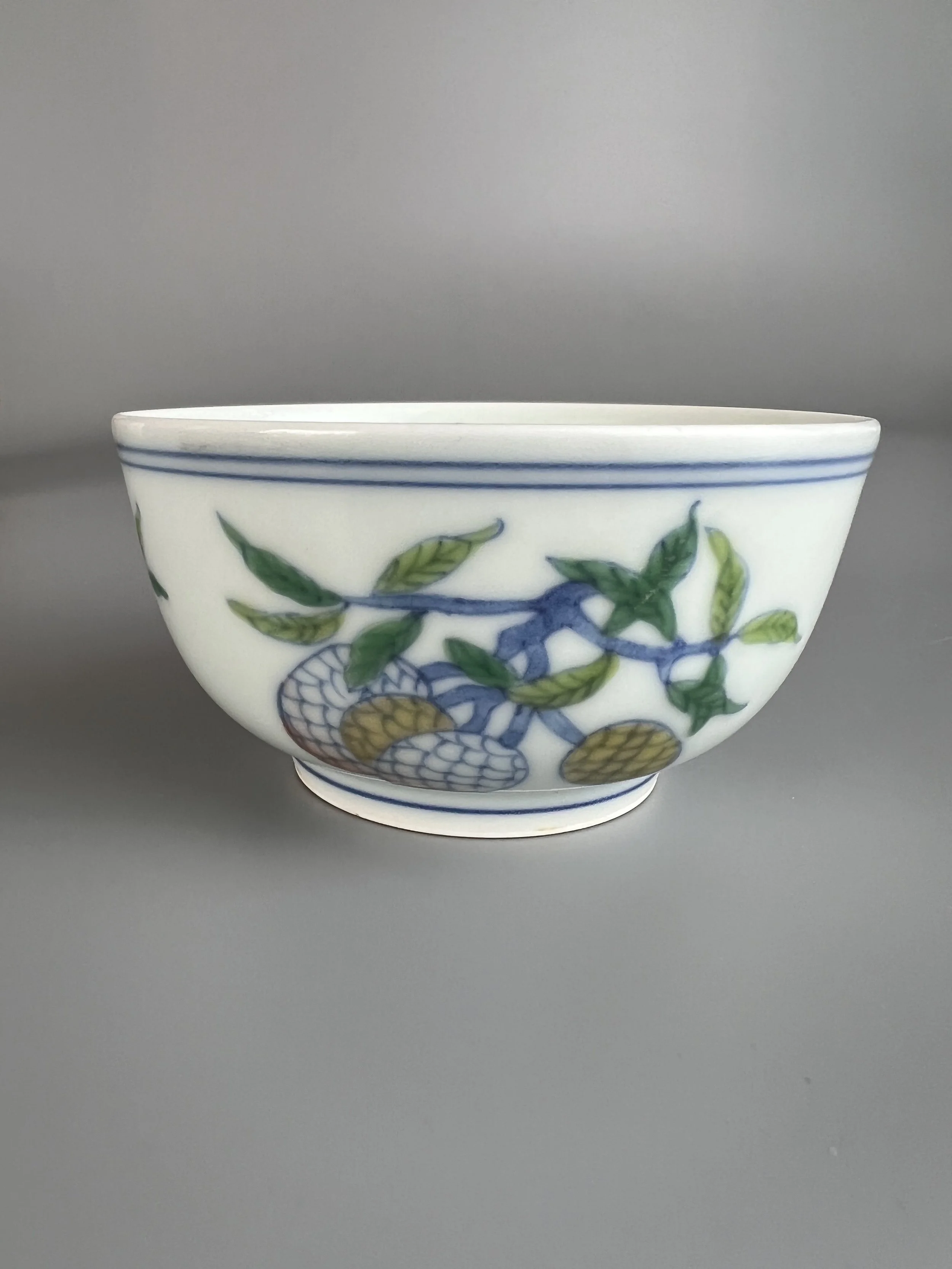 Image 2 of 12
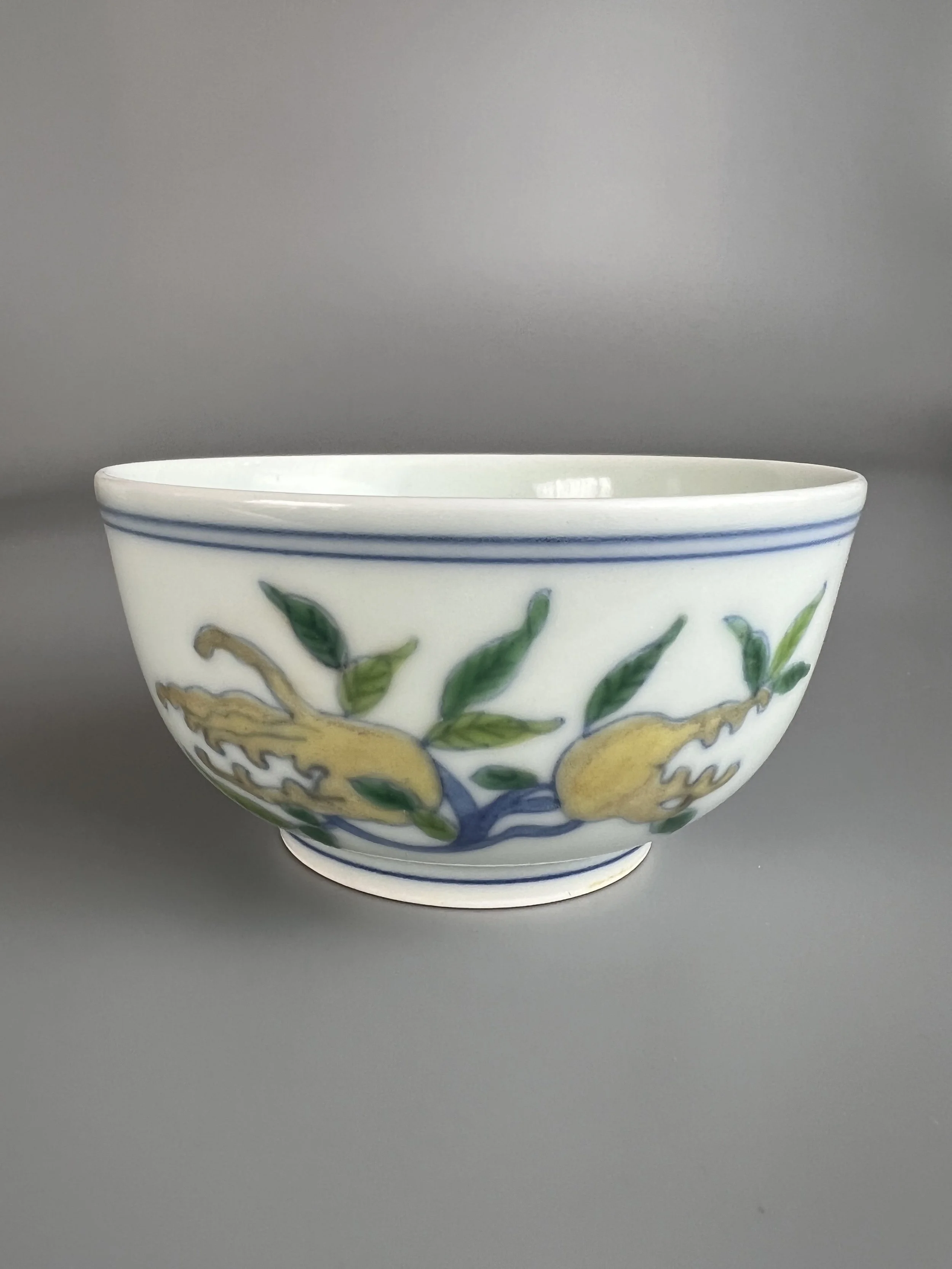 Image 3 of 12
 Image 4 of 12
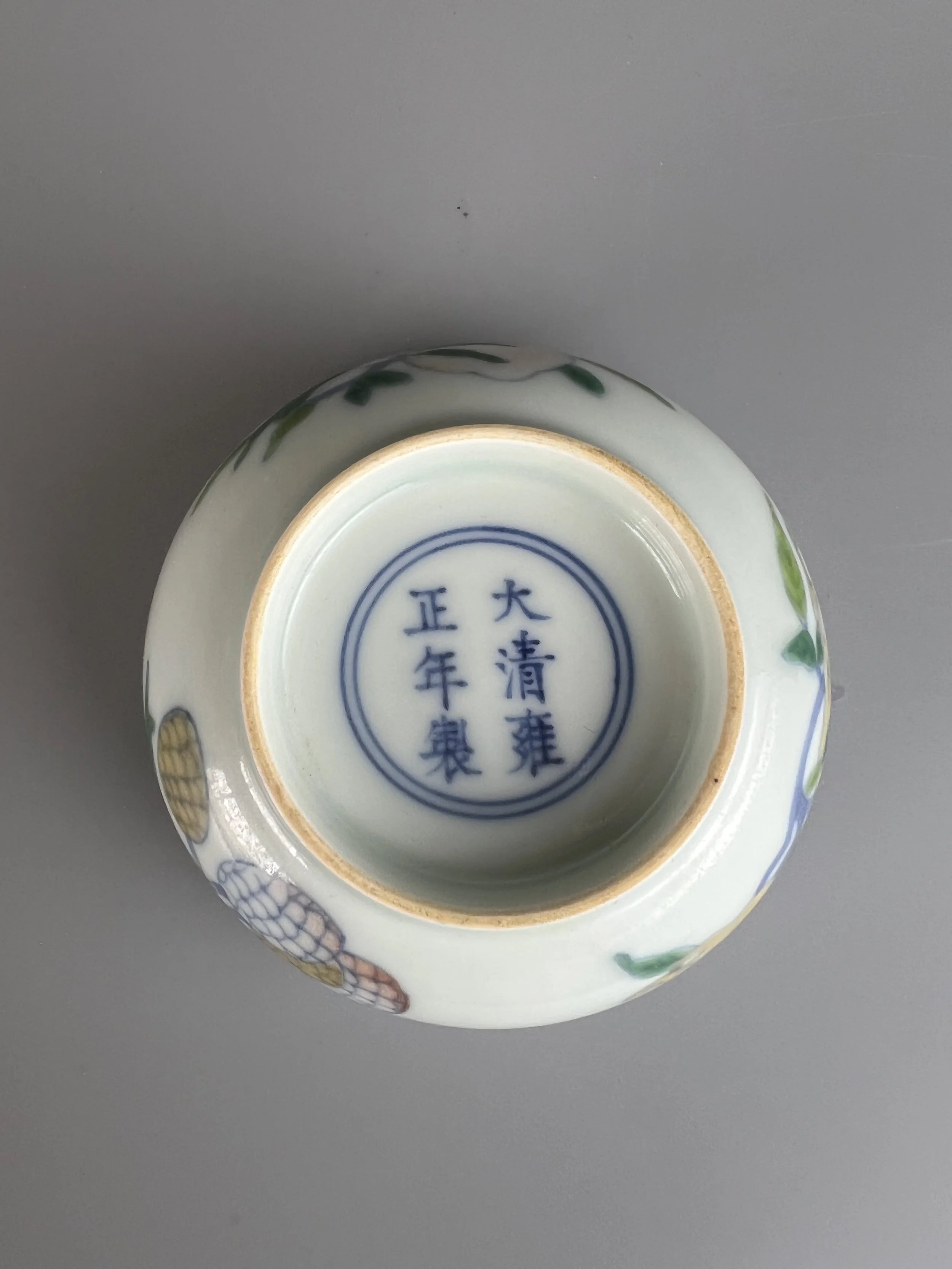 Image 5 of 12
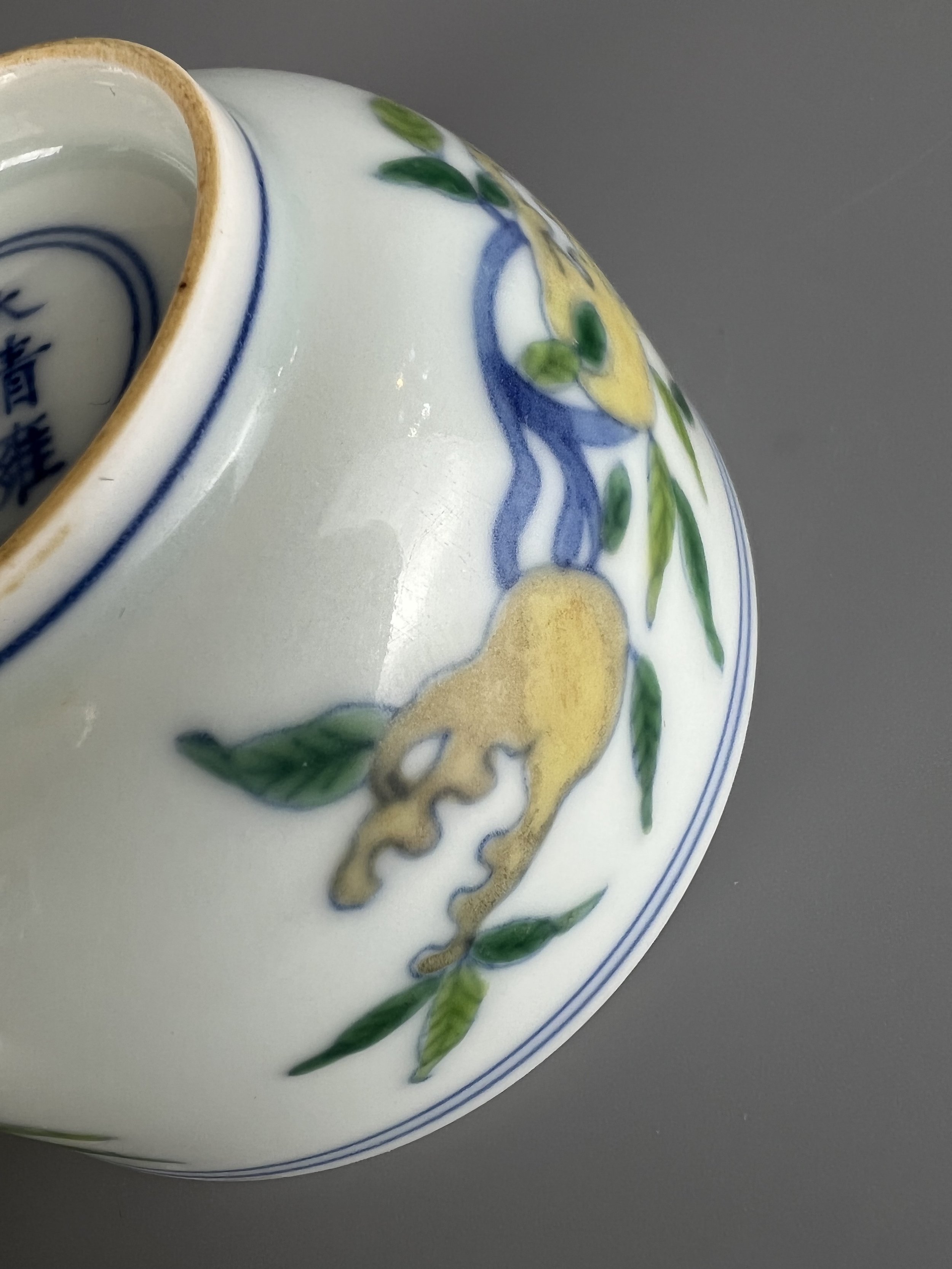 Image 6 of 12
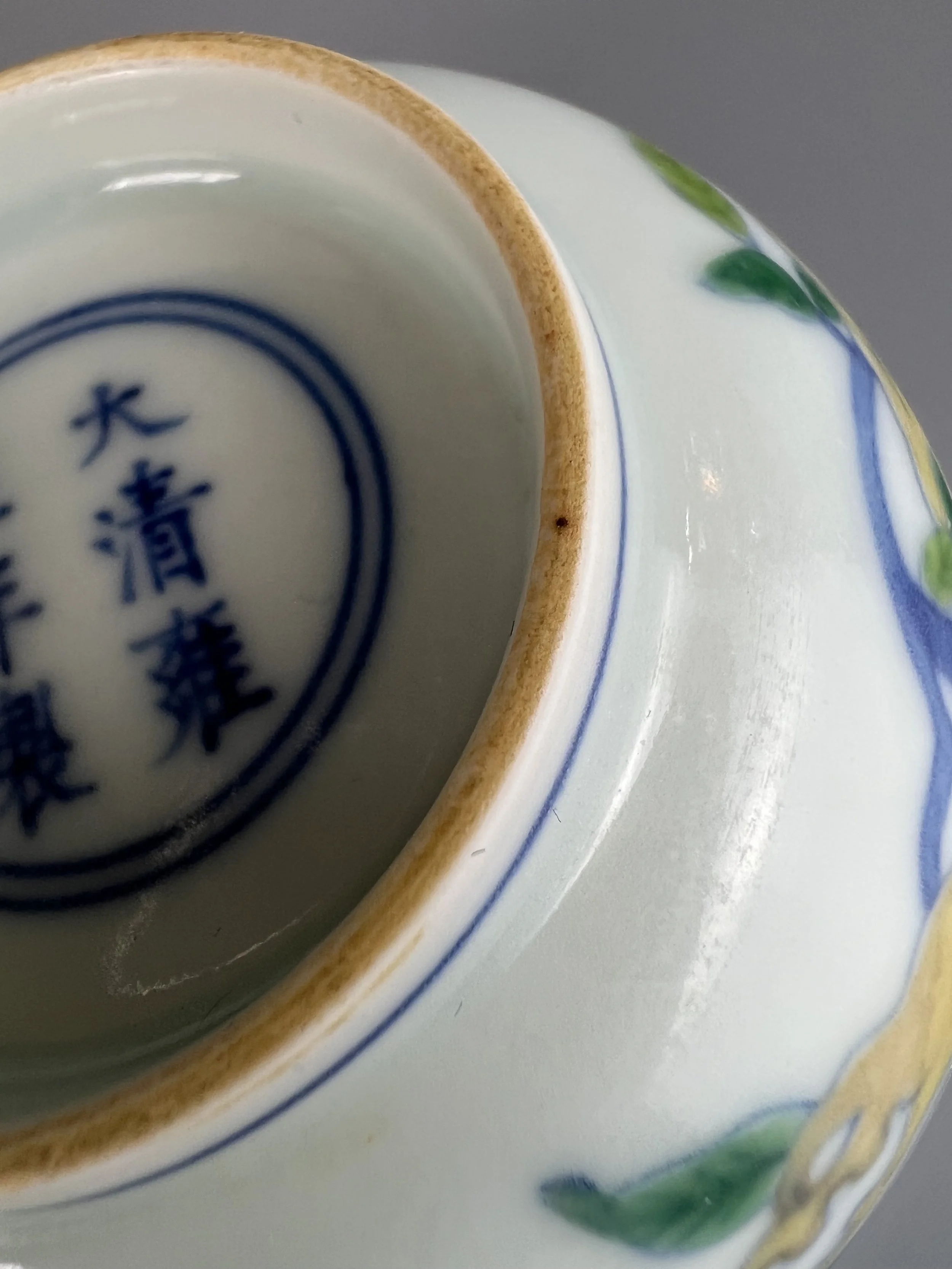 Image 7 of 12
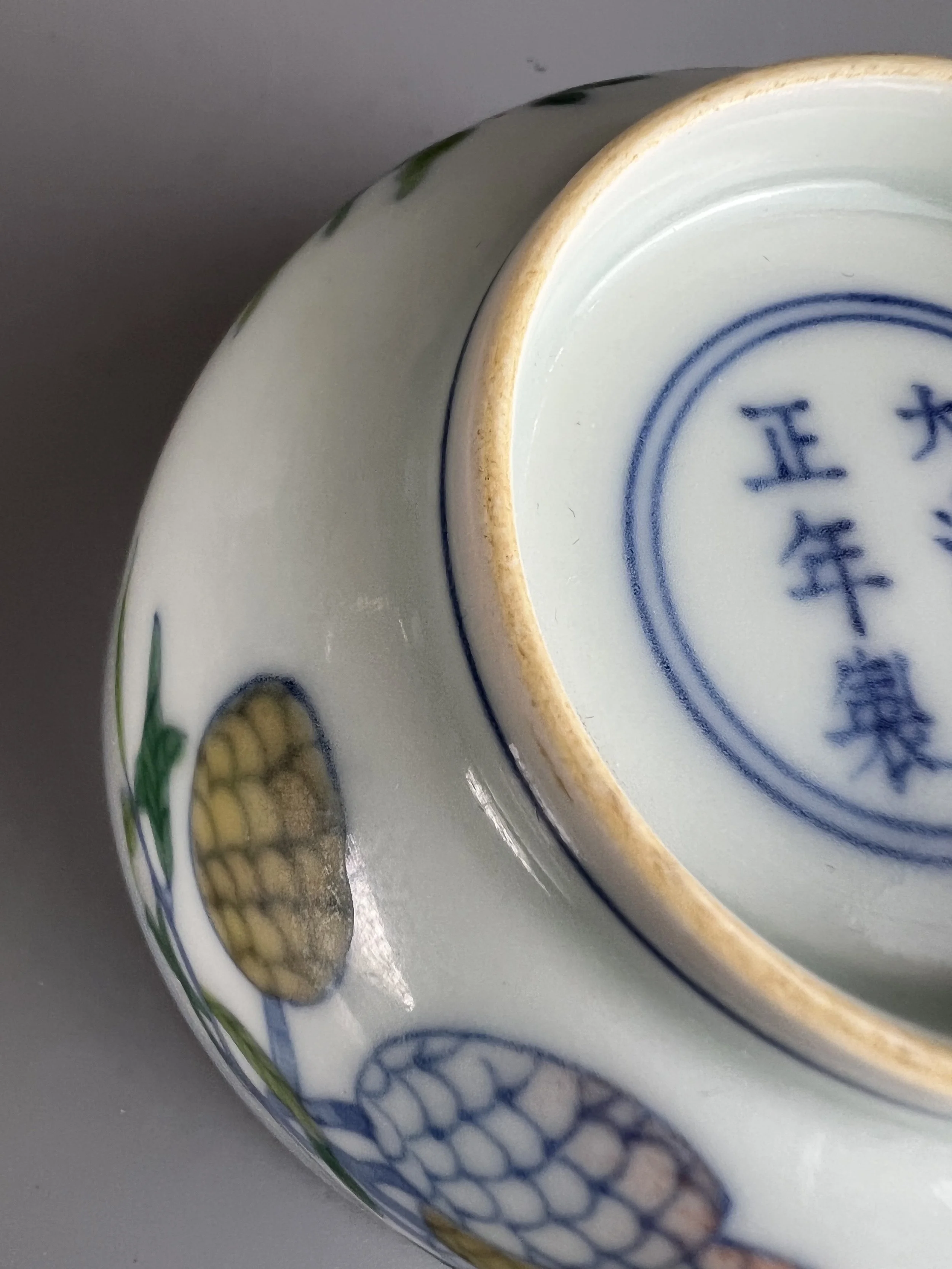 Image 8 of 12
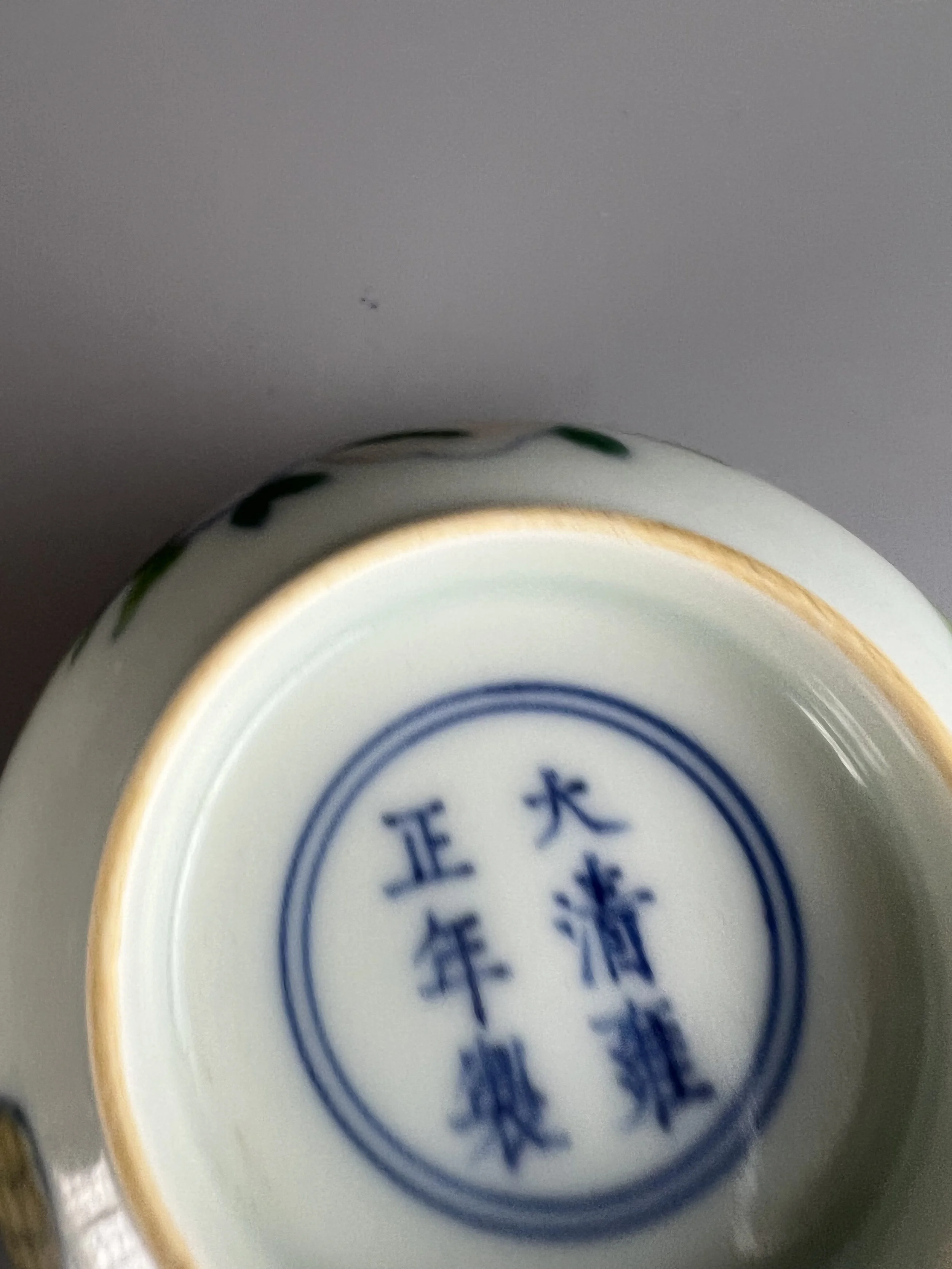 Image 9 of 12
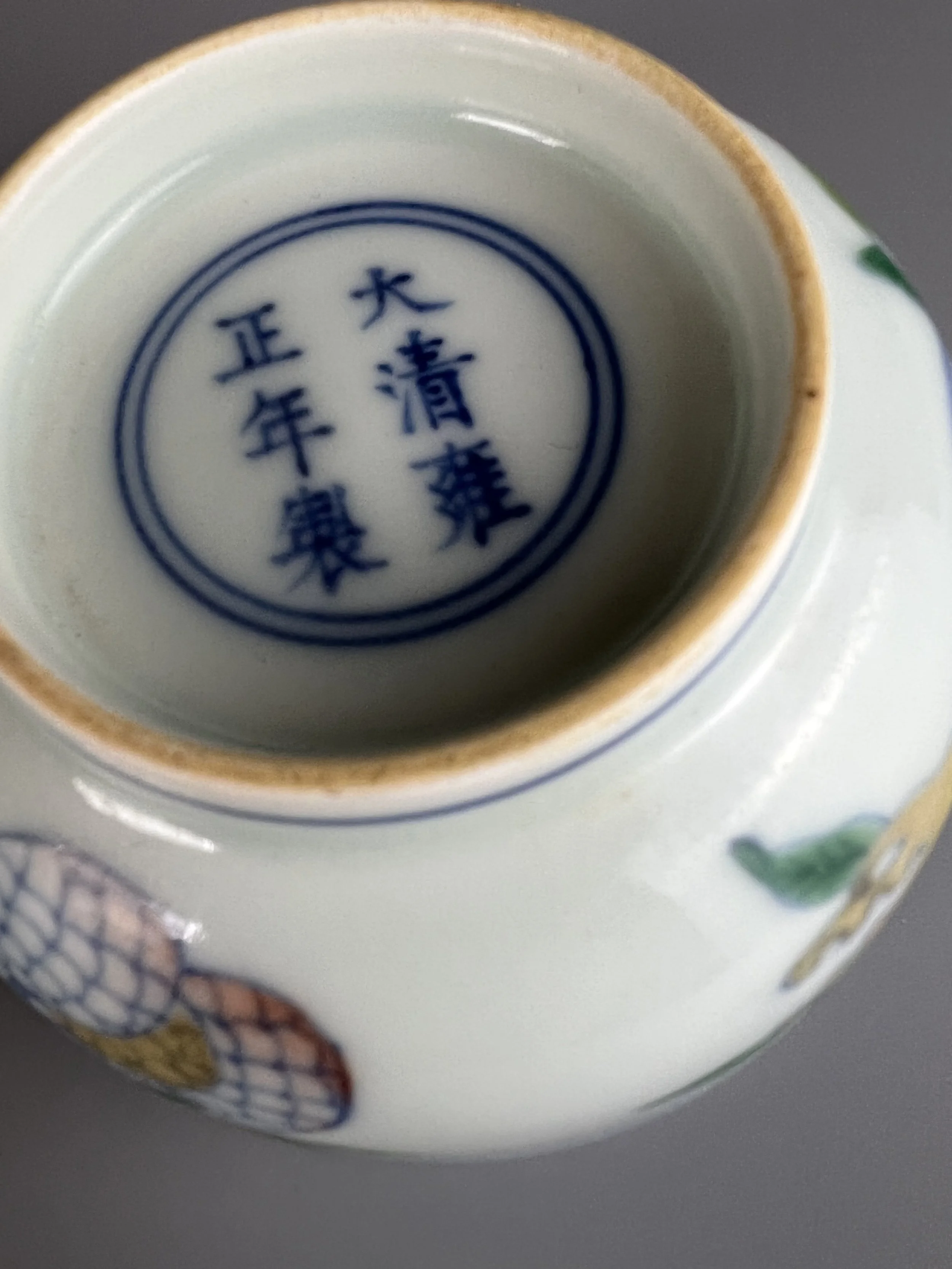 Image 10 of 12
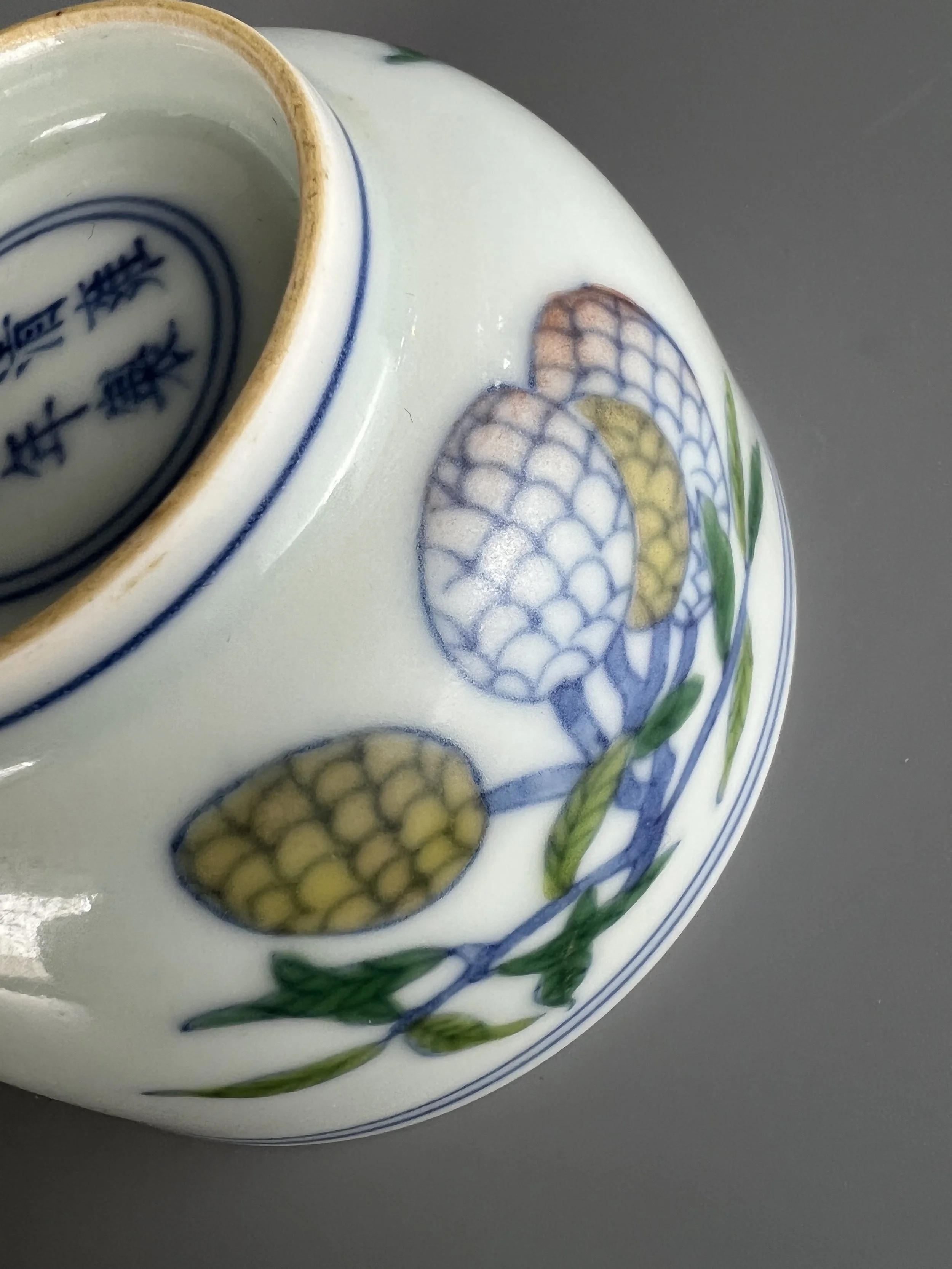 Image 11 of 12
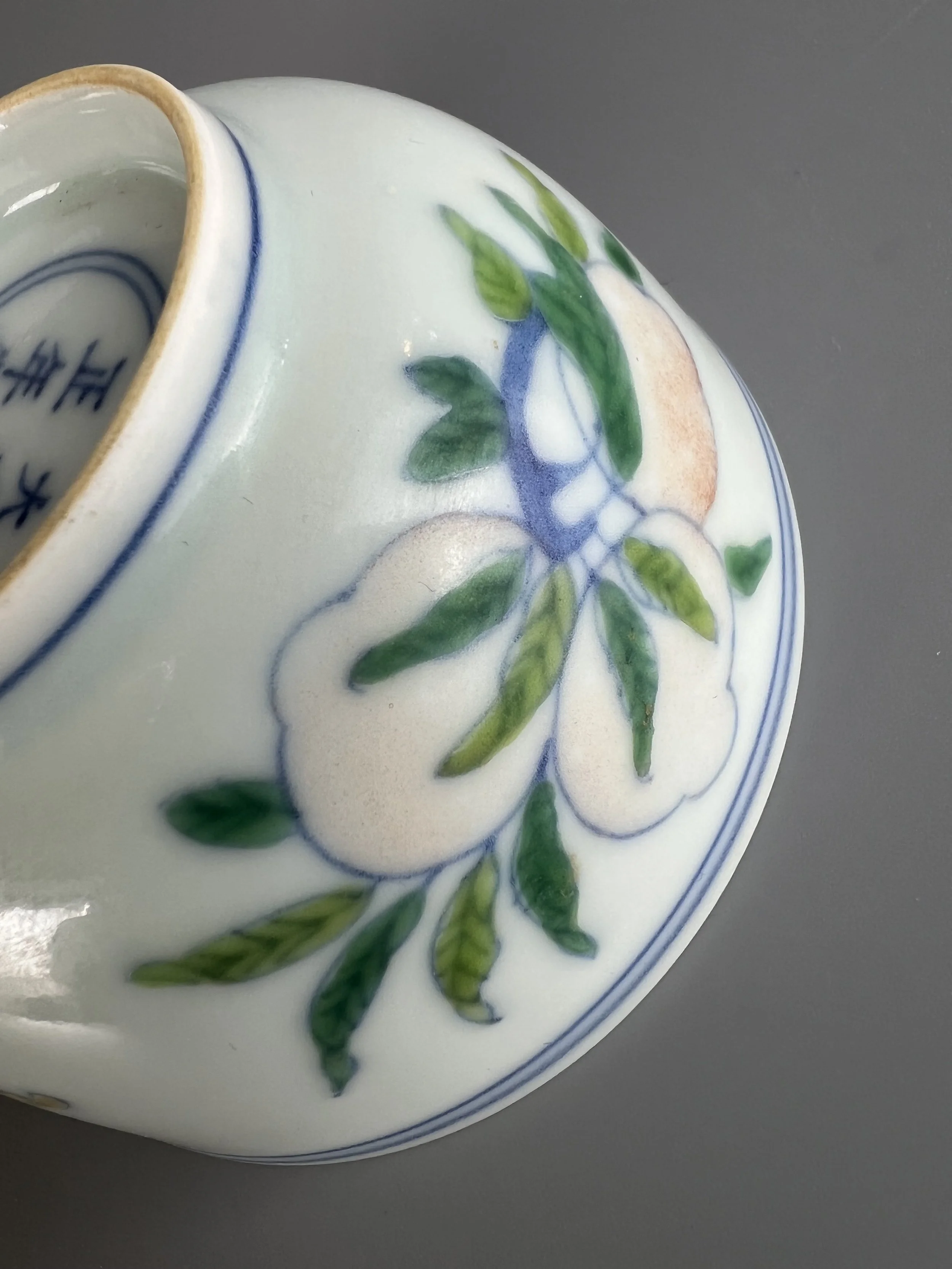 Image 12 of 12
Yongzheng-period Doucai 'Three Auspicious Fruits' Cup from the Qing Dynasty
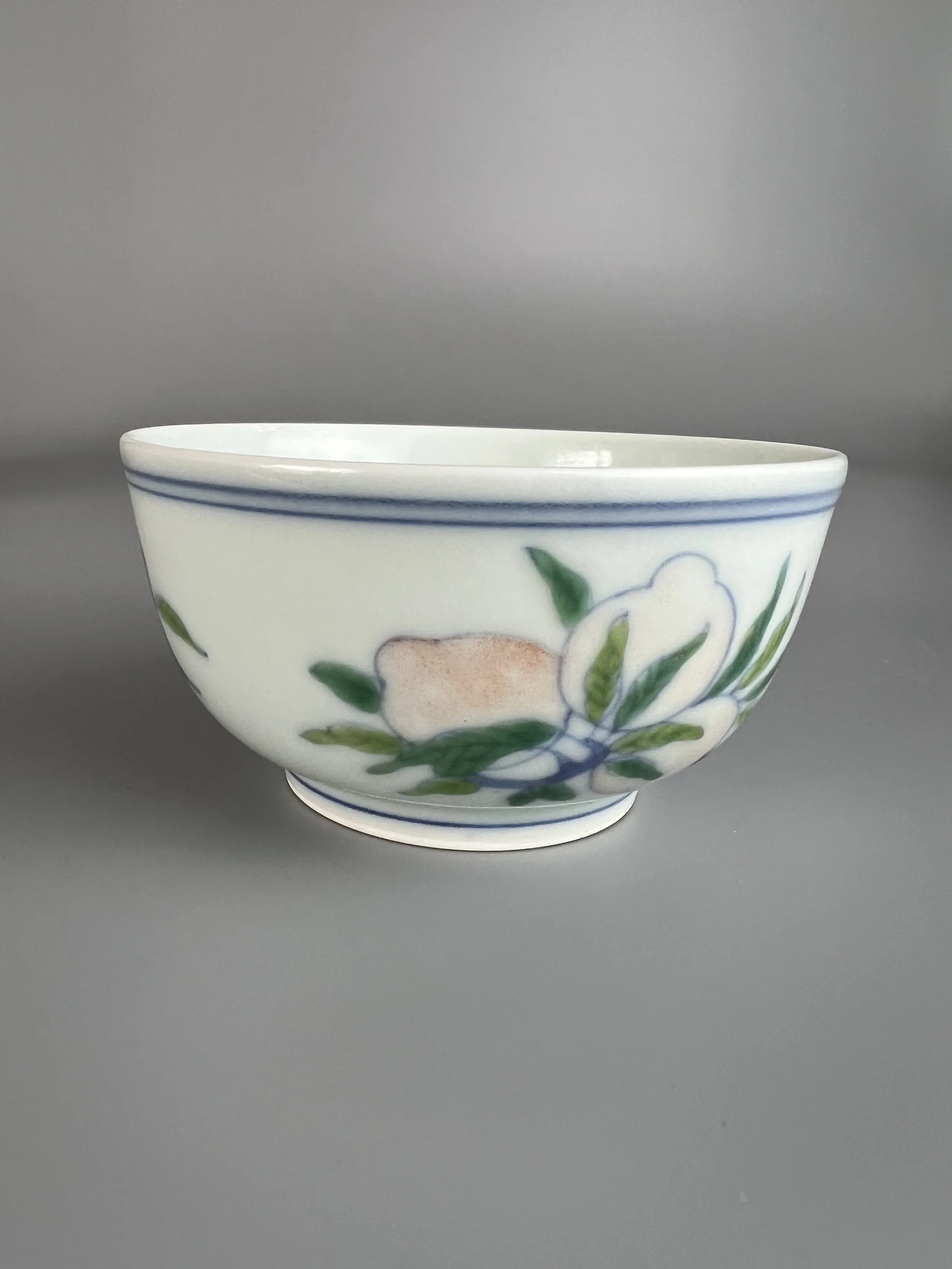
This piece is a treasure among doucai porcelain from the Yongzheng reign of the Qing Dynasty. Measuring 9.1 cm in diameter and 4 cm in height, its form is exquisitely refined and elegant, perfectly sized to fit in the palm of the hand. The exterior is decorated using the doucai technique with the classic motif of the "Three Abundances" or "Three Auspicious Fruits," symbolizing the complete blessings of "Fortune, Prosperity, and Longevity." The base bears a six-character mark in underglaze blue within a double circle, reading "Da Qing Yongzheng nian zhi" (Made in the Yongzheng reign of the Great Qing Dynasty), a standard inscription for official wares of this period. This cup concentrates the essence of Yongzheng porcelain craftsmanship and stands as a representative object for studying the imperial aesthetics and peak technical achievements of the Yongzheng era.
I. Form and Decoration: The Artistic Presentation of Auspicious Meaning
The cup's shape is regular and graceful, with a lightweight yet firm porcelain body and a glossy, jade-like glaze. The primary decorative theme on the exterior is the "Three Abundances" design, derived from the "Three Blessings"典故 (allusion) in the Daoist text Zhuangzi·Tiandi, and was a common auspicious motif in Yongzheng imperial wares:
*Buddha's Hand Citron (Foshou)**: A homophone for "fortune" (Fu, 福), its finger-like segments symbolize good fortune and the grasping of happiness. In the design, the citron's "fingers" are depicted stretching naturally, painted in iron-red with green-enameled leaves, appearing vivid and lifelike.
*Peach**: Symbolizes longevity. The peach fruit is painted plump and full, rendered with delicate famille rose enamels that create natural tonal transitions, giving it the texture of a ripe fruit, complemented by leaves outlined in underglaze blue.
*Pomegranate**: With its numerous seeds, it signifies many children and grandchildren, and familial prosperity. The pomegranate is shown with its skin split open, revealing the packed seeds. The seeds are dotted with red enamel, and the leaves are painted in underglaze blue, full of vitality.
These three fruits encircle the body of the cup in a well-spaced and harmonious composition, executed with meticulous painting. The depiction of the fruits emphasizes realism and three-dimensionality. The color scheme is fresh, bright, and elegant, adhering to natural forms while transcending mere botanical illustration. It incorporates the artistic refinement of court painters towards auspicious patterns, reflecting the Yongzheng Emperor's pursuit of a "refined, elegant, and delicate" aesthetic taste.
II. Technical Characteristics: The Pinnacle of Doucai Technique
"Doucai" (literally "contrasting colors" or "joined colors") refers to the vibrant interplay between underglaze blue and overglaze enamels. This cup perfectly exemplifies the unparalleled technical mastery of Yongzheng-period doucai:
1. Underglaze Blue: First, the entire decorative outline was traced with cobalt blue pigment, after which the piece was fired at a high temperature. The blue coloring is pure and brilliant, with lines fine, smooth, and flowing—as precise as gossamer—defining the skeletal framework of the pattern.
2. Overglaze Enameling: Within the blue outlines, various overglaze enamels such as iron-red, famille rose, green, and yellow were carefully applied, followed by a second, lower-temperature firing. The enamel pigments were ground and prepared to an exceptional degree of fineness. Their colors are vibrant yet softly graduated, creating a delightful contrast with the crystal-white glaze background and the serene, elegant blue outlines.
3. Period Characteristics: Compared to the古朴雅致 (simple, rustic elegance) of Chenghua-period (Ming) doucai, Yongzheng doucai exhibits greater refinement and delicacy in composition and color application. This cup employs a wider variety of enamels (such as the use of famille rose) and demonstrates even more meticulous painting. Its overall style appears more exquisitely beautiful, elegant, and peerlessly refined, representing the absolute peak of Qing Dynasty overglaze enamel porcelain technique.
III. Inscription and Historical Context
The six-character reign mark "Da Qing Yongzheng nian zhi" on the base is written in regular kaishu script within double circles. The calligraphy is neat, elegant, and executed with strong brushstrokes, characteristic of the standard inscription for mid-to-late Yongzheng official wares. The Yongzheng Emperor involved himself closely in the minutiae of the imperial kiln's production, demanding that porcelain be "务必精细" (necessarily refined) and "文雅" (cultivated and elegant). Superintendents such as Nian Xiyao and Tang Ying, adhering to the Emperor's wishes, drove the quality of Yongzheng imperial porcelain to unprecedented heights. Every aspect of this cup—from its form and pattern to its enameling and inscription—reflects the stringent standards, innovative spirit, and pursuit of ultimate craftsmanship that defined this period.
IV. Summary and Value
This Yongzheng doucai 'Three Auspicious Fruits' cup is not merely a functional imperial vessel for drinking; it is a precious object of display and connoisseurship that merges profound cultural symbolism, high artistic beauty, and顶尖 (top-tier) technical skill. Through the "Three Abundances" motif, it embodies the imperial family's wishes for good fortune, official rank, longevity, and the flourishing of descendants. Its modest size, flawless body, glaze, and painting concretely and meticulously attest to the "巧夺天工、清新隽永" (divinely skillful, fresh, and meaningfully enduring) artistic style of Yongzheng imperial ware. It is an indispensable classic form for collecting and researching Qing Dynasty Yongzheng official porcelain, possessing immense artistic, historical, and collectible value.
This piece is a treasure among doucai porcelain from the Yongzheng reign of the Qing Dynasty. Measuring 9.1 cm in diameter and 4 cm in height, its form is exquisitely refined and elegant, perfectly sized to fit in the palm of the hand. The exterior is decorated using the doucai technique with the classic motif of the "Three Abundances" or "Three Auspicious Fruits," symbolizing the complete blessings of "Fortune, Prosperity, and Longevity." The base bears a six-character mark in underglaze blue within a double circle, reading "Da Qing Yongzheng nian zhi" (Made in the Yongzheng reign of the Great Qing Dynasty), a standard inscription for official wares of this period. This cup concentrates the essence of Yongzheng porcelain craftsmanship and stands as a representative object for studying the imperial aesthetics and peak technical achievements of the Yongzheng era.
I. Form and Decoration: The Artistic Presentation of Auspicious Meaning
The cup's shape is regular and graceful, with a lightweight yet firm porcelain body and a glossy, jade-like glaze. The primary decorative theme on the exterior is the "Three Abundances" design, derived from the "Three Blessings"典故 (allusion) in the Daoist text Zhuangzi·Tiandi, and was a common auspicious motif in Yongzheng imperial wares:
*Buddha's Hand Citron (Foshou)**: A homophone for "fortune" (Fu, 福), its finger-like segments symbolize good fortune and the grasping of happiness. In the design, the citron's "fingers" are depicted stretching naturally, painted in iron-red with green-enameled leaves, appearing vivid and lifelike.
*Peach**: Symbolizes longevity. The peach fruit is painted plump and full, rendered with delicate famille rose enamels that create natural tonal transitions, giving it the texture of a ripe fruit, complemented by leaves outlined in underglaze blue.
*Pomegranate**: With its numerous seeds, it signifies many children and grandchildren, and familial prosperity. The pomegranate is shown with its skin split open, revealing the packed seeds. The seeds are dotted with red enamel, and the leaves are painted in underglaze blue, full of vitality.
These three fruits encircle the body of the cup in a well-spaced and harmonious composition, executed with meticulous painting. The depiction of the fruits emphasizes realism and three-dimensionality. The color scheme is fresh, bright, and elegant, adhering to natural forms while transcending mere botanical illustration. It incorporates the artistic refinement of court painters towards auspicious patterns, reflecting the Yongzheng Emperor's pursuit of a "refined, elegant, and delicate" aesthetic taste.
II. Technical Characteristics: The Pinnacle of Doucai Technique
"Doucai" (literally "contrasting colors" or "joined colors") refers to the vibrant interplay between underglaze blue and overglaze enamels. This cup perfectly exemplifies the unparalleled technical mastery of Yongzheng-period doucai:
1. Underglaze Blue: First, the entire decorative outline was traced with cobalt blue pigment, after which the piece was fired at a high temperature. The blue coloring is pure and brilliant, with lines fine, smooth, and flowing—as precise as gossamer—defining the skeletal framework of the pattern.
2. Overglaze Enameling: Within the blue outlines, various overglaze enamels such as iron-red, famille rose, green, and yellow were carefully applied, followed by a second, lower-temperature firing. The enamel pigments were ground and prepared to an exceptional degree of fineness. Their colors are vibrant yet softly graduated, creating a delightful contrast with the crystal-white glaze background and the serene, elegant blue outlines.
3. Period Characteristics: Compared to the古朴雅致 (simple, rustic elegance) of Chenghua-period (Ming) doucai, Yongzheng doucai exhibits greater refinement and delicacy in composition and color application. This cup employs a wider variety of enamels (such as the use of famille rose) and demonstrates even more meticulous painting. Its overall style appears more exquisitely beautiful, elegant, and peerlessly refined, representing the absolute peak of Qing Dynasty overglaze enamel porcelain technique.
III. Inscription and Historical Context
The six-character reign mark "Da Qing Yongzheng nian zhi" on the base is written in regular kaishu script within double circles. The calligraphy is neat, elegant, and executed with strong brushstrokes, characteristic of the standard inscription for mid-to-late Yongzheng official wares. The Yongzheng Emperor involved himself closely in the minutiae of the imperial kiln's production, demanding that porcelain be "务必精细" (necessarily refined) and "文雅" (cultivated and elegant). Superintendents such as Nian Xiyao and Tang Ying, adhering to the Emperor's wishes, drove the quality of Yongzheng imperial porcelain to unprecedented heights. Every aspect of this cup—from its form and pattern to its enameling and inscription—reflects the stringent standards, innovative spirit, and pursuit of ultimate craftsmanship that defined this period.
IV. Summary and Value
This Yongzheng doucai 'Three Auspicious Fruits' cup is not merely a functional imperial vessel for drinking; it is a precious object of display and connoisseurship that merges profound cultural symbolism, high artistic beauty, and顶尖 (top-tier) technical skill. Through the "Three Abundances" motif, it embodies the imperial family's wishes for good fortune, official rank, longevity, and the flourishing of descendants. Its modest size, flawless body, glaze, and painting concretely and meticulously attest to the "巧夺天工、清新隽永" (divinely skillful, fresh, and meaningfully enduring) artistic style of Yongzheng imperial ware. It is an indispensable classic form for collecting and researching Qing Dynasty Yongzheng official porcelain, possessing immense artistic, historical, and collectible value.
清雍正斗彩福禄寿三多杯鉴赏
本品为清雍正时期斗彩瓷器之珍品,口径9.1厘米,高4厘米,形制精巧隽秀,盈手可握。杯身外壁以斗彩工艺绘经典“三多”图样,寓意“福禄寿”俱全,底部书青花双圈“大清雍正年制”六字楷书款,为雍正官窑典型款识。此杯集雍正瓷艺之精粹于一身,是研究雍正朝宫廷审美与制瓷巅峰技艺的代表性器物。
一、器形与纹饰:吉祥寓意的艺术化呈现
此杯器形规整优雅,胎骨轻盈坚致,釉面莹润如玉。外壁主题纹饰为“三多图”,源出《庄子·天地》中“华封三祝”的典故,是雍正官窑常见的吉祥题材:
*佛手**:谐音“福”,其形如掌,象征**福泽**与掌握幸福。图中佛手指尖舒展,以矾红绘就,点缀绿彩枝叶,生动逼真。
*桃子**:象征**长寿**。桃实饱满丰腴,以淡雅粉彩渲染,过渡自然,呈现出成熟果实的质感,旁衬青花勾勒的枝叶。
*石榴**:因籽粒繁多,寓意**多子多孙、家族兴旺**。石榴果皮绽开,露出累累籽实,以红彩点染籽粒,青花绘枝叶,富有生机。
三者环绕杯身,布局疏朗有致,画工精细入微。果实描绘注重写实与立体感,色彩搭配清新雅丽,既符合自然形态,又超越了纯粹写生,融入了宫廷画师对吉祥纹样的艺术提炼,体现了雍正皇帝追求“文雅精细”的审美趣味。
二、工艺特征:斗彩技术的登峰造极
“斗彩”又称“逗彩”,为釉下青花与釉上彩料争奇斗艳之意。此杯完美展现了雍正斗彩冠绝古今的工艺水准:
1. 釉下青花:先行以钴料勾勒全部纹饰轮廓,入窑高温烧成。其青花发色纯正,线条纤细流畅,如游丝般精准地定义了图案骨架。
2. 釉上填彩:在青花轮廓内,精心填绘矾红、粉彩、绿彩、黄彩等多种釉上彩料,再经低温二次烧造。彩料研炼极精,呈色娇艳欲滴且过渡柔和,与晶莹的白釉地、幽靓的青花线相映成趣。
3. 时代特色:与明代成化斗彩的古朴雅致相比,雍正斗彩在构图、用彩上更为秀逸精巧。此杯彩料品种更为丰富(如粉彩的运用),绘制工致程度更高,整体风格更显**秀美清雅、工丽无匹**,代表了清代彩瓷工艺的巅峰。
三、款识与时代背景
底部“大清雍正年制”六字青花楷书款,书写于双圈之内。其字体工整秀丽,笔道有力,为典型雍正中晚期官窑标准款识。雍正皇帝对御窑厂生产事无巨细均亲自过问,要求瓷器“务要精细”、“文雅”,督陶官年希尧、唐英秉承上意,致使雍正官窑瓷器质量达到前所未有的高度。此杯从造型、纹样到彩绘、款识,无不体现这一时期**严苛的标准、创新的精神与极致的工艺追求**。
四、总结与价值
此雍正斗彩福禄寿三多杯,不仅是一件实用的宫廷饮器,更是一件融合了深厚文化寓意、高度艺术美感与顶尖工艺技术的陈设珍玩。它通过“三多”题材,寄托了皇室对福气、禄位、长寿及子孙绵延的美好祈愿;其小巧的尺寸、无可挑剔的胎釉彩绘,则具体而微地印证了雍正官窑“巧夺天工、清新隽永”的艺术风格,是收藏与研究清代雍正官窑瓷器不可或缺的经典器型,具有极高的艺术价值、历史价值与收藏价值。
This piece is a treasure among doucai porcelain from the Yongzheng reign of the Qing Dynasty. Measuring 9.1 cm in diameter and 4 cm in height, its form is exquisitely refined and elegant, perfectly sized to fit in the palm of the hand. The exterior is decorated using the doucai technique with the classic motif of the "Three Abundances" or "Three Auspicious Fruits," symbolizing the complete blessings of "Fortune, Prosperity, and Longevity." The base bears a six-character mark in underglaze blue within a double circle, reading "Da Qing Yongzheng nian zhi" (Made in the Yongzheng reign of the Great Qing Dynasty), a standard inscription for official wares of this period. This cup concentrates the essence of Yongzheng porcelain craftsmanship and stands as a representative object for studying the imperial aesthetics and peak technical achievements of the Yongzheng era.
I. Form and Decoration: The Artistic Presentation of Auspicious Meaning
The cup's shape is regular and graceful, with a lightweight yet firm porcelain body and a glossy, jade-like glaze. The primary decorative theme on the exterior is the "Three Abundances" design, derived from the "Three Blessings"典故 (allusion) in the Daoist text Zhuangzi·Tiandi, and was a common auspicious motif in Yongzheng imperial wares:
*Buddha's Hand Citron (Foshou)**: A homophone for "fortune" (Fu, 福), its finger-like segments symbolize good fortune and the grasping of happiness. In the design, the citron's "fingers" are depicted stretching naturally, painted in iron-red with green-enameled leaves, appearing vivid and lifelike.
*Peach**: Symbolizes longevity. The peach fruit is painted plump and full, rendered with delicate famille rose enamels that create natural tonal transitions, giving it the texture of a ripe fruit, complemented by leaves outlined in underglaze blue.
*Pomegranate**: With its numerous seeds, it signifies many children and grandchildren, and familial prosperity. The pomegranate is shown with its skin split open, revealing the packed seeds. The seeds are dotted with red enamel, and the leaves are painted in underglaze blue, full of vitality.
These three fruits encircle the body of the cup in a well-spaced and harmonious composition, executed with meticulous painting. The depiction of the fruits emphasizes realism and three-dimensionality. The color scheme is fresh, bright, and elegant, adhering to natural forms while transcending mere botanical illustration. It incorporates the artistic refinement of court painters towards auspicious patterns, reflecting the Yongzheng Emperor's pursuit of a "refined, elegant, and delicate" aesthetic taste.
II. Technical Characteristics: The Pinnacle of Doucai Technique
"Doucai" (literally "contrasting colors" or "joined colors") refers to the vibrant interplay between underglaze blue and overglaze enamels. This cup perfectly exemplifies the unparalleled technical mastery of Yongzheng-period doucai:
1. Underglaze Blue: First, the entire decorative outline was traced with cobalt blue pigment, after which the piece was fired at a high temperature. The blue coloring is pure and brilliant, with lines fine, smooth, and flowing—as precise as gossamer—defining the skeletal framework of the pattern.
2. Overglaze Enameling: Within the blue outlines, various overglaze enamels such as iron-red, famille rose, green, and yellow were carefully applied, followed by a second, lower-temperature firing. The enamel pigments were ground and prepared to an exceptional degree of fineness. Their colors are vibrant yet softly graduated, creating a delightful contrast with the crystal-white glaze background and the serene, elegant blue outlines.
3. Period Characteristics: Compared to the古朴雅致 (simple, rustic elegance) of Chenghua-period (Ming) doucai, Yongzheng doucai exhibits greater refinement and delicacy in composition and color application. This cup employs a wider variety of enamels (such as the use of famille rose) and demonstrates even more meticulous painting. Its overall style appears more exquisitely beautiful, elegant, and peerlessly refined, representing the absolute peak of Qing Dynasty overglaze enamel porcelain technique.
III. Inscription and Historical Context
The six-character reign mark "Da Qing Yongzheng nian zhi" on the base is written in regular kaishu script within double circles. The calligraphy is neat, elegant, and executed with strong brushstrokes, characteristic of the standard inscription for mid-to-late Yongzheng official wares. The Yongzheng Emperor involved himself closely in the minutiae of the imperial kiln's production, demanding that porcelain be "务必精细" (necessarily refined) and "文雅" (cultivated and elegant). Superintendents such as Nian Xiyao and Tang Ying, adhering to the Emperor's wishes, drove the quality of Yongzheng imperial porcelain to unprecedented heights. Every aspect of this cup—from its form and pattern to its enameling and inscription—reflects the stringent standards, innovative spirit, and pursuit of ultimate craftsmanship that defined this period.
IV. Summary and Value
This Yongzheng doucai 'Three Auspicious Fruits' cup is not merely a functional imperial vessel for drinking; it is a precious object of display and connoisseurship that merges profound cultural symbolism, high artistic beauty, and顶尖 (top-tier) technical skill. Through the "Three Abundances" motif, it embodies the imperial family's wishes for good fortune, official rank, longevity, and the flourishing of descendants. Its modest size, flawless body, glaze, and painting concretely and meticulously attest to the "巧夺天工、清新隽永" (divinely skillful, fresh, and meaningfully enduring) artistic style of Yongzheng imperial ware. It is an indispensable classic form for collecting and researching Qing Dynasty Yongzheng official porcelain, possessing immense artistic, historical, and collectible value.
This piece is a treasure among doucai porcelain from the Yongzheng reign of the Qing Dynasty. Measuring 9.1 cm in diameter and 4 cm in height, its form is exquisitely refined and elegant, perfectly sized to fit in the palm of the hand. The exterior is decorated using the doucai technique with the classic motif of the "Three Abundances" or "Three Auspicious Fruits," symbolizing the complete blessings of "Fortune, Prosperity, and Longevity." The base bears a six-character mark in underglaze blue within a double circle, reading "Da Qing Yongzheng nian zhi" (Made in the Yongzheng reign of the Great Qing Dynasty), a standard inscription for official wares of this period. This cup concentrates the essence of Yongzheng porcelain craftsmanship and stands as a representative object for studying the imperial aesthetics and peak technical achievements of the Yongzheng era.
I. Form and Decoration: The Artistic Presentation of Auspicious Meaning
The cup's shape is regular and graceful, with a lightweight yet firm porcelain body and a glossy, jade-like glaze. The primary decorative theme on the exterior is the "Three Abundances" design, derived from the "Three Blessings"典故 (allusion) in the Daoist text Zhuangzi·Tiandi, and was a common auspicious motif in Yongzheng imperial wares:
*Buddha's Hand Citron (Foshou)**: A homophone for "fortune" (Fu, 福), its finger-like segments symbolize good fortune and the grasping of happiness. In the design, the citron's "fingers" are depicted stretching naturally, painted in iron-red with green-enameled leaves, appearing vivid and lifelike.
*Peach**: Symbolizes longevity. The peach fruit is painted plump and full, rendered with delicate famille rose enamels that create natural tonal transitions, giving it the texture of a ripe fruit, complemented by leaves outlined in underglaze blue.
*Pomegranate**: With its numerous seeds, it signifies many children and grandchildren, and familial prosperity. The pomegranate is shown with its skin split open, revealing the packed seeds. The seeds are dotted with red enamel, and the leaves are painted in underglaze blue, full of vitality.
These three fruits encircle the body of the cup in a well-spaced and harmonious composition, executed with meticulous painting. The depiction of the fruits emphasizes realism and three-dimensionality. The color scheme is fresh, bright, and elegant, adhering to natural forms while transcending mere botanical illustration. It incorporates the artistic refinement of court painters towards auspicious patterns, reflecting the Yongzheng Emperor's pursuit of a "refined, elegant, and delicate" aesthetic taste.
II. Technical Characteristics: The Pinnacle of Doucai Technique
"Doucai" (literally "contrasting colors" or "joined colors") refers to the vibrant interplay between underglaze blue and overglaze enamels. This cup perfectly exemplifies the unparalleled technical mastery of Yongzheng-period doucai:
1. Underglaze Blue: First, the entire decorative outline was traced with cobalt blue pigment, after which the piece was fired at a high temperature. The blue coloring is pure and brilliant, with lines fine, smooth, and flowing—as precise as gossamer—defining the skeletal framework of the pattern.
2. Overglaze Enameling: Within the blue outlines, various overglaze enamels such as iron-red, famille rose, green, and yellow were carefully applied, followed by a second, lower-temperature firing. The enamel pigments were ground and prepared to an exceptional degree of fineness. Their colors are vibrant yet softly graduated, creating a delightful contrast with the crystal-white glaze background and the serene, elegant blue outlines.
3. Period Characteristics: Compared to the古朴雅致 (simple, rustic elegance) of Chenghua-period (Ming) doucai, Yongzheng doucai exhibits greater refinement and delicacy in composition and color application. This cup employs a wider variety of enamels (such as the use of famille rose) and demonstrates even more meticulous painting. Its overall style appears more exquisitely beautiful, elegant, and peerlessly refined, representing the absolute peak of Qing Dynasty overglaze enamel porcelain technique.
III. Inscription and Historical Context
The six-character reign mark "Da Qing Yongzheng nian zhi" on the base is written in regular kaishu script within double circles. The calligraphy is neat, elegant, and executed with strong brushstrokes, characteristic of the standard inscription for mid-to-late Yongzheng official wares. The Yongzheng Emperor involved himself closely in the minutiae of the imperial kiln's production, demanding that porcelain be "务必精细" (necessarily refined) and "文雅" (cultivated and elegant). Superintendents such as Nian Xiyao and Tang Ying, adhering to the Emperor's wishes, drove the quality of Yongzheng imperial porcelain to unprecedented heights. Every aspect of this cup—from its form and pattern to its enameling and inscription—reflects the stringent standards, innovative spirit, and pursuit of ultimate craftsmanship that defined this period.
IV. Summary and Value
This Yongzheng doucai 'Three Auspicious Fruits' cup is not merely a functional imperial vessel for drinking; it is a precious object of display and connoisseurship that merges profound cultural symbolism, high artistic beauty, and顶尖 (top-tier) technical skill. Through the "Three Abundances" motif, it embodies the imperial family's wishes for good fortune, official rank, longevity, and the flourishing of descendants. Its modest size, flawless body, glaze, and painting concretely and meticulously attest to the "巧夺天工、清新隽永" (divinely skillful, fresh, and meaningfully enduring) artistic style of Yongzheng imperial ware. It is an indispensable classic form for collecting and researching Qing Dynasty Yongzheng official porcelain, possessing immense artistic, historical, and collectible value.
清雍正斗彩福禄寿三多杯鉴赏
本品为清雍正时期斗彩瓷器之珍品,口径9.1厘米,高4厘米,形制精巧隽秀,盈手可握。杯身外壁以斗彩工艺绘经典“三多”图样,寓意“福禄寿”俱全,底部书青花双圈“大清雍正年制”六字楷书款,为雍正官窑典型款识。此杯集雍正瓷艺之精粹于一身,是研究雍正朝宫廷审美与制瓷巅峰技艺的代表性器物。
一、器形与纹饰:吉祥寓意的艺术化呈现
此杯器形规整优雅,胎骨轻盈坚致,釉面莹润如玉。外壁主题纹饰为“三多图”,源出《庄子·天地》中“华封三祝”的典故,是雍正官窑常见的吉祥题材:
*佛手**:谐音“福”,其形如掌,象征**福泽**与掌握幸福。图中佛手指尖舒展,以矾红绘就,点缀绿彩枝叶,生动逼真。
*桃子**:象征**长寿**。桃实饱满丰腴,以淡雅粉彩渲染,过渡自然,呈现出成熟果实的质感,旁衬青花勾勒的枝叶。
*石榴**:因籽粒繁多,寓意**多子多孙、家族兴旺**。石榴果皮绽开,露出累累籽实,以红彩点染籽粒,青花绘枝叶,富有生机。
三者环绕杯身,布局疏朗有致,画工精细入微。果实描绘注重写实与立体感,色彩搭配清新雅丽,既符合自然形态,又超越了纯粹写生,融入了宫廷画师对吉祥纹样的艺术提炼,体现了雍正皇帝追求“文雅精细”的审美趣味。
二、工艺特征:斗彩技术的登峰造极
“斗彩”又称“逗彩”,为釉下青花与釉上彩料争奇斗艳之意。此杯完美展现了雍正斗彩冠绝古今的工艺水准:
1. 釉下青花:先行以钴料勾勒全部纹饰轮廓,入窑高温烧成。其青花发色纯正,线条纤细流畅,如游丝般精准地定义了图案骨架。
2. 釉上填彩:在青花轮廓内,精心填绘矾红、粉彩、绿彩、黄彩等多种釉上彩料,再经低温二次烧造。彩料研炼极精,呈色娇艳欲滴且过渡柔和,与晶莹的白釉地、幽靓的青花线相映成趣。
3. 时代特色:与明代成化斗彩的古朴雅致相比,雍正斗彩在构图、用彩上更为秀逸精巧。此杯彩料品种更为丰富(如粉彩的运用),绘制工致程度更高,整体风格更显**秀美清雅、工丽无匹**,代表了清代彩瓷工艺的巅峰。
三、款识与时代背景
底部“大清雍正年制”六字青花楷书款,书写于双圈之内。其字体工整秀丽,笔道有力,为典型雍正中晚期官窑标准款识。雍正皇帝对御窑厂生产事无巨细均亲自过问,要求瓷器“务要精细”、“文雅”,督陶官年希尧、唐英秉承上意,致使雍正官窑瓷器质量达到前所未有的高度。此杯从造型、纹样到彩绘、款识,无不体现这一时期**严苛的标准、创新的精神与极致的工艺追求**。
四、总结与价值
此雍正斗彩福禄寿三多杯,不仅是一件实用的宫廷饮器,更是一件融合了深厚文化寓意、高度艺术美感与顶尖工艺技术的陈设珍玩。它通过“三多”题材,寄托了皇室对福气、禄位、长寿及子孙绵延的美好祈愿;其小巧的尺寸、无可挑剔的胎釉彩绘,则具体而微地印证了雍正官窑“巧夺天工、清新隽永”的艺术风格,是收藏与研究清代雍正官窑瓷器不可或缺的经典器型,具有极高的艺术价值、历史价值与收藏价值。