Dimensions: Height: 9 cm, Mouth Diameter: 18 cm, Foot Diameter: 8 cm
Reign Mark: “Da Ming Hongzhi Nian Zhi” (Made in the Hongzhi Reign of the Great Ming) in six-character, two-line regular script within a double-circle in underglaze blue on the base.
I. Form and Glaze: The Refined Elegance of the Hongzhi Era
The bowl exhibits a classic, harmonious, and well-proportioned form. It has a flared mouth, a smoothly rounded body, and a ring foot, with flowing, uncluttered lines that embody the characteristically dignified, stable, yet elegant style of Hongzhi official ware. The interior and exterior are fully covered with a glaze of a pale, greenish-white tone. The glaze layer is even and thin, with a soft, lustrous, jade-like quality—a hallmark of mid-Ming dynasty Jingdezhen official porcelain, distinct from the thicker glazes of the Jiajing and Wanli periods that followed. This understated glaze provides the perfect plain ground for the intricate incised and filled decoration.
II. Technical Mastery: The Unification of Knife and Brush in an Imperial Art
This piece exemplifies the highly demanding “incised and filled” (anke tiancai) technique, a hallmark of Ming imperial porcelain. Its creation was a multi-stage process:
Incising on the Unglazed Body: A skilled artisan first meticulously carved the complete design of the dragon and the turbulent waves onto the dry, unfired body (biscuit). The incised lines are deep, sharp, and fluid, rendering the dragon's scales, claws, teeth, whiskers, and the foaming sea waves in precise detail, showcasing the exceptional compositional and carving skills of the court artisans.
Applying Transparent Glaze and High-Temperature Firing: After incising, the entire piece was coated with the aforementioned transparent greenish-white glaze and fired in a single high-temperature firing at approximately 1300°C, resulting in a plain white-glazed bowl with an incised pattern.
Filling with Color and Low-Temperature Refiring: On the already-fired piece, only the dragon motif was carefully filled with a low-temperature lead-based green glaze. The bowl was then fired a second time in a lower-temperature enamel kiln at around 800°C. This final step achieved the striking visual contrast of “green decoration on a white ground.”
This technique required precise control over the depth of the carving and the viscosity of the green glaze to ensure crisp designs and clean color boundaries, resulting in a very low success rate and making such pieces particularly rare and valuable.
III. Decorative Motif and Symbolism: Emblems of Imperial Virtue and Celestial Power
The central motif on the bowl's interior and exterior is a “dragon chasing a flaming pearl”. A powerful and agile five-clawed dragon leaps majestically above roaring waves and stylized rocky outcrops (jiangya), pursuing the flaming pearl ahead. The dragon's form is rendered with dynamic energy, its scales clearly defined and its claws like steel hooks, yet its eyes possess a restraint characteristic of the mid-Ming period. The key technical feature is that the dragon's body is entirely filled with a bright, translucent “lake-water” green glaze, creating a powerful visual contrast against the surrounding waves, which are rendered solely through incised lines and left in the original white glaze color.
This color scheme of “green dragon on a white ground” originated in the Yongle and Xuande periods and reached its peak of refinement during the Hongzhi reign. In the Ming imperial context, the color green symbolized the regeneration of all living things and the manifestation of heavenly virtue. Combined with the dragon motif representing imperial authority, it simultaneously conveyed the emperor's majesty and resonated with the historical assessment of the Hongzhi Emperor as benevolent, filial, and diligent—a perfect fusion of an object's essence with the spirit of its age.
IV. Reign Mark and Period Significance: Testimony of a Standard Artifact
The six-character, two-line regular script mark within the underglaze-blue double circles on the base, “Da Ming Hongzhi Nian Zhi,” is executed in a refined, upright manner. The calligraphy appears somewhat naive yet possesses inner strength, representing the typical “Hongzhi mark” style. The cobalt blue is pale and elegant, having lost the intensity of the late Chenghua period but not yet developed the duller tones of the Zhengde era and later. It stands at the transitional point of mid-Ming cobalt usage and serves as a crucial element for period identification.
V. Collectibility and Market Position
Firing operations at the Hongzhi imperial kilns were relatively limited, leading to the saying, “Hongzhi official wares are few and far between.” Among these, pieces utilizing the incised and filled technique with green glaze are particularly rare and are consistently regarded as masterpieces of Ming imperial porcelain in major auctions.
Academic Value: This bowl combines the standard Hongzhi form, typical body and glaze, a technically demanding decoration, and an authoritative reign mark, making it a reference artifact (biaozhunqi) for studying the technical standards and courtly art of the Hongzhi period.
Artistic Value: Its craftsmanship merges the sculptural quality of incision with the visual impact of color. The clear contrast between white and green, coupled with its spacious and grand composition, represents the pinnacle of the balanced aesthetic of refined elegance and opulence in mid-Ming imperial taste.
Market Value: Based on past auction records, Hongzhi official green-glazed wares in excellent condition with clear reign marks, especially those featuring dragon motifs, are often valued in the range of several million RMB or higher. Their worth derives not only from their scarcity but also from the profound historical context and peak technical achievement they represent.
In summary, this Hongzhi green-glazed “dragon among waves” bowl is more than a mere vessel; it is a historical document in ceramic form, a courtly painting executed with knife, brush, glaze, and color, silently narrating the technical ingenuity and aesthetic aspirations of a dynasty at its peak five centuries ago.
明弘治官窑绿釉刻填海水龙纹碗
规格数据:高9厘米,口径18厘米,足径8厘米
款识:碗底青花双圈内书“大明弘治年制”六字双行楷书款
一、器型与釉色:弘治一朝的清雅风范
此碗器型规整典雅,比例和谐。敞口,弧腹圆润饱满,下承圈足,线条舒展流畅,毫无冗赘,呈现出弘治官窑特有的敦厚稳重、优雅大方之气韵。碗内外通体施釉,釉色呈浅淡的青白色,釉层匀薄,光泽温润柔和,如脂似玉,是明代中期景德镇官窑胎釉的典型特征,与后来嘉靖、万历的肥厚釉面形成鲜明对比。这种含蓄内敛的釉色,为后续的刻划与填彩工艺提供了绝佳的素底。
二、工艺精髓:刀笔合一的宫廷绝艺
本品采用了明代官窑中工艺难度极高的刻填彩(亦称“暗刻填彩”)技法。其制作需分多步完成:
素坯刻划:工匠先在未施釉的瓷胎上,以锐利的工具精细刻划出龙纹与海水江崖的完整图案。刻痕深峻,线条流畅,龙身鳞甲、爪牙、须发及海水波涛均纤毫毕现,展现出宫廷画师与匠人超凡的构图能力与刀工。
施透明釉高温烧成:刻划完成后,通体覆盖上文所述的青白透明釉,入窑经约1300℃高温首次烧成,制成光素的白釉刻花瓷。
填彩低温复烧:在已成器的刻花纹饰上,仅于龙纹部分精心填施低温铅绿釉,再入约800℃的彩炉进行第二次焙烧。最终成就了“白地绿彩”的鲜明视觉效果。
此工艺要求工匠对刻划深度、绿釉流动性有精准掌控,方能确保图案清晰、色彩边界分明,成品率极低,故尤为珍贵。
三、纹饰解读:帝德与天威的象征
碗心及外壁主题纹饰为赶珠龙纹。一矫健威猛的五爪龙昂首腾跃于澎湃的海水江崖之上,追逐前方的火焰宝珠。龙体刻画极具动态,鳞甲森然,爪如钢钩,但龙睛却蕴含一份明代中期特有的内敛与平和。其工艺重点在于:龙身满填娇嫩莹润的湖水绿釉,与周围仅以暗刻线条表现、留出釉面本色的汹涌海水形成强烈对比。
这种“白地绿龙”的配色方案,源自永乐、宣德时期,至弘治朝发展至纯熟巅峰。绿色在明代宫廷寓意滋生万物、昭示天德,与代表皇权的龙纹结合,既彰显天子威仪,又暗合弘治皇帝本人敦厚仁孝、励精图治的史家评价,是器物精神与时代气象的完美融合。
四、款识与时代:标准器的见证
碗底青花双圈内的六字双行楷书款“大明弘治年制”,笔迹清秀端庄,字体略显稚拙而力道内蕴,为典型的“弘治款” 特征。其青花发色浅淡雅致,已无成化晚期之浓艳,亦未出现正德后之灰暗,正处于明代中期青花色料转变的节点,是断代的重要依据。
五、收藏价值与市场定位
弘治一朝御窑烧造活动相对较少,有“弘治官窑少弘治”之说。其中,采用刻填彩工艺的绿彩器物更属凤毛麟角,在历次重要拍卖中均被视为明代官窑的名品。
学术价值:本品集标准弘治器型、典型胎釉、高难度工艺、权威款识于一身,是研究弘治官窑制瓷水平与宫廷艺术的标准器。
艺术价值:其工艺结合了刻划的雕塑感与彩绘的视觉冲击,白绿二色对比鲜明,构图疏朗大气,代表了明代中期皇家审美中清雅与富丽平衡的至高境界。
市场价值:参照历年拍卖记录,品相完好、款识清晰的弘治官窑绿彩器,尤其是龙纹作品,市场估值常在数百万元人民币及以上。其价值不仅在于稀缺性,更在于它承载的深厚历史与工艺巅峰地位。
综上,此弘治绿釉刻填海水龙纹碗,非仅一饮器,实为一件以陶瓷为载体的历史文书、一幅以刀笔与釉彩绘就的宫廷画卷,静默诉说着五百年前一个王朝鼎盛期的工艺智慧与美学追求。
Dimensions: Height: 9 cm, Mouth Diameter: 18 cm, Foot Diameter: 8 cm
Reign Mark: “Da Ming Hongzhi Nian Zhi” (Made in the Hongzhi Reign of the Great Ming) in six-character, two-line regular script within a double-circle in underglaze blue on the base.
I. Form and Glaze: The Refined Elegance of the Hongzhi Era
The bowl exhibits a classic, harmonious, and well-proportioned form. It has a flared mouth, a smoothly rounded body, and a ring foot, with flowing, uncluttered lines that embody the characteristically dignified, stable, yet elegant style of Hongzhi official ware. The interior and exterior are fully covered with a glaze of a pale, greenish-white tone. The glaze layer is even and thin, with a soft, lustrous, jade-like quality—a hallmark of mid-Ming dynasty Jingdezhen official porcelain, distinct from the thicker glazes of the Jiajing and Wanli periods that followed. This understated glaze provides the perfect plain ground for the intricate incised and filled decoration.
II. Technical Mastery: The Unification of Knife and Brush in an Imperial Art
This piece exemplifies the highly demanding “incised and filled” (anke tiancai) technique, a hallmark of Ming imperial porcelain. Its creation was a multi-stage process:
Incising on the Unglazed Body: A skilled artisan first meticulously carved the complete design of the dragon and the turbulent waves onto the dry, unfired body (biscuit). The incised lines are deep, sharp, and fluid, rendering the dragon's scales, claws, teeth, whiskers, and the foaming sea waves in precise detail, showcasing the exceptional compositional and carving skills of the court artisans.
Applying Transparent Glaze and High-Temperature Firing: After incising, the entire piece was coated with the aforementioned transparent greenish-white glaze and fired in a single high-temperature firing at approximately 1300°C, resulting in a plain white-glazed bowl with an incised pattern.
Filling with Color and Low-Temperature Refiring: On the already-fired piece, only the dragon motif was carefully filled with a low-temperature lead-based green glaze. The bowl was then fired a second time in a lower-temperature enamel kiln at around 800°C. This final step achieved the striking visual contrast of “green decoration on a white ground.”
This technique required precise control over the depth of the carving and the viscosity of the green glaze to ensure crisp designs and clean color boundaries, resulting in a very low success rate and making such pieces particularly rare and valuable.
III. Decorative Motif and Symbolism: Emblems of Imperial Virtue and Celestial Power
The central motif on the bowl's interior and exterior is a “dragon chasing a flaming pearl”. A powerful and agile five-clawed dragon leaps majestically above roaring waves and stylized rocky outcrops (jiangya), pursuing the flaming pearl ahead. The dragon's form is rendered with dynamic energy, its scales clearly defined and its claws like steel hooks, yet its eyes possess a restraint characteristic of the mid-Ming period. The key technical feature is that the dragon's body is entirely filled with a bright, translucent “lake-water” green glaze, creating a powerful visual contrast against the surrounding waves, which are rendered solely through incised lines and left in the original white glaze color.
This color scheme of “green dragon on a white ground” originated in the Yongle and Xuande periods and reached its peak of refinement during the Hongzhi reign. In the Ming imperial context, the color green symbolized the regeneration of all living things and the manifestation of heavenly virtue. Combined with the dragon motif representing imperial authority, it simultaneously conveyed the emperor's majesty and resonated with the historical assessment of the Hongzhi Emperor as benevolent, filial, and diligent—a perfect fusion of an object's essence with the spirit of its age.
IV. Reign Mark and Period Significance: Testimony of a Standard Artifact
The six-character, two-line regular script mark within the underglaze-blue double circles on the base, “Da Ming Hongzhi Nian Zhi,” is executed in a refined, upright manner. The calligraphy appears somewhat naive yet possesses inner strength, representing the typical “Hongzhi mark” style. The cobalt blue is pale and elegant, having lost the intensity of the late Chenghua period but not yet developed the duller tones of the Zhengde era and later. It stands at the transitional point of mid-Ming cobalt usage and serves as a crucial element for period identification.
V. Collectibility and Market Position
Firing operations at the Hongzhi imperial kilns were relatively limited, leading to the saying, “Hongzhi official wares are few and far between.” Among these, pieces utilizing the incised and filled technique with green glaze are particularly rare and are consistently regarded as masterpieces of Ming imperial porcelain in major auctions.
Academic Value: This bowl combines the standard Hongzhi form, typical body and glaze, a technically demanding decoration, and an authoritative reign mark, making it a reference artifact (biaozhunqi) for studying the technical standards and courtly art of the Hongzhi period.
Artistic Value: Its craftsmanship merges the sculptural quality of incision with the visual impact of color. The clear contrast between white and green, coupled with its spacious and grand composition, represents the pinnacle of the balanced aesthetic of refined elegance and opulence in mid-Ming imperial taste.
Market Value: Based on past auction records, Hongzhi official green-glazed wares in excellent condition with clear reign marks, especially those featuring dragon motifs, are often valued in the range of several million RMB or higher. Their worth derives not only from their scarcity but also from the profound historical context and peak technical achievement they represent.
In summary, this Hongzhi green-glazed “dragon among waves” bowl is more than a mere vessel; it is a historical document in ceramic form, a courtly painting executed with knife, brush, glaze, and color, silently narrating the technical ingenuity and aesthetic aspirations of a dynasty at its peak five centuries ago.
明弘治官窑绿釉刻填海水龙纹碗
规格数据:高9厘米,口径18厘米,足径8厘米
款识:碗底青花双圈内书“大明弘治年制”六字双行楷书款
一、器型与釉色:弘治一朝的清雅风范
此碗器型规整典雅,比例和谐。敞口,弧腹圆润饱满,下承圈足,线条舒展流畅,毫无冗赘,呈现出弘治官窑特有的敦厚稳重、优雅大方之气韵。碗内外通体施釉,釉色呈浅淡的青白色,釉层匀薄,光泽温润柔和,如脂似玉,是明代中期景德镇官窑胎釉的典型特征,与后来嘉靖、万历的肥厚釉面形成鲜明对比。这种含蓄内敛的釉色,为后续的刻划与填彩工艺提供了绝佳的素底。
二、工艺精髓:刀笔合一的宫廷绝艺
本品采用了明代官窑中工艺难度极高的刻填彩(亦称“暗刻填彩”)技法。其制作需分多步完成:
素坯刻划:工匠先在未施釉的瓷胎上,以锐利的工具精细刻划出龙纹与海水江崖的完整图案。刻痕深峻,线条流畅,龙身鳞甲、爪牙、须发及海水波涛均纤毫毕现,展现出宫廷画师与匠人超凡的构图能力与刀工。
施透明釉高温烧成:刻划完成后,通体覆盖上文所述的青白透明釉,入窑经约1300℃高温首次烧成,制成光素的白釉刻花瓷。
填彩低温复烧:在已成器的刻花纹饰上,仅于龙纹部分精心填施低温铅绿釉,再入约800℃的彩炉进行第二次焙烧。最终成就了“白地绿彩”的鲜明视觉效果。
此工艺要求工匠对刻划深度、绿釉流动性有精准掌控,方能确保图案清晰、色彩边界分明,成品率极低,故尤为珍贵。
三、纹饰解读:帝德与天威的象征
碗心及外壁主题纹饰为赶珠龙纹。一矫健威猛的五爪龙昂首腾跃于澎湃的海水江崖之上,追逐前方的火焰宝珠。龙体刻画极具动态,鳞甲森然,爪如钢钩,但龙睛却蕴含一份明代中期特有的内敛与平和。其工艺重点在于:龙身满填娇嫩莹润的湖水绿釉,与周围仅以暗刻线条表现、留出釉面本色的汹涌海水形成强烈对比。
这种“白地绿龙”的配色方案,源自永乐、宣德时期,至弘治朝发展至纯熟巅峰。绿色在明代宫廷寓意滋生万物、昭示天德,与代表皇权的龙纹结合,既彰显天子威仪,又暗合弘治皇帝本人敦厚仁孝、励精图治的史家评价,是器物精神与时代气象的完美融合。
四、款识与时代:标准器的见证
碗底青花双圈内的六字双行楷书款“大明弘治年制”,笔迹清秀端庄,字体略显稚拙而力道内蕴,为典型的“弘治款” 特征。其青花发色浅淡雅致,已无成化晚期之浓艳,亦未出现正德后之灰暗,正处于明代中期青花色料转变的节点,是断代的重要依据。
五、收藏价值与市场定位
弘治一朝御窑烧造活动相对较少,有“弘治官窑少弘治”之说。其中,采用刻填彩工艺的绿彩器物更属凤毛麟角,在历次重要拍卖中均被视为明代官窑的名品。
学术价值:本品集标准弘治器型、典型胎釉、高难度工艺、权威款识于一身,是研究弘治官窑制瓷水平与宫廷艺术的标准器。
艺术价值:其工艺结合了刻划的雕塑感与彩绘的视觉冲击,白绿二色对比鲜明,构图疏朗大气,代表了明代中期皇家审美中清雅与富丽平衡的至高境界。
市场价值:参照历年拍卖记录,品相完好、款识清晰的弘治官窑绿彩器,尤其是龙纹作品,市场估值常在数百万元人民币及以上。其价值不仅在于稀缺性,更在于它承载的深厚历史与工艺巅峰地位。
综上,此弘治绿釉刻填海水龙纹碗,非仅一饮器,实为一件以陶瓷为载体的历史文书、一幅以刀笔与釉彩绘就的宫廷画卷,静默诉说着五百年前一个王朝鼎盛期的工艺智慧与美学追求。
 Image 1 of 14
 Image 2 of 14
 Image 3 of 14
 Image 4 of 14
 Image 5 of 14
 Image 6 of 14
 Image 7 of 14
 Image 8 of 14
 Image 9 of 14
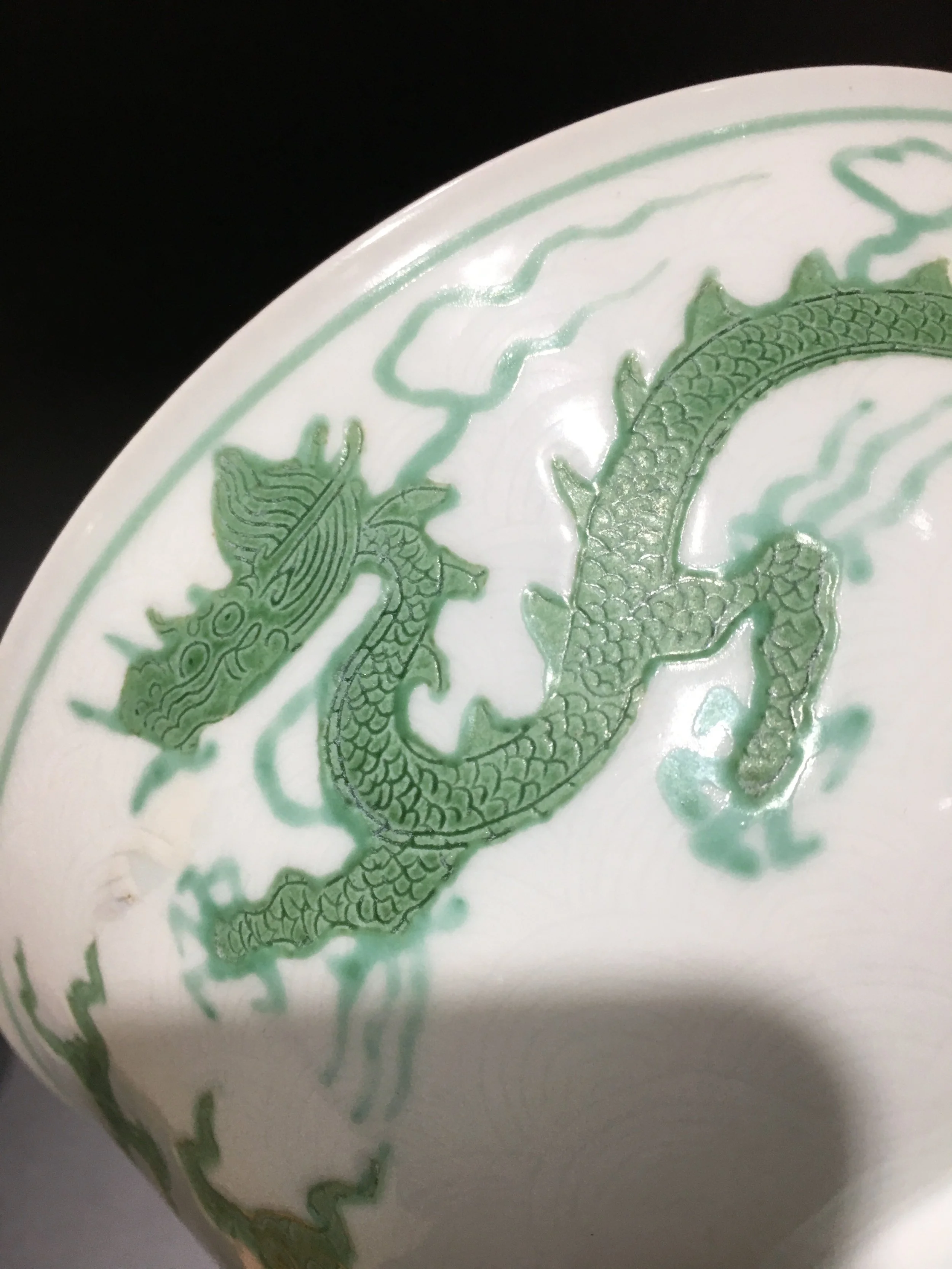 Image 10 of 14
 Image 11 of 14
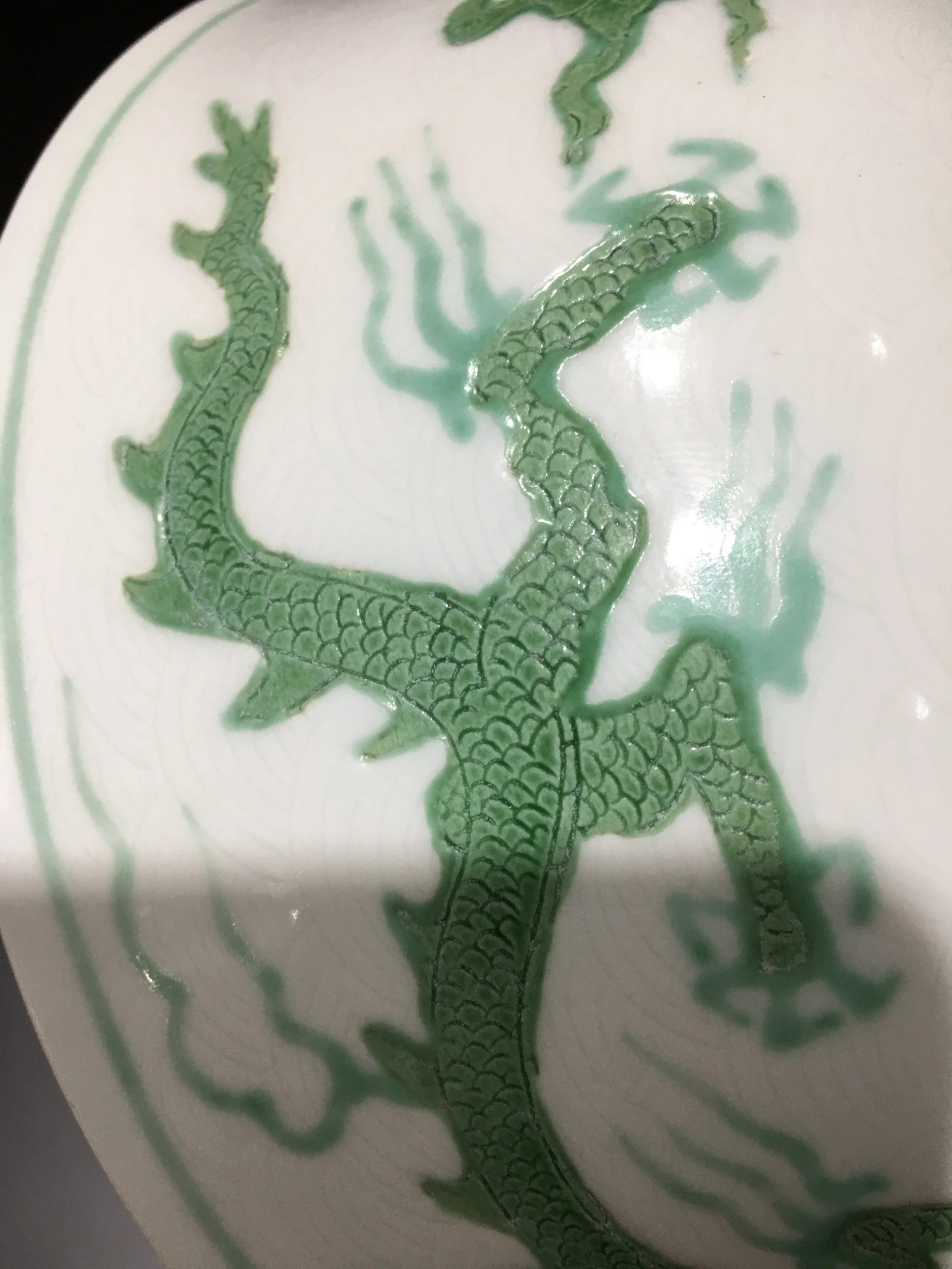 Image 12 of 14
 Image 13 of 14
 Image 14 of 14