 Image 1 of 11
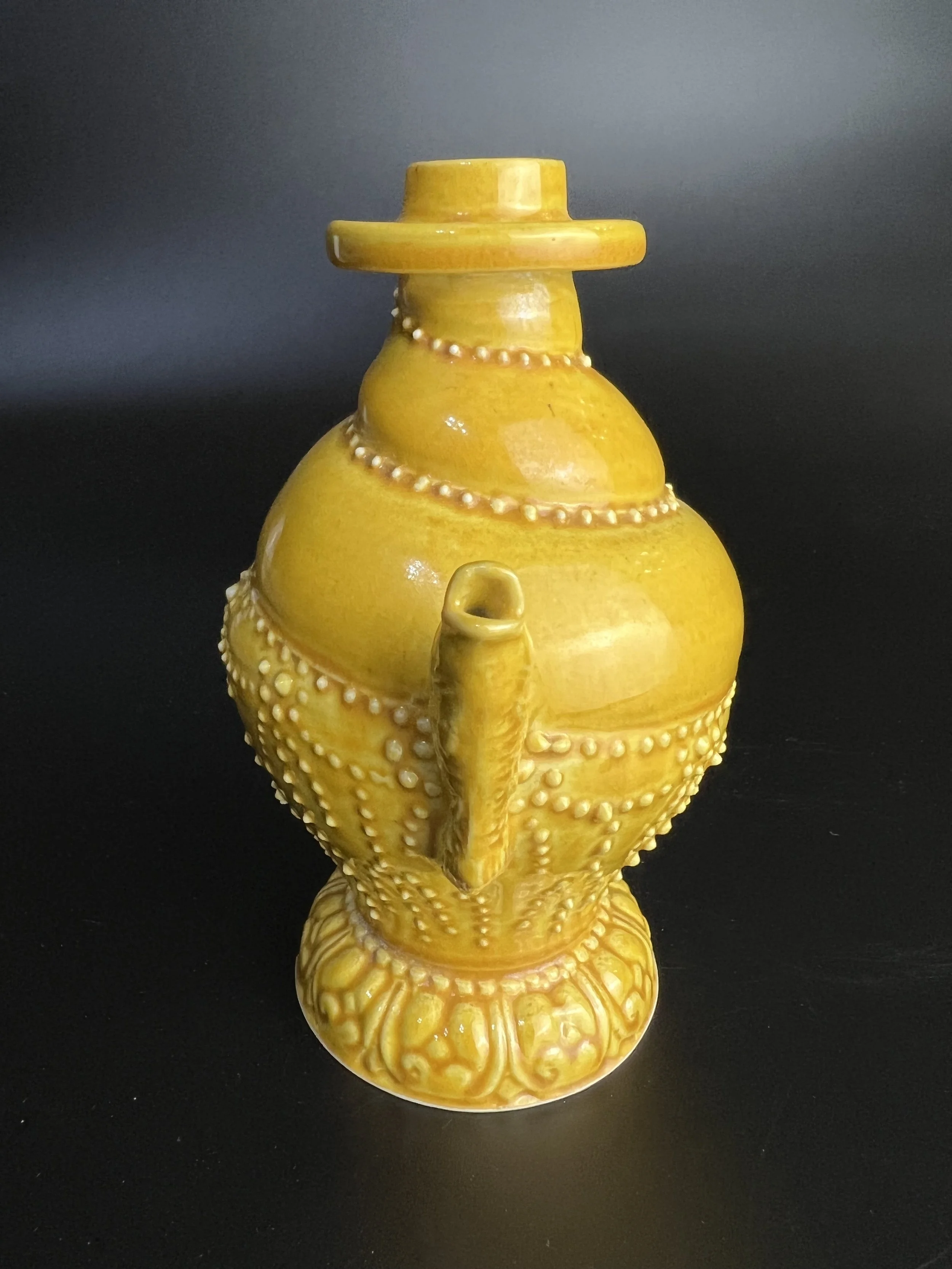 Image 2 of 11
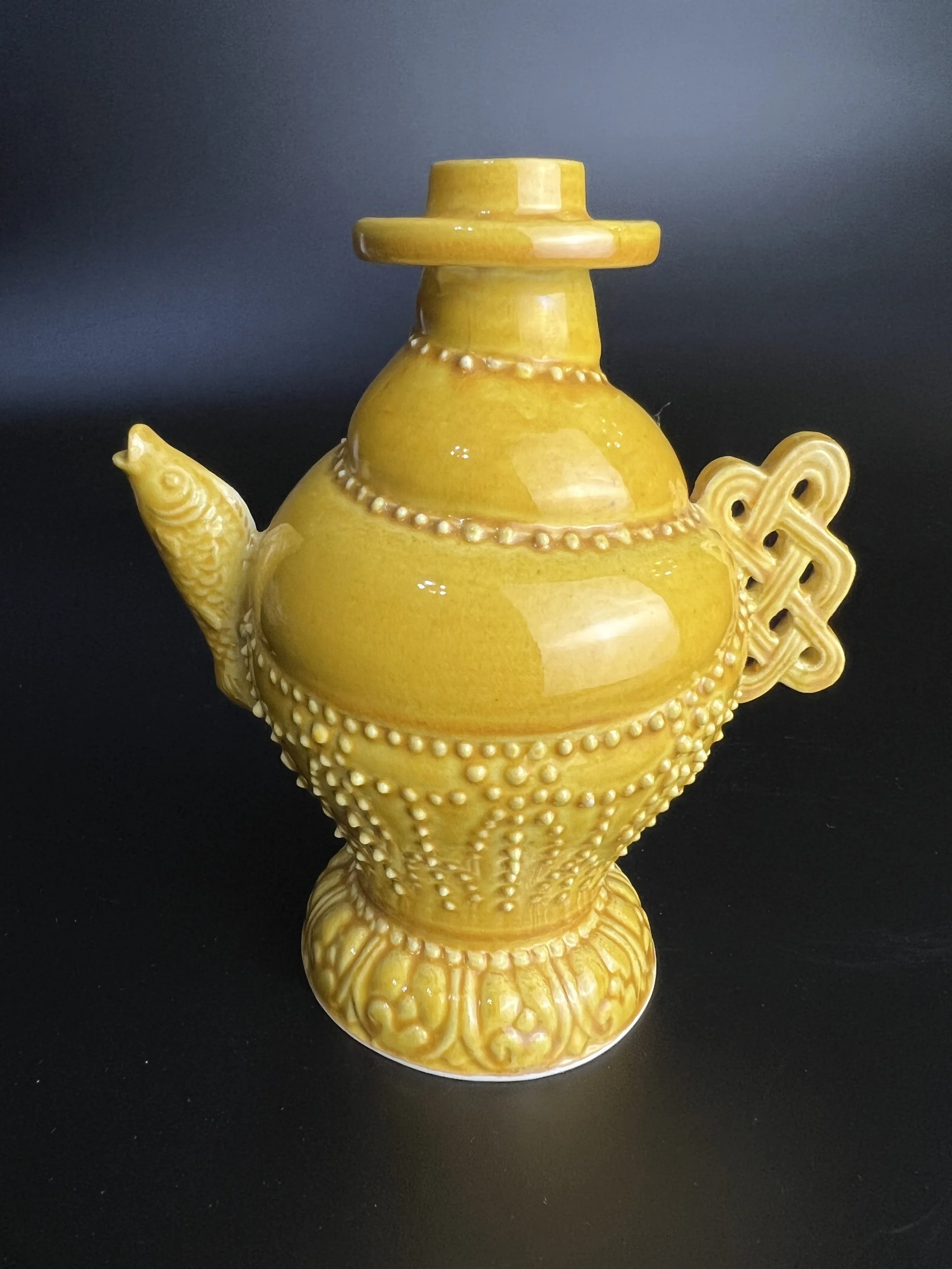 Image 3 of 11
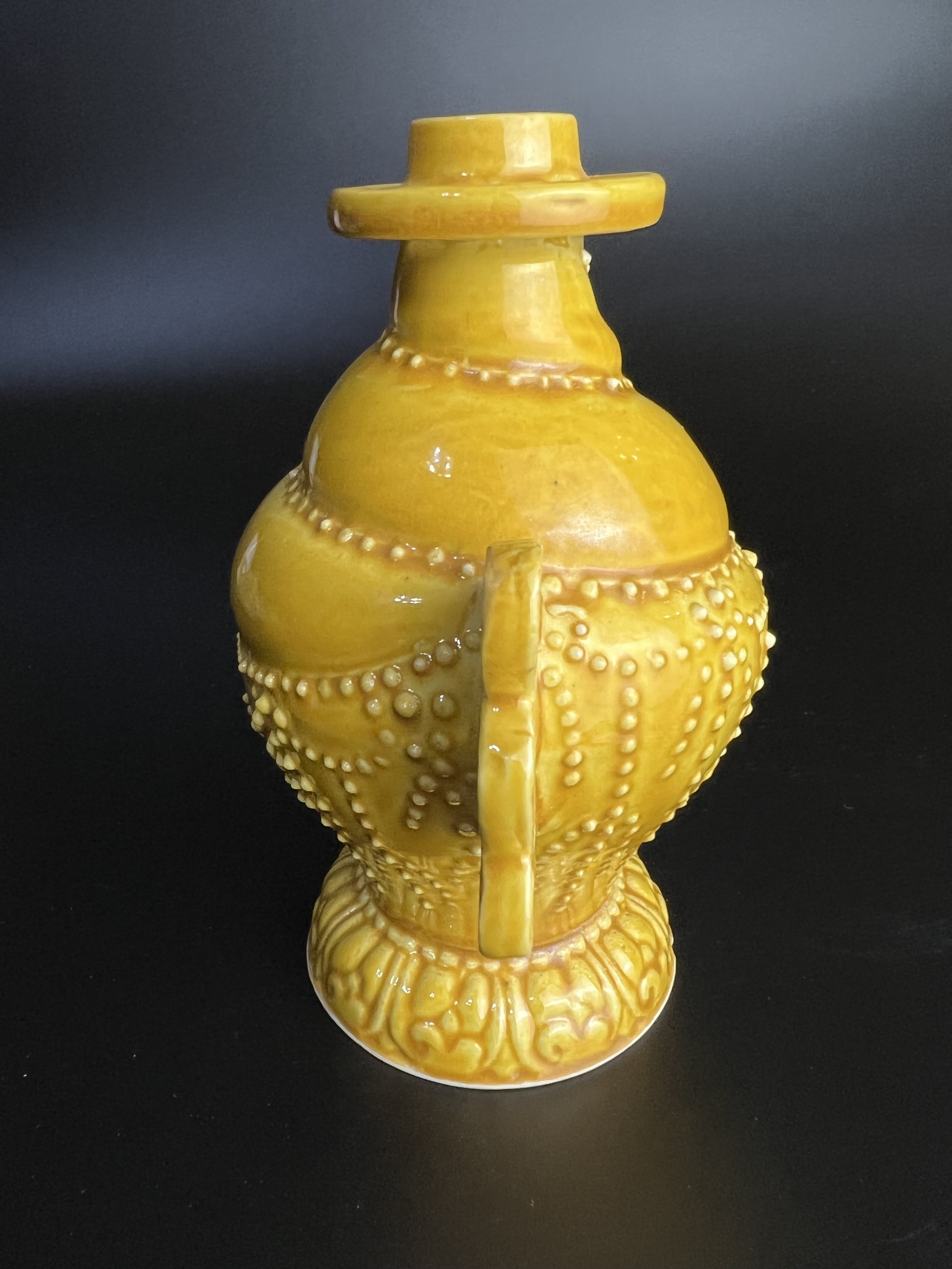 Image 4 of 11
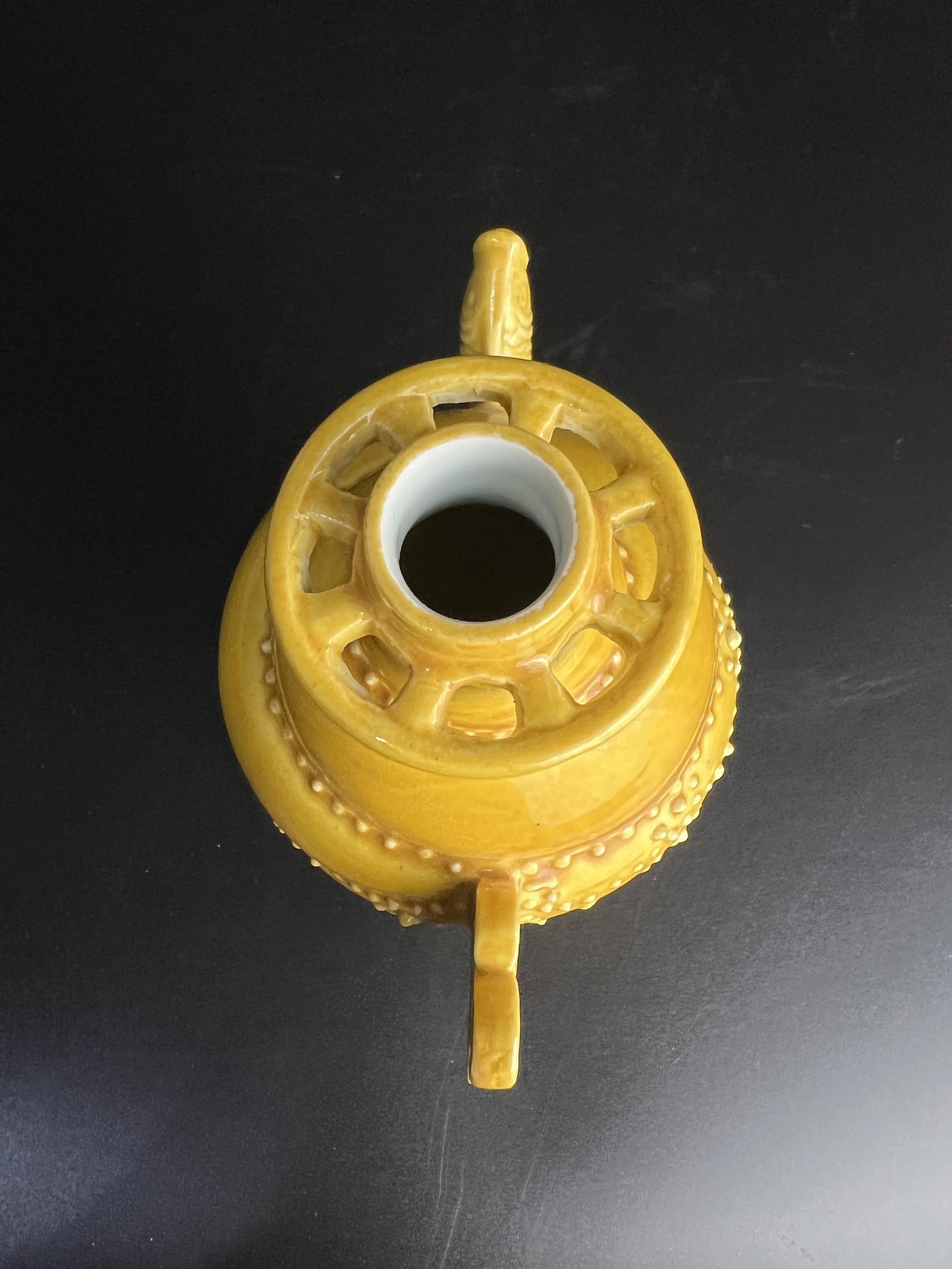 Image 5 of 11
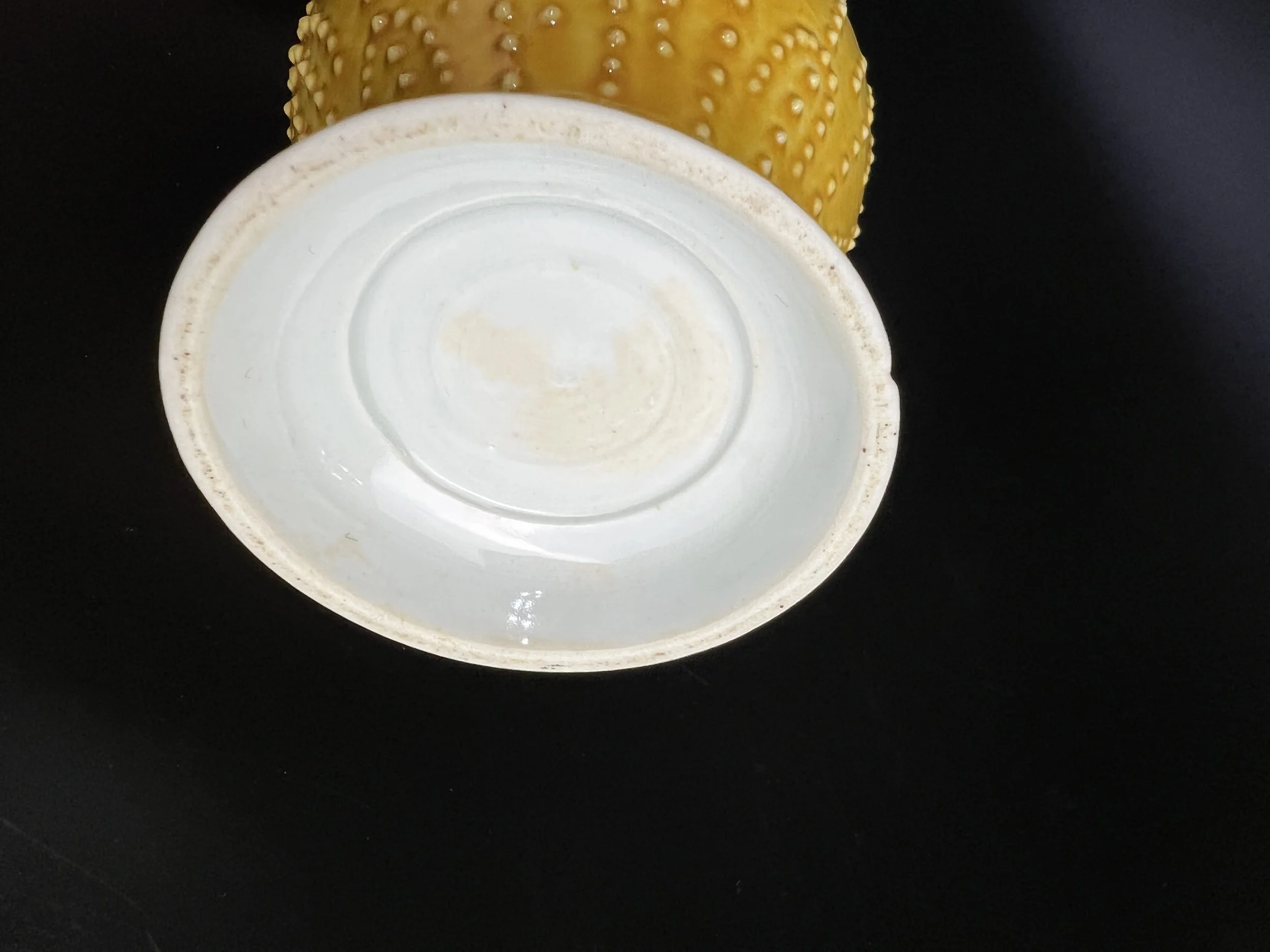 Image 6 of 11
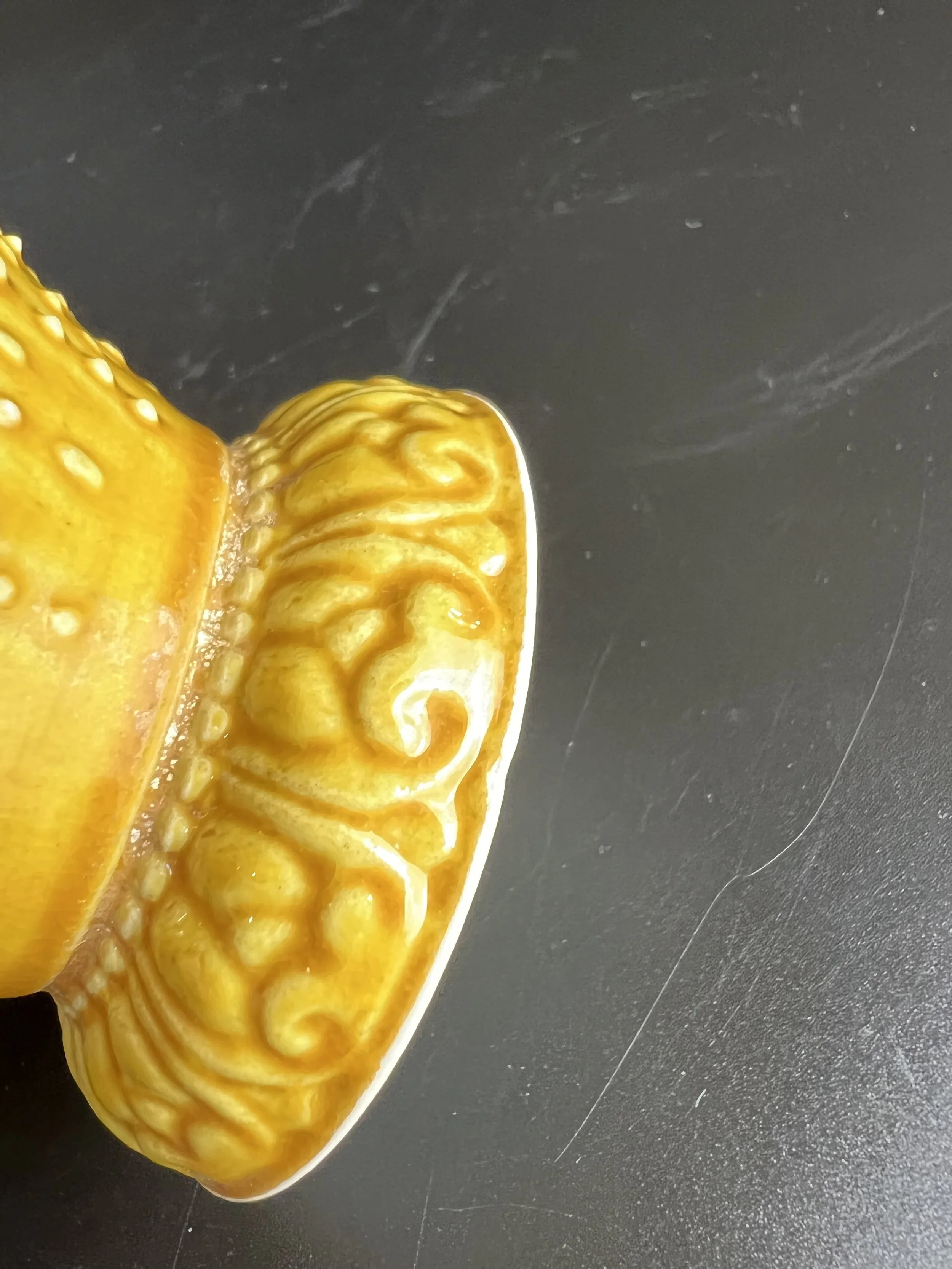 Image 7 of 11
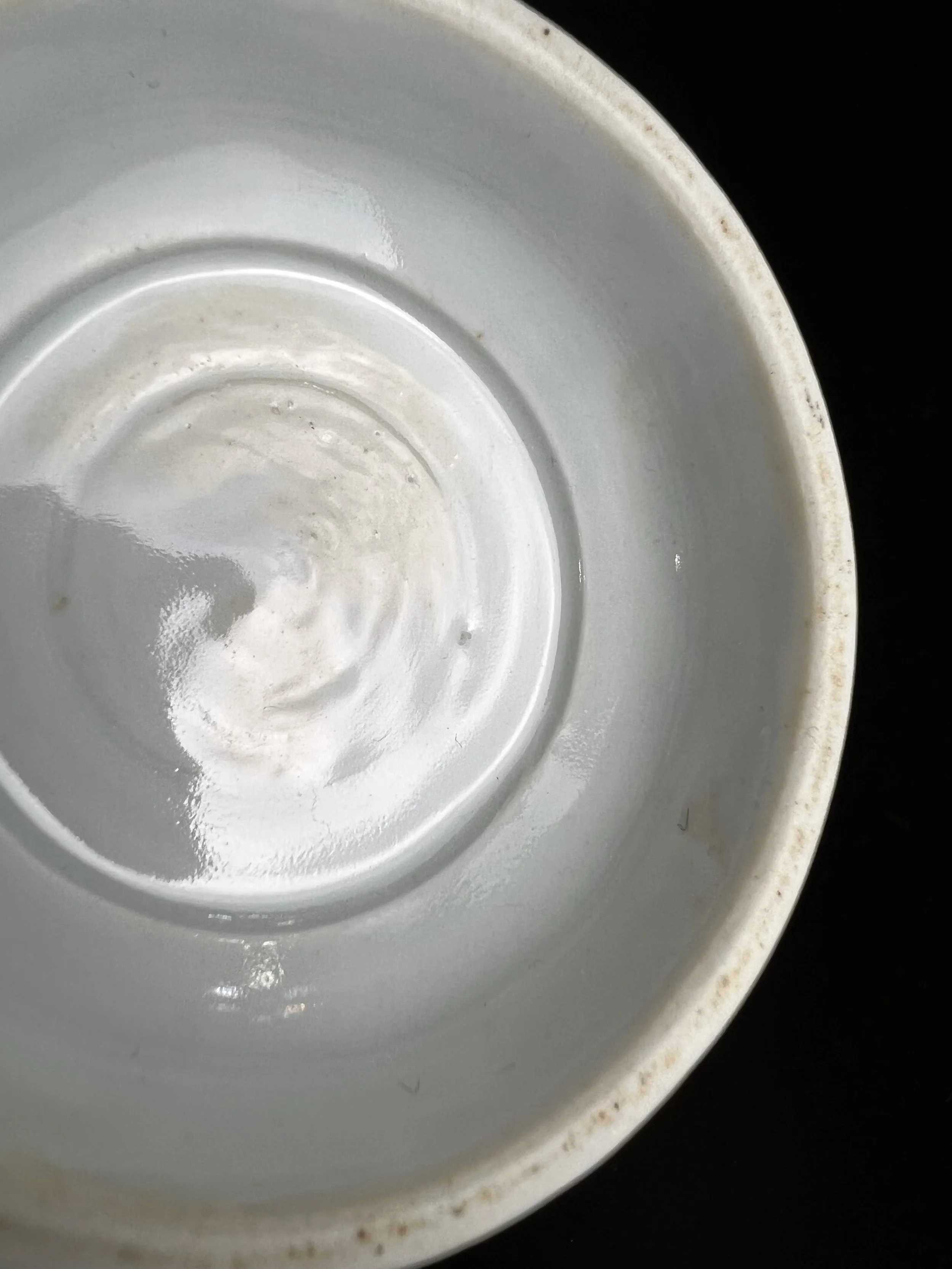 Image 8 of 11
 Image 9 of 11
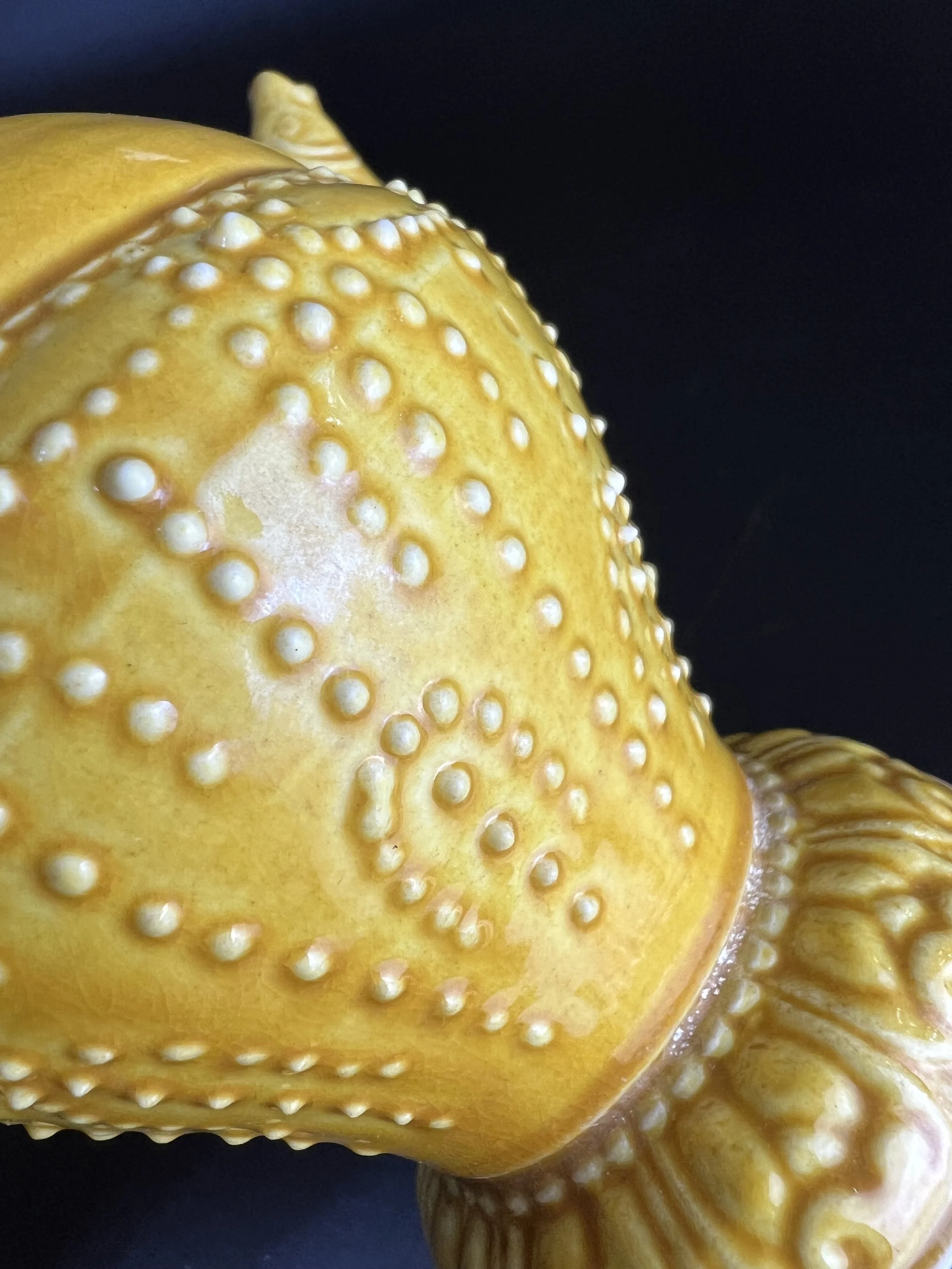 Image 10 of 11
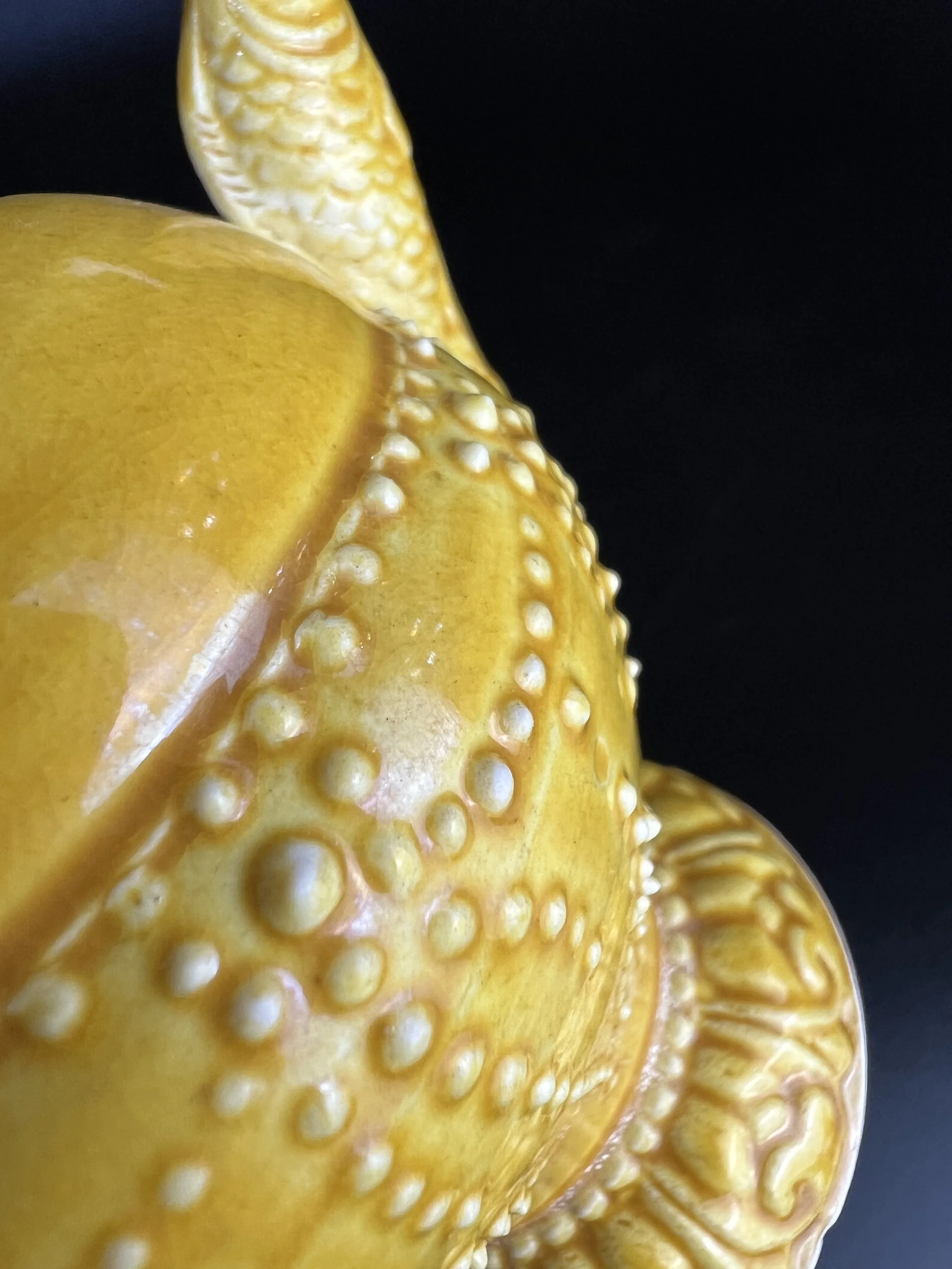 Image 11 of 11
An Appreciation of the Ming Yongle Jiaohuang (Poured Yellow) Glaze Conch-Shaped Ewer with Fish-Mouth Spout
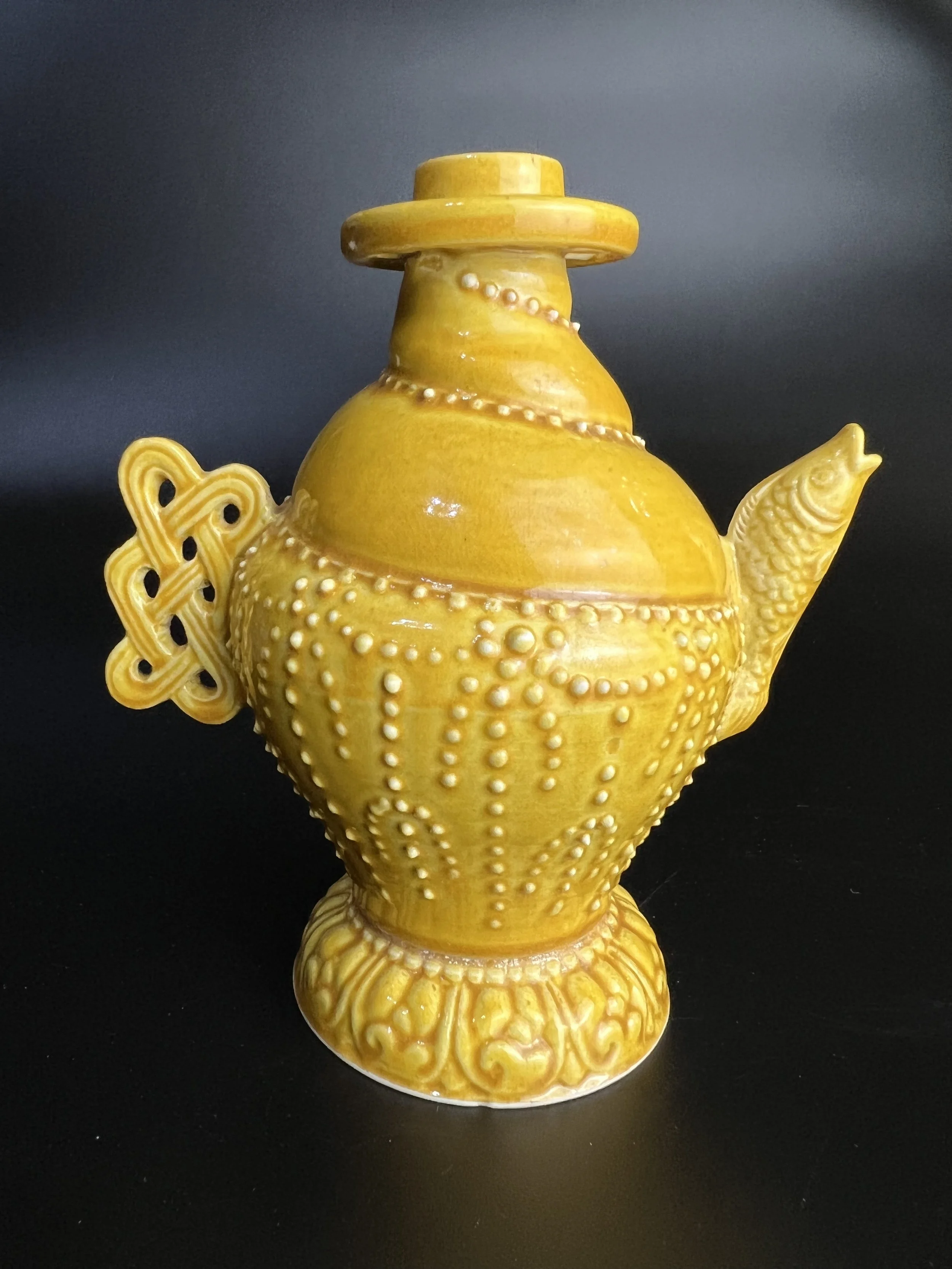
This ewer, measuring 12 cm in height, bears no reign mark and has no lid. Its主体 (main body) is shaped like a conch, adorned with applied璎珞纹 (pendant necklace pattern). The mouthrim is fashioned in the form of an eight-spoked wheel, while the spout is ingeniously crafted as a fish with its mouth open. The handle is shaped like a traditional Chinese knot. The sheer uniqueness of its form and the richness of its symbolic meaning make this piece an unparalleled example, perhaps a孤例 (unique surviving example), among Yongle imperial porcelain.
An Appreciation of the Ming Yongle Jiaohuang (Poured Yellow) Glaze Conch-Shaped Ewer with Fish-Mouth Spout
Among the imperial porcelains of the Ming dynasty, the Yongle reign (1403-1424) is renowned for its comprehensive range of materials and the simultaneous flourishing of blue-and-white and monochrome glazes. This Yongle-era Jiaohuang glaze conch-shaped ewer with a fish-mouth spout, standing 12 cm high, is a marvel of ingenious form. It融合 (integrates) multiple elements—the conch, fish, eight-spoked wheel, Chinese knot, and jewel necklace pattern—into a single object. Although it bears no reign mark and lacks its original lid, it speaks volumes through its unique artistic language. It tells the story of the Yongle Emperor's ambitious voyages, his reverence for Tibetan Buddhism, and his broad-minded embrace of diverse civilizations. Though small in size, this ewer carries profound historical significance and stands as a rare and exceptional treasure within the corpus of Yongle imperial porcelain.
The Marvel of Form: Conch Body, Fish-Mouth Spout
The主体 (main form) of this ewer is modeled after a conch shell. The shell spirals upwards in smooth, natural lines full of rhythmic grace. The surface of the conch body is adorned with applied 璎珞纹 (yīngluò wén, necklace/jewel pendant pattern) . Yingluo originally refers to the ornamental necklaces or decorations on the crown of Buddhist deities, often depicted as strings of pearls. Here, the pattern is rendered through molding or applied relief techniques, each pearl distinct, rounded, and smooth, seamlessly integrating with the body and enhancing the vessel's luxurious气息 (aura) and religious connotations.
The spout (流, liú) is a particularly ingenious design, taking the form of a fish with its mouth open. The slightly open fish mouth serves as the channel for pouring liquid. In traditional Chinese culture, the fish symbolizes prosperity and abundance (as "fish" (鱼, yú) is a homophone for "surplus" (余, yú)), as well as transformation and transcendence ("fish transforming into a dragon"). An open-mouthed fish further evokes imagery of "swallowing all things" and "endless generation." This design not only fulfills a practical function but also imbues the object with a sense of dynamic life.
The mouthrim of the ewer is shaped like an eight-spoked wheel (八辐轮, bā fú lún) . The eight-spoked wheel represents the Buddhist 法轮 (Dharma wheel) , symbolizing the Buddha's teachings turning endlessly, crushing ignorance and delusion. The eight spokes correspond to the Noble Eightfold Path, making it a crucial ritual symbol in Tibetan Buddhism. The spokes are clearly defined, the lines strong and vigorous, creating a visual contrast between strength and柔美 (soft elegance) with the graceful curves of the conch below.
The handle of the ewer is designed in the shape of a traditional Chinese knot (中国结, zhōngguó jié) , with lines looping back and forth in a continuous,婉转 (winding, graceful) manner. The Chinese knot symbolizes good fortune, auspiciousness, and everlasting unity. Using this form for the handle not only makes it easy to grip but also carries the profound meaning of "connecting the four seas" and "harmonizing all nations."
The Precious Glaze: The Dawn of Jiaohuang
This ewer is entirely covered in a Jiaohuang (poured yellow) glaze. The glaze colour is delicate, elegant, even, and translucent. During the Yongle reign, yellow glaze was still in its early stages of development, making surviving examples exceptionally rare. Compared to the mature "Jiaohuang" (delicate yellow) glaze of the Chenghua and Hongzhi periods, the Yongle yellow glaze appears slightly more含蓄内敛 (subtle and restrained). However, it already possesses the nascent qualities of being "colored like beeswax, textured like solidified cream." The glaze surface is lustrous and bright, with a faint bluish tinge where it pools slightly, demonstrating the early exploratory achievements of the Yongle imperial kilns in glaze配方 (recipes) and firing temperatures.
Profound Meaning: A Confluence of Civilizations
This ewer integrates the conch, fish, eight-spoked wheel, Chinese knot, and necklace pattern. Each element carries deep significance:
Conch: In Tibetan Buddhism, the conch (specifically the右旋法螺, right-turning conch) is one of the Eight Auspicious Symbols, representing the far-reaching sound of the Dharma. The Yongle Emperor, Zhu Di, was a devout follower of Tibetan Buddhism. He frequently invited Tibetan lamas to the capital and held grand Buddhist ceremonies in the court. This ewer, shaped like a conch, is a vivid reflection of this historical context.
Eight-Spoked Wheel: A symbol of the Buddha's teachings, representing the Yongle Emperor's philosophy of governance—to rule the empire through the Dharma, thereby winning the hearts of the people.
璎珞 (Necklace/Jewel Pendant) : A Buddhist装饰 (ornamentation), symbolizing solemnity and offerings, forming a complete Buddhist symbolic体系 (system) alongside the conch and Dharma wheel.
Fish: A traditional Han Chinese auspicious motif, symbolizing abundance and freedom. The fish-mouth spout adds an ingenious layer of meaning, evoking phrases like "like a fish in water" (being in one's element) and "moving with skill and ease."
Chinese Knot: A traditional Han Chinese装饰 (ornament), symbolizing good fortune and connection. Serving as the handle, it is both practical and imbued with the deep meaning of "connecting Han and Tibetan cultures" and "integrating China and foreign lands."
The conch originates from Tibetan Buddhism; the fish and Chinese knot are rooted in Han Chinese tradition; the eight-spoked wheel embodies Buddhist philosophy; and the necklace pattern bridges both cultures. These five elements coexist harmoniously on this small ewer that can be held in one hand. It is a miniature缩影 (epitome) of the Yongle era's spirit—a time when "Han and Tibet were one family" and "China and the world united in harmony."
Question of Function: Ritual Object or Gift?
This ewer bears no mark and has no lid, and its unique form does not conform to the standard shapes of traditional teapots or wine ewers. Scholars speculate that its function may have been one of two possibilities:
First, it could have served as a Tibetan Buddhist ritual object. The conch was originally a musical instrument blown in ceremonies. While this ewer could not be blown, it might have functioned as a净水瓶 (pure water vase) used in initiation (abhisheka) or offering rituals, holding sacred nectar or pure water for Buddhist veneration or blessings.
Second, it might have been a ritual vessel for bestowal upon foreign vassals or dignitaries. To maintain harmonious relations with distant peoples, the Yongle Emperor frequently bestowed gifts such as porcelain, silk, gold, and silver upon Tibetan religious leaders and envoys from Western regions. This ewer integrates both Han and Tibetan elements, appealing to Tibetan aesthetics while showcasing the majesty of the Celestial Empire. It is highly likely that this was a piece of "diplomatic gift porcelain" specially commissioned from the imperial kilns for such purposes.
Conclusion
This Yongle Jiaohuang glaze conch-shaped ewer with a fish-mouth spout, within its miniature scale of 12 cm,凝聚 (condenses) the most extraordinary creativity, the most exquisite craftsmanship, and the most profound symbolism of the Yongle imperial kilns. With its conch body, fish spout, eight-spoked wheel mouthrim, Chinese knot handle, and necklace pattern adornment, it熔于一炉 (fuses together) the solemnity of Tibetan Buddhism, the auspiciousness of Han tradition, and the magnificence of imperial art. Though it bears no mark for authentication and lacks its original lid, through its unique artistic language, it speaks to future generations of that great era six hundred years ago—an era of openness, inclusiveness, and imperial vision. Among Yongle imperial porcelains, this ewer can truly be called a "divine product among exceptional forms, an unmatched masterpiece among奇器 (extraordinary vessels)."
明永乐 浇黄釉海螺形鱼嘴壶赏析
在明代御窑瓷器中,永乐一朝以"诸料悉备,青花与单色釉并盛"而著称。这件高12厘米的永乐浇黄釉海螺形鱼嘴壶,造型奇巧,融合海螺、鱼、八辐轮、中国结、璎珞等多种元素于一身,既无款识,亦无原盖,却以其独特的艺术语言,诉说着永乐大帝开拓西洋、崇奉藏传佛教、包容多元文明的宏阔胸襟。此壶虽尺寸小巧,却承载着深厚的历史意涵,堪称永乐御窑中罕见的"另类"珍品。
造型之奇:海螺为体,鱼嘴为流
此壶主体造型取法海螺,螺壳盘旋而上,线条流畅自然,极富韵律感。螺体表面贴饰璎珞纹——璎珞本为佛像颈间或宝冠上的装饰,以连珠状垂挂,此处以模印或堆贴技法呈现,粒粒分明,珠圆玉润,与螺体浑然一体,增添了器物的华贵气息与宗教意蕴。
壶的流部匠心独运,作鱼形张嘴状,鱼口微张即为出水流道。鱼在中国传统文化中寓意"富贵有余""鱼龙变化",而张嘴之鱼更有"吞吐万物""生生不息"之象。这一设计既符合实用功能,又赋予器物以灵动的生命感。
壶的口沿呈八辐轮状——八辐轮即佛教"法轮"之象征,代表佛法如轮,辗转不停,破除无明。八辐则对应八正道,是藏传佛教中极为重要的法器符号。口沿处轮辐分明,线条刚劲,与下方海螺的柔美曲线形成刚柔相济的视觉对比。
壶的把手设计为中国结形状,线条回环往复,婉转连绵。中国结象征吉祥如意、永结同心,以此作把,既便于持握,又寓含"联结四海""和谐万邦"的深远意涵。
釉色之贵:浇黄初熟
此壶通体施浇黄釉,釉色娇嫩淡雅,匀净明澈。永乐一朝,黄釉尚处初创阶段,传世器物极为罕见。较之成化、弘治时期成熟的"娇黄"釉,永乐黄釉略显含蓄内敛,却已初具"色如蜜蜡,质若凝脂"的雏形。釉面莹润光亮,积釉处微微泛青,展现出永乐御窑对釉料配方与烧成温度的早期探索成果。
意涵之深:多元文明的交融
此壶集海螺、鱼、八辐轮、中国结、璎珞于一身,每一元素皆有深意:
海螺:在藏传佛教中,海螺(右旋法螺)为八吉祥之一,象征法音远播。永乐皇帝朱棣笃信藏传佛教,曾多次邀请藏地高僧入京,并在宫廷举行盛大法会。此壶以海螺为形,正是这一背景的生动写照。
八辐轮:佛法之象征,代表永乐的治国理念——以佛法治理天下,使万民归心。
璎珞:佛教装饰,寓意庄严与供养,与海螺、法轮共同构成完整的佛教符号体系。
鱼:汉地传统吉祥纹饰,象征富足与自由。鱼嘴为流,更添"如鱼得水""游刃有余"的巧思。
中国结:汉地传统装饰,象征吉祥与联结。以中国结作把,既实用,又寓含"联结汉藏""融通中外"的深意。
海螺来自藏传佛教,鱼与中国结来自汉地传统,八辐轮融汇佛理,璎珞贯通汉藏——这五种元素和谐共处于一掌可握的小壶之上,恰如永乐一朝"汉藏一家""中外合璧"的时代气象的缩影。
功能之疑:礼佛抑或赏赐?
此壶无款无盖,造型奇特,非传统茶壶或酒壶之制式。学者推测,其功能可能有二:
其一,藏传佛教法器。海螺本为法会中吹奏之乐器,此壶虽不能吹奏,却可能作为灌顶或供养仪式中的净水瓶,盛装甘露净水,用于礼佛或加持。
其二,赏赐外藩之礼器。永乐帝为怀柔远人,常以瓷器、丝绸、金银器等赏赐西藏宗教领袖及西域诸国使臣。此壶集汉藏元素于一体,既符合藏地审美,又彰显天朝威仪,极有可能为御窑专为赏赐而制的"外交礼品瓷"。
结语
这件永乐浇黄釉海螺形鱼嘴壶,以12厘米的微缩尺幅,凝聚了永乐御窑最奇崛的创意、最精湛的工艺、最深邃的意涵。它以海螺为体,以鱼为流,以八辐轮为口,以中国结为把,以璎珞为饰,将藏传佛教的庄严、汉地传统的吉祥、宫廷艺术的华贵融于一炉。虽无款识可考,虽无原盖相配,却以其独一无二的艺术语言,向后人诉说着六百年前那个开放包容、雄视万邦的伟大时代。在永乐御窑瓷器中,此壶堪称"别格中的神品,奇器中的绝唱"。
This ewer, measuring 12 cm in height, bears no reign mark and has no lid. Its主体 (main body) is shaped like a conch, adorned with applied璎珞纹 (pendant necklace pattern). The mouthrim is fashioned in the form of an eight-spoked wheel, while the spout is ingeniously crafted as a fish with its mouth open. The handle is shaped like a traditional Chinese knot. The sheer uniqueness of its form and the richness of its symbolic meaning make this piece an unparalleled example, perhaps a孤例 (unique surviving example), among Yongle imperial porcelain.
An Appreciation of the Ming Yongle Jiaohuang (Poured Yellow) Glaze Conch-Shaped Ewer with Fish-Mouth Spout
Among the imperial porcelains of the Ming dynasty, the Yongle reign (1403-1424) is renowned for its comprehensive range of materials and the simultaneous flourishing of blue-and-white and monochrome glazes. This Yongle-era Jiaohuang glaze conch-shaped ewer with a fish-mouth spout, standing 12 cm high, is a marvel of ingenious form. It融合 (integrates) multiple elements—the conch, fish, eight-spoked wheel, Chinese knot, and jewel necklace pattern—into a single object. Although it bears no reign mark and lacks its original lid, it speaks volumes through its unique artistic language. It tells the story of the Yongle Emperor's ambitious voyages, his reverence for Tibetan Buddhism, and his broad-minded embrace of diverse civilizations. Though small in size, this ewer carries profound historical significance and stands as a rare and exceptional treasure within the corpus of Yongle imperial porcelain.
The Marvel of Form: Conch Body, Fish-Mouth Spout
The主体 (main form) of this ewer is modeled after a conch shell. The shell spirals upwards in smooth, natural lines full of rhythmic grace. The surface of the conch body is adorned with applied 璎珞纹 (yīngluò wén, necklace/jewel pendant pattern) . Yingluo originally refers to the ornamental necklaces or decorations on the crown of Buddhist deities, often depicted as strings of pearls. Here, the pattern is rendered through molding or applied relief techniques, each pearl distinct, rounded, and smooth, seamlessly integrating with the body and enhancing the vessel's luxurious气息 (aura) and religious connotations.
The spout (流, liú) is a particularly ingenious design, taking the form of a fish with its mouth open. The slightly open fish mouth serves as the channel for pouring liquid. In traditional Chinese culture, the fish symbolizes prosperity and abundance (as "fish" (鱼, yú) is a homophone for "surplus" (余, yú)), as well as transformation and transcendence ("fish transforming into a dragon"). An open-mouthed fish further evokes imagery of "swallowing all things" and "endless generation." This design not only fulfills a practical function but also imbues the object with a sense of dynamic life.
The mouthrim of the ewer is shaped like an eight-spoked wheel (八辐轮, bā fú lún) . The eight-spoked wheel represents the Buddhist 法轮 (Dharma wheel) , symbolizing the Buddha's teachings turning endlessly, crushing ignorance and delusion. The eight spokes correspond to the Noble Eightfold Path, making it a crucial ritual symbol in Tibetan Buddhism. The spokes are clearly defined, the lines strong and vigorous, creating a visual contrast between strength and柔美 (soft elegance) with the graceful curves of the conch below.
The handle of the ewer is designed in the shape of a traditional Chinese knot (中国结, zhōngguó jié) , with lines looping back and forth in a continuous,婉转 (winding, graceful) manner. The Chinese knot symbolizes good fortune, auspiciousness, and everlasting unity. Using this form for the handle not only makes it easy to grip but also carries the profound meaning of "connecting the four seas" and "harmonizing all nations."
The Precious Glaze: The Dawn of Jiaohuang
This ewer is entirely covered in a Jiaohuang (poured yellow) glaze. The glaze colour is delicate, elegant, even, and translucent. During the Yongle reign, yellow glaze was still in its early stages of development, making surviving examples exceptionally rare. Compared to the mature "Jiaohuang" (delicate yellow) glaze of the Chenghua and Hongzhi periods, the Yongle yellow glaze appears slightly more含蓄内敛 (subtle and restrained). However, it already possesses the nascent qualities of being "colored like beeswax, textured like solidified cream." The glaze surface is lustrous and bright, with a faint bluish tinge where it pools slightly, demonstrating the early exploratory achievements of the Yongle imperial kilns in glaze配方 (recipes) and firing temperatures.
Profound Meaning: A Confluence of Civilizations
This ewer integrates the conch, fish, eight-spoked wheel, Chinese knot, and necklace pattern. Each element carries deep significance:
Conch: In Tibetan Buddhism, the conch (specifically the右旋法螺, right-turning conch) is one of the Eight Auspicious Symbols, representing the far-reaching sound of the Dharma. The Yongle Emperor, Zhu Di, was a devout follower of Tibetan Buddhism. He frequently invited Tibetan lamas to the capital and held grand Buddhist ceremonies in the court. This ewer, shaped like a conch, is a vivid reflection of this historical context.
Eight-Spoked Wheel: A symbol of the Buddha's teachings, representing the Yongle Emperor's philosophy of governance—to rule the empire through the Dharma, thereby winning the hearts of the people.
璎珞 (Necklace/Jewel Pendant) : A Buddhist装饰 (ornamentation), symbolizing solemnity and offerings, forming a complete Buddhist symbolic体系 (system) alongside the conch and Dharma wheel.
Fish: A traditional Han Chinese auspicious motif, symbolizing abundance and freedom. The fish-mouth spout adds an ingenious layer of meaning, evoking phrases like "like a fish in water" (being in one's element) and "moving with skill and ease."
Chinese Knot: A traditional Han Chinese装饰 (ornament), symbolizing good fortune and connection. Serving as the handle, it is both practical and imbued with the deep meaning of "connecting Han and Tibetan cultures" and "integrating China and foreign lands."
The conch originates from Tibetan Buddhism; the fish and Chinese knot are rooted in Han Chinese tradition; the eight-spoked wheel embodies Buddhist philosophy; and the necklace pattern bridges both cultures. These five elements coexist harmoniously on this small ewer that can be held in one hand. It is a miniature缩影 (epitome) of the Yongle era's spirit—a time when "Han and Tibet were one family" and "China and the world united in harmony."
Question of Function: Ritual Object or Gift?
This ewer bears no mark and has no lid, and its unique form does not conform to the standard shapes of traditional teapots or wine ewers. Scholars speculate that its function may have been one of two possibilities:
First, it could have served as a Tibetan Buddhist ritual object. The conch was originally a musical instrument blown in ceremonies. While this ewer could not be blown, it might have functioned as a净水瓶 (pure water vase) used in initiation (abhisheka) or offering rituals, holding sacred nectar or pure water for Buddhist veneration or blessings.
Second, it might have been a ritual vessel for bestowal upon foreign vassals or dignitaries. To maintain harmonious relations with distant peoples, the Yongle Emperor frequently bestowed gifts such as porcelain, silk, gold, and silver upon Tibetan religious leaders and envoys from Western regions. This ewer integrates both Han and Tibetan elements, appealing to Tibetan aesthetics while showcasing the majesty of the Celestial Empire. It is highly likely that this was a piece of "diplomatic gift porcelain" specially commissioned from the imperial kilns for such purposes.
Conclusion
This Yongle Jiaohuang glaze conch-shaped ewer with a fish-mouth spout, within its miniature scale of 12 cm,凝聚 (condenses) the most extraordinary creativity, the most exquisite craftsmanship, and the most profound symbolism of the Yongle imperial kilns. With its conch body, fish spout, eight-spoked wheel mouthrim, Chinese knot handle, and necklace pattern adornment, it熔于一炉 (fuses together) the solemnity of Tibetan Buddhism, the auspiciousness of Han tradition, and the magnificence of imperial art. Though it bears no mark for authentication and lacks its original lid, through its unique artistic language, it speaks to future generations of that great era six hundred years ago—an era of openness, inclusiveness, and imperial vision. Among Yongle imperial porcelains, this ewer can truly be called a "divine product among exceptional forms, an unmatched masterpiece among奇器 (extraordinary vessels)."
明永乐 浇黄釉海螺形鱼嘴壶赏析
在明代御窑瓷器中,永乐一朝以"诸料悉备,青花与单色釉并盛"而著称。这件高12厘米的永乐浇黄釉海螺形鱼嘴壶,造型奇巧,融合海螺、鱼、八辐轮、中国结、璎珞等多种元素于一身,既无款识,亦无原盖,却以其独特的艺术语言,诉说着永乐大帝开拓西洋、崇奉藏传佛教、包容多元文明的宏阔胸襟。此壶虽尺寸小巧,却承载着深厚的历史意涵,堪称永乐御窑中罕见的"另类"珍品。
造型之奇:海螺为体,鱼嘴为流
此壶主体造型取法海螺,螺壳盘旋而上,线条流畅自然,极富韵律感。螺体表面贴饰璎珞纹——璎珞本为佛像颈间或宝冠上的装饰,以连珠状垂挂,此处以模印或堆贴技法呈现,粒粒分明,珠圆玉润,与螺体浑然一体,增添了器物的华贵气息与宗教意蕴。
壶的流部匠心独运,作鱼形张嘴状,鱼口微张即为出水流道。鱼在中国传统文化中寓意"富贵有余""鱼龙变化",而张嘴之鱼更有"吞吐万物""生生不息"之象。这一设计既符合实用功能,又赋予器物以灵动的生命感。
壶的口沿呈八辐轮状——八辐轮即佛教"法轮"之象征,代表佛法如轮,辗转不停,破除无明。八辐则对应八正道,是藏传佛教中极为重要的法器符号。口沿处轮辐分明,线条刚劲,与下方海螺的柔美曲线形成刚柔相济的视觉对比。
壶的把手设计为中国结形状,线条回环往复,婉转连绵。中国结象征吉祥如意、永结同心,以此作把,既便于持握,又寓含"联结四海""和谐万邦"的深远意涵。
釉色之贵:浇黄初熟
此壶通体施浇黄釉,釉色娇嫩淡雅,匀净明澈。永乐一朝,黄釉尚处初创阶段,传世器物极为罕见。较之成化、弘治时期成熟的"娇黄"釉,永乐黄釉略显含蓄内敛,却已初具"色如蜜蜡,质若凝脂"的雏形。釉面莹润光亮,积釉处微微泛青,展现出永乐御窑对釉料配方与烧成温度的早期探索成果。
意涵之深:多元文明的交融
此壶集海螺、鱼、八辐轮、中国结、璎珞于一身,每一元素皆有深意:
海螺:在藏传佛教中,海螺(右旋法螺)为八吉祥之一,象征法音远播。永乐皇帝朱棣笃信藏传佛教,曾多次邀请藏地高僧入京,并在宫廷举行盛大法会。此壶以海螺为形,正是这一背景的生动写照。
八辐轮:佛法之象征,代表永乐的治国理念——以佛法治理天下,使万民归心。
璎珞:佛教装饰,寓意庄严与供养,与海螺、法轮共同构成完整的佛教符号体系。
鱼:汉地传统吉祥纹饰,象征富足与自由。鱼嘴为流,更添"如鱼得水""游刃有余"的巧思。
中国结:汉地传统装饰,象征吉祥与联结。以中国结作把,既实用,又寓含"联结汉藏""融通中外"的深意。
海螺来自藏传佛教,鱼与中国结来自汉地传统,八辐轮融汇佛理,璎珞贯通汉藏——这五种元素和谐共处于一掌可握的小壶之上,恰如永乐一朝"汉藏一家""中外合璧"的时代气象的缩影。
功能之疑:礼佛抑或赏赐?
此壶无款无盖,造型奇特,非传统茶壶或酒壶之制式。学者推测,其功能可能有二:
其一,藏传佛教法器。海螺本为法会中吹奏之乐器,此壶虽不能吹奏,却可能作为灌顶或供养仪式中的净水瓶,盛装甘露净水,用于礼佛或加持。
其二,赏赐外藩之礼器。永乐帝为怀柔远人,常以瓷器、丝绸、金银器等赏赐西藏宗教领袖及西域诸国使臣。此壶集汉藏元素于一体,既符合藏地审美,又彰显天朝威仪,极有可能为御窑专为赏赐而制的"外交礼品瓷"。
结语
这件永乐浇黄釉海螺形鱼嘴壶,以12厘米的微缩尺幅,凝聚了永乐御窑最奇崛的创意、最精湛的工艺、最深邃的意涵。它以海螺为体,以鱼为流,以八辐轮为口,以中国结为把,以璎珞为饰,将藏传佛教的庄严、汉地传统的吉祥、宫廷艺术的华贵融于一炉。虽无款识可考,虽无原盖相配,却以其独一无二的艺术语言,向后人诉说着六百年前那个开放包容、雄视万邦的伟大时代。在永乐御窑瓷器中,此壶堪称"别格中的神品,奇器中的绝唱"。